Plot Explained Spoilers guaranteed!
Plot Explained

Browse by genre

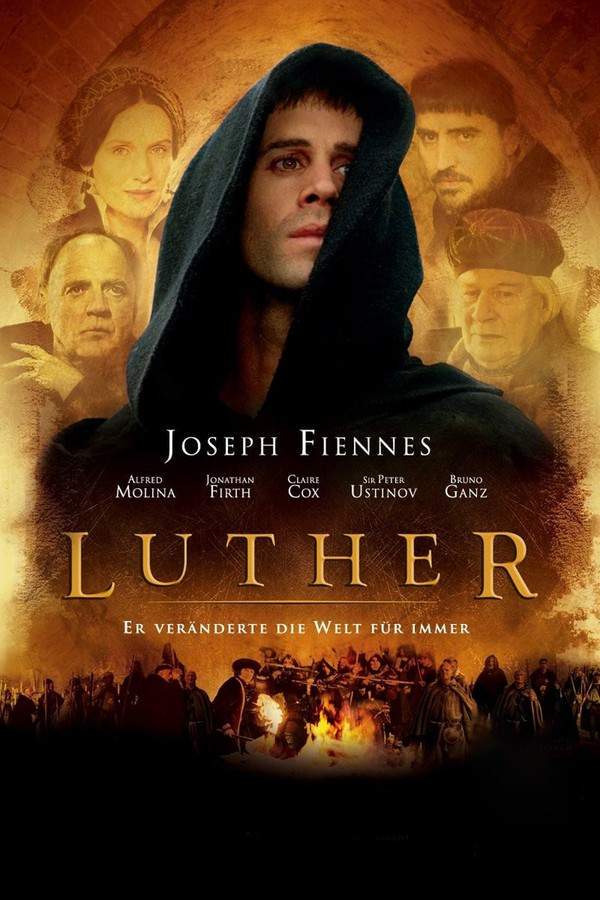
Luther (2003) movie poster

Timeline

Luther (2003) Timeline Explained – Every Event in Order

Release, runtime and language
2003 · 123 min · English
Loading streaming availability…
Directed by
Eric Till
Starring
Alfred Molina, Bruno Ganz, Joseph Fiennes, Peter Ustinov
Budget
$30M

In the early 16th century, Martin Luther, a young and idealistic German monk, becomes increasingly troubled by the corruption and materialism he observes within the Catholic Church. His growing concerns lead him to challenge established doctrines and practices, initiating a profound theological debate that ultimately sparks the Protestant Reformation and reshapes the religious landscape of Europe.

On this page (6)
  1. 1 Where to watch
  2. 2 Events in order (13)
  3. 3 Timeline questions answered
  4. 4 Movie threads
  5. 5 Movies like Luther
  6. 6 Every angle
Loading streaming availability…

13 events in order · contains spoilers

Luther Timeline: Events in Chronological Order

Every key event of Luther (2003) in order, scene by scene, with when and where it takes place. Use it to untangle flashbacks, time jumps and parallel storylines, to refresh your memory before the sequel or to find the exact scene you are thinking of.

  1. Storm triggers Luther's monastic vow

    A violent thunderstorm drives Luther to fear for his life. In the crisis, he dedicates himself to God and chooses the Augustinian path, becoming an Augustinian friar. The decision marks the start of his lifelong religious journey.

    When
    1505
    Where
    Home
  2. Luther becomes a friar under Staupitz

    Two years into his vows, Luther serves at St. Augustine's Monastery in Erfurt and wrestles with the image of God as a deity of hate. His supervisor, Johann von Staupitz, counsels him to seek Christ's mercy rather than his own judgment. The mentor's guidance steers Luther toward a more compassionate understanding of faith.

    When
    1507
    Where
    Erfurt
  3. Trip to Rome sparks crisis over indulgences

    Luther delivers a letter for Staupitz to Rome and is unsettled by the city's hypocrisy and wealth. In Rome he encounters relics and even a skull claimed to be John the Baptist, and he purchases an indulgence, which troubles him. This experience plants the seeds for his later critique of indulgences.

    Where
    Rome
  4. Return to Germany and teach love of God

    Back in Germany, Luther is assigned to Wittenberg where he begins teaching that God is not a God of hate but a God of love. He emphasizes grace and mercy over wrath in his sermons and writings. This shift sets the stage for challenging church practices.

    Where
    Wittenberg
  5. Luther denounces indulgences and posts the 95 Theses

    With the backdrop of Pope Leo X's papacy, Luther denounces indulgences as a mere paper and questions their authority. He pins his 95 theses to the door of the church, calling for an open debate about indulgences. This act ignites a clash with church authorities.

    When
    1513
    Where
    Wittenberg
  6. Summoned to Augsburg to answer for his writings

    Luther is summoned to Augsburg to answer before Cardinal Cajetan and other church officials. The questioning tests his resolve and willingness to defend his reformist views. The encounter intensifies the confrontation between reformers and papal authority.

    When
    1518
    Where
    Augsburg
  7. Excommunication and protection by Frederick the Wise

    Following his condemnation, the pope excommunicates Luther and orders him to be delivered to Rome. Prince-elector Frederick the Wise intervenes, offering sanctuary and protection in Saxony. Luther evades capture and continues his reform work from his new safe haven.

    Where
    Saxony
  8. Diet of Worms verdict

    Luther is brought before Charles V and the Cardinals at Worms, where he is asked to recant his writings. He asks for time to consider his response, and the next day he refuses to recant his beliefs. The trial establishes his defiant stand and secures his status as an outlaw in the eyes of the Empire.

    When
    1521
    Where
    Worms
  9. Luther hides at Wartburg and begins translation

    Frederick the Wise hides Luther at Wartburg Castle to protect him from authorities. During this exile, Luther begins translating the Bible into German, bringing religious texts to a broader audience. The secretive stay deepens his influence on the Reformation.

    When
    1521-1522
    Where
    Wartburg Castle
  10. Karlstadt pushes the Great Peasants' Revolt

    Luther's former colleague Andreas Karlstadt encourages the Great Peasants' Revolt against oppressive nobles. Luther is shocked by the revolt and urges the princes to quell it, differentiating reform from social upheaval. The tension highlights rivalries within the reform movement.

    When
    1524-1525
    Where
    Germany
  11. Bible translation completed during exile

    While in exile, Luther completes a German translation of the Bible, making scriptures accessible to lay readers. The project cements his influence on Protestant practice and German religious culture. The translated Bible becomes a cornerstone of the Luther era.

    When
    1522-1523
    Where
    Wartburg Castle / Germany
  12. Luther marries Katharina von Bora

    Luther marries Katharina von Bora, a former nun, sealing a new personal life alongside his public reform. The marriage challenges conventions and strengthens the reformist leadership in Wittenberg. Their partnership becomes a symbol of Protestant family life.

    When
    1525
    Where
    Wittenberg
  13. Diet of Augsburg and the Augsburg Confession

    Charles V summons evangelical princes to the Diet of Augsburg to outlaw Protestantism and the German Bible. The nobles refuse to recant and, instead, are allowed to present the Augsburg Confession. The event marks a formal confrontation between reformers and Catholic authorities.

    When
    1530
    Where
    Augsburg

Last updated: November 22, 2025 at 15:58

Was this helpful?

Timeline questions answered

Luther Timeline Explained: Your Questions Answered

When does it happen, and why in that order? The questions people ask about the chronology of Luther (2003): time jumps, flashbacks, cause and effect between scenes and the correct order of events, each answered with spoilers.

Q1

What was the Diet of Augsburg and what happened there?

The Diet of Augsburg in 1530 was a meeting called by Emperor Charles V to resolve religious divisions in the Holy Roman Empire. Charles attempted to outlaw Protestantism and the German Bible, demanding that evangelical princes recant their beliefs. Instead, the princes refused and were allowed to read the Augsburg Confession, a formal statement of Lutheran beliefs. The event marked a formal, public confrontation between Catholic authorities and Protestant reformers.

Foreshadowing: The Augsburg Confession becomes a foundational document of Lutheranism.

  • diet of augsburg
  • augsburg confession
  • charles v
  • evangelical princes
Q1

Why did Martin Luther become a monk after the thunderstorm?

Luther became a monk during a violent thunderstorm in 1505 when he feared for his life. In that moment of crisis, he vowed to dedicate himself to God if he survived. This spontaneous vow led him to join the Augustinian friary, marking the beginning of his lifelong religious journey. The experience reflected his deep-seated fear of divine judgment and his desperate search for spiritual security.

Foreshadowing: The storm and his vow foreshadow his lifelong struggle with understanding God's mercy versus judgment.

  • luther monk vow
  • augustinian friar
  • storm vow
Q2

Why did Luther struggle with his view of God?

Luther initially perceived God as a merciless, vengeful deity who would condemn sinners to eternal damnation. This fearful image of God caused him intense spiritual torment and doubt. He believed he could never be worthy of salvation through his own efforts, which drove him to seek a different understanding of faith and divine love.

Foreshadowing: His early struggle with God's judgment sets up his later theological breakthrough about salvation by faith alone.

  • luther faith
  • god of love vs judgment
  • spiritual turmoil
Q3

What advice did Staupitz give Luther about faith?

Luther's mentor Johann von Staupitz encouraged him to shift his focus from his own worthiness to the mercy of Christ. Staupitz taught him to seek God's love and grace rather than obsess over personal judgment. This guidance helped Luther move toward a more compassionate understanding of faith, planting the seeds for his later teachings about salvation through grace.

Foreshadowing: Staupitz's guidance directly influences Luther's later theological breakthrough about grace and mercy.

  • staupitz mentor
  • luther guidance
  • christ mercy
Q4

What did Luther witness in Rome that troubled him?

During his trip to Rome, Luther was deeply disturbed by the Church's hypocrisy and wealth. He saw the opulence and moral laxity among clergy, encountered numerous relics including a skull claimed to be John the Baptist, and purchased an indulgence. These experiences exposed the corruption within the Catholic Church and planted the seeds for his later critique of indulgences and church practices.

Foreshadowing: His experience with relics and indulgences in Rome directly motivates his later attack on the indulgence system.

  • rome trip
  • church corruption
  • indulgences
  • relics
Q5

Why did Luther denounce indulgences?

Luther denounced indulgences because he saw them as a corrupt practice that exploited people's fear of damnation. He believed salvation could not be purchased through money, but came only through genuine faith and God's grace. When Pope Leo X commissioned Johann Tetzel to sell indulgences to fund church projects, Luther publicly called them "just a piece of paper" and challenged the church's authority over salvation.

Foreshadowing: His challenge to indulgences leads directly to the posting of the 95 Theses.

  • indulgences
  • 95 theses
  • tetzel
  • salvation faith
Q6

What was the 95 Theses and why did it matter?

The 95 Theses was Luther's list of 95 arguments challenging the practice and authority of indulgences. He posted it on the church door in Wittenberg in 1517, inviting open debate. This act directly challenged the Catholic Church's corrupt practices and sparked the Protestant Reformation. It forced the church to confront questions about salvation, authority, and corruption that had gone unquestioned for centuries.

Foreshadowing: The posting of the Theses marks the beginning of the Protestant Reformation.

  • 95 theses
  • Wittenberg
  • church door
  • reformation start
Q7

Why was Luther excommunicated by the Pope?

Luther was excommunicated because his teachings directly challenged the Pope's authority and the Catholic Church's doctrine. After posting the 95 Theses, he refused to recant his views during examinations by Cardinal Cajetan and other church officials. Pope Leo X issued the papal bull of excommunication in 1521, formally condemning Luther as a heretic and ordering his arrest.

Foreshadowing: Excommunication forces Luther into hiding and accelerates the political dimensions of the Reformation.

  • excommunication
  • pope leo x
  • heresy
  • papal bull
Q8

Why did Frederick the Wise protect Luther?

Frederick the Wise, the Prince-elector of Saxony, protected Luther because he saw value in Luther's challenge to church corruption and wanted to preserve his region's autonomy from Rome's influence. As a powerful German prince, Frederick had the political motivation to shield Luther from papal authority. He secretly relocated Luther to Wartburg Castle, allowing him to continue his reform work while evading capture and possible execution.

Foreshadowing: Frederick's protection enables Luther to continue his work and translation of the Bible.

  • frederick the wise
  • saxony
  • protection
  • wartburg castle
Q9

What was the Great Peasants' Revolt and what was Luther's role?

The Great Peasants' Revolt (1524-1525) was a widespread uprising of German peasants against oppressive nobility. Andreas Karlstadt, Luther's colleague, encouraged the revolt, believing reform should include social change. Luther was shocked by the violence and urged the princes to suppress it, distinguishing between spiritual reform and social revolution. This event revealed tensions within the reform movement about whether religious change should also bring political change.

Foreshadowing: The revolt highlights the complex political landscape of the Reformation beyond theological debates.

  • peasants revolt
  • karlstadt
  • social reform
  • nobility
Q10

Why did Luther marry Katharina von Bora?

Luther married Katharina von Bora in 1525 because he believed priests and monks should be allowed to marry, challenging the Catholic requirement of celibacy. Katharina was a former nun who had left her convent. Their marriage became a powerful symbol of Protestant rejection of monastic traditions and represented a new model of Protestant family life. The marriage also provided Luther with personal stability during the turbulent reform years.

Foreshadowing: Luther's marriage demonstrates that Protestant reform extended beyond theology to personal lifestyle.

  • katharina von bora
  • marriage
  • nun
  • priest marriage
Q12

Why did Luther refuse to recant at the Diet of Worms?

At the Diet of Worms in 1521, Luther was brought before Emperor Charles V and cardinals who demanded he recant his writings. After asking for time to consider, Luther famously refused, declaring that he could not go against his conscience and the truth of Scripture. His defiance established him as a martyr for religious reform and made him an outlaw in the eyes of the Empire, but it also solidified his place as the leader of the Protestant movement.

Foreshadowing: His refusal at Worms cements his role as the symbolic leader of the Reformation.

  • diet of worms
  • recant
  • charles v
  • conscience scripture
Q13

Why was translating the Bible into German significant?

While hiding at Wartburg Castle, Luther translated the Bible into German, completing the work between 1522 and 1523. This translation was significant because it made Scripture accessible to ordinary German people who could not read Latin. By putting the Bible in vernacular hands, Luther enabled direct engagement with religious texts and undermined the Catholic Church's monopoly on biblical interpretation, a cornerstone of Protestant reform.

Foreshadowing: The German Bible becomes a foundation for both religious reform and the German language itself.

  • bible translation
  • german bible
  • vernacular
  • wartburg

Movie threads

More Movies Like Luther, by Mood & Story

Curated lists built around what makes Luther tick: the same mood, the same kind of story or the same emotional payoff. Each list explains why these movies belong together.

Intellectual Rebellion Movies Like Luther

Stories of profound thinkers whose ideas spark seismic societal shifts. Explore movies like Luther that chronicle historical figures whose ideas challenged the status quo. If you enjoyed the story of Martin Luther's theological debate, you'll find similar films about intellectual upheaval, societal transformation, and the personal turmoil of being a revolutionary thinker.

  • historical
  • ideological
  • revolutionary
  • thought-provoking
  • serious
  • weighty
  • Tone: serious, weighty, hopeful
  • Pacing: steady, deliberate, character-driven
Why these movies?

The story pattern: Narratives in this thread follow a clear arc: a protagonist, often an insider, becomes disillusioned with a powerful institution. Their growing conviction leads to a public challenge, triggering conflict, persecution, and a gradual, hard-won transformation of the world around them. The journey is one of profound internal and external struggle leading to a lasting legacy.

Why they belong together: Movies are grouped here for their shared focus on the power of ideas to drive historical change. They share a serious, weighty atmosphere, a steady, methodical pace that allows for intellectual engagement, and a central character arc defined by conviction, rebellion, and enduring impact.

Spiritual Crisis Movies Similar to Luther

Intimate portraits of individuals grappling with profound spiritual turmoil. Find films similar to Luther that explore deep spiritual and ideological turmoil. If you were captivated by Martin Luther's internal struggle with faith and corruption, these movies feature characters on solemn journeys of doubt, revelation, and personal reformation against powerful systems.

  • spiritual
  • contemplative
  • somber
  • troubled
  • serious
  • weighty
  • Tone: somber, dark, contemplative
  • Pacing: steady, introspective
Why these movies?

The story pattern: The narrative pattern follows a protagonist's deeply personal struggle with a core belief system. Faced with contradiction or hypocrisy, they enter a period of intense contemplation and conflict, often leading to a transformative personal breakthrough or a new, more authentic path. The structure is internal and psychological, even when set against a large historical backdrop.

Why they belong together: These films are united by their heavy emotional weight and dark, serious tone focused on spiritual and moral questions. They share a steady pace that allows for introspection, a medium intensity born from internal conflict, and a contemplative mood that prioritizes the character's psychological journey over external action.

If you liked this

Movies Like Luther

Similar movies to Luther: the same genre, themes or kind of story. Each one comes with its own plot summary, timeline and ending explained.

Browse all movie summaries

Every angle

Luther (2003) Explained: Plot, Timeline & Characters

Everything about Luther in one place: what happens in the plot summary, the timeline in chronological order, the characters and meaning and a spoiler-free summary. What's After the Movie adds the cast, box office and post-credit scenes.

Coming soon on iOS and Android

The Plot Explained Movie Summary App

Plot summaries, endings explained and timelines on your phone. Catch up on any movie in minutes, save your favorites and never miss a twist again.

Be the first to know when we launch. Your email stays private, always.

Learn more about the app