Plot Explained Spoilers guaranteed!
Plot Explained

Browse by genre

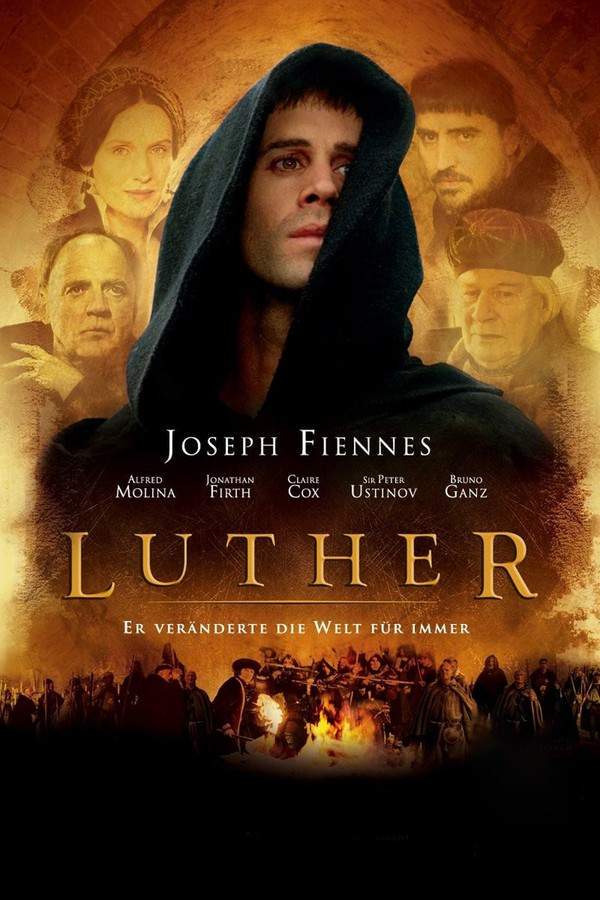
Luther (2003) movie poster

Characters & Themes

Luther (2003) Characters, Setting & Themes Explained

Release, runtime and language
2003 · 123 min · English
Loading streaming availability…
Directed by
Eric Till
Starring
Alfred Molina, Bruno Ganz, Joseph Fiennes, Peter Ustinov
Budget
$30M

In the early 16th century, Martin Luther, a young and idealistic German monk, becomes increasingly troubled by the corruption and materialism he observes within the Catholic Church. His growing concerns lead him to challenge established doctrines and practices, initiating a profound theological debate that ultimately sparks the Protestant Reformation and reshapes the religious landscape of Europe.

On this page (8)
  1. 1 Where to watch
  2. 2 Characters explained (5)
  3. 3 Where & when it takes place
  4. 4 Themes & meaning (3)
  5. 5 Character & meaning questions
  6. 6 Movie threads
  7. 7 Movies like Luther
  8. 8 Every angle
Loading streaming availability…

5 main characters · contains spoilers

Luther Characters Explained: Who Is Who

The main characters of Luther (2003), heroes and villains: what drives them, how they change over the course of the story and what each of them reveals about the film's bigger ideas.

  • Martin Luther (Joseph Fiennes)

    A German monk who evolves into a fearless reformer. He wrestles with the idea of a loving God while challenging indulgences and church authority, eventually posting the 95 Theses and leading a movement that changes Western Christianity. His journey is marked by conscience, courage, and a relentless search for theological clarity.

    • ✝️ Monk
    • 🧠 Theologian
    • 🗺️ Reformer
  • Johann von Staupitz

    Luther's mentor and supervisor, who urges him to focus on Christ rather than himself. He provides pastoral guidance and supports Luther's early reformist ideas, acting as a stabilizing influence during turbulent times.

    • 🧭 Mentor
    • 🕊️ Spiritual advisor
  • Pope Leo X

    The pope during Luther's rise, whose policies and indulgence campaigns set the stage for institutional confrontation. He represents the papal authority and the political-religious stakes of the era.

    • 👑 Church authority
    • 🏛️ Papal power
  • Charles V

    The Holy Roman Emperor who presides over trials and imperial politics during Luther's ascent. His decisions at Worms and in the Diet of Augsburg shape the fate of Protestantism.

    • 🤴 Imperial power
    • ⚖️ Legal authority
  • Katharina von Bora

    A former nun who marries Luther, symbolizing the personal and social shifts of the era. Their partnership reflects a new model of religious life outside traditional monastic structures.

    • 💒 Marriage
    • 🕊️ Reform era

Last updated: November 22, 2025 at 15:32

Was this helpful?

Setting

Where and When Does Luther Take Place?

The setting of Luther (2003): the year and time period, the places and locations, and how they shape the characters, the mood and the tension of the story.

Time period

Early 16th century (1500s)

Set during the Renaissance-era upheavals in the Holy Roman Empire, the film follows Luther from his conversion in 1505 through the 1510s and into the early 1520s. It maps the rise of reformist ideas as indulgences and church authority come under scrutiny. The period culminates in the Diet of Worms and the Augsburg Confession, reflecting a decade of religious and political struggle.

Location

Erfurt, Wittenberg, Worms, Wartburg Castle, Rome, Augsburg

The story spans Erfurt, Wittenberg, Worms, Wartburg Castle, Rome and Augsburg. In Erfurt, Luther joins the Augustinian order at the St. Augustine Monastery. Wittenberg becomes the hub of his teaching and the birthplace of his reforming ideas, while Worms hosts his famous trial. Wartburg Castle provides a protected refuge as Rome and Augsburg frame the broader drama surrounding indulgences and imperial politics.

  • 🏰 Historic cities
  • ⛪ Monastic life
  • 🧭 Reform movement
  • 🗺️ European travel

Last updated: November 22, 2025 at 15:32

Was this helpful?

3 major themes

Luther Meaning: Themes & Message Explained

What is Luther (2003) really about? The emotional, social and philosophical themes the film keeps returning to, its symbolism and the message beneath the surface.

  • Faith vs Dogma

    The film centers on Luther's shift from viewing God as wrathful to embracing a message of divine love. It explores personal conscience clashing with church authority, and how conviction can fuel reform. The narrative shows faith as a lived, interpretive experience rather than blind obedience.

  • Indulgences

    Indulgences are presented as a corrupt practice driving wealth to Rome and a tool for power. Luther's critique of indulgences sparks a public debate and a re-examination of what salvation means. The theme highlights how economic interests intertwine with spiritual claims.

  • Dissent and Reform

    Dissent arises as Luther posts his theses and refuses to recant at Worms, demonstrating the conflict between emerging national reform movements and papal authority. The film traces how institutional structures push back, while reformers mobilize princes to support religious change. The period culminates in the Augsburg Confession, formalizing a new Protestant identity.

Last updated: November 22, 2025 at 15:32

Was this helpful?

Character & theme questions

Luther Characters & Meaning: Your Questions Answered

The questions people ask about Luther (2003): who the characters really are, their relationships, what the symbols mean, where it takes place and what the movie is really about. Each answer contains spoilers.

Q1

Where does the movie Luther take place?

The movie is set across several key European locations: Erfurt where Luther joins the Augustinian monastery, Wittenberg where he teaches and posts his 95 Theses, Worms where he faces his famous trial, Wartburg Castle where he hides in exile, Rome representing the papal authority he challenges, and Augsburg where the Augsburg Confession formalizes Protestant identity.

Foreshadowing: The film opens in Erfurt's St. Augustine Monastery, establishing Luther's spiritual beginning before his reformation begins.

  • erfurt
  • wittenberg
  • worms
  • wartburg castle
  • settings
  • locations
Q2

When does Luther take place?

The film is set during the early 16th century, spanning from 1505 when Luther joins the Augustinian order through the 1510s and into the early 1520s, covering the height of the Protestant Reformation within the Holy Roman Empire.

Foreshadowing: The Renaissance-era setting provides the intellectual and cultural backdrop for religious questioning and reform.

  • 1500s
  • 16th century
  • historical period
  • renaissance
  • early modern europe
Q3

What does Faith vs Dogma mean in Luther?

The theme explores Luther's personal transformation from viewing God as wrathful to embracing divine love and grace. It examines how personal conscience clashes with institutional church authority, showing faith as a lived interpretive experience rather than blind obedience to doctrinal rules.

Foreshadowing: Luther's early spiritual struggles in the monastery hint at his later rejection of blind faith in church doctrines.

  • faith
  • dogma
  • conscience
  • grace
  • theology
  • religious reform
Q4

Who is Martin Luther in the movie?

Martin Luther is portrayed as a German monk who evolves into a fearless religious reformer. Initially an idealistic monk troubled by church corruption, he challenges the practice of indulgences, posts the 95 Theses, and sparks the Protestant Reformation that reshapes Western Christianity.

Foreshadowing: His initial crisis of faith in the monastery establishes his lifelong quest for theological truth.

  • martin luther
  • reformer
  • monk
  • 95 theses
  • protestant reformation
Q5

What role does Wittenberg play in Luther?

Wittenberg serves as the birthplace of Luther's reforming ideas and the hub of his teaching at the university. It is where he posts his 95 Theses on the castle door, initiating the public debate that sparks the Reformation and transforms European religious life.

Foreshadowing: Luther's appointment to Wittenberg University positions him perfectly to challenge church practices.

  • wittenberg
  • university
  • 95 theses
  • castle door
  • reformation birthplace
Q6

What are indulgences in the movie Luther?

Indulgences are depicted as a corrupt practice where the church sells forgiveness of sins for money, driving wealth to Rome and serving as a tool for papal power. Luther's critique of indulgences sparks public debate and forces a re-examination of what salvation truly means beyond financial transactions.

Foreshadowing: Tetzel's indulgence sales in Germany provide the immediate catalyst for Luther's 95 Theses.

  • indulgences
  • forgiveness
  • salvation
  • corruption
  • tetzel
  • papal authority
Q7

Who is Johann von Staupitz in Luther?

Johann von Staupitz is Luther's mentor and supervisor in the Augustinian order who urges him to focus on Christ rather than his own spiritual struggles. He provides pastoral guidance and supports Luther's early reformist ideas, acting as a stabilizing influence during turbulent times.

Foreshadowing: Staupitz's advice to look to Christ foreshadows Luther's theological breakthrough on grace and faith.

  • johann von staupitz
  • mentor
  • augustinian
  • spiritual guidance
Q8

What is the Dissent and Reform theme in Luther?

The theme depicts how Luther's act of posting his theses and refusing to recant at Worms creates conflict between emerging national reform movements and papal authority. It traces how institutional structures push back while reformers mobilize princes, culminating in the Augsburg Confession that formally establishes Protestant identity.

Foreshadowing: The posting of the 95 Theses represents the first overt act of dissent that transforms into organized reform.

  • dissent
  • reform
  • worms
  • augsburg confession
  • protestantism
  • imperial politics
Q9

What is the Diet of Worms in Luther?

The Diet of Worms is the imperial trial where Luther appears before Emperor Charles V and is called to recant his writings. His famous refusal to recant, declaring 'Here I stand,' marks a pivotal moment where religious conscience challenges political authority and accelerates the Reformation.

Foreshadowing: The buildup to Worms shows increasing pressure from both church and empire on Luther's teachings.

  • diet of worms
  • charles v
  • trial
  • recantation
  • here i stand
Q10

Who is Katharina von Bora in Luther?

Katharina von Bora is a former nun who marries Luther, symbolizing the personal and social shifts of the Reformation era. Their partnership represents a new model of religious life outside traditional monastic structures, reflecting the broader social transformations enabled by Protestant teachings.

Foreshadowing: Luther's eventual marriage contradicts the monastic vows he once took, showing his complete break with Catholic tradition.

  • katharina von bora
  • marriage
  • nun
  • reformed religious life
  • partnership
Q11

Who is Pope Leo X in Luther?

Pope Leo X is the pope during Luther's rise, whose indulgence campaigns and policies set the stage for institutional confrontation. He represents the papal authority and the political-religious stakes of the era, defending church practices that Luther challenges as corrupt.

Foreshadowing: Leo X's approval of indulgence sales directly conflicts with Luther's growing objections.

  • pope leo x
  • indulgence campaigns
  • papal authority
  • vatican
  • romans
Q12

Who is Charles V in Luther?

Charles V is the Holy Roman Emperor who presides over Luther's trial at Worms and the subsequent imperial politics surrounding the Reformation. His decisions shape the fate of Protestantism, balancing between supporting papal authority and managing the emerging religious divisions within his empire.

Foreshadowing: Charles V's final authority over Luther's fate creates the ultimate test of imperial vs. religious power.

  • charles v
  • emperor
  • holy roman empire
  • worms
  • imperial politics

Movie threads

More Movies Like Luther, by Mood & Story

Curated lists built around what makes Luther tick: the same mood, the same kind of story or the same emotional payoff. Each list explains why these movies belong together.

Intellectual Rebellion Movies Like Luther

Stories of profound thinkers whose ideas spark seismic societal shifts. Explore movies like Luther that chronicle historical figures whose ideas challenged the status quo. If you enjoyed the story of Martin Luther's theological debate, you'll find similar films about intellectual upheaval, societal transformation, and the personal turmoil of being a revolutionary thinker.

  • historical
  • ideological
  • revolutionary
  • thought-provoking
  • serious
  • weighty
  • Tone: serious, weighty, hopeful
  • Pacing: steady, deliberate, character-driven
Why these movies?

The story pattern: Narratives in this thread follow a clear arc: a protagonist, often an insider, becomes disillusioned with a powerful institution. Their growing conviction leads to a public challenge, triggering conflict, persecution, and a gradual, hard-won transformation of the world around them. The journey is one of profound internal and external struggle leading to a lasting legacy.

Why they belong together: Movies are grouped here for their shared focus on the power of ideas to drive historical change. They share a serious, weighty atmosphere, a steady, methodical pace that allows for intellectual engagement, and a central character arc defined by conviction, rebellion, and enduring impact.

Spiritual Crisis Movies Similar to Luther

Intimate portraits of individuals grappling with profound spiritual turmoil. Find films similar to Luther that explore deep spiritual and ideological turmoil. If you were captivated by Martin Luther's internal struggle with faith and corruption, these movies feature characters on solemn journeys of doubt, revelation, and personal reformation against powerful systems.

  • spiritual
  • contemplative
  • somber
  • troubled
  • serious
  • weighty
  • Tone: somber, dark, contemplative
  • Pacing: steady, introspective
Why these movies?

The story pattern: The narrative pattern follows a protagonist's deeply personal struggle with a core belief system. Faced with contradiction or hypocrisy, they enter a period of intense contemplation and conflict, often leading to a transformative personal breakthrough or a new, more authentic path. The structure is internal and psychological, even when set against a large historical backdrop.

Why they belong together: These films are united by their heavy emotional weight and dark, serious tone focused on spiritual and moral questions. They share a steady pace that allows for introspection, a medium intensity born from internal conflict, and a contemplative mood that prioritizes the character's psychological journey over external action.

If you liked this

Movies Like Luther

Similar movies to Luther: the same genre, themes or kind of story. Each one comes with its own plot summary, timeline and ending explained.

Browse all movie summaries

Every angle

Luther (2003) Explained: Plot, Timeline & Characters

Everything about Luther in one place: what happens in the plot summary, the timeline in chronological order, the characters and meaning and a spoiler-free summary. What's After the Movie adds the cast, box office and post-credit scenes.

Coming soon on iOS and Android

The Plot Explained Movie Summary App

Plot summaries, endings explained and timelines on your phone. Catch up on any movie in minutes, save your favorites and never miss a twist again.

Be the first to know when we launch. Your email stays private, always.

Learn more about the app