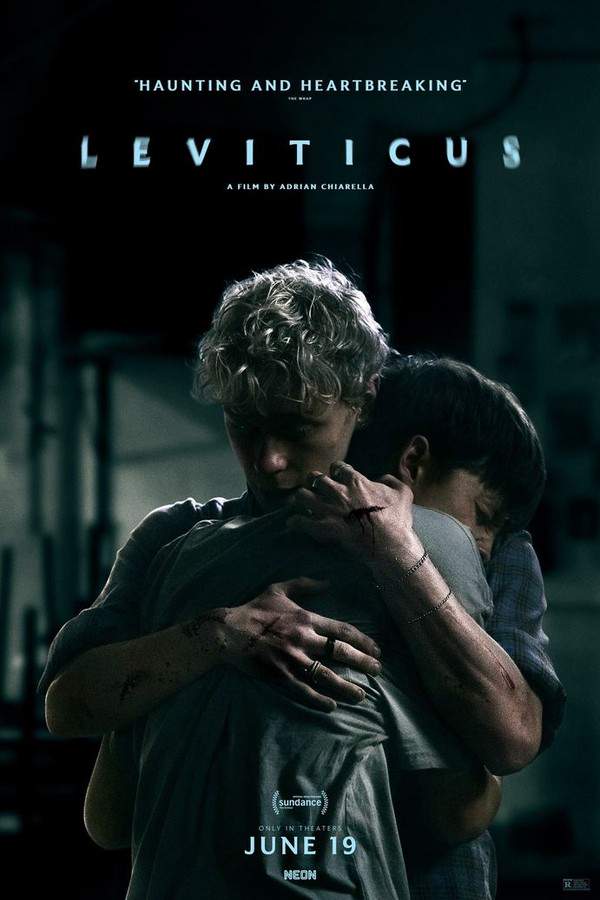
Leviticus

Leviticus

Year: 2026

Runtime: 1 h 26 m

Language: english

Director: Adrian Chiarella

Echo Score: 88

Budget: $3.5M

HorrorRomanceSci-FiThriller

Two star-crossed teenage boys must escape a violent entity that takes the form of the person they desire most - each other.

Where to Watch Leviticus?

Find where to stream, rent, or buy Leviticus (2026) in the US with current JustWatch availability, up-to-date pricing, and platform listings for subscription, rental, and digital purchase options.

Warning: spoilers below!

Haven’t seen Leviticus yet? This summary contains major spoilers. Bookmark the page, watch the movie, and come back for the full breakdown. If you're ready, scroll on and relive the story!

Leviticus (2026) – Full Plot Summary & Ending Explained

Read the complete plot breakdown of Leviticus (2026), including all key story events, major twists, and the ending explained in detail. Discover what really happened, and what it all means.

Last updated: July 26, 2026 at 07:28

Was this helpful?

Leviticus (2026) Plot Questions Answered – Summary FAQ

Explore frequently asked questions about Leviticus (2026) with spoiler-rich answers covering the full plot summary, major story beats, character motivations, hidden details, and ending meaning. This movie summary FAQ helps explain confusing scenes, plot twists, and narrative decisions in clear, searchable detail.

Q1

What is the entity that hunts Naim and Ryan?

A.

The entity is a supernatural predator that manifests as the person its victim desires most. In Leviticus, that means it appears as Naim to Ryan and as Ryan to Naim. According to Jessica's explanation in the hospital, the entity only appears when the victim is alone, grows stronger over time, and currently has no known method of stopping it.

The photo booth pictures at the roller rink showing Ryan kissing an invisible figure are the first visual confirmation that the entity imitates desire.

entitysupernatural threatdesiresrulesleviticus horror
Q2

Why did the deliverance ritual summon the entity?

A.

The ritual performed by the deliverance healer, intended to purge Ryan and Hunter of their homosexual desires, functions as the catalyst that activates the entity. Naim watches Ryan and Hunter convulse, vomit, and scream in agony during the ritual, and the supernatural danger only becomes visible to him afterward. The ritual's attempt to violently suppress desire creates the psychic wound the entity feeds on.

Izzie's later mention of Marnie dying after her own ritual confirms that the entity is a recurring consequence of these deliverance sessions, not a one-off event.

deliverance ritualhealerentity originsupernatural catalystconversion therapy
Q3

Why did Ryan tell Naim to stay away after the roller rink?

A.

Ryan escapes the roller rink having been physically strangled by an unseen force and recognizes that the entity is targeting him specifically. By warning Naim to stay away, Ryan is trying to protect Naim from becoming entangled in a danger he cannot explain and cannot fight. The warning also reflects Ryan's realization that being close to Naim may actually intensify the entity's attacks, since it already takes Naim's form.

This moment previews the bus ride later in Leviticus, where Ryan admits the entity will only ever appear as Naim, confirming closeness is both their bond and their curse.

ryan warningroller rinkprotectionentity dangerseparation
Q4

How did the entity kill Hunter?

A.

Hunter was attacked and dragged away by the same invisible force that strangled Ryan at the roller rink. Naim witnesses the assault but cannot see the attacker, and Hunter's decapitated head is later found in a nearby field. The escalation from non-lethal strangulation to decapitation shows the entity growing stronger and more aggressive as time passes in Leviticus.

Hunter's parents' decision to enlist the deliverance healer marks him as a target long before the kill, foreshadowing that those who undergo the ritual become the entity's primary prey.

hunter deathentity attackdecapitationinvisible forceescalation
Q5

Why did Arlene hire the same healer for Naim?

A.

Arlene hires the deliverance healer for Naim because she believes undergoing the ritual will make him appear 'cured' to the hostile evangelical community and therefore keep him safe from violence and rejection. The decision is driven by maternal fear rather than religious belief, since Arlene later admits she already knew the ritual's deadly consequences. It reveals how parental protection can become complicity when it relies on the same system causing harm.

Her later confession that she knew the risks retroactively reframes the entire hire as a calculated sacrifice rather than ignorance.

arlenedeliverance healernaimparental protectionritual
Q6

Why did the detective dismiss Naim's report about the entity?

A.

The detective dismisses Naim because his story involves an invisible force that only appears to victims, a decapitation with no visible attacker, and claims tied to two boys in a secret same-sex relationship. Rather than investigate the supernatural elements, the officer uses the visit as an opportunity to out Naim to Arlene. The scene highlights how the town's institutional response to LGBTQ+ identities is itself part of the danger Naim faces in Leviticus.

The detective's choice to inform Arlene directly sets up her decision to hire the healer, escalating the threat instead of stopping it.

police dismissaldetectivereporting entityinstitutional failureouting
Q7

Why did Naim out Ryan and Hunter's relationship to their parents?

A.

Naim outs Ryan and Hunter out of jealousy, acting on possessiveness over Ryan after learning Ryan is also involved with Hunter. The act is cruel and impulsive, not strategic, and it triggers the chain of events that leads to the deliverance ritual, Hunter's parents' involvement, and ultimately the entity's activation. Naim's later horror at the ritual's consequences underscores how a moment of personal jealousy sets the entire horror of Leviticus in motion.

Naim's guilt over this betrayal is what drives him to try to protect Ryan afterward, making the outing the emotional engine of the entire plot.

outingjealousynaim betrayalryan huntermotivation
Q8

What happened to Ryan after the derelict mill burned down?

A.

After Naim lures the entity into the derelict mill and sets it ablaze, Ryan disappears from the town. Authorities later confirm there is no trace of him in the mill ruins, suggesting the entity took him or that Ryan's death was completed by the fire rather than the entity. His absence is never resolved on screen, leaving his fate ambiguous in Leviticus.

Ryan's earlier confession that he wanted the entity to appear only as Naim hints that he had already accepted a bond with the entity that could not be cleanly severed.

ryan disappearancemill fireentity trapambiguous endingleviticus climax
Q9

Why did Naim leave Arlene at the gas station at the end?

A.

Naim leaves Arlene after she admits she knew the deliverance ritual's deadly consequences before hiring the healer for him. Her confession reveals that her protection was a calculated gamble with his life, not an act of unconditional safety. Choosing to walk away and board a bus on his own is Naim's first act of self-determination in Leviticus, reclaiming agency from both the entity and the family that failed him.

Arlene's earlier insistence on the healer already carried this betrayal; Naim simply did not have the words for it until her admission.

arlene confessiongas stationabandonmentagencyending
Q10

Who was Marnie and why does her death matter?

A.

Marnie is a girl mentioned by Izzie who died after undergoing the same deliverance ritual the healer performed on Ryan and Hunter. Her death confirms that the ritual is not a localized accident but a recurring mechanism that has produced fatalities before. For Naim, Marnie's existence transforms the entity from a one-off haunting into a documented pattern of lethal outcomes tied to conversion practices.

The fact that no one in the town has publicly connected Marnie's death to the ritual foreshadows how the community suppresses the truth to preserve its beliefs.

marnieritual deathhistorypatterndeliverance
Q11

How does the entity get stronger over time?

A.

According to Jessica's hospital explanation in Leviticus, the entity feeds on and intensifies through its victims' suppressed desires, becoming more powerful the longer it stalks them. Each attack escalates in violence, from invisible strangulation at the roller rink to Hunter's decapitation, and the attacks continue even when victims try to flee or stay apart. This escalation is what eventually pushes Naim to the desperate choice of burning the mill.

The photo booth images of Ryan kissing 'nothing' are the first hint that the entity's presence is intensifying before any physical attack occurs.

entity powerescalationdesiresjessica explanationhorror mechanics
Q12

Why did Ryan say he wanted the entity to appear only as Naim?

A.

On the bus ride after visiting Jessica, Ryan confesses that since the entity will follow him forever regardless of what they do, he would rather it always take the form of the person he actually loves. The statement is less about surrender and more about choosing intimacy with Naim over the terror of being hunted by a stranger. It reframes the horror in Leviticus as a doomed romance where the threat and the desire are the same face.

The wake confrontation already proved the entity can perfectly mimic Ryan, making Ryan's request a logical acceptance of what has been shown.

ryan confessionbus scenedoomed romanceentity formdesire
Q13

Why did the entity attack Naim as Ryan at Hunter's wake?

A.

At Hunter's wake, Naim and Ryan share a kiss outside, and the figure that violently attacks Naim is not the real Ryan but the entity wearing his face. The attack happens precisely because Naim has just acted on his desire, and the entity exploits moments of romantic vulnerability. Naim only realizes the truth afterward at home, when the real Ryan appears inside and the attack's impossibility becomes clear.

The ritual sequence earlier already established that the entity feeds on desire; the wake simply moves that feeding from private feeling into public action.

wake attackentity impersonationkiss triggerdesirehunter wake
Q14

Is the entity still active at the end of Leviticus?

A.

Yes. After Naim boards the bus, the entity is visibly lingering outside, confirming the mill fire did not destroy it. The film's final image suggests the entity has simply relocated with Naim rather than been defeated, turning the escape from the town into a continuation of the haunting. This unresolved ending leaves the threat permanently attached to Naim and his relationship.

Jessica's warning that there is no known way to stop the entity already implied the mill plan could only contain it, not kill it.

entity endingbus sceneunresolved horrorlingering threatleviticus ending
Q15

What are the rules of the entity that Jessica explains?

A.

Jessica explains three core rules of the entity in the hospital: it manifests as the person its victim desires most, it only appears when the victim is alone, and it grows stronger over time with no known method of stopping it. These rules define the horror of Leviticus because they make intimacy both the trigger and the trap, and they remove any conventional path to safety. Every survival decision the boys make is forced to operate within these constraints.

Each of Jessica's rules is demonstrated before she states them: the roller rink photo shows the form, the lone attacks show the isolation rule, and Hunter's death shows the escalation.

entity rulesjessicahospital sceneisolationescalation

Ending Explained – What Happens at the End of Leviticus?

Still wondering what the ending of Leviticus (2026) really means? Here’s a spoiler-heavy breakdown of the final scene, major twists, and the deeper themes that shape the film’s conclusion.

Naim’s ability to trust has been systematically destroyed by the curse. The entity assumes the appearance of the person its victim most desires, meaning that any encounter with Ryan may be either the boy Naim loves or a lure leading him to a violent death. The adults who should help make that uncertainty worse. Arlene physically delivers her terrified son to the town’s “deliverance” healer, and the ritual does not remove desire; it infects Naim with fear of it. After Naim and Ryan survive the immediate pursuit, the final confrontation with Arlene exposes that her betrayal was not an innocent mistake made in ignorance. She tells Naim that what was done “can’t be undone” and reveals she had been warned the change was irreversible. She still does not offer a real apology. Instead, she argues that she will not be alive forever and that her son, like everyone else, needs fear to keep him on the narrow Christian path. Naim and Ryan ultimately leave the conservative town together. Their departure gives them distance from the healer, their families, and the community that authorized the ritual, but it does not kill or contain the shape-shifting entity. It remains somewhere behind them, able to exploit the same learned fear in another encounter. The boys escape the place that empowered it without receiving a supernatural guarantee of safety.

Arlene’s admission is the ending’s decisive horror because it removes the comforting explanation that conversion practices are harmful only when parents misunderstand them. She understands that she is placing Naim at risk and accepts that danger as a tool of discipline. The director’s conception of the monster follows directly from that logic: exorcisms claiming to take queerness out of teenagers actually put terror inside them, teaching them to experience their own feelings as an approaching predator. That is why Naim cannot solve the curse simply by identifying the “real” Ryan once. Every future desire can reactivate the doubt the adults installed. Leaving together is nevertheless a substantial choice. Naim and Ryan refuse the premise that safety depends on isolation, celibacy, or obedience to people who knowingly endangered them. The still-living creature prevents the road out of town from becoming a cure, just as geographical escape cannot instantly undo internalized shame. Hope rests in the boys choosing companionship while afraid. They are not fearless at the end; they have stopped accepting fear as proof that their love is wrong.

Last updated: August 26, 2026 at 20:31

Was this helpful?
Mobile App Preview

Coming soon on iOS and Android

The Plot Explained Mobile App

From blockbusters to hidden gems - dive into movie stories anytime, anywhere. Save your favorites, discover plots faster, and never miss a twist again.

Sign up to be the first to know when we launch. Your email stays private, always.

Explore Movie Threads

Discover curated groups of movies connected by mood, themes, and story style. Browse collections built around emotion, atmosphere, and narrative focus to easily find films that match what you feel like watching right now.

Love weaponized into horror like in Leviticus

Stories where the thing you crave most is the very thing that hunts you.Looking for horror movies like Leviticus where desire itself becomes the threat? These films blend supernatural terror with tragic romance, featuring shape-shifting entities, doppelgangers, or psychic monsters that weaponize longing, attraction, and love. Expect psychological dread, doomed intimacy, and bodies of work where the monster wears the face of the one you want most.

doppelganger horrordesire as baitdoomed intimacyparanoid longingbody horrorpsychological dreadforbidden love

Narrative Summary

In these stories, the protagonist wants something deeply and specifically, and an otherworldly force latches onto that want, shapeshifting into the object of desire as a predatory strategy. The horror grows out of psychological manipulation rather than brute force: the victim cannot fight back without denying their own heart, and every tender moment risks being a trap. The story unfolds as a slow erosion of trust, with characters forced to question whether the lover in front of them is real or the monster wearing their skin. The romance engine and the survival engine become the same engine, which is what makes the dread so intimate and the tragedy so heavy.

Why These Movies?

These films share a core conceptual hook: desire is bait, love is a vulnerability, and the monster exploits emotional intimacy rather than physical weakness. They tend toward dark tones, heavy emotional weight, and variable pacing that alternates between quiet doomed-romance beats and violent confrontations. Viewers who respond to the idea that wanting someone can literally put you in danger will feel right at home in this thread, and the shape-shifting doppelganger archetype is a recurring anchor.

Doomed romance survival thrillers like in Leviticus

Two hearts find each other just as something inevitable comes for them both.Searching for movies like Leviticus where star-crossed lovers are hunted by an inescapable force? This thread gathers sci-fi horror and thriller stories that blend tragic romance with high-stakes pursuit, forbidden or marginalized love, and characters who must escape together or die together. Expect teen or young adult protagonists, claustrophobic tension, and emotional weight that lingers long after the credits.

star-crossedon the runforbidden lovepredator and preyclaustrophobicdoomedyoung lovesurvival

Narrative Summary

These stories introduce two characters whose bond is immediate, intense, and clearly fated, but almost immediately place them in the crosshairs of something they cannot negotiate with: a predator, a system, a curse, or a war. The narrative then becomes a series of escapes, close calls, and forced intimacy under pressure, with the relationship deepening precisely because the threat refuses to let them rest. Moments of tenderness are interrupted by pursuit, and moments of pursuit reveal new layers of devotion. The arc usually trends toward tragedy or ambiguity, with hope offered but rarely rewarded.

Why These Movies?

Films in this thread share a structural pattern: a young or marginalized couple, a love the world does not want them to have, and an external threat that turns the romance into a survival pact. They tend toward dark tones, heavy emotional weight, and variable pacing that balances intimate character moments with sustained chase or stalking sequences. The combination of romance score and tension score both running high is a reliable signature, as is a sense that escape is possible in any single scene but survival is not guaranteed across the whole film.

Unlock the Full Story of Leviticus

Don't stop at just watching - explore Leviticus in full detail. From the complete plot summary and scene-by-scene timeline to character breakdowns, thematic analysis, and a deep dive into the ending - every page helps you truly understand what Leviticus is all about. Plus, discover what's next after the movie.

Leviticus Timeline

Track the full timeline of Leviticus with every major event arranged chronologically. Perfect for decoding non-linear storytelling, flashbacks, or parallel narratives with a clear scene-by-scene breakdown.

Leviticus Timeline

Characters, Settings & Themes in Leviticus

Discover the characters, locations, and core themes that shape Leviticus. Get insights into symbolic elements, setting significance, and deeper narrative meaning - ideal for thematic analysis and movie breakdowns.

Characters, Settings & Themes in Leviticus

Leviticus Ending Explained

What really happened at the end of Leviticus? This detailed ending explained page breaks down final scenes, hidden clues, and alternate interpretations with expert analysis and viewer theories.

Leviticus Ending Explained

More About Leviticus

Visit What's After the Movie to explore more about Leviticus: box office results, cast and crew info, production details, post-credit scenes, and external links - all in one place for movie fans and researchers.

More About Leviticus