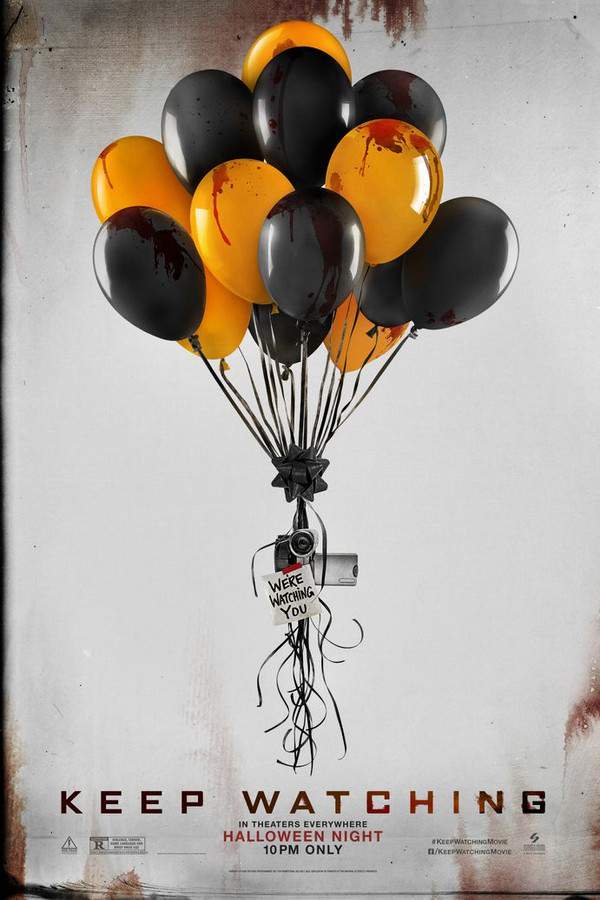
An ominous opening sequence shows a hooded figure photographing a young woman’s corpse in an empty field, followed by a rapid montage of Internet screenshots and video clips depicting women killed in ritual murders by a shadowy cybercult. The footage lands on an anonymous underground website where members are urged to "kill Kristy," a name rooted in Latin meaning "follower of God." This chilling setup frames the film’s central threat as both digital and physical, weaving horror through screens and streets alike.
Justine [Haley Bennett] is a college student living on financial aid at a private university in the Northeastern United States, and she struggles to make Thanksgiving work within her tight budget. With her boyfriend [Lucas Till] Aaron and roommate [Erica Ash] Nicole leaving for the holiday, Justine finds herself alone on a campus that's nearly emptied by break week. Around her, the campus atmosphere is watchful yet isolating, punctuated by the presence of a security guard Wayne [Mathew St. Patrick], a front gate worker Dave [Al Vicente], and a groundskeeper Scott [James Ransone], characters who will briefly become part of her increasingly perilous night.
On Thanksgiving night, Justine borrows Nicole’s car and heads to a nearby convenience store. There, a hooded girl, Violet [Ashley Greene], compliments the car and later demands a student discount on sunglasses; when Justine offers to pay, Violet refuses and hurls a venomous insult. Inside Justine’s world, someone has already breached her laptop, and a snuff film unfolds on the screen. Violet reappears in the room armed with a box cutter, prompting Justine to flee. Outside, Wayne is murdered right before her eyes by a masked assailant, and she discovers Dave dead in his vehicle.
As the killers assemble, Violet begins recording Justine and declares that they will hunt her, telling her to "run to God." Justine escapes to Scott’s house seeking help, but the gang strikes there as well—murdering Scott’s dog and hanging him from a swing set in the yard. When Justine tries to call 9‑1‑1 from Scott’s cell, she finds the line has been hacked by the cult. The group bombards her with video clips and threatening messages, forcing her to improvise and hide as the night tightens around her.
A tense sequence follows: Justine climbs to a roof and is cornered, finally leaping off to escape, aided by a break in her fall among the tree branches. Aaron arrives only to be killed, and Justine subsequently uses Aaron’s car to pin one cult member against a wall, crushing him. She then dashes to the gym’s swimming pool, slitting a second member’s throat with her car keys and sinking a third by drowning him. With defiant endurance, she fights back, beating another to death with a baseball bat.
Amid the chaos, Justine finds a text on the dead man’s phone from Violet asking whether he has “killed Kristy yet.” She answers yes and uncovers photos of the cult’s other victims, all promising to eradicate the “Kristys” of the world—women who are pure, beautiful, and privileged, whom the cult believes they follow, or serve, as God’s emissaries.
Using pool chemicals, Justine creates a flammable powder and dresses in the dead man’s mask and jacket. She approaches Violet’s car, communicates that the others are dead, and when Violet steps closer, Justine ignites the powder and burns Violet alive. She photographs Violet’s corpse with the phone and uploads the image to the same site that started this nightmare.
A final montage reveals a pattern: similar cult murders have occurred in other states and cities, but Justine’s testimony and the access to the phone lead to the arrest of many of the cult’s members. The post‑credits scene offers a grim tease—a young woman is attacked by another cult killer outside her home, only to be stopped by a masked defender whose identity remains unseen.
- A tense, cat-and-mouse nightmare plays out across campus and urban spaces, blending online infamy with real-world violence.
- The story centers on a young woman’s resilience as she turns the tables on a ritualistic killer regime, using wit, courage, and improvised tools to survive.
- The film’s moral tension probes how easily fear, control, and intimidation can migrate from screens to streets, and how the pursuit of safety can demand brutal choices.
Justine [Haley Bennett] emerges as a resourceful, determined protagonist who refuses to surrender to the terror around her, while the film offers a stark look at the way digital ecosystems can amplify violence and manufacture fear.