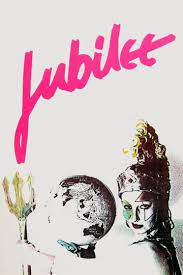
Queen Elizabeth I Jenny Runacre [is transported] by the occultist John Dee, who commands Ariel from The Tempest to bring her into the film’s present day. She lands in a ruined, mid-1970s Britain, moving through crumbling streets and a city that feels hollowed out by social and urban decay. The surrounding world is populated by a loose, aimless group of nihilists—mostly young women—whose lives are as fragmentary as the city around them, and among them are the provocatively named Amyl Nitrate, Bod, Chaos, Crabs and Mad, each contributing to a mood that is as anarchic as it is disenchanted. Amyl Nitrate, Toyah Willcox leads a squat-based scene where history is taught in a way that glorifies radical violence, even as she reminisces about a past life in ballet, a juxtaposition that foreshadows the film’s ongoing tension between artifice and cruelty, performance and peril.
In this volatile milieu, an early set piece introduces Sphinx and Angel, two incestuous bisexual brothers who loom over the group’s dynamics with a charged, unsettling presence. The narrative’s momentum is propelled by the disturbing act Bod commits: she, a sex-hating anarchist, has just strangled and killed Queen Elizabeth II, stealing her crown in a capricious street robbery. The act marks a brutal, destabilizing turn in a film already shimmying between fantasy, satire, and raw aggression.
From the squat, the action spills into a café where Crabs drifts toward a younger musician named Kid, Mad rips up postcards, and Bod launches a crude assault on a waitress using a bottle of tomato sauce. Bod then makes contact with the impresario Borgia Ginz, a character who embodies the crossover between show business and political opportunism. When Ginz enters the scene, Amyl’s presence is already clear, and the pair’s meeting unfolds with a sense of theatricality and menace; Borgia Ginz introduces a new axis of power, and his ambitions—turning abandoned spaces into musical venues—signal a rot the city is already chewing on. Jack Birkett appears here as the impresario, linking the persona to its on-screen presence.
Ginz’s arrival reveals a broader plan: to convert the derelict Westminster Cathedral and Buckingham Palace into performance spaces, a bold, brazen fusion of culture and desecration that mirrors the gang’s escalating trespasses. The group’s progress is punctuated by violence as well as music, with Mad, Bod and Crabs asphyxiating a one-night stand named Happy Days with red plastic sheeting, and Bod throttling an androgynous rock star named Lounge Lizard—a brutal interruption to a world where gigs and glamour seem within reach only to slip away again.
The story threads a violent rhythm through Westminster Cathedral’s disco milieu, where Kid and a policeman clash in a feverish altercation. As Kid makes a television debut, Viv—a former artist who is drawn into the gang’s orbit—joins Sphinx, Angel and the male members on a visit to Max, an ex-soldier at a bingo hall. The city’s policing and morality collide in a frenzy of brutality, claiming Sphinx, Angel and Kid in a cascade of violent police action. In the wake of these deaths, revenge becomes a driving force: Bod and Amyl execute a calculated assault to castrate the policeman who begins an affair with Crabs, while the other officer—now a target of Bod’s bombing—meets a fiery end at his own doorstep.
As the violence peaks, Ginz leads the four women away to Dorset, a reclusive, right-wing aristocratic enclave that he regards as “the only safe place to live these days.” The move marks a surreal pivot from urban decay to a pastoral, almost nostalgic refuge, and it culminates in a recording contract that promises a future amid a social order the film insists is already broken. The crew’s journey is juxtaposed with Dee, Ariel, and Elizabeth's attempts to interpret the signs of anarchic modernity around them, and the film closes on a strange, poignant return to a sixteenth-century sensibility, a dreamlike respite that juxtaposes Elizabeth’s spectral presence with the era’s own myths and dreams.
Throughout, the film maintains a detached, observational tone, letting its shocking events unfold with a chilly, almost documentary clarity. The characters drift through a world that treats violence as spectacle and performance as a currency, and the narrative never shies away from the uncomfortable collisions between history, rebellion, and the commodification of art. The result is a provocative, fragrantly transgressive tableau in which power, sexuality, and identity collide across time, leaving the viewer to weigh the costs of cultural decay against the lure of spectacle and music.