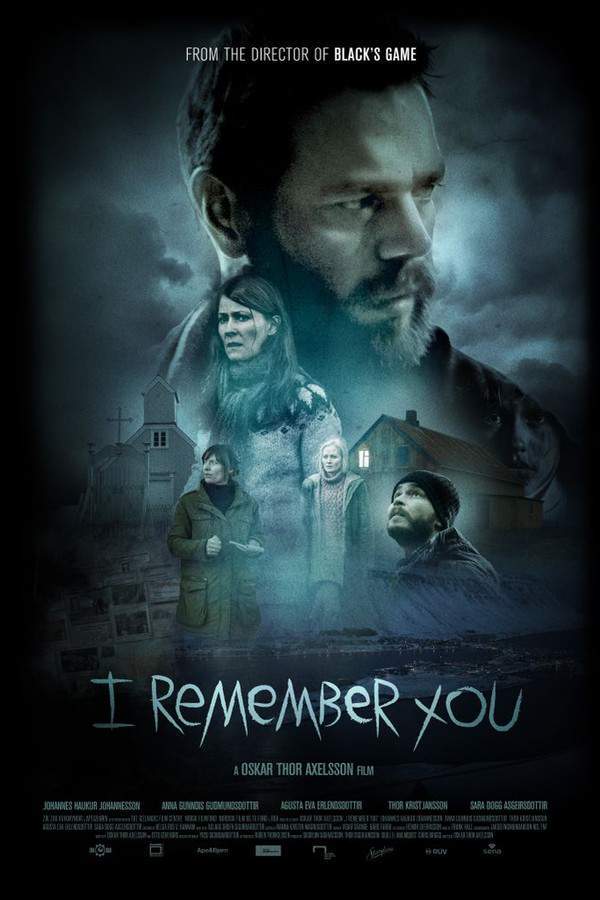
Freyr, a doctor in an Icelandic city, assists local police when an elderly woman is found hanged inside an old church. Crosses are carved into her back, initially treated as a consequence of domestic abuse, but the case takes a darker turn when the dead woman's husband insists he never touched her. Policewoman Dagny links the death to the decades-old disappearance of a young boy named Bernódus, and shows him a photograph of Bernódus's classmates — eight faces scratched out with crosses. She explains that Bernódus was bullied by his peers, and that his ultra-religious, abusive father blamed him for his wife’s death in childbirth, leaving the young boy with the same carved-back crosses. Six of the eight classmates have since died in mysterious accidents, all bearing crosses on their backs. Freyr, still haunted by the unresolved disappearance of his own son, Benni, begins to see visions of Bernódus, the haunting images intruding into his waking life and blurring the lines between memory and reality.
In a parallel thread, Katrín, Garðar, and Katrín's best friend Líf relocate to a small, largely abandoned hamlet to renovate a long-neglected house into a bed-and-breakfast. While scouting the property, Katrín discovers an old cemetery where one grave is missing a headstone. The trio experiences a cascade of eerie events — unsettling noises in the house, a creaking stairway that sprains Katrín’s ankle, and strange glimpses of Bernódus’s ghost by the creek. With cell phone reception non-existent, they are cut off from help as the supernatural pressure builds. In the house’s cellar, Katrín uncovers Bernódus’s body, clutching a photograph of his mother who bears a striking resemblance to Katrín herself. The discovery shakes them deeply, and they decide to abandon the house and move to another empty dwelling nearby, hoping to escape what they’ve unleashed.
Back with Freyr, his investigations deepen as Benni’s autistic friend reveals that Benni was last seen inside a “green submarine.” Freyr pieces together a mosaic of clues: a seventh bully dies by apparent suicide, and a trove of newspaper clippings about Benni’s disappearance appears in his room. He learns that the eighth bully was Úrsúla, a woman grappling with schizophrenia, who implies that Benni’s fate is linked to Bernódus’s awakening. Úrsúla confesses that Bernódus had been awakened by the arrival of Benni’s ghost in the house. Bernódus’s path leads the investigators to understand that he disembarked at the abandoned hamlet near his late mother’s grave, where he wandered and eventually died in the cellar.
As the threads converge, Dagny analyzes the growing pattern surrounding Benni and Bernódus and pieces together a crucial revelation: Benni’s spectral clue is in fact a misinterpreted image of a septic tank rather than a green submarine. Surveillance footage from the gas station where Benni was last seen shows Katrín, Garðar, and Líf moving with a septic tank they intended to install during the renovations. The missing headstone, the ghostly appearances, and the septic-tank clue point to a past that the trio tried to bury. The timeline reveals that Katrín, Garðar, and Líf’s actions happened years earlier; Garðar and Líf are found dead, Líf mortally wounded, while Katrín vanishes.
Dagny’s breakthrough crystallizes: Benni crawled into the septic tank while the others were inside the restaurant, and the tragedy left Benni dead. The police and Freyr confront the truth at the abandoned house: Benni’s body lies inside the septic tank, and Katrín’s fate remains unresolved. Freyr, overwhelmed by grief yet haunted by closure, sits inside the house as a quiet observer. A final, poignant moment unfolds as Freyr is drawn toward the cellar, where the bodies of Katrín and Bernódus lie side by side, but he chooses not to look inside. He leaves with Benni’s body, the blue-jacketed ghost of Benni accompanying him as a sign that he’s no longer trapped, while the ghosts of Katrín and Bernódus hold hands and watch him go, their fates finally united in a somber, enduring stillness.