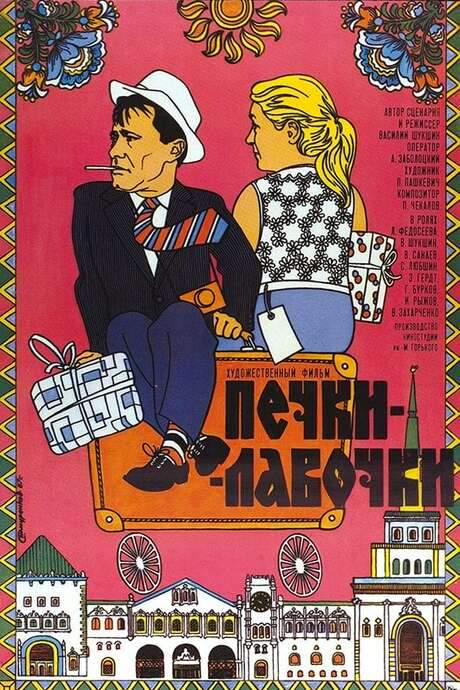
In a quiet provincial town called Lesogorsk, the year 1980 brings a quiet breakthrough: a modest physics teacher unveils a device that can identify a child’s latent talents and potential paths across a wide spectrum—art, sport, science, craft, and more. Fueled by curiosity and a wish to help, he travels to Moscow to share his invention with interested minds and institutions. But the reception he meets is cool at best—skeptical officials, wary reporters, and a city that questions whether such a leap is possible or trustworthy. Among the curious observers is a photojournalist named Gosha, who immediately senses the sensational angle his paper could exploit. Yet the moment the inventor examines Gosha’s own talents, he reveals a startling verdict: Gosha is not destined to become a great writer, but a clown, a detail that shocks him and sours the initial prospect of a breakthrough story.
A decade passes, and the town’s once-hidden promise seems to have blossomed in unexpected ways. A remarkable wave of talented youths—artists, athletes, scientists, and skilled craftsmen—from Lesogorsk rises to national and even international acclaim, as if the town itself were quietly seeding brilliance into the world. The device’s theory appears vindicated in practice, though none of the recipients publicly speak of the mysterious origin of their gifts. Gosha, now the head of a newspaper department, finds himself stalled professionally and personally, his career stubbornly unfulfilled. Driven by a hunger for a compelling story, he returns to the tale of the inventor, determined to uncover the truth behind this unlikely renaissance and to understand what the device might truly reveal about talent and destiny.
As Gosha’s investigation deepens, he learns that the inventor’s insights extended beyond the public showcases of talent. The scientist had once scanned his wife while she slept and foresaw her gift for sculpture, a prediction that later proved astonishingly accurate and brought her acclaimed success. The more Gosha digs, the more the pattern of hidden talents—often unrecognized at first—begins to cohere around the inventor’s work. Yet a crucial piece is missing: a scan of the inventor’s own son’s talents was inadvertently destroyed by the boy himself, leaving a haunting gap in the scientist’s covenants of revelation and potential.
Compelled to find closure, Gosha pursues the trail to its end and discovers that the inventor has died. The device, once a beacon of possibility, has been dismantled before his passing, leaving behind a sense of unfinished business and what-ifs. In the wake of that revelation, a ceremonial honoring the scientist in Lesogorsk becomes a turning point for Gosha. Inspired by the memory of the man who dared to chart human potential, he resolves to change his own life—even if it means embracing a new path later in life, guided by the belief that talents can illuminate not just fame, but a more meaningful and purposeful existence.
The story, at its core, threads together the tension between belief and doubt, the allure of extraordinary ability, and the costs and consequences of peering into what people might become. It invites readers to ponder how a small invention could ripple through a community, transforming dreams, careers, and identities, while leaving us to question whether we can ever truly measure or predict the full scope of a person’s gifts—and whether choosing to live differently, after all the discoveries, might be the bravest talent of all.