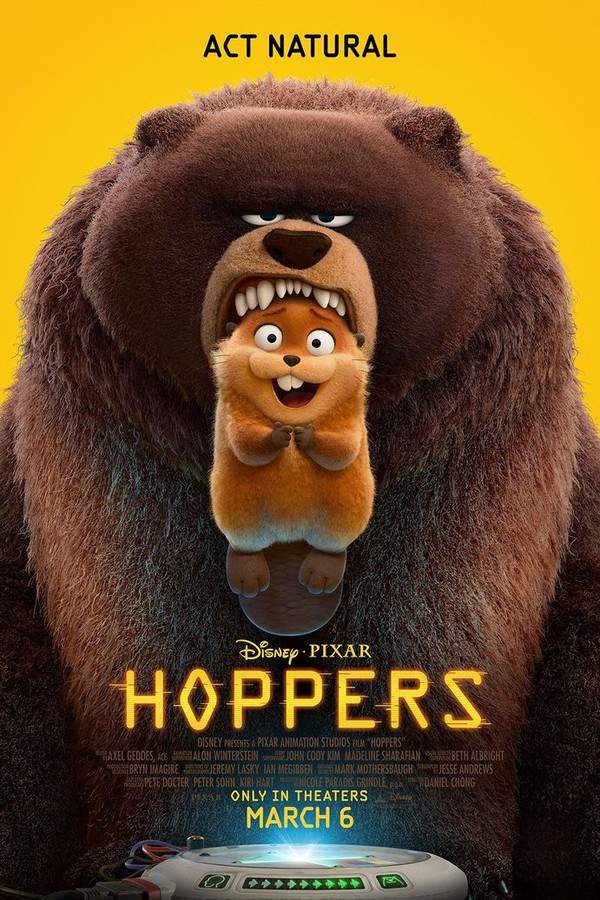
#363105 Year: 2026
Runtime: 1 h 45 m
Language: english
Director: Daniel Chong
Echo Score: 70Budget: $150M
What if you could talk to animals and actually hear their thoughts? In a Disney‑Pixar adventure, scientists have devised a method to “hop” human consciousness into lifelike robotic animals, allowing people to live as the creatures. The tale follows Mabel, an animal lover who volunteers for the experiment, embarking on an unexpected adventure that blurs the line between human and animal.
Find where to stream, rent, or buy Hoppers (2026) in the US with current JustWatch availability, up-to-date pricing, and platform listings for subscription, rental, and digital purchase options.
Warning: spoilers below!
Haven’t seen Hoppers yet? This summary contains major spoilers. Bookmark the page, watch the movie, and come back for the full breakdown. If you're ready, scroll on and relive the story!
Read the complete plot breakdown of Hoppers (2026), including all key story events, major twists, and the ending explained in detail. Discover what really happened, and what it all means.
A young Mabel, Piper Curda, tries to free a clutch of classroom animals by slipping them into her backpack, but the plan unfolds with a sudden commotion and a fire alarm that lands her in trouble. After the incident, she is dropped off at her grandmother’s house, where Karen Huie plays a warm, guiding presence who teaches her to pause, listen, and observe the world of nature. On a quiet walk through a local forest glade, Mabel sits on a rock and discovers a surprising sense of calm and connection as animals begin to appear around her. The visit plants a seed in her heart: a future spent protecting the creatures and places she loves.
As the years pass, that seed grows into a lifelong devotion. Mabel chooses to stay near Beaverton rather than head off to college, devoting herself to helping animals alongside her grandmother. When illness finally takes her grandmother, she leaves Mabel a jacket and a message of resilience, a tangible link to a simpler, more hopeful time. Grief gives way to purpose, and Mabel finds herself living alone in her grandmother’s house, determined to defend the glade against encroaching danger.
The central threat comes from Mayor Jerry Generazzo, a charismatic figure seeking to win re-election by expanding the road network and bulldozing the glade. Jon Hamm embodies Jerry’s political calculus—promises of progress masking a disregard for the living world that depends on the glade. From a dam where dynamite has been placed to an escalating signature drive, Jerry and Mabel find themselves locked in a stubborn confrontation. After a day of rejections on the streets, Mabel’s campaign trails into a moment of awkward humor when she discovers that an elderly listener with a hearing aid misreads her petition as a grocery list.
Back at Beaverton University, she interrupts a class led by Dr. Sam, whose gravitas and passion for conservation become a new focal point in her mission. Kathy Najimy embodies Dr. Sam, whose Hoppers program—a radical leap into the possibility of shared consciousness with robotic animal proxies—opens a doorway to a world where humans can communicate with wildlife in intimate, experiential ways. Mabel learns that the beaver she has been tracking is not a real creature but a robot designed to study and protect the glade. Undeterred, she climbs into the beaver body herself, embracing the chance to see the glade through animal eyes.
Her leap leads to a breathtaking night of discovery in the glade, where she meets a lazy beaver named Loaf and is briefly pulled into a world where animals talk, share rules, and live together in a community. Eduardo Franco gives Loaf a charming mix of mischief and loyalty as Mabel saves him from a bear and learns about “pond rules” that govern this unusual society. Among the first to welcome her is King George, a monarch among the mammals who rules from a grand, communal lodge. Bobby Moynihan lends George a blend of gruff practicality and surprising warmth as he explains how the animal society has formed its own order, with residents ranging from a frog chorus to a close-knit council.
Conner, one of Dr. Sam’s colleagues, slips into a robotic bird to observe Mabel and the glade from a new angle, a reminder that the scientists’ reach into nature is both inspiring and unsettling. Sam Richardson brings a cautious, curious presence to this dynamic, highlighting the tension between curiosity and intrusion. As Mabel learns more about the glade’s inhabitants, she uncovers the truth behind the animals’ departure: Jerry’s construction of hollow, noise-emitting trees designed to disrupt wildlife, a scheme that silences the glade’s voice and movement.
In a climactic sequence, Mabel confronts the dam and the tree that is splitting the community, and the assembly of animal monarchs— including a Fish Queen, a trio of Snake queens, and an Insect Queen—gathers in the wake of these revelations. The Insect Queen is portrayed with regal presence, and her role deepens the political intrigue of the glade’s leadership. Meryl Streep lends a ceremonial intensity to this queenly figure, underscoring the stakes of the council’s deliberations. The Insect Queen’s son Titus, played by Dave Franco, steps into a more defiant role as he seeks to empower the insect realm with brutal certainty, prompting a clash that tests Mabel’s resolve and the possibility of peaceful coexistence.
What follows is a tense braid of alliances and betrayals. Titus and the council push for a drastic plan: vice-clamp the human world with an apex predator squad, while the council’s manipulations threaten to erupt into violence. Vanessa Bayer contributes a calculating menace as Diane, a shark-turned-assassin who becomes the violent face of the council’s retaliation. The consequences of these plans ripple through the glade, complicating Mabel’s relationship with George as she tries to balance advocacy with the power to enact real change.
The crisis escalates when a dramatic car ambush and a high-stakes political rally push all sides toward a breaking point. The council’s push for domination collides with Mabel’s plea for cooperation, and a twist of fate forces Mabel and Jerry to confront the human cost of the glade’s struggle. As events unfold, the trees begin to fall and the city’s plans threaten to overwhelm the community. Titus’s schemes come to a head in a star-crossed moment that ends with a surprising, brutal turn of fate, including a fierce confrontation with a rival king of the animal world—an encounter that leaves the glade’s future suddenly uncertain.
In the aftermath, a wildfire sweeps through the glade, testing every creature’s resolve. With the transmitter damaged and the animals momentarily silenced, King George steps into a leadership role and orchestrates a coordinated response: tear down the dam, flood the glade, and extinguish the blaze. Jerry recalibrates his plan, declaring the glade a protected preserve and pledging to work with Mabel to repair the damage. The political landscape shifts as the Hoppers program is exposed, and Dr. Sam’s team is brought to account, clearing the way for brighter, safer collaboration between humans and animals.
The story returns to the quiet, hopeful cadence of early days. Mabel graduates from college, eyes bright with a future of study and stewardship, and asks Dr. Sam for a job, joining the lab as an assistant in the evolving exploration of robotic wildlife and ecological resilience. She also returns to the glade, where she finds George still perched on the same rock that began it all. Their friendship endures even as words become scarce—George texting with Mabel’s phone to keep in touch—and a shared conviction that nature’s voice deserves to be heard, protected, and celebrated by all who listen. The glade is saved, the freeway reimagined, and a new era of cooperation between people and creatures begins, rooted in memory, respect, and a stubborn, hopeful faith in the power of small acts to change a world.
Last updated: March 05, 2026 at 18:40
Explore frequently asked questions about Hoppers (2026) with spoiler-rich answers covering the full plot summary, major story beats, character motivations, hidden details, and ending meaning. This movie summary FAQ helps explain confusing scenes, plot twists, and narrative decisions in clear, searchable detail.
Mabel chose to stay because of her deep bond with her grandmother and her passion for protecting the glade. Rather than leaving for college, she remained at a local college so she could continue visiting her grandmother and caring for the animals they both loved.
The Hoppers program enables human consciousness to be transferred into lifelike robotic animals. Once hopped in, the human can experience the world from that animal's perspective and understand real animals' thoughts and speech. Mabel uses this to hop into a robotic beaver and gain the ability to understand animal communication.
Mayor Jerry erected false trees that emit a high-pitched noise only animals can hear. This ultrasonic sound frightened the animals and forced them to leave. When Mabel discovers and destroys one of these trees, the animals realize they've been tricked and return to the glade.
Earlier, Mayor Jerry claims the animals have left on their own, setting up the reveal that he actually drove them away.
When the Animal Council votes to kill Mayor Jerry, Mabel tries to intervene and accidentally kills the Insect Queen in the chaos. This causes her caterpillar son Titus to transform into a butterfly and become the new Insect King, shifting the council's vengeance toward Mabel and George instead.
After Titus becomes Insect King, the Council schemes to clone Mayor Jerry using Dr. Sam's lab. The plan involves having Titus hop into the Jerry clone, attend his campaign rally, and use the fake trees' noise devices to massacre all the humans by destroying their brains.
Mabel and George sneak into Mayor Jerry's car and use text-to-speech on his phone to communicate with him. When the robotic shark Diane is dropped onto the car, they divert the vehicle, causing it to crash off a bridge and stopping the assassination attempt.
With the transmitter broken and unable to communicate verbally, George takes charge and commands the animals to tear down the dam. The resulting flood waters the glade and extinguishes the wildfire, saving the ecosystem.
Earlier in the story, the animals rebuild the dam after returning to the glade, setting up this solution.
The transmitter that allowed Mabel to understand animals breaks during the final battle. At the ending, Mabel finds George on the same rock where her grandmother first taught her to appreciate nature. While they can no longer speak directly, they maintain their friendship through his phone's text-to-speech feature.
Mabel's grandmother brought her to this same rock in childhood to be still and listen to nature, establishing its symbolic importance.
Titus climbs the last remaining fake tree to activate it and carry out the Council's plan to attack humans. However, the tree falls and destroys the robot he's inside. Titus is then eaten alive by the Frog King, ending both his reign and the threat.
Despite the Hoppers program being shut down and Dr. Sam being removed from the university, Mabel asks for a job and is hired as Dr. Sam's assistant for future studies. This represents her finding a new purpose that combines her love of animals with the technology that helped her save the glade.
Still wondering what the ending of Hoppers (2026) really means? Here’s a spoiler-heavy breakdown of the final scene, major twists, and the deeper themes that shape the film’s conclusion.
The conclusion of Hoppers shifts the focus from a standard environmental conflict to a more complex lesson about the consequences of unchecked action. While Mabel spends much of the film fighting Mayor Jerry’s construction plans, the finale reveals that her own chaotic approach to activism has inadvertently paved the way for a much darker threat. The true antagonist emerges in Titus, the ambitious Insect King who rises to power after Mabel accidentally kills his mother, the Queen. Unlike Mabel, whose destructive tendencies are born of carelessness, Titus is calculating; he seeks to turn Jerry’s sonic technology into a weapon of mass murder against humanity. This distinction forces Mabel to evolve from a reckless agitator into a leader who understands that how one fights is just as important as what they are fighting for.
The climax brings these threads together when Mabel stops Titus, leading to a forest fire that threatens to destroy the very Glade she aimed to protect. In a pivotal moment of unity, the humans and animal kingdoms come together to save Beaverton, proving that genuine community is forged through cooperation rather than coercion. The resolution offers a nuanced truce: Jerry abandons his destructive highway project after developing a respect for Mabel’s tenacity, while Mabel learns to temper her drive with empathy and restraint. By the time the Hopper technology is shut down, severing her ability to speak with the animals, Mabel’s bond with George remains intact, symbolizing that true connection relies on understanding rather than technology. Ultimately, Hoppers argues that while passion is necessary to inspire change, it must be balanced with a respect for others to avoid creating new cycles of destruction.
Last updated: March 16, 2026 at 11:31
Discover curated groups of movies connected by mood, themes, and story style. Browse collections built around emotion, atmosphere, and narrative focus to easily find films that match what you feel like watching right now.
Quirky stories where technology unlocks a deeper connection with the natural world.Discover movies like Hoppers that blend imaginative sci-fi concepts with heartfelt environmental messages. If you enjoyed the theme of using inventive tech to connect with and protect nature, you'll find similar uplifting and adventurous stories here.
Stories in this thread typically follow a protagonist who gains a unique ability or technology that allows them to see or interact with nature in a new way. This discovery propels them on a mission, often against antagonistic forces, to protect an ecosystem or community, culminating in a heartwarming resolution that emphasizes harmony between technology and the natural world.
These movies are grouped together because they share a core mix of whimsical, inventive sci-fi and a sincere, advocacy-driven environmental heart. They balance lighthearted adventure with meaningful themes, creating an experience that is both fun and thought-provoking without being overly dark or intense.
Emotional stories about outsiders finding their place and purpose with an unlikely group.Explore movies like Hoppers that focus on characters finding a new family and purpose. If you were moved by Mabel's connection with her animal friends and the theme of overcoming loss through community, you'll enjoy these similarly heartwarming stories.
The narrative pattern begins with a protagonist experiencing loneliness or loss. Through an unexpected adventure, they cross paths with a group of characters who are also outsiders. By working together towards a common goal, they form a deep, familial bond, helping each other heal and ultimately finding a new home and purpose together.
These films are united by their emotional core, which revolves around the healing power of community. They mix medium emotional weight with a steady, character-driven pace, resulting in stories that are contemplative and heartwarming, with a fulfilling, happy resolution that emphasizes connection over conflict.
Don't stop at just watching - explore Hoppers in full detail. From the complete plot summary and scene-by-scene timeline to character breakdowns, thematic analysis, and a deep dive into the ending - every page helps you truly understand what Hoppers is all about. Plus, discover what's next after the movie.
Track the full timeline of Hoppers with every major event arranged chronologically. Perfect for decoding non-linear storytelling, flashbacks, or parallel narratives with a clear scene-by-scene breakdown.
Discover the characters, locations, and core themes that shape Hoppers. Get insights into symbolic elements, setting significance, and deeper narrative meaning - ideal for thematic analysis and movie breakdowns.
What really happened at the end of Hoppers? This detailed ending explained page breaks down final scenes, hidden clues, and alternate interpretations with expert analysis and viewer theories.