Plot Explained Spoilers guaranteed!
Plot Explained

Browse by genre

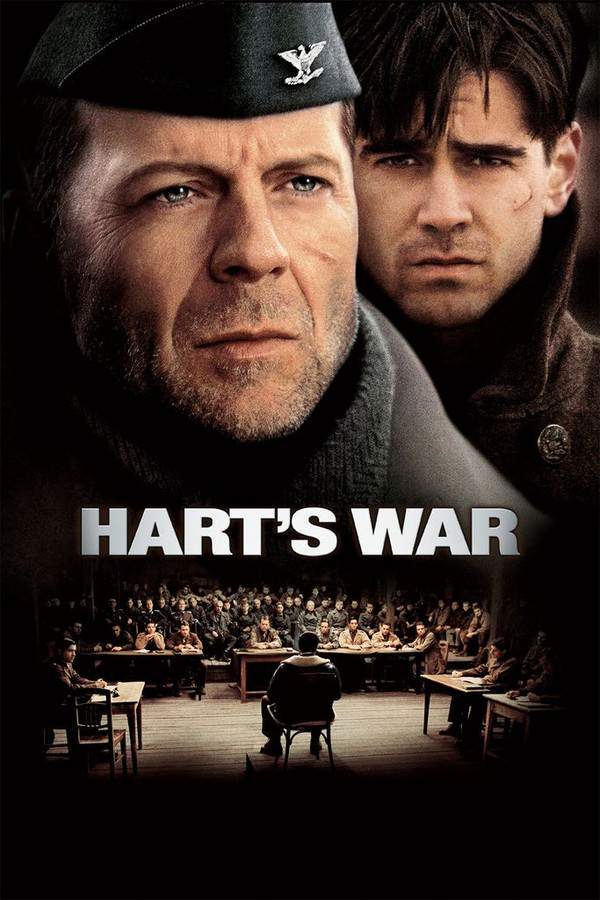
Hart's War (2002) movie poster

Plot Summary

Hart's War (2002) Plot Summary Explained

Release, runtime and language
2002 · 125 min · English
Loading streaming availability…
Directed by
Gregory Hoblit
Starring
Bruce Willis, Colin Farrell
Budget
$70M

During World War II, a young officer's aide is captured by the Germans and imprisoned in a brutal POW camp. He unexpectedly finds himself defending a black soldier accused of a serious crime, a case that demands a courtroom trial within the camp. As he investigates, he uncovers a complex web of deceit and must confront the prejudices and dangers present within the prison, all while questioning his own loyalties and the meaning of justice in wartime.

On this page (6)
  1. 1 Where to watch
  2. 2 What happens: full plot
  3. 3 Plot questions answered
  4. 4 Movie threads
  5. 5 Movies like Hart's War
  6. 6 Every angle
Loading streaming availability…

Full plot summary · contains spoilers

What Happens in Hart's War: Full Plot Summary

The whole story of Hart's War (2002) explained, from the opening scene to the final frame: every key event, every twist and what it all adds up to. Read it as a quick recap before the sequel, to check a scene you missed, or to finally understand what really happened.

Belgium, December 16, 1944: First Lieutenant Thomas Hart, portrayed by Colin Farrell, finds himself captured by German commandos amidst the unfolding chaos of the Battle of the Bulge. After being taken to a local prison, his boots are confiscated, leaving him vulnerable and exposed in a cold cell. As the threat of frostbite and pneumonia looms, he is coerced into revealing intelligence to his German interrogator. Subsequently, he and a group of American soldiers are transported by train to a prisoner of war camp. In a dramatic turn of events, a squadron of P-51 Mustangs inadvertently attacks the train after the letters POW, obscured beneath layers of snow, are not visible. This tragic incident leads to the deaths of some POWs due to friendly fire, compelling the men to spell out POW with their bodies in a desperate attempt to avert further attacks.

Upon reaching the camp, Hart undergoes debriefing with the senior American officer, Colonel William McNamara, played by Bruce Willis. When questioned about his cooperation with the Germans, Hart denies any wrongdoing, though McNamara knows the truth, having observed Hart's three-day ordeal with a Level 1 interrogator. Instead of allowing him the comfort of bunking with fellow officers, McNamara assigns him to the barracks for enlisted men, a decision that deepens the tension between them.

Things become even more complicated with the arrival of two Tuskegee Airmen, Second Lieutenants Lincoln A. Scott and Lamar T. Archer, who are the only Black officers in the camp. Their position is made perilous by the hostility of Staff Sergeant Vic W. Bedford, a vile racist threatening their very existence. Soon, a spike found in Archer's bunk leads to a tragic escalation; the Germans seize Archer, executing him under the pretense of attempting to escape. Almost simultaneously, an American radio set up to receive coded messages is discovered and destroyed.

The stakes rise drastically when Bedford is later found dead, with Scott accused of his murder—a reprisal for being framed for Archer's execution. With his legal background as a former Yale law student, Hart is tasked by McNamara to defend Scott in a court-martial that gains the consent of the camp's commandant, Oberst Werner Visser.

As the trial unfolds, tensions flare. Visser hands Hart a manual on US Army court-martial procedures, thereby intensifying the clash with McNamara, who finds his authority questioned. On the stand, Scott delivers a poignant testimony about the grave inequities faced by Black soldiers who volunteered to serve their nation yet were met with scorn.

In a twist of fate during the trial, Hart uncovers a hidden tunnel, revealing an escape plan that McNamara discloses was intentionally crafted to distract from an impending attack on what the Allies erroneously believe to be a shoe factory. The truth soon emerges that Bedford had schemed to frame Archer and orchestrate an escape based on betrayal. Hart is horrified to learn of McNamara’s ruthless decisions, prioritizing the lives of many over the life of an individual to further their cause.

As the trial reaches its conclusion, McNamara and 34 men feign illness to evade participation, slipping away to execute their escape. In a moment of sacrifice during his closing argument, Hart asserts that he was responsible for Bedford's death in a bid to save Scott. This revelation leads to immediate repercussions, with Visser preparing to execute Hart for his claim.

However, in a remarkable turn of selflessness, McNamara returns to the camp, choosing to accept full responsibility for Hart's actions, even as an explosion adjacent to the camp signals the beginning of chaos. Moved by Hart's bravery, McNamara sacrifices his own life to spare the other prisoners.

In the aftermath, Scott leads the salute to McNamara's fallen figure. Three months later, as the German forces surrender to the Allies, the prison camp is liberated, marking an end to this harrowing chapter of their struggle.
Last updated: November 02, 2024 at 12:04

Was this helpful?

Plot questions answered

Hart's War Plot Explained: Your Questions Answered

The questions people ask most about Hart's War (2002): what happens in the confusing scenes, why the characters do what they do, the twists, hidden details and what the ending means. Each answer contains spoilers.

Q1

Why did McNamara send Hart to the enlisted men's barracks instead of the officer quarters?

McNamara assigned Hart to the enlisted barracks because he knew Hart had cooperated with German interrogators during his three-day ordeal. Though Hart denied any wrongdoing during debriefing, McNamara had observed his prolonged session with a Level 1 interrogator. By demoting Hart's living conditions, McNamara was punishing him for the perceived betrayal and keeping him isolated from the other officers who might learn what had transpired.

  • Hart
  • McNamara
  • barracks
  • punishment
  • interrogation
  • cooperation
Q2

Why did the Germans execute Lamar Archer?

The Germans executed Archer after a spike was planted in his bunk, which was framed as evidence of an escape attempt. In reality, Staff Sergeant Bedford, a virulent racist, had orchestrated the framing to get rid of Archer. The Germans used the fabricated evidence as a pretext to execute Archer, treating the Tuskegee Airmen as less than human and making an example of him to intimidate the other prisoners.

  • Archer
  • execution
  • Germans
  • spike
  • escape
  • framing
  • Bedford
Q3

Who really killed Staff Sergeant Bedford?

The film leaves Bedford's killer ambiguous, but the circumstances strongly suggest McNamara orchestrated the murder to eliminate a dangerous racist who threatened to derail the broader escape plan. Bedford had framed Archer, leading to his execution, and was becoming increasingly unstable. McNamara needed to remove him to maintain order in the camp and protect the secret escape operation, though the exact killer remains officially unresolved.

  • Bedford
  • murder
  • McNamara
  • killer
  • death
  • Tuskegee Airmen
Q4

Why did Hart claim he was responsible for Bedford's death during his closing argument?

Hart confessed to killing Bedford to save Lieutenant Scott, who was falsely accused of the murder. By claiming responsibility, Hart hoped to prevent Scott from being convicted and executed for a crime he didn't commit. Hart knew the real circumstances were far more complicated involving McNamara's plans, and he was willing to sacrifice himself to protect the only Black officer left in the camp.

Foreshadowing: Hart had earlier discovered the tunnel and learned of McNamara's manipulative schemes.

  • Hart
  • Bedford
  • confession
  • trial
  • Scott
  • sacrifice
  • court-martial
Q5

What was the purpose of the tunnel McNamara built?

The tunnel was not primarily for escape, it was a decoy. McNamara revealed to Hart that the escape was designed to draw German attention away from an impending Allied bombing raid on what the Allies believed was a shoe factory (but was actually something more significant). McNamara intentionally prioritized the military mission over individual lives, using the escape as a distraction while knowing many men would likely die during the raid.

Foreshadowing: Earlier in the film, an American radio set up to receive coded messages was discovered and destroyed, cutting off communication about the true target.

  • tunnel
  • escape
  • McNamara
  • decoy
  • bombing
  • distraction
  • military mission
Q6

Why did Colonel McNamara return to the camp after escaping?

McNamara returned to take full responsibility for Hart's confession that he killed Bedford. When Hart claimed responsibility during his closing argument to save Scott, Visser prepared to execute Hart. McNamara chose to come back and accept the blame for everything, sacrificing his own life to spare Hart and the other prisoners. This act of redemption demonstrated that Hart's courage had changed McNamara, who finally placed individual life above the mission.

Foreshadowing: Hart's willingness to die for Scott had visibly moved McNamara during the trial.

  • McNamara
  • return
  • sacrifice
  • responsibility
  • Hart
  • redemption
  • death
Q7

Why did the P-51 Mustangs attack the train carrying the POWs?

The P-51 Mustangs attacked the train because they couldn't see the letters POW written on the train car. The letters had been obscured by layers of snow during the winter transport. When the American pilots saw the train moving through the Ardennes, they mistook it for a German vehicle and strafed it, resulting in friendly fire casualties among the American prisoners.

  • P-51 Mustangs
  • train
  • friendly fire
  • snow
  • POW
  • attack
  • Battle of the Bulge
Q8

What intelligence did Hart reveal during his German interrogation?

The specific intelligence Hart revealed is not detailed in the film, but he was coerced while suffering from frostbite and pneumonia in a cold cell without his boots. German interrogators used his vulnerable physical state and the threat of death to extract information. This cooperation is what led McNamara to punish him by assigning him to the enlisted barracks upon arrival at the camp.

  • Hart
  • interrogation
  • intelligence
  • Germans
  • frostbite
  • coercion
  • betrayal
Q9

Why did the German commandant Visser allow a court-martial to take place in the POW camp?

Visser permitted the court-martial partly to maintain order among the prisoners and partly to observe the American justice system in action. He deliberately handed Hart a manual on US Army court-martial procedures, seemingly allowing the Americans to conduct their own trial. However, this also created an opportunity for Visser to assert control and witness the internal divisions among the prisoners, particularly regarding racial tensions.

  • Visser
  • court-martial
  • Germans
  • camp
  • trial
  • procedures
  • commandant
Q10

What happened to Lincoln Scott after the trial?

After Hart's confession saved him from conviction, Scott was not executed and remained in the camp until liberation. Three months later, when the German forces surrendered and the camp was liberated by the Allies, Scott was among the survivors. He leads the salute to McNamara's fallen figure, honoring the colonel who ultimately sacrificed himself for Hart and the other prisoners.

  • Scott
  • survival
  • liberation
  • salute
  • McNamara
  • after
  • ending
Q11

What was the real reason McNamara orchestrated the murder trial?

McNamara used the trial as a smokescreen to execute his escape plan. While the court's attention and the Germans' curiosity were focused on the murder trial, McNamara and 34 men feigned illness and slipped away to begin their escape. The trial kept both American and German authorities distracted, allowing the escape to proceed with less scrutiny. McNamara manipulated every aspect of the situation to serve the broader military objective.

Foreshadowing: The discovery of the radio and coded messages being destroyed earlier cut off communication about the true military target.

  • McNamara
  • trial
  • escape
  • manipulation
  • military
  • plan
  • smokescreen

Movie threads

More Movies Like Hart's War, by Mood & Story

Curated lists built around what makes Hart's War tick: the same mood, the same kind of story or the same emotional payoff. Each list explains why these movies belong together.

Military Justice Dramas like Hart's War

Courtroom battles and ethical dilemmas within the rigid confines of war. Find movies like Hart's War where legal proceedings and moral conflicts unfold under the extreme pressure of war. These stories feature intense courtroom battles, difficult ethical choices, and characters forced to define justice in life-or-death situations.

  • tense
  • moral conflict
  • procedural
  • claustrophobic
  • urgent
  • somber
  • Tone: dark, tense, morally complex
  • Pacing: steady, procedural
Why these movies?

The story pattern: A central legal or ethical conflict, often a trial, serves as the narrative engine. Characters, usually soldiers or prisoners, must navigate a rigid system while confronting personal biases and external threats. The search for truth is complicated by the greater mission of war, leading to sacrifices and difficult verdicts.

Why they belong together: They share a focus on procedural justice within a high-stakes, life-or-death environment. The tone is intensely serious, driven by moral conflict and the claustrophobic pressure of military hierarchy or captivity, making the legal battle a matter of survival.

Claustrophobic Prison Dramas like Hart's War

Confronting prejudice and survival in the oppressive confines of captivity. If you liked the tense, oppressive atmosphere of Hart's War, explore movies set in confined prisons or camps. These films focus on survival, moral decay, and the complex social hierarchies that develop under extreme duress.

  • oppressive
  • claustrophobic
  • grim
  • tense
  • moral dilemma
  • survival
  • Tone: grim, oppressive, somber
  • Pacing: steady, escalating tension
Why these movies?

The story pattern: The narrative unfolds within the strict physical and social boundaries of a prison or camp. A catalyst event, such as an injustice or a new arrival, disrupts the fragile status quo, exposing systemic flaws and forcing characters to choose between self-preservation and solidarity. The confined setting amplifies every tension.

Why they belong together: They are united by an oppressive, claustrophobic setting that acts as a pressure cooker for moral and social conflict. The tone is grim and tense, focusing on the psychological toll of captivity and the difficult choices required to maintain one's humanity.

If you liked this

Movies Like Hart's War

Similar movies to Hart's War: the same genre, themes or kind of story. Each one comes with its own plot summary, timeline and ending explained.

Browse all movie summaries

Every angle

Hart's War (2002) Explained: Plot, Timeline & Characters

Everything about Hart's War in one place: what happens in the plot summary, the timeline in chronological order, the characters and meaning and a spoiler-free summary. What's After the Movie adds the cast, box office and post-credit scenes.

Coming soon on iOS and Android

The Plot Explained Movie Summary App

Plot summaries, endings explained and timelines on your phone. Catch up on any movie in minutes, save your favorites and never miss a twist again.

Be the first to know when we launch. Your email stays private, always.

Learn more about the app