Year: 1969
Runtime: 96 mins
Language: English
Director: Stanley Donen
An aging gay couple runs a barber shop in London’s East End. One partner, a part‑time actor, faces a trial for allegedly propositioning a police officer. Over one night they reminisce about their tender yet volatile shared past and contemplate a uncertain future apart, offering a bittersweet portrait of love and loss.
Warning: spoilers below!
Haven’t seen Staircase yet? This summary contains major spoilers. Bookmark the page, watch the movie, and come back for the full breakdown. If you're ready, scroll on and relive the story!
Read the complete plot breakdown of Staircase (1969), including all key story events, major twists, and the ending explained in detail. Discover what really happened—and what it all means.
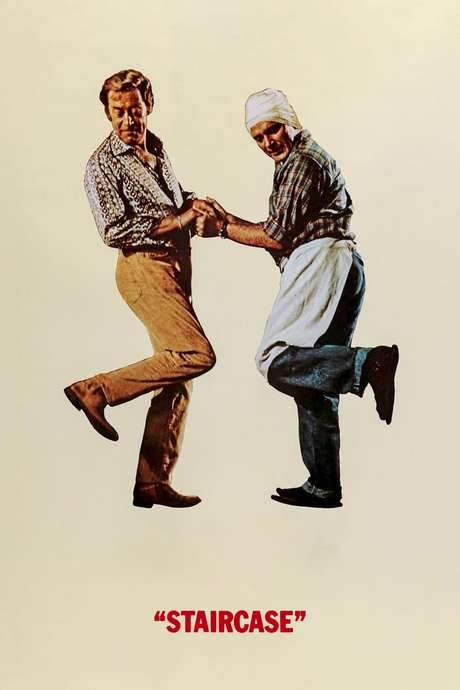
Harry Leeds and Charles Dyer are two queer hairdressers who have shared a life and a business for two decades, running Chez Harry, a bustling barbershop tucked in London’s East End. Their home life is a rough-and-tumble mix of affection and sharp-edged quarrels, with Harry’s bedridden mother living upstairs, watching the world from a distance. Harry, who suffers from alopecia, refuses to wear a toupee, opting instead for a simple bandage that covers his head, a small detail that stubbornly anchors his sense of self. Charlie, ever the showman, is an actor who seems to measure his worth by the flash of a spotlight, constantly dropping mentions of his latest gig or brush with fame. The couple’s banter is relentless—barbed, witty, and laced with a stubborn pride that both sustains and strains their bond. Their home is a surface of practiced ease and beneath it, a lifetime of intimate irritations, even as they navigate a creeping discomfort over Cassy, Charlie’s daughter, and what a future might look like for their unusual family.
One night, Charlie faces a crushing deviation from their routine: he is summoned to court on a charge of lewd public behavior for dressing in drag. The accusation cuts close to the nerve of their shared life—public, performative, and sexual identity laid bare for judgment. The next morning, the couple rides a motorcycle to a park, a quiet, pointed conversation about children and what kind of future they can imagine together. The mood is hushed but weighty, as both wrestle with the possibility of consequences that could upend everything they’ve built. The very next day reveals a new ache: Charlie visits his mother in a nursing home, a place of faded recognition where she does not seem to know him. Outside, Harry offers quiet consolation, and the two wander toward another park filled with young people, a scene that sharpens the stakes of Charlie’s potential punishment and the fragile balance of their relationship.
A further dramatic turn arrives when Charlie invites a younger man, Jack, into their apartment. The interlude triggers another storm of hurt and resentment, with Harry growing weary of Charlie’s insistence on his acting career and his reluctance to bring Cassy into their world. The tension spills over, and when Jack leaves, Harry slips into the bathroom where Charlie finds him unconscious, though Harry quickly recovers. The incident deepens the fault lines between them, turning their domestic space into a theater of fear, regret, and the question of whether their love can endure the mounting pressure from the outside world.
As the day of trial approaches, Charlie, before stepping out, contemplates life without Harry and prays for some form of mercy or clarity. Harry briefly appears downstairs, wearing a dark-haired toupee that tries to disguise another truth, and asks Charlie for his judgment. Charlie, choosing kindness but unable to fully erase the sting of honesty, refrains from the harsher verdict and instead returns to the safer armor of the bandage. The exchange is tender and painful, a meditation on honesty, vulnerability, and the stubbornness that keeps them together. Harry asks to accompany Charlie to the trial, but Charlie declines, insisting he must face the consequences alone. In a final, quiet reversal of the momentum that has pushed them apart, Charlie steps out and, in a small, hopeful moment, calls for Harry. The two walk out of the door together, choosing to face the uncertain road ahead not as lovers divided by fear, but as a pair who have weathered judgment and still find one another in the end.
Throughout, the film frames a relationship that survives not by perfection but by a stubborn commitment to one another, a willingness to confront social norms, and the fragile humanity that appears in every quiet, confessional moment. The stark cityscape, the intimate interiors, and the relentless dialogue all serve to illuminate a love that is at once tender, resistant, and endlessly complicated. The characters’ lives intersect with a broader world that watches and weighs their choices, yet the story remains intensely focused on the private truths that keep Harry and Charlie connected even when the world seems bent on pulling them apart.
Last Updated: October 07, 2025 at 09:23
Discover curated groups of movies connected by mood, themes, and story style. Browse collections built around emotion, atmosphere, and narrative focus to easily find films that match what you feel like watching right now.
Stories that explore the tender complexities and weathered affection of enduring partnerships.Discover movies like Staircase that focus on the intricate, bittersweet dynamics of long-term partnerships. If you appreciated the tender yet volatile portrait of an aging gay couple, you'll find similar emotional depth and nuanced character studies in these films about love, commitment, and the weight of shared history.
Narratives in this thread often unfold over a confined timeframe, using dialogue-heavy scenes and reminiscence to explore the layers of a shared life. The central conflict is typically internal to the relationship, driven by external pressures, personal regrets, or the simple, daunting challenge of navigating a future together.
Movies are grouped here for their shared focus on the bittersweet reality of long-term intimacy, their slow, character-driven pacing, and their ability to find both warmth and strain within a single relationship. They share a mood that is tender, contemplative, and intimately melancholic.
Personal turmoil unfolds in intimate settings, where conversation carries the weight of drama.Explore films similar to Staircase where a looming external threat forces a couple to confront their past and future in one tense night. These movies use a confined setting and heavy dialogue to build emotional tension, focusing on the quiet drama of domestic life under pressure.
The narrative pattern involves a confined timeframe (often a single night or day) and a limited setting where characters are forced to confront a pressing external issue. The plot is secondary to the emotional revelations and character dynamics that unfold through extended, charged conversations, often revisiting the past to understand the present crisis.
This thread connects films through their use of a confined setting and limited timeframe to amplify emotional stakes. They share a slow, deliberate pacing that allows for deep character exploration, a medium intensity derived from high personal stakes, and a mood that is anxious, intimate, and contemplative.
Don't stop at just watching — explore Staircase in full detail. From the complete plot summary and scene-by-scene timeline to character breakdowns, thematic analysis, and a deep dive into the ending — every page helps you truly understand what Staircase is all about. Plus, discover what's next after the movie.
Track the full timeline of Staircase with every major event arranged chronologically. Perfect for decoding non-linear storytelling, flashbacks, or parallel narratives with a clear scene-by-scene breakdown.
Discover the characters, locations, and core themes that shape Staircase. Get insights into symbolic elements, setting significance, and deeper narrative meaning — ideal for thematic analysis and movie breakdowns.
Get a quick, spoiler-free overview of Staircase that covers the main plot points and key details without revealing any major twists or spoilers. Perfect for those who want to know what to expect before diving in.
Visit What's After the Movie to explore more about Staircase: box office results, cast and crew info, production details, post-credit scenes, and external links — all in one place for movie fans and researchers.
Discover movies like Staircase that share similar genres, themes, and storytelling elements. Whether you’re drawn to the atmosphere, character arcs, or plot structure, these curated recommendations will help you explore more films you’ll love.
Staircase (1969) Scene-by-Scene Movie Timeline
Staircase (1969) Movie Characters, Themes & Settings
Staircase (1969) Spoiler-Free Summary & Key Flow
Movies Like Staircase – Similar Titles You’ll Enjoy
Closet Monster (2016) Film Overview & Timeline
The Closet (2001) Complete Plot Breakdown
Cut Sleeve Boys (2007) Movie Recap & Themes
The Story of the Stone (2018) Movie Recap & Themes
Forgive and Forget (2000) Plot Summary & Ending Explained
Get Your Stuff (2000) Detailed Story Recap
The Line of Beauty (1000) Movie Recap & Themes
Davy and Stu (2006) Ending Explained & Film Insights
Another Love Story (1986) Complete Plot Breakdown
Torch Song Trilogy (1988) Complete Plot Breakdown
Like In The Movies (1000) Ending Explained & Film Insights
Stonewall (1995) Full Summary & Key Details
Lilies (1996) Full Movie Breakdown
Beautiful Thing (1996) Complete Plot Breakdown
The Trials of Oscar Wilde (1960) Detailed Story Recap