

Plot Explained Spoilers guaranteed!
Plot Explained

Browse by genre

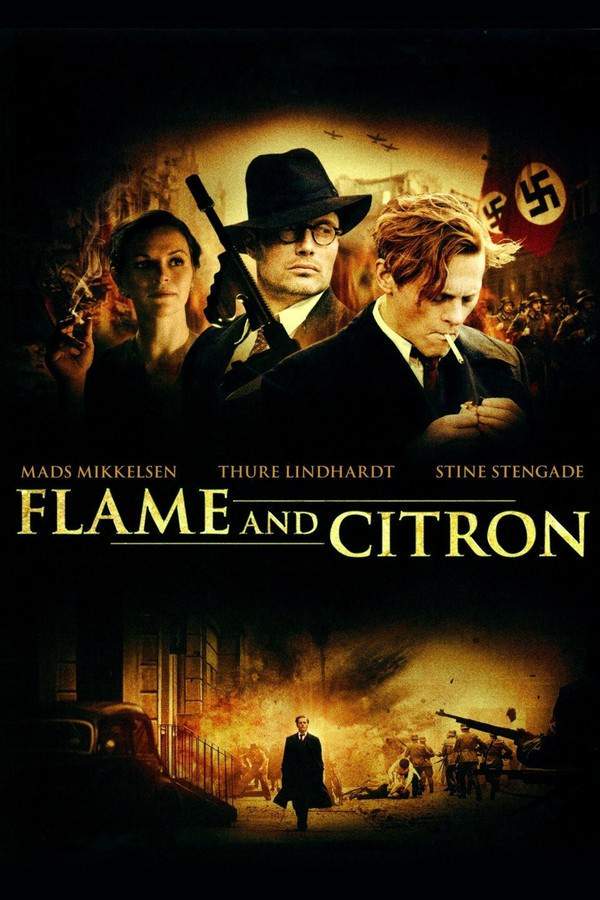
Flame and Citron (2009) movie poster

Timeline

Flame and Citron (2009) Timeline Explained – Every Event in Order

Release, runtime and language
2009 · 130 min · Danish
Directed by
Ole Christian Madsen

During the final days of World War II in occupied Denmark, resistance fighters Flame and Citron carry out dangerous missions, eliminating those who collaborate with the Nazis. When they are ordered to assassinate a comrade, they grapple with difficult moral choices and the complexities of their cause. Their focus turns to Karl Heinz Hoffman, the brutal Gestapo chief, as they become entangled in a deadly game of deception and pursuit, where allegiances are tested and the stakes are incredibly high.

On this page (6)
  1. 1 Where to watch
  2. 2 Events in order (15)
  3. 3 Timeline questions answered
  4. 4 Movie threads
  5. 5 Movies like Flame and Citron
  6. 6 Every angle

Where to watch

Where to Watch Flame and Citron (2009)

Where can you watch Flame and Citron? Stream, rent or buy it in the US, including on Kanopy: current JustWatch availability with up-to-date prices.

Streaming availability powered by JustWatch

15 events in order · contains spoilers

Flame and Citron Timeline: Events in Chronological Order

Every key event of Flame and Citron (2009) in order, scene by scene, with when and where it takes place. Use it to untangle flashbacks, time jumps and parallel storylines, to refresh your memory before the sequel or to find the exact scene you are thinking of.

  1. Occupation and order to attack Abwehr targets

    After the Nazi invasion, Bent Flammen and Jørgen Citronen are ordered by their handler Winther to eliminate Abwehr agents. They debate against targeting Danes only to minimize German retaliation, but the mission proceeds as official instruction. The assignment sets the tone for the resistance's risky balancing of ethics and danger.

    When
    Early 1940s
    Where
    Copenhagen, Denmark
  2. Lorentzen killed; Gilbert and Seibold spared

    Bent carries out the hit on Elisabeth Lorentzen, but fails to kill Horst Gilbert and Hermann Seibold. The resistance experiences the growing risk of exposure as their targets include German intelligence assets. The failure intensifies the pressure on Bent and Jørgen.

    When
    Shortly after the orders
    Where
    Copenhagen, Denmark
  3. Family birthday reveals hardship

    Jørgen, his wife Bodil and daughter Ann celebrate Ann’s birthday in their car, highlighting their financial strain. Bodil reveals she is seeing another man, adding personal peril to their dangerous lives. The moment contrasts with the resistance’s clandestine world.

    When
    Evening during Ann's birthday
    Where
    Copenhagen, Denmark
  4. Spex urges pause for a larger plan

    In a meeting with Spex from Danish Army Intelligence, they are told there will be no more attacks so a larger operation can be prepared. Bent and Jørgen decide to ignore the order and continue their activities. The disagreement underscores the tension between strategic restraint and bold action.

    When
    Later period during occupation
    Where
    Copenhagen, Denmark
  5. Gilbert is killed by Jørgen

    Following the tension with Spex, Jørgen shoots and kills Gilbert, escalating the conflict with the Abwehr. Bent continues to be involved, but the resistance’s actions increase the Gestapo’s focus on them. The killing signifies a turning point in their campaign.

    When
    After Spex meeting
    Where
    Copenhagen, Denmark
  6. Robbery to support the family

    That night, Jørgen robs a grocery store and brings the stolen goods to his family, attempting to ease their hardship. Bodil’s admission of seeing another man deepens the strain on their relationship. The line between resistance violence and personal desperation blurs.

    When
    That night
    Where
    Local Danish towns near Copenhagen
  7. Winther suspects informant

    After several resistance members are killed by the Gestapo, Winther suspects there is an informer among them. The suspicion sets off a dangerous game of mistrust within the resistance. The stakes of betrayal become personal for Bent and Jørgen.

    When
    After multiple killings
    Where
    Danish resistance network
  8. Ketty reveals loyalty and involvement

    Bent visits Ketty at her hotel and they have an intimate moment. Ketty then tells him she works for Winther and for Danish army intelligence, and that Winther is not working for the British. This revelation upends Bent’s assumptions about loyalties.

    When
    After the erotic encounter
    Where
    Ketty’s hotel, Copenhagen
  9. Ketty named informer; death order issued

    In a later meeting, Winther identifies Ketty as the informer and orders her death to prevent exposure. Bent and Jørgen realize they may have been maneuvered by a web of lies. The trust between resistance members continues to erode.

    When
    Later stage in the plot
    Where
    Bar/meeting room, Copenhagen
  10. Winther escapes to Stockholm; trap realized

    Bent and Jørgen search for Winther in a bar and discover that he has escaped to Stockholm, confirming that a trap has been set by the Gestapo. They manage to flee the ensuing pursuit and avoid capture for the moment. The chase exposes the danger of their networks across borders.

    When
    During the pursuit
    Where
    Copenhagen and Stockholm, Denmark/Sweden
  11. Plan to strike Hoffmann; ambush aborted

    They decide to kill Karl Heinz Hoffmann, the Gestapo leader, and seize control of the Gestapo’s favorite restaurant. Bent aborts the plan when police approach, illustrating how close they are to discovery. The plan’s failure foreshadows the crackdown to come.

    When
    Planning phase; night
    Where
    Copenhagen, Denmark
  12. Ambush causes civilian casualties and Ketty flees

    On the road, Bent, Jørgen and their group open fire on two cars bearing Nazi flags and tragically kill a father while wounding a child. Ketty flees to Stockholm fearing Hoffmann’s retaliation. The incident marks a brutal turning point in the resistance’s actions.

    When
    Ambush night
    Where
    Road near Copenhagen
  13. Round-up, Jørgen dies; Bent survives momentarily

    During a general round-up of the German-allied Danish police, Jørgen leaps a fence and is shot, and later dies defending a safe house. Bent evades capture briefly but ultimately, with Gestapo closing in, his courage gives way to despair. The resistance leaders are crushed in the crackdown.

    When
    During the crackdown
    Where
    Copenhagen, Denmark
  14. Bent’s suicide and Ketty’s reward

    Bent, back at his home, commits suicide with a cyanide pill as the Gestapo closes in. Hoffmann later rewards Ketty for helping capture Bent, and a letter from Bent is found, expressing his feelings and doubt about Ketty’s betrayal. The ending casts a stark light on loyalty and betrayal.

    When
    At the end of the crackdown
    Where
    Bent’s home and Hoffmann’s location
  15. Legacy and remembrance

    The film closes with notes about Bent and Jørgen’s legacy, honoring their resistance work and the costs paid. Their actions are remembered in Danish history, serving as a somber reminder of the price of resistance. The narrative ends with a memorial tone that outlives the characters themselves.

    When
    Post-war
    Where
    Denmark, post-war memory

Last updated: October 09, 2025 at 15:44

Was this helpful?

Timeline questions answered

Flame and Citron Timeline Explained: Your Questions Answered

When does it happen, and why in that order? The questions people ask about the chronology of Flame and Citron (2009): time jumps, flashbacks, cause and effect between scenes and the correct order of events, each answered with spoilers.

Q1

Why were Flame and Citron ordered to kill Danish collaborators?

Handler Aksel Winther ordered them to eliminate three Abwehr officers, Elisabeth Lorentzen, Horst Gilbert, and Hermann Seibold, to weaken German intelligence. He claimed the orders came from the Danish government in exile. Bent and Jørgen debated the ethical implications, knowing that killing fellow Danes would invite harsh German reprisals against the Danish population, but they proceeded with the mission anyway.

Foreshadowing: Earlier, Winther emphasizes that the mission is official instruction, setting up the moral conflict that haunts both fighters throughout the film.

  • Aksel Winther
  • Abwehr
  • killing
  • Danish collaborators
  • moral dilemma
Q2

Who was the informant betraying the Danish resistance?

Ketty Selmer was the informant. She worked as a courier between Stockholm and Copenhagen, but was actually a double agent reporting to both Winther and Danish army intelligence, though not to the British as Bent assumed. Her betrayal led to the Gestapo cracking down on resistance members and ultimately contributed to the round-up that killed Jørgen and drove Bent to suicide.

Foreshadowing: Ketty warns Bent that army intelligence wanted her near Hoffmann, hinting at her deeper involvement in the counterintelligence operations.

  • Ketty Selmer
  • informant
  • betrayal
  • double agent
  • Gestapo
Q3

Why did Ketty betray Flame and Citron to the Gestapo?

Ketty was working for Danish army intelligence and was positioned near Hoffmann as part of a counterintelligence operation. Her loyalty was to the intelligence services rather than to the resistance fighters. After Bent and Jørgen were compromised, Hoffmann rewarded Ketty for her role in helping apprehend them, confirming her betrayal was calculated and self-serving.

Foreshadowing: When Ketty reveals her true employer to Bent, she mentions Winther doesn't work for the British, foreshadowing her own divided loyalties.

  • Ketty Selmotron
  • betrayal
  • motivation
  • Hoffmann
  • intelligence
Q4

Why did the resistance kill civilians during the ambush?

Bent, Jørgen and their group ambushed two cars bearing Nazi flags on a road near Copenhagen, believing they were targeting enemy personnel. They tragically discovered they had killed a father and wounded a child instead. The mistake was a devastating accident caused by the fog of war and the hasty identification of vehicles with Nazi insignia.

Foreshadowing: The film shows the resistance operating under increasing pressure and desperation, which contributed to the careless identification of targets.

  • civilian casualties
  • ambush
  • mistake
  • resistance
  • accident
Q5

Why did Bent commit suicide at the end?

Bent took a cyanide pill as the Gestapo closed in on his home. With Jørgen already dead, his resistance network crushed, Ketty revealed as the betrayer, and no escape routes remaining, Bent chose suicide over capture and interrogation. The letter found in Hoffmann's room revealed his inner doubts and feelings about Ketty's betrayal, showing he was emotionally devastated by the turn of events.

Foreshadowing: The letter found in Hoffmann's room earlier foreshadows Bent's despair and his struggle with trust and loyalty.

  • Bent Faurschou Hviid
  • suicide
  • cyanide
  • Gestapo
  • capture
Q6

Was Winther working for the British or against the resistance?

Winther claimed to represent the Danish government in exile and commanded the resistance fighters. However, Ketty revealed to Bent that Winther did not work for the British, suggesting he had his own agenda or was operating under different loyalties. He later fled to Stockholm, confirming he had set a trap for Bent and Jørgen while escaping before the Gestapo closed in.

Foreshadowing: Ketty's revelation about Winther's loyalties comes after their intimate encounter, destabilizing Bent's trust in his handler.

  • Aksel Winther
  • loyalty
  • British
  • government in exile
  • Stockholm
Q7

How did Jørgen die at the end?

Jørgen was killed during a brutal German round-up of Danish resistance members. He managed to leap a fence to escape initial capture but was shot during a skirmish at a safe house when German forces attacked with submachine guns and grenades. He died defending the safe house while Bent managed to evade capture briefly.

Foreshadowing: Earlier, Jørgen escapes a fence during the round-up but returns to the safe house, where the fatal attack occurs.

  • Jørgen Haagen Schmith
  • death
  • safe house
  • round-up
  • shooting
Q8

Why was Ketty rewarded after the resistance was crushed?

Hoffmann rewarded Ketty for helping him apprehend the resistance fighters. Ketty had been positioned near Hoffmann as part of her intelligence work, and her information contributed to the Gestapo's successful crackdown on Bent and Jørgen's network. Her betrayal of the resistance was rewarded with money and protection from the man she had informated against.

Foreshadowing: The warning from Ketty that army intelligence wanted her near Hoffmann hints at her deeper role in the operation.

  • Ketty Selmer
  • Hoffmann
  • reward
  • betrayal
  • Gestapo
Q9

Why did the plan to kill Hoffmann fail?

Bent and Jørgen planned to assassinate Karl Heinz Hoffmann, the Gestapo chief, and seize control of a restaurant favored by occupation forces, a symbolic and strategic victory. Bent aborted the mission when police approached, forcing the group to flee. This failure allowed Hoffmann to continue leading the Gestapo's crackdown, which ultimately led to the resistance's destruction.

Foreshadowing: Bent's father reveals that Hoffmann and his associates visit his hotel, establishing the connection that makes the assassination plan possible.

  • Karl Heinz Hoffmann
  • assassination
  • failed plan
  • Gestapo chief
  • Copenhagen
Q10

What was Ketty's true role in the resistance?

Ketty posed as a courier carrying messages between Stockholm and Copenhagen, which drew Bent to her at a Copenhagen bar. In reality, she worked for both Winther and Danish army intelligence. Her position allowed her to move between resistance circles and the Gestapo, making her a dangerous double agent whose true allegiance was to Danish intelligence services rather than the underground fighters.

Foreshadowing: The erotic encounter between Bent and Ketty at her hotel precedes her revelation about working for intelligence services.

  • Ketty Selmer
  • courier
  • double agent
  • intelligence
  • Stockholm

Movie threads

More Movies Like Flame and Citron, by Mood & Story

Curated lists built around what makes Flame and Citron tick: the same mood, the same kind of story or the same emotional payoff. Each list explains why these movies belong together.

Resistance dramas like Flame and Citron

Gripping stories of moral compromise and sacrifice under brutal occupation. If you liked the tense, high-stakes world of Flame and Citron, explore more movies about resistance fighters and spies. These similar war stories and thrillers capture the moral complexity, sacrifice, and constant danger faced by those fighting from the shadows.

  • tense
  • paranoid
  • gripping
  • desperate
  • suspenseful
  • tragic
  • Tone: tense, bleak, morally ambiguous
  • Pacing: fast, driven by missions and pursuit
Why these movies?

The story pattern: Narratives in this thread typically follow a small group or individual operatives as they carry out dangerous missions against an oppressive regime. The journey is often one of increasing moral compromise, where initial ideals are tested by brutal realities, leading to paranoia, betrayal, and tragic sacrifices.

Why they belong together: These movies are grouped by their shared setting of clandestine warfare and their focus on the heavy emotional and moral weight borne by their protagonists. They create a consistently tense and bleak mood through a portrayal of desperate individuals trapped in a deadly game.

Bleak and morally complex thrillers like Flame and Citron

High-stakes stories where protagonists are tested by a corrupt and deceptive world. For viewers who appreciated the intense, morally gray, and tragic narrative of Flame and Citron, this section features similar movies. Discover other bleak thrillers and crime dramas with fast pacing, heavy themes, and endings that provide no easy answers.

  • bleak
  • suspenseful
  • morally ambiguous
  • gripping
  • tragic
  • desperate
  • Tone: tense, bleak, dark
  • Pacing: fast, high-pressure
Why these movies?

The story pattern: The narrative arc in these films is a downward spiral, where a protagonist's righteous or necessary mission becomes corrupted by the very system they are fighting. The plot is driven by a cat-and-mouse dynamic filled with betrayals, forcing characters into impossible choices that ultimately lead to their undoing or profound disillusionment.

Why they belong together: These films are united by their shared visceral experience: a fast-paced, high-intensity plot combined with a tense, morally ambiguous tone that culminates in a bleak resolution. The emotional journey is consistently heavy, prioritizing psychological tension and tragic outcomes over hope or redemption.

If you liked this

Movies Like Flame and Citron

Similar movies to Flame and Citron: the same genre, themes or kind of story. Each one comes with its own plot summary, timeline and ending explained.

Browse all movie summaries

Every angle

Flame and Citron (2009) Explained: Plot, Timeline & Characters

Everything about Flame and Citron in one place: what happens in the plot summary, the timeline in chronological order, the characters and meaning and a spoiler-free summary. What's After the Movie adds the cast, box office and post-credit scenes.

Coming soon on iOS and Android

The Plot Explained Movie Summary App

Plot summaries, endings explained and timelines on your phone. Catch up on any movie in minutes, save your favorites and never miss a twist again.

Be the first to know when we launch. Your email stays private, always.

Learn more about the app