















Plot Explained Spoilers guaranteed!
Plot Explained

Browse by genre

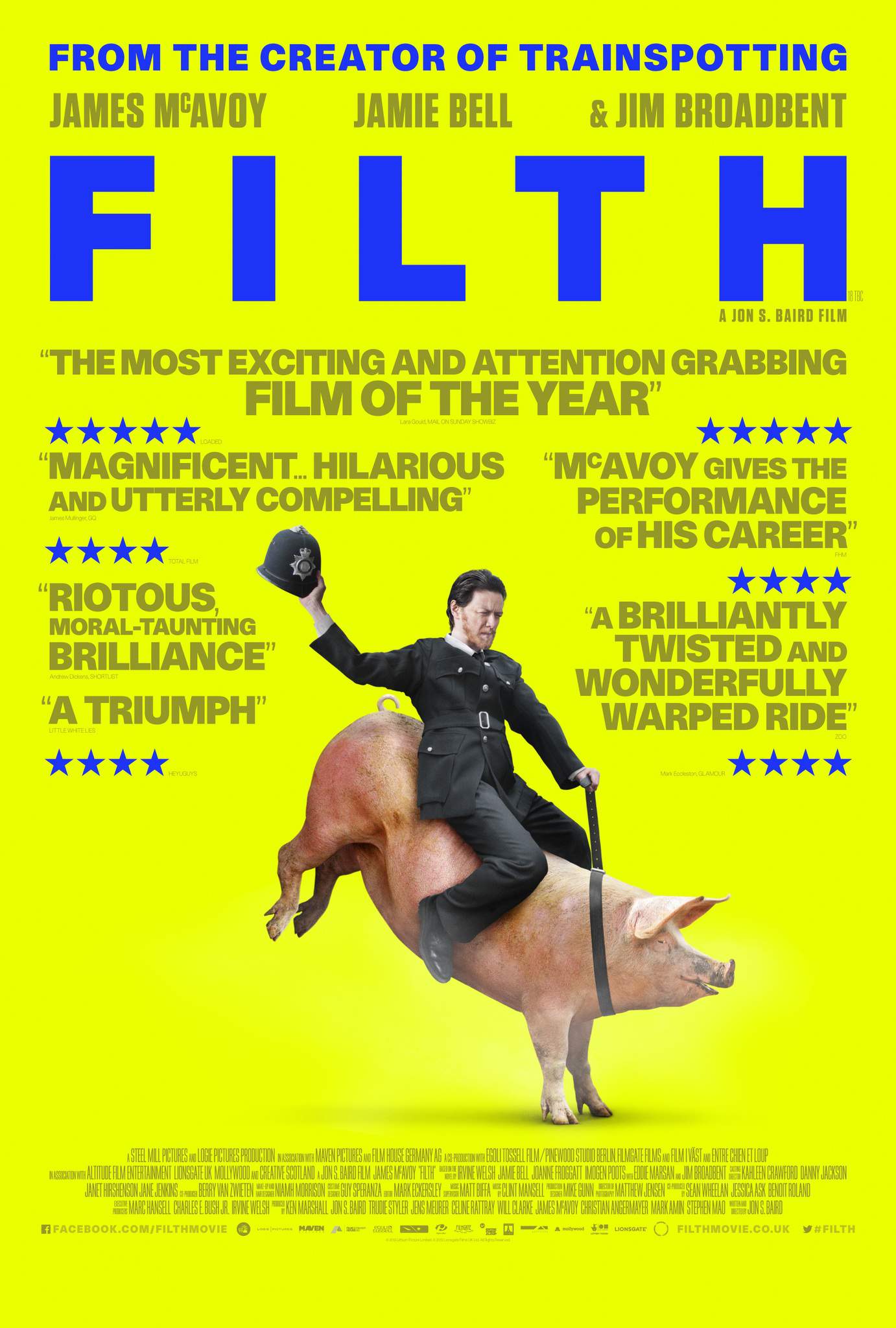
Filth (2014) movie poster

Timeline

Filth (2014) Timeline Explained – Every Event in Order

Release, runtime and language
2014 · 97 min · English
JustWatch #4,057 21
Directed by
Jon S. Baird

Driven by a desperate need for recognition and advancement, Detective Sergeant Bruce Robertson manipulates his colleagues and exploits a gruesome murder investigation. Employing sharp wit and calculated strategies, he attempts to outsmart his superiors and seize a coveted promotion. However, his ambition and flawed methods lead him down a dangerous path, blurring the lines between justice and personal gain.

On this page (7)
  1. 1 Where to watch
  2. 2 Events in order (15)
  3. 3 Timeline questions answered
  4. 4 The book behind the movie
  5. 5 Movie threads
  6. 6 Movies like Filth
  7. 7 Every angle

Where to watch

Where to Watch Filth (2014)

Where can you watch Filth? Stream, rent or buy it in the US, including on fuboTV, Hoopla and Kanopy: current JustWatch availability with up-to-date prices.

Streaming availability powered by JustWatch

15 events in order · contains spoilers

Filth Timeline: Events in Chronological Order

Every key event of Filth (2014) in order, scene by scene, with when and where it takes place. Use it to untangle flashbacks, time jumps and parallel storylines, to refresh your memory before the sequel or to find the exact scene you are thinking of.

  1. Introduction of Bruce Robertson

    Bruce Robertson, a Detective Sergeant in Edinburgh, is introduced as a manipulative character struggling with borderline personality disorder. He indulges in drugs, alcohol, and abusive relationships, hinting at his self-destructive lifestyle.

    Where
    Edinburgh, Scotland
  2. Robertson's Games and Bullying

    Robertson engages in 'the games', a term he uses to describe his foul plots against his workmates. He particularly targets his mild-mannered friend, Clifford Blades, by prank calling his wife, which adds to the chaos around him.

  3. Murder Investigation Assigned

    Robertson’s opportunity for promotion arises when he is assigned to investigate the murder of a Japanese student, believed to be a hate crime. This assignment could be the key to advancing his career as he aims to become a Detective Inspector.

    Where
    Edinburgh Police Department
  4. Robertson's Manipulation of Bunty

    Robertson manipulates Bunty, Clifford's wife, by advising her to indulge the pervert prank caller to help apprehend him. This creates a complicated dynamic as Robertson secretly enjoys her attention while exploiting her ignorance.

  5. Deteriorating Mental State

    As the investigation continues, Robertson's grip on reality weakens, leading to hallucinations and increased paranoia. His mental health issues intensify, revealing his troubled past and guilt over his brother's tragic death.

  6. Drug Use to Cope

    Determined to push through his investigation, Robertson continues using drugs, exacerbating his psychological problems. He also includes himself in the investigation while keeping Amanda Drummond, his colleague, out of the loop.

  7. Peter Inglis Exposed

    Robertson skillfully exposes Peter Inglis's sexual orientation, ensuring that Inglis's chances for promotion are sabotaged. This act reflects Robertson's unscrupulous tactics as he seeks to climb the ranks in his department.

  8. Robertson’s Broken Family

    It is revealed that Robertson's ex-wife, Carole, left him, denying him access to their daughter Stacey. This impact on his personal life fuels his obsession with the promotion he desperately seeks.

  9. Trip to England

    Robertson takes a drug and sex trip to England with Clifford, attempting to escape the mounting pressure of his professional and personal troubles. This escapade further highlights his reckless lifestyle.

    Where
    England
  10. Framing Clifford Blades

    In a desperate move, Robertson frames Clifford for the prank calls, leading to Clifford's arrest. This manipulation showcases Robertson's moral decline and his readiness to sacrifice relationships for personal gain.

  11. Peter Inglis' Suicide

    After being suspended from the force due to Robertson's machinations, Peter Inglis tragically commits suicide. This event underscores the devastating consequences of Robertson’s ruthless behavior.

  12. Robertson's Confrontation with Gorman

    Robertson is captured and brutally beaten by Gorman and his gang, who are linked to the murder case. In a moment of desperation, Robertson manages to kill Gorman by throwing him out a window.

  13. Consequences of Actions

    After the chaotic events, rather than receiving a promotion for his actions, Robertson is demoted to Constable. This twist reveals the ironic turn of fate as a rookie, Ray Lennox, is promoted instead.

  14. Final Apology

    Blades receives a tape of Robertson apologizing for his betrayals, reflecting Robertson's lingering remorse. This moment highlights the personal connections that Robertson has damaged throughout the film.

  15. Suicide Attempt

    Towards the end of the film, Robertson attempts suicide by hanging, overwhelmed by his guilt and failures. His moment is interrupted by a woman and her child knocking at his door, leading him to break the fourth wall and bring a darkly humorous end to his turmoil.

Last updated: May 12, 2025 at 07:04

Was this helpful?

Timeline questions answered

Filth Timeline Explained: Your Questions Answered

When does it happen, and why in that order? The questions people ask about the chronology of Filth (2014): time jumps, flashbacks, cause and effect between scenes and the correct order of events, each answered with spoilers.

Q1

Why does Bruce Robertson manipulate everyone around him?

Robertson manipulates colleagues to advance his career and satisfy his own needs because he has borderline personality disorder, which makes him emotionally unstable and self-destructive. His manipulation is driven by a desperate need for recognition and control, combined with his belief that everyone else is equally corrupt. He treats relationships as games where winning is the only thing that matters.

Foreshadowing: Early scenes show Robertson enjoying cruel pranks on coworkers, establishing his view of relationships as transactional.

  • Bruce Robertson
  • manipulation
  • borderline personality disorder
  • promotion
  • colleague games
Q2

What is the murder case Bruce Robertson investigates?

Robertson investigates the brutal murder of a Japanese student in Edinburgh, which police suspect is a hate crime committed by a group of white students. The case becomes his opportunity to earn a promotion to Detective Inspector, though he manipulates the investigation for personal gain rather than justice.

Foreshadowing: The murder investigation is introduced early as Robertson's path to advancement.

  • Japanese student murder
  • hate crime
  • investigation
  • promotion
Q3

Why does Bruce Robertson expose Peter Inglis?

Robertson exposes Peter Inglis's sexuality to sabotage his chances for the same promotion Robertson wants. Knowing the police department has prejudice against gay officers, Robertson uses this information as a calculated move to eliminate his main competitor, demonstrating his ruthless willingness to destroy others for career advancement.

Foreshadowing: Robertson's competitive dynamic with Peter is established early, with Robertson viewing him as a threat.

  • Peter Inglis
  • sexuality
  • promotion
  • sabotage
  • police department
Q4

What happens to Peter Inglis after being exposed?

After Robertson exposes Peter Inglis's sexuality, Peter is suspended from the force. The shame and professional destruction become unbearable, leading Peter to commit suicide. This tragedy underscores the devastating consequences of Robertson's ruthless manipulation.

Foreshadowing: The film's mounting pressure on Peter signals his deteriorating state before the tragic outcome.

  • Peter Inglis suicide
  • suspension
  • consequences
  • police prejudice
Q5

Why does Bruce Robertson frame Clifford Blades?

Robertson frames Clifford Blades as the prank caller after Clifford accidentally accompanies him to England, jeopardizing Robertson's plans. In retaliation, Robertson plants evidence to have Clifford arrested, sacrificing his friendship without remorse to protect his own interests and maintain his reputation.

Foreshadowing: Robertson's pattern of targeting Clifford throughout the film establishes his willingness to destroy him.

  • Clifford Blades
  • framing
  • prank calls
  • arrest
  • betrayal
Q6

What is Bruce Robertson's mental state throughout the film?

Robertson experiences escalating hallucinations and paranoia as the film progresses, eventually descending into full-blown insanity. His mental deterioration is fueled by drug use, guilt over his brother's death, and the collapse of his carefully constructed manipulation schemes. These surreal moments reveal his traumatic past.

Foreshadowing: Early hallucinations hint at Robertson's psychological fragility beneath his confident exterior.

  • hallucinations
  • mental illness
  • paranoia
  • drug use
  • insanity
Q7

What is the revelation about Bruce Robertson's past?

Through conversations with Dr. Rossi, Robertson reveals he carries intense guilt over a childhood incident that caused his younger brother's death. This traumatic memory haunts him throughout the film, contributing to his self-destructive behavior and mental breakdown, though the full details remain somewhat ambiguous.

Foreshadowing: Robertson's hallucinations increasingly feature memories that hint at this childhood tragedy.

  • brother death
  • childhood trauma
  • guilt
  • Dr. Rossi
  • past
Q8

Why does Bruce Robertson kill Gorman?

Robertson kills Gorman, the Neo-Nazi gang leader responsible for the Japanese student's murder, during a brutal confrontation. After being captured and beaten by Gorman's gang, Robertson pushes Gorman out a window in a desperate act of survival. This violent act is one of the few moments Robertson acts courageously, though it comes too late to save his career.

Foreshadowing: Robertson's investigation gradually connects Gorman to the murder case.

  • Gorman
  • Neo-Nazi
  • murder
  • killing
  • self-defense
  • window
Q9

What happens to Bruce Robertson at the end of the film?

Rather than receiving the promotion he desperately wanted, Robertson is demoted to Constable and reassigned to uniform duties. His career is destroyed, his relationships are ruined, and he ends up preparing to commit suicide. The irony is complete when rookie Ray Lennox gets promoted to Detective Inspector instead.

Foreshadowing: Robertson's escalating mistakes throughout the investigation foreshadow his ultimate downfall.

  • demotion
  • promotion
  • Constable
  • Ray Lennox
  • career end
Q10

What does the ending of Filth mean?

The ending shows Robertson attempting suicide but being interrupted by a woman and her child. He then breaks the fourth wall, delivering his catchphrase "Same rules apply" while the chair collapses beneath him. This darkly comedic conclusion suggests Robertson remains unchanged, still viewing life as a game he can't win, with his ultimate fate left ambiguously humorous rather than definitively tragic.

Foreshadowing: The film's consistent dark humor and Robertson's self-aware narration set up this meta conclusion.

  • fourth wall
  • suicide attempt
  • same rules apply
  • ending
  • dark comedy

Movie threads

More Movies Like Filth, by Mood & Story

Curated lists built around what makes Filth tick: the same mood, the same kind of story or the same emotional payoff. Each list explains why these movies belong together.

Dark character studies of mental collapse like in Filth

Intense psychological journeys into the collapse of a fractured mind. If you were captivated by the raw and unsettling portrayal of Bruce Robertson's descent in Filth, this collection features similar movies about characters spiraling into madness. These films share a high intensity, dark tone, and complex narratives that explore the grim realities of mental breakdown, addiction, and trauma.

  • self-destructive
  • unsettling
  • psychological
  • chaotic
  • oppressive
  • tragic
  • Tone: dark, unsettling, tragic
  • Pacing: fast, frenetic, chaotic
Why these movies?

The story pattern: The narrative pattern follows a deeply flawed protagonist on a downward spiral. The story structure often becomes nonlinear or incorporates surreal elements to reflect their deteriorating mental state. The central conflict is internal, pitting the character against their own psyche, with external events serving as catalysts for their ultimate collapse.

Why they belong together: These movies are grouped together because they prioritize a harrowing, character-driven experience centered on psychological decay. They share a high emotional weight, bleak outlook, and an unflinching, often chaotic approach to depicting mental illness, making for a deeply immersive and disturbing viewing journey.

Gritty crime thrillers about corruption like Filth

Stories where ambition in a broken world leads to absolute corruption. For viewers who enjoyed the depiction of police corruption and toxic ambition in Filth, this list highlights similar movies with fast-paced, complex plots set in morally bankrupt worlds. These gritty stories often feature anti-heroes whose ruthless pursuit of power leads to their own downfall amidst a backdrop of institutional decay.

  • gritty
  • cynical
  • tense
  • corrupt
  • manipulative
  • oppressive
  • Tone: dark, gritty, cynical
  • Pacing: fast, tense, intricate
Why these movies?

The story pattern: The plot typically revolves around a high-stakes goal within a competitive, dysfunctional system. The protagonist manipulates colleagues and exploits situations, believing their methods are justified. However, their actions create a web of consequences that inevitably tightens around them, leading to isolation, demotion, or ruin, highlighting the self-defeating nature of their ambition.

Why they belong together: These films are connected by their exploration of ambition within corrupt systems. They share a gritty, oppressive mood, fast pacing driven by manipulative schemes, and a complex narrative structure involving multiple characters and subplots. The tone is consistently dark, focusing on the toxic intersection of personal flaws and institutional failure.

If you liked this

Movies Like Filth

Similar movies to Filth: the same genre, themes or kind of story. Each one comes with its own plot summary, timeline and ending explained.

Browse all movie summaries

Every angle

Filth (2014) Explained: Plot, Timeline & Characters

Everything about Filth in one place: what happens in the plot summary, the timeline in chronological order, the characters and meaning and a spoiler-free summary. What's After the Movie adds the cast, box office and post-credit scenes.

Coming soon on iOS and Android

The Plot Explained Movie Summary App

Plot summaries, endings explained and timelines on your phone. Catch up on any movie in minutes, save your favorites and never miss a twist again.

Be the first to know when we launch. Your email stays private, always.

Learn more about the app