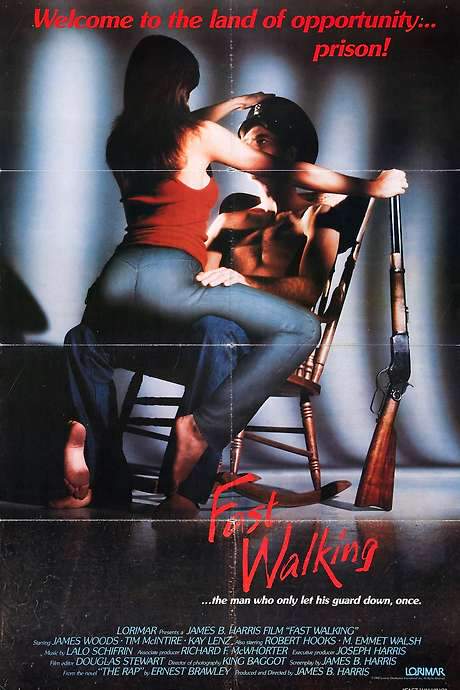
James Woods as Frank Miniver, also known as Fast-Walking, is a corrupt but lovable Oregon state prison guard. He smokes, peddles marijuana, and supplements his meager salary by running prostitutes for Mexican laborers out of his cousin Evie's convenience store, where Evie (played by Susan Tyrrell) helps keep the operation humming.
At work, he stays in close contact with Wasco, his other cousin who is incarcerated and deeply embedded in vice, both inside and outside the prison. Tim McIntire as Wasco peddles women and narcotics and even dreams of pulling off fraudulent banking schemes. He tries to force a rival, Bullet, into surrendering in-prison operations to Wasco, tightening his grip on the underground network. Bullet (portrayed by Timothy Carey) is the bold, dangerous competitor whom Wasco seeks to overtly outmaneuver.
An outside accomplice to Wasco is Moke, a striking young woman who does Wasco’s bidding and doesn’t shy away from using her wiles to influence the inside game. Kay Lenz plays Moke, a key player who even seduces Fast-Walking to serve the larger scheme.
Into the tense, racially charged environment of the prison arrives Galliot, a black political prisoner who becomes a focal point of Wasco’s lethal plotting. Robert Hooks takes on the role of William Galliot, whose presence sparks a dangerous chain of moves. Wasco hatches a plan to have Galliot killed, a scheme that sets off a volatile sequence of avoidances and confrontations within the prison’s walls.
Fast-Walking responds by arranging to have Galliot sprung from the facility, drawn by the lure of a half-whispered reward—$50,000 and a secret key tucked away in a belt buckle that supposedly opens a safe-deposit box. The offer injects a tantalizing but perilous motive into the already precarious web of loyalties and betrayals.
As the plot thickens, Wasco discovers the intense relationship between Fast-Walking and Moke and feels jealousy flare up, turning fear into a new kind of threat. He masterminds a scheme to enlist Moke in killing Galliot, a plan that unfolds with chilling precision: Moke fires a high-powered rifle, catching Galliot as he fumbles his escape—dressed as a prison guard, yet suddenly vulnerable to the consequences of the plan. The moment underscores how quickly power, sex, money, and survival blur into a single, dangerous game.
In the aftermath, the balance of power shifts once more as Fast-Walking confronts the consequences of the players’ choices. The story closes on a note that echoes the old adage that what goes around, comes around, leaving a stark reminder that debts—whether paid in cash, violence, or deception—do not fade away. Throughout, the film paints a raw portrait of ambition, corruption, loyalty, and the high price of crossing lines that were never meant to be crossed.