





Plot Explained Spoilers guaranteed!
Plot Explained

Browse by genre

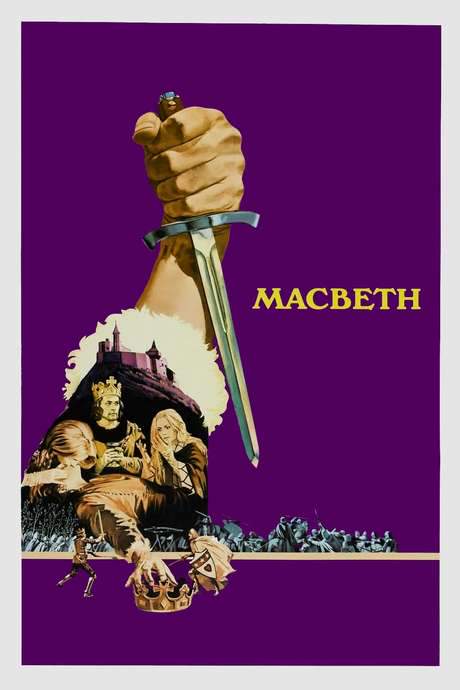
Macbeth (1971) movie poster

Timeline

Macbeth (1971) Timeline Explained – Every Event in Order

Release, runtime and language
1971 · 141 mins · English
Directed by
Roman Polanski
Starring
John Stride, Jon Finch, Terence Bayler, Martin Shaw, Richard Pearson, Sydney Bromley

Set in 11th‑century Scotland, Macbeth, a war‑lord praised for his bravery, is spurred by a prophecy delivered by three witches and the relentless ambition of his wife. Overcome by doubt, he murders his sovereign and betrays comrades, plunging into a ruthless cycle of bloodshed, crime and suspicion.

On this page (6)
  1. 1 Where to watch
  2. 2 Events in order (15)
  3. 3 Timeline questions answered
  4. 4 Movie threads
  5. 5 Movies like Macbeth
  6. 6 Every angle

Where to watch

Where to Watch Macbeth (1971)

Where can you watch Macbeth? Stream, rent or buy it in the US, including on Amazon Video, Apple TV Store and Fandango At Home: current JustWatch availability with up-to-date prices.

Streaming availability powered by JustWatch

15 events in order · contains spoilers

Macbeth Timeline: Events in Chronological Order

Every key event of Macbeth (1971) in order, scene by scene, with when and where it takes place. Use it to untangle flashbacks, time jumps and parallel storylines, to refresh your memory before the sequel or to find the exact scene you are thinking of.

  1. Invasion repelled by Macbeth and Banquo

    A Norwegian and Irish invasion aided by a traitorous Thane of Cawdor is repelled by Macbeth and Banquo. The victory raises Macbeth's standing among the Scottish nobles and begins to push his ambitions toward the throne. The immediate threat to Duncan's rule starts to shift as power consolidates around Macbeth.

    Where
    Scotland (battlefield)
  2. Duncan names Macbeth Thane of Cawdor

    Duncan sentences the traitor Cawdor to death and awards Macbeth the title Thane of Cawdor. The decision elevates Macbeth's status at court, even though he and Banquo do not yet hear the news. The prophecy's lure grows stronger as opportunities to act present themselves.

    Where
    King's camp/court
  3. Macbeth and Banquo meet the Three Witches

    On the road after the battle, Macbeth and Banquo encounter Three Witches who hail Macbeth as Thane of Cawdor and future king, and declare Banquo will be 'lesser' and 'greater'. The encounter stirs ambition and fear, planting the seeds for the upcoming choices. The prophecy sets the course for the drama to unfold.

    Where
    Road outside the camp
  4. Nobles inform Macbeth of his new title

    Back at the camp, nobles inform Macbeth that he has been named Thane of Cawdor, filling him with awe and fear about the prospect of seizing Duncan's throne. Banquo watches the developments with cautious curiosity as the prophecy takes on a personal dimension.

    Where
    Camp near Macbeth's castle
  5. Macbeth writes to Lady Macbeth

    Macbeth writes a letter to Lady Macbeth detailing the witches' prophecy and his new title. Lady Macbeth responds with delight but also fears that her husband lacks ruthlessness, and she resolves to push him toward action.

    Where
    Macbeth's castle
  6. Duncan names Malcolm Prince of Cumberland

    Duncan proclaims Malcolm as heir and Prince of Cumberland, making him the next king in line. Macbeth is unsettled by this obstacle and Banquo remains wary of the prophecy's implications. The monarch's decision intensifies the tension surrounding Macbeth's future plans.

    Where
    Duncan's court
  7. Royal visit at Macbeth's castle

    That night, the royal party stays at Macbeth's castle and is greeted by Lady Macbeth with practiced warmth. Her hospitality masks a ruthless plan to secure the throne as she manipulates those around them.

    When
    night
    Where
    Macbeth's castle
  8. Duncan murdered by Macbeth

    Urged by Lady Macbeth, Macbeth enters Duncan's chamber after drugging the guards. Duncan awakens briefly and unknowingly names Macbeth, who then stabs him, killing the king. Macbeth frames the guards for the murder and then murders them when Duncan's corpse is discovered.

    When
    night
    Where
    Duncan's chamber, Macbeth's castle
  9. Malcolm and Donalbain flee; Macbeth's kingship anticipated

    Fearing a conspiracy, Malcolm and Donalbain flee to England and Ireland to preserve themselves. The Thane of Ross realizes that Macbeth's future as king is now a reality, even if it unsettles the realm.

    Where
    Scotland
  10. Coronation and risks at Scone; Macduff heads to Fife

    A courtier hails Macbeth as king at Scone, and Macduff heads back to his home in Fife, wary of Macbeth's power. The consolidation of power continues as factions form across Scotland.

    Where
    Scone; Fife
  11. Banquo’s murder plot and execution

    To secure his throne, Macbeth orders Banquo and his son Fleance killed, hiring two murderers and using Ross as the Third Murderer. The attempt succeeds against Banquo but Fleance escapes, leaving Macbeth in increasing fear of the prophecy’s threat.

    Where
    Scotland (near castle)
  12. Banquo’s ghost and the witches’ deception

    At a royal banquet, Banquo's ghost haunts Macbeth, triggering fear and a crisis of control. He seeks out the witches again, who perform a ritual that convinces him of invincibility and reinforces the prophecy that he cannot be defeated until Birnam Wood comes to Dunsinane.

    When
    night
    Where
    Macbeth's castle (banquet hall)
  13. Ross and the fall of Lady Macduff

    Ross travels to Fife to coordinate resistance against Macbeth, but leaves the doors of the castle ajar for Macbeth's killers. In Fife, Lady Macduff and her children are slain by the murderers, illustrating the brutal reach of Macbeth's rule.

    Where
    Fife; castle
  14. Invasion by English forces and Birnam Wood

    English forces, led by Malcolm and Siward, invade Scotland and march on Dunsinane, using branches from Birnam Wood to camouflage their numbers. The united front poses the final challenge to Macbeth's grip on the throne.

    Where
    Dunsinane; Birnam Wood
  15. Macbeth defeated and Malcolm crowned

    In a final duel, Macduff reveals he was delivered by Caesarean section and defeats Macbeth, who is beheaded. Malcolm is proclaimed King of Scotland, and order begins to return to the realm as the witches’ influence lingers over the throne.

    When
    final confrontation
    Where
    Dunsinane

Last updated: December 04, 2025 at 15:33

Was this helpful?

Timeline questions answered

Macbeth Timeline Explained: Your Questions Answered

When does it happen, and why in that order? The questions people ask about the chronology of Macbeth (1971): time jumps, flashbacks, cause and effect between scenes and the correct order of events, each answered with spoilers.

Q1

Why does Macbeth kill King Duncan?

Macbeth kills Duncan after the witches prophecy names him future king and Duncan names his son Malcolm as heir, creating an obstacle to the throne. Lady Macbeth urges him to act, and when Duncan stays at their castle, they seize the opportunity to murder him and frame the guards. The prophecy and his wife's relentless ambition combine to overcome his initial doubts.

Foreshadowing: The witches' prophecy first sparks Macbeth's ambition when they hail him as Thane of Cawdor and future king.

  • duncan murder
  • regicide
  • lady macbeth influence
  • three witches prophecy
Q2

Why does Lady Macbeth push Macbeth toward murder?

Lady Macbeth fears her husband lacks the ruthlessness needed to seize power, stating that he is 'too full o' the milk of human kindness' to act. She resolves to steel herself to cruelty and push him toward killing Duncan, believing the throne is their rightful destiny. Her ambition matches or exceeds his own.

Foreshadowing: Lady Macbeth's initial scene shows her reading Macbeth's letter and immediately plotting how to make him king.

  • lady macbeth ambition
  • macbeth weakness
  • push toward murder
  • marriage dynamics
Q3

Why does Macbeth arrange Banquo's murder?

Macbeth orders Banquo and his son Fleance killed because the witches prophesied that Banquo's descendants would become kings, while Macbeth himself would have no heirs. Fearing this threat to his unstable throne, Macbeth hires murderers to eliminate Banquo, though Fleance escapes.

Foreshadowing: After becoming king, Macbeth recalls the witches' prophecy about Banquo and becomes paranoid about his lineage.

  • banquo murder
  • fleance escape
  • witches prophecy
  • macbeth paranoia
Q4

Why does Fleance escape the murder plot?

Fleance escapes because one of the murderers is separated from the others during the attack, allowing Fleance to flee into the night. His escape is crucial because the witches prophesied that Banquo's line would produce future kings, making his survival a direct threat to Macbeth's rule.

Foreshadowing: The murder plot deliberately targets both Banquo and Fleance to prevent the prophecy from coming true.

  • fleance escape
  • banquo son
  • witches prophecy fulfillment
  • macbeth threat
Q5

Why does the English army march with branches from Birnam Wood?

The English army, led by Malcolm and Siward, uses branches from Birnam Wood to camouflage their numbers as they advance on Dunsinane. This fulfills the witches' prophecy that Macbeth cannot be defeated 'till Birnam Wood comes to Dunsinane.' The living forest literally moves toward the castle.

Foreshadowing: The witches explicitly warn Macbeth that he cannot be harmed until Birnam Wood moves to Dunsinane.

  • birnam wood
  • dunsinane
  • witches prophecy
  • english invasion
  • macbeth invincibility
Q6

Why can Macduff defeat Macbeth when others cannot?

Macduff defeats Macbeth because he was delivered by Caesarean section, making him 'not of woman born' in the traditional sense. The witches had prophesied that Macbeth cannot be harmed by any man 'of woman born,' creating a loophole Macduff exploits in their final duel.

Foreshadowing: The witches' equivocal prophecy gives Macbeth false confidence in his invincibility.

  • macduff birth
  • caesarean section
  • not of woman born
  • witches prophecy loophole
Q7

Why do Malcolm and Donalbain flee after Duncan's murder?

Malcolm and Donalbain flee Scotland because they fear for their lives, suspecting the murder may be a conspiracy to eliminate the royal line. Their fleeing casts suspicion on them and inadvertently makes Macbeth appear innocent, while they seek safety in England and Ireland to preserve themselves.

Foreshadowing: Before the murder, Lady Macbeth notes that Duncan's sons would be suspected if anything happened to their father.

  • malcolm fled
  • donalbain fled
  • duncan sons
  • suspicion
  • succession crisis
Q8

Why does Ross serve as the Third Murderer in Banquo's killing?

Ross appears as the third murderer in the plot against Banquo, though his exact motivation remains ambiguous in the film. He later travels to Macduff's castle and leaves the doors ajar, allowing Macbeth's killers to enter, demonstrating his shift from courtly ally to complicit facilitator in Macbeth's atrocities.

Foreshadowing: Ross's initial role as a noble who delivers news makes his betrayal more striking.

  • ross betrayal
  • third murderer
  • macduff family killed
  • noble court
Q9

Why does Lady Macbeth descend into madness?

Lady Macbeth succumbs to guilt and madness from her involvement in Duncan's murder and the subsequent bloodshed. Her mental state deteriorates as the consequences of their actions escalate, and she becomes increasingly consumed by the psychological weight of their crimes, eventually breaking down completely.

Foreshadowing: Early hints of Lady Macbeth's psychological fragility appear in her sleepwalking scene and obsessive hand-washing.

  • lady macbeth madness
  • guilt
  • sleepwalking
  • psychological breakdown
Q10

Why do the witches' prophecies control Macbeth's actions?

The witches' prophecies control Macbeth because the first prophecy immediately comes true, the Thane of Cawdor is executed and Macbeth receives the title. This confirmation makes him believe his destiny is predetermined, emboldening him to seize the throne. However, the prophecies are deliberately equivocal and deceptive, leading Macbeth to misinterpret them as guarantees of safety.

Foreshadowing: The very first encounter proves the prophecy correct when Macbeth is named Thane of Cawdor.

  • three witches
  • prophecy
  • fate versus choice
  • macbeth downfall
  • equivocation
Q11

Why does Macduff leave his wife and children vulnerable?

Macduff travels to England to join Malcolm and gather forces against Macbeth, leaving his family in Fife. While this leaves them vulnerable to Macbeth's revenge, Macduff's departure serves the larger cause of overthrowing the tyrant. His family pays the ultimate price when Macbeth orders their murder.

Foreshadowing: Macduff's departure is framed as necessary for the resistance, though it proves fatal for his household.

  • macduff family
  • fife
  • macbeth revenge
  • resistance against tyranny
Q12

Why does Macbeth lose control of his kingdom?

Macbeth loses control because his tyrannical rule and widespread murders alienate the Scottish nobles. As Macduff and Malcolm gather English support and march on Dunsinane, the nobles desert Macbeth. His paranoia and violence create the very rebellion he tried to prevent, ultimately leading to his isolation and defeat.

Foreshadowing: The gradual desertion of Scottish nobles mirrors the escalating violence of Macbeth's reign.

  • macbeth tyranny
  • noble rebellion
  • macbeth isolation
  • downfall
  • scotland lost

Movie threads

More Movies Like Macbeth, by Mood & Story

Curated lists built around what makes Macbeth tick: the same mood, the same kind of story or the same emotional payoff. Each list explains why these movies belong together.

Tales of Ambition and Downfall like Macbeth

Stories where a protagonist's ruthless drive leads to moral decay and inevitable ruin. For viewers who appreciated the fatalistic drive in Macbeth, this section collects movies like it. These stories explore similar themes of ambition and corruption, featuring protagonists whose moral collapse and psychological torment lead to a tragic ending, perfect for fans of intense, character-driven dramas.

  • ambitious
  • fatalistic
  • paranoid
  • somber
  • unsettled
  • violent
  • Tone: dark, tragic, fatalistic
  • Pacing: steady, methodical
Why these movies?

The story pattern: The narrative follows a clear, downward arc: a prophecy or opportunity ignites ambition, leading to a pivotal moral transgression (like regicide). This act triggers a chain of paranoia, further violence, and betrayal, isolating the protagonist until their inevitable, often violent, demise.

Why they belong together: Movies in this thread share a core narrative structure of a rise-and-fall driven by ambition. They create a coherent experience through their dark tone, heavy emotional weight, and bleak endings, focusing on the psychological cost of power and the inescapable nature of a self-made fate.


Psychological Thrillers with Paranoid Atmospheres like Macbeth

Films that build a claustrophobic atmosphere of dread as a character's sanity unravels. If you liked the oppressive, paranoid feeling in Macbeth, this section finds similar movies. These films share a dark, steady-paced vibe where a character's guilt and ambition create a suffocating sense of dread, perfect for those seeking psychologically intense and unsettling stories.

  • oppressive
  • paranoid
  • unsettled
  • somber
  • psychological
  • claustrophobic
  • Tone: dark, unsettling, oppressive
  • Pacing: steady, slow burn
Why these movies?

The story pattern: These stories often begin with a destabilizing event that seeds doubt. The protagonist becomes increasingly isolated and suspicious, perceiving threats everywhere. The narrative unfolds through their distorted perspective, emphasizing ghostly visions, real or imagined betrayals, and a growing chasm between their public front and private torment.

Why they belong together: These films are grouped by their shared, oppressive mood and psychological focus. The coherence comes from a consistent dark tone, high tension, and a pacing that methodically builds unease. They prioritize the internal experience of paranoia and guilt over external action, creating a specific, intense vibe.

If you liked this

Movies Like Macbeth

Similar movies to Macbeth: the same genre, themes or kind of story. Each one comes with its own plot summary, timeline and ending explained.

Browse all movie summaries

Every angle

Macbeth (1971) Explained: Plot, Timeline & Characters

Everything about Macbeth in one place: what happens in the plot summary, the timeline in chronological order, the characters and meaning and a spoiler-free summary. What's After the Movie adds the cast, box office and post-credit scenes.

Coming soon on iOS and Android

The Plot Explained Movie Summary App

Plot summaries, endings explained and timelines on your phone. Catch up on any movie in minutes, save your favorites and never miss a twist again.

Be the first to know when we launch. Your email stays private, always.

Learn more about the app