Plot Explained Spoilers guaranteed!
Plot Explained

Browse by genre

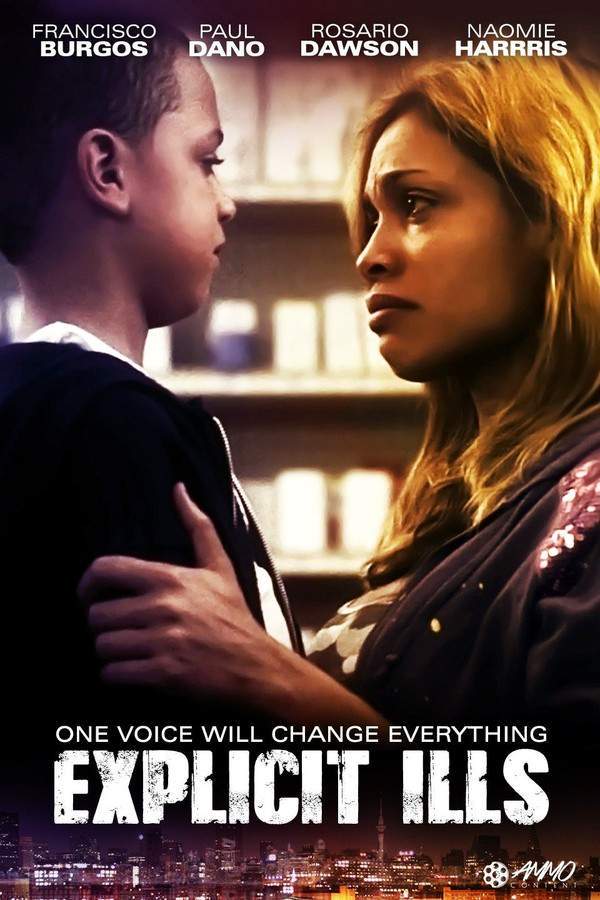
Explicit Ills (2009) movie poster

Plot Summary

Explicit Ills (2009) Plot Summary Explained

Release, runtime and language
2009 · 87 min · English

In the gritty Philadelphia underworld, the lives of several individuals become intertwined. Babo, a young man battling asthma, grows up in a challenging neighborhood with his mother and their eccentric neighbor Demitri, who harbors unusual ambitions. Nearby, Jill grapples with marital problems while her teenage son becomes increasingly focused on achieving a perfect physique. The narrative explores their struggles and unexpected connections within this complex urban landscape.

On this page (6)
  1. 1 Where to watch
  2. 2 What happens: full plot
  3. 3 Plot questions answered
  4. 4 Movie threads
  5. 5 Movies like Explicit Ills
  6. 6 Every angle

Where to watch

Where to Watch Explicit Ills (2009)

Where can you watch Explicit Ills? Stream, rent or buy it in the US, including on Amazon Prime Video, Fawesome and Hoopla: current JustWatch availability with up-to-date prices.

Streaming availability powered by JustWatch

Full plot summary · contains spoilers

What Happens in Explicit Ills: Full Plot Summary

The whole story of Explicit Ills (2009) explained, from the opening scene to the final frame: every key event, every twist and what it all adds up to. Read it as a quick recap before the sequel, to check a scene you missed, or to finally understand what really happened.

Jim Jarmusch serves as the executive producer for the deeply moving drama Explicit ILLS, which marks the impressive directorial debut of actor Mark Webber, known for his roles in The Hottest State and Storytelling. In this film, we are transported to a gritty and often overlooked Philadelphia, a city far removed from the lighthearted comedies typically showcased. Here, the local residents grapple with the stark realities of life, facing challenges such as poverty and hardship, but amidst this struggle, the film carries a potent message of hope.

Having gained recognition as an accomplished indie actor, Webber's script vividly captures a diverse array of characters as they navigate their lives during an unforgettable summer. For example, we meet Michelle (played by Frankie Shaw) and Jacob (Lou Taylor Pucci), aspiring artists whose dreams are overshadowed by the grip of drug addiction. Meanwhile, Jill (Naomie Harris) and Kaleef (Tariq Trotter) represent the idea of spiritual well-being, albeit while facing precarious financial straits as parents to their son Heslin (Ross K. Kim-McManus).

Among the neighborhood's diverse residents is the asthmatic Babo (played by Francisco Burgos), who is watched over by his protective mother, portrayed by Rosario Dawson. Then there’s young Demetri (Martin Cepeda), a teenager who must learn to temper his bravado to win the affections of the girl he dreams about. Finally, Rocco (Paul Dano) is an aspiring actor who struggles daily to forge his path amidst overwhelming challenges.

Webber employs a unique visual style for each narrative thread, creating a synthetic, video-game-like surreality for the young lovers consumed by their drug-related escapades. In contrast, the domestic life of Jill and Kaleef is portrayed with a precise and measured aesthetic, while Babo’s story is infused with a nostalgic, aged tint that evokes a sense of innocence. Crucially, Webber refrains from forcing connections between his characters, which heightens the emotional impact of the film's conclusion.

As these varied lives converge during a communal march advocating for affordable universal health care, Explicit ILLS ultimately reveals its core message in a manner that feels authentic rather than preachy. The film does an exceptional job of highlighting the complexities of life in Philadelphia, encouraging viewers to consider the pressing issues faced by its residents with compassion and understanding.

Last updated: May 13, 2025 at 20:30

Was this helpful?

Plot questions answered

Explicit Ills Plot Explained: Your Questions Answered

The questions people ask most about Explicit Ills (2009): what happens in the confusing scenes, why the characters do what they do, the twists, hidden details and what the ending means. Each answer contains spoilers.

Q1

Why don't the characters' storylines intersect until the final scene?

The film's director Mark Webber intentionally keeps the characters' stories separate throughout most of the movie. Each character's narrative uses a distinct visual style, Michelle and Jacob's storyline has a synthetic, video-game-like quality, while Jill and Kaleef's life is portrayed with precise, measured aesthetics. This separation allows the film to explore each character's individual struggles with poverty, addiction, and financial hardship before bringing them together at the health care march, making their eventual convergence more emotionally impactful.

Foreshadowing: Early scenes establish each character's isolated struggles, from Babo's asthma to Rocco's acting dreams, setting up the eventual collective action.

  • character arcs
  • intersection
  • visual storytelling
  • independent storylines
Q2

Why does the health care march serve as the climax?

The health care march becomes the climax because it represents the first time all the separate characters come together for a shared cause. For characters like Jill and Kaleef, who face financial precarity while raising their son Heslin, universal health care is a pressing personal issue. The march transforms individual struggles into collective action, allowing the film to deliver its message of hope and solidarity without feeling preachy.

Foreshadowing: The earlier introduction of Jill and Kaleef's financial struggles and Babo's asthma medical needs hint at why health care matters deeply to this community.

  • health care march
  • climax
  • solidarity
  • community action
  • universal health care
Q3

Why does the film use different visual styles for each character's story?

Director Mark Webber uses distinct visual treatments to reflect the unique emotional states and themes of each storyline. Michelle and Jacob's drug-induced escapades are portrayed with a synthetic, video-game-like surreality, emphasizing how addiction distorts their perception of reality. Jill and Kaleef's domestic scenes use precise, measured cinematography to convey their struggle to maintain stability. Babo's storyline receives a nostalgic, aged tint that evokes innocence and vulnerability. These stylistic choices help viewers emotionally connect with each character's distinct experience.

Foreshadowing: The visual differentiation begins early, with the first introductions of each character establishing their unique visual tone.

  • visual style
  • cinematography
  • directorial choices
  • character themes
Q4

What drives Demetri's behavior throughout the film?

Demetri, the teenager who must learn to temper his bravado, is driven by his desire to win the affections of a girl he dreams about. His journey illustrates the complexities of adolescent identity and romantic pursuit within the tough backdrop of his Philadelphia neighborhood. The film shows him wrestling with masculine identity as he attempts to prove himself worthy of her attention.

Foreshadowing: Demetri's introduction establishes his romantic obsession, which becomes the catalyst for his character development.

  • Demetri
  • adolescent romance
  • masculinity
  • character motivation
Q5

How does drug addiction affect Michelle and Jacob's relationship?

Michelle and Jacob, both aspiring artists, see their dreams derailed by drug abuse. Their addiction creates a cycle of escapism that overshadows their artistic aspirations. The video-game-like visual style applied to their storyline emphasizes the distorted, surreal nature of their drug-induced experiences, showing how substance abuse consumes their lives and pulls them away from their goals.

Foreshadowing: Their introduction immediately establishes their artistic ambitions alongside the presence of drug-related temptations.

  • drug addiction
  • Michelle
  • Jacob
  • aspiring artists
  • relationship decay
Q6

Why is Babo's asthma important to the story?

Babo's asthma serves as a symbol of vulnerability within the harsh urban environment of Philadelphia. His condition requires constant care from his protective mother, highlighting the additional health challenges faced by families in low-income neighborhoods. The medical needs associated with asthma also connects to the film's larger theme of health care access, making Babo's condition thematically relevant to the communal march for universal health care.

Foreshadowing: Babo's introduction establishes his health vulnerability early, positioning it as a recurring concern throughout the narrative.

  • Babo
  • asthma
  • health vulnerability
  • medical needs
  • urban hardship
Q7

Why does the film end on a hopeful note despite its heavy themes?

The film maintains a hopeful tone because it focuses on community resilience and collective action rather than solely on suffering. While the characters face poverty, addiction, and financial hardship, their participation in the health care march demonstrates solidarity and the possibility of change. The summary explicitly describes the film as carrying a 'potent message of hope' that feels authentic rather than preachy, using the communal march to show people coming together to address shared challenges.

Foreshadowing: Even in early scenes showing individual struggles, there's an underlying sense of connection between neighbors that builds toward the final convergence.

  • hopeful ending
  • community resilience
  • collective action
  • social change
Q8

What thematic element unifies the separate storylines?

All the storylines are unified by the shared theme of struggling against adversity in Philadelphia's gritty urban environment. Whether it's financial instability, addiction, health challenges, or blocked dreams, each character faces their own hardship. The film explores how people navigate poverty and hardship while maintaining hope, with the universal health care march serving as the thematic convergence point where these individual struggles become a collective demand for change.

Foreshadowing: The opening scenes establish Philadelphia's harsh reality as the common foundation for all characters' journeys.

  • thematic unity
  • shared hardship
  • Philadelphia
  • urban struggle
  • common themes
Q9

What does the title Explicit Ills refer to?

The title 'Explicit Ills' refers to the film's direct engagement with the explicit ailments, both physical and social, that affect the characters. These include Babo's asthma, the financial illnesses afflicting Jill and Kaleef, the addiction plaguing Michelle and Jacob, and the broader systemic ill of inadequate health care access. The title suggests the film is openly addressing these problems rather than hiding them, matching the film's approach of showing the harsh realities of Philadelphia life while offering a path toward collective healing through the march.

Foreshadowing: The title is introduced early, reflecting the film's commitment to showing problems openly throughout the narrative.

  • title meaning
  • explicit illness
  • social commentary
  • health care access
Q10

What does Rocco's acting ambition represent in the film?

Rocco, the aspiring actor portrayed by Paul Dano, represents the theme of ambition amid overwhelming challenges. His daily struggle to forge his path in a world that feels indifferent to his dreams embodies the broader theme of perseverance that runs through all the character storylines. While his storyline may seem separate from the main conflicts, it reinforces the film's exploration of how people in difficult circumstances pursue their passions despite systemic obstacles.

Foreshadowing: Rocco's introduction establishes his determination early, showing his refusal to abandon his dreams despite the harsh environment.

  • Rocco
  • acting ambition
  • perseverance
  • dreams
  • adversity

Movie threads

More Movies Like Explicit Ills, by Mood & Story

Curated lists built around what makes Explicit Ills tick: the same mood, the same kind of story or the same emotional payoff. Each list explains why these movies belong together.

Interconnected urban dramas like Explicit Ills

Multiple lives intertwine within a single, complex urban landscape. For viewers who enjoyed the multi-strand narrative of Explicit Ills, this section features movies like it that weave together separate lives within a single city. Discover similar complex dramas where individual stories create a powerful, collective portrait of urban struggle and community.

  • urban
  • reflective
  • compassionate
  • interconnected
  • gritty
  • hopeful
  • Tone: reflective, compassionate, hopeful
  • Pacing: variable, character-driven
Why these movies?

The story pattern: Stories in this thread follow a mosaic structure, introducing a set of distinct characters whose lives unfold in parallel. The plot doesn't focus on a single protagonist but on the emerging connections and shared environment, often culminating in a moment that brings the disparate threads together thematically or physically.

Why they belong together: Movies are grouped here for their shared narrative architecture of interconnected lives and their deep focus on a specific urban setting as a character itself. They share a compassionate, observational tone that finds meaning in the everyday struggles and connections of a community.

Movies with gritty hopefulness like Explicit Ills

Stories that find light and resilience amidst heavy, realistic struggles. If you liked how Explicit Ills balanced heavy themes with a potent message of hope, explore these similar films. Find dramas that tackle tough subjects with a compassionate lens, ultimately leaving you with a feeling of resilience and optimism rather than despair.

  • hopeful
  • gritty
  • compassionate
  • melancholic
  • resilient
  • urban struggle
  • Tone: hopeful, compassionate, melancholic
  • Pacing: steady, reflective
Why these movies?

The story pattern: The narrative pattern involves characters facing significant adversity within a challenging environment. The conflict is real and weighty, but the focus is on their resilience, small acts of kindness, and the emergence of community support. The ending often provides a sense of hard-won hope or a step toward a better future, rather than a simple resolution.

Why they belong together: These films are grouped by their unique tonal blend: they are emotionally heavy yet fundamentally hopeful. They share a commitment to realism in their depiction of struggle while maintaining a compassionate, humanistic perspective that believes in the potential for goodness and change.

If you liked this

Movies Like Explicit Ills

Similar movies to Explicit Ills: the same genre, themes or kind of story. Each one comes with its own plot summary, timeline and ending explained.

Browse all movie summaries

Every angle

Explicit Ills (2009) Explained: Plot, Timeline & Characters

Everything about Explicit Ills in one place: what happens in the plot summary, the timeline in chronological order, the characters and meaning and a spoiler-free summary. What's After the Movie adds the cast, box office and post-credit scenes.

Coming soon on iOS and Android

The Plot Explained Movie Summary App

Plot summaries, endings explained and timelines on your phone. Catch up on any movie in minutes, save your favorites and never miss a twist again.

Be the first to know when we launch. Your email stays private, always.

Learn more about the app