





Plot Explained Spoilers guaranteed!
Plot Explained

Browse by genre

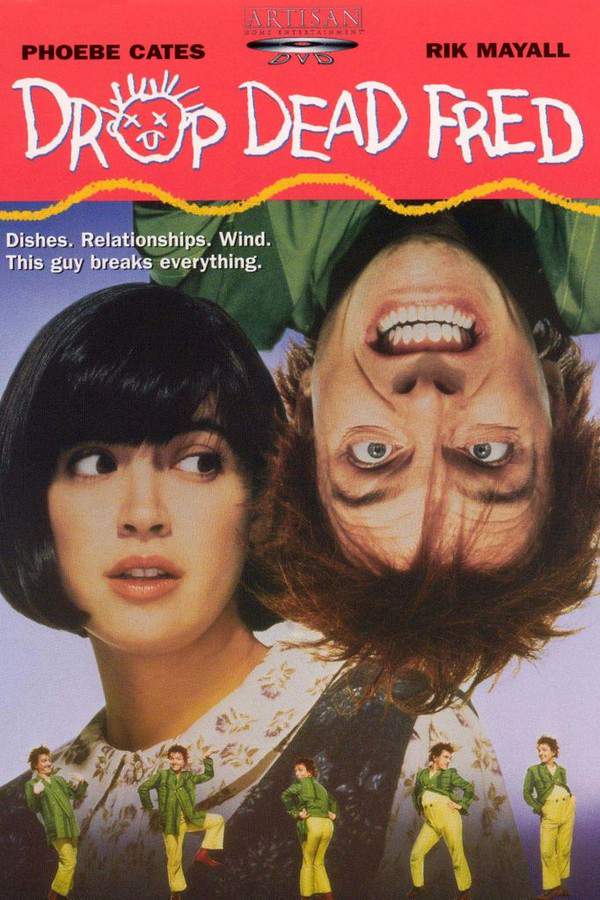
Drop Dead Fred (1991) movie poster

Timeline

Drop Dead Fred (1991) Timeline Explained – Every Event in Order

Release, runtime and language
1991 · 103 min · English
Directed by
Ate de Jong
Starring
Carrie Fisher, Tim Matheson, Ron Eldard, Daniel Gerroll, Phoebe Cates, Marsha Mason

A woman struggling with a monotonous life finds unexpected joy when her imaginary childhood friend, Drop Dead Fred, reappears. This free-spirited and mischievous figure helps her break free from her repressed emotions and rediscover a sense of playful rebellion, ultimately helping her to confront her frustrations and embrace a more authentic version of herself.

On this page (6)
  1. 1 Where to watch
  2. 2 Events in order (15)
  3. 3 Timeline questions answered
  4. 4 Movie threads
  5. 5 Movies like Drop Dead Fred
  6. 6 Every angle

Where to watch

Where to Watch Drop Dead Fred (1991)

Where can you watch Drop Dead Fred? Stream, rent or buy it in the US, including on Amazon Video, Apple TV Store and Fandango At Home: current JustWatch availability with up-to-date prices.

Streaming availability powered by JustWatch

15 events in order · contains spoilers

Drop Dead Fred Timeline: Events in Chronological Order

Every key event of Drop Dead Fred (1991) in order, scene by scene, with when and where it takes place. Use it to untangle flashbacks, time jumps and parallel storylines, to refresh your memory before the sequel or to find the exact scene you are thinking of.

  1. Elizabeth's Attempt to Reconnect

    Elizabeth Cronin, a court reporter in Minneapolis, makes a brave attempt to connect with her estranged husband, Charles. However, this meeting quickly turns sour as she learns he is determined to divorce her and is involved with another woman named Annabella.

    Where
    Minneapolis
  2. A Series of Misfortunes

    After her disappointing encounter with Charles, Elizabeth finds herself stranded when two thieves rob her. One steals her purse, while the other takes her car, leading to a cascade of unfortunate events that ultimately results in her arriving late to work.

  3. Job Loss

    Elizabeth's tardiness at the courthouse leads to her termination from her job as a court reporter. This marked the beginning of a downward spiral in her life as she grapples with both personal and professional disappointments.

    Where
    Courthouse
  4. Childhood Memories Resurface

    While leaving the courthouse, Elizabeth runs into Mickey Bunce, an old friend from her childhood. This meeting brings back fond memories of their youthful antics, particularly involving an imaginary friend named Drop Dead Fred, whom Elizabeth remembers with both joy and regret.

  5. Returning to Her Mother's Home

    After some encouragement from her friend Janie, Elizabeth decides to move back in with her overbearing mother, Polly. Within moments of her return, Polly chastises Elizabeth for her failed marriage and pressure begins to mount as tensions rise.

  6. Makeover Gone Wrong

    In a desperate attempt to win back Charles's affection, Elizabeth undergoes a drastic makeover. However, this transformation is soon overshadowed by Fred’s unexpected return, throwing her plans into chaos.

  7. Fred's Mischief

    As Drop Dead Fred reenters Elizabeth's life, his antics lead to widespread chaos including the destruction of a restaurant and the sinking of Janie's houseboat. These events prompt concern from Elizabeth's mother, who insists on seeking professional help.

  8. Therapy Session

    Elizabeth is taken to see a child psychologist by her mother, where she is prescribed medication intended to eliminate Fred from her life. This moment signifies a critical attempt to suppress her childhood imagination and unresolved issues.

    Where
    Psychologist's Office
  9. A Traumatic Memory

    During therapy, Elizabeth recalls a traumatic moment from her childhood when she felt abandoned. This pivotal memory involves her imaginary friend Fred hiding from her mother's rage, underscoring the emotional scars left by her family dynamics.

  10. Crashing Charles' Party

    With a newfound sense of clarity, Elizabeth and Fred devise a plan to crash a party hosted by Charles. This escapade represents her embracing the chaos in her life while also attempting to reclaim her sense of self.

    Where
    Charles' Party
  11. Reality Hits

    During the party, Elizabeth initially feels excited about rekindling her relationship with Charles. However, her joy is short-lived as Fred reveals Charles' ongoing infidelity with Annabella, forcing Elizabeth to confront harsh truths.

    Where
    Party Venue
  12. Emotional Collapse

    The revelation of Charles' betrayal leads Elizabeth to emotional turmoil, resulting in a physical and mental breakdown. This crisis acts as a catalyst, leading her to deeper introspection and a quest for rediscovery.

  13. Liberating the Childhood Self

    In a dream sequence, Elizabeth confronts her childhood self, who has been imprisoned by fear. With Fred's guidance, she liberates this young version of herself, signifying a major breakthrough in her emotional recovery.

    Where
    Dream Space
  14. Breaking Free from Charles

    Upon awakening, Elizabeth feels empowered and chooses to end her relationship with Charles for good. This moment symbolizes her reclaiming control over her life, standing up to both Charles and her mother.

  15. A New Beginning

    As Elizabeth embarks on a new chapter, she visits Mickey and discovers that Fred has taken a new form in the life of Mickey's daughter, Natalie. Although Elizabeth cannot see Fred, she reflects on their shared journey and the impact he had on her life.

Last updated: November 22, 2024 at 10:39

Was this helpful?

Timeline questions answered

Drop Dead Fred Timeline Explained: Your Questions Answered

When does it happen, and why in that order? The questions people ask about the chronology of Drop Dead Fred (1991): time jumps, flashbacks, cause and effect between scenes and the correct order of events, each answered with spoilers.

Q1

Why does Drop Dead Fred return to Elizabeth's life as an adult?

Fred returns when Elizabeth is at her lowest point, recently divorced, fired from her job, and stranded after being robbed. His reappearance coincides with her reconnecting with childhood friend Mickey, triggering repressed memories of her difficult relationship with her overbearing mother. Fred embodies the playful, rebellious part of herself that she suppressed to survive her childhood, returning now because her emotional state has cracked open the door for that repressed aspect to resurface.

Foreshadowing: Early scenes show Elizabeth running into Mickey, who reminds her of the joy and comfort Fred provided during her troubled childhood.

  • imaginary friend
  • return
  • childhood trauma
  • repression
  • emotional breakthrough
Q2

Why does Elizabeth move back in with her mother after her divorce?

After losing her job and being stranded in Minneapolis with no support system, Elizabeth feels she has nowhere else to go. Her friend Janie encourages her to return home, believing family would help. However, this decision trap her in an emotionally abusive environment where her mother immediately criticizes her for the divorce, showing that returning to her mother's house represents Elizabeth's pattern of choosing familiar dysfunction over uncertain freedom.

  • mother
  • divorce
  • living arrangements
  • dysfunction
  • family
Q3

Why does Fred cause so much chaos and destruction?

Fred's mischief isn't randomly destructive, it's a manifestation of Elizabeth's repressed anger toward the oppressive control her mother and husband exercised over her. When Fred destroys a restaurant, sinks Janie's houseboat, and creates public chaos, these acts represent Elizabeth's unconscious desire to rebel against the rigid, controlled life she's been living. The escalation of his antics mirrors Elizabeth's internal explosion of accumulated resentment.

Foreshadowing: Flashbacks reveal Fred always brought both joy and chaos to Elizabeth's childhood, reflecting the duality of her relationship with rebellion versus compliance.

  • chaos
  • destruction
  • rebellion
  • repressed anger
  • defiance
Q4

Why does Polly take Elizabeth to a child psychologist?

Polly takes Elizabeth to a psychologist because she's concerned about her daughter's erratic behavior, which she views as abnormal and embarrassing. However, this action reveals Polly's fundamental misunderstanding, she sees Fred as a mental illness to be cured rather than understanding he's a manifestation of emotional trauma from Elizabeth's childhood. The psychologist prescribes medication meant to suppress Fred, representing the cultural tendency to pathologize imagination and silence inner voices rather than address root emotional wounds.

  • psychologist
  • medication
  • mother
  • mental health
  • suppression
Q5

What is the significance of the childhood memory with the jack-in-the-box?

The jack-in-the-box memory reveals the original trauma that created Fred. When young Elizabeth imagined Fred hiding inside a jack-in-the-box to escape Polly's rage, she experienced profound abandonment, her protector had to hide to survive, leaving her alone with her mother's anger. This traumatic moment also coincides with Elizabeth's father leaving the family, teaching young Elizabeth that expressing herself leads to abandonment. The letter she wrote to Fred, begging him to take her away, shows she saw imagination as her only escape from an intolerable reality.

Foreshadowing: Throughout the film, Fred's presence is tied to moments of emotional crisis, suggesting he emerged as a coping mechanism from this original wound.

  • childhood trauma
  • jack-in-the-box
  • abandonment
  • father leaving
  • letter
Q6

Why does Fred reveal Charles' infidelity at the party?

Fred reveals Charles' ongoing affair with Annabella because his purpose has always been to help Elizabeth see and face difficult truths. While Elizabeth hoped the party would lead to reconciliation, Fred's loyalty to her authentic well-being override her desire for comfort. This moment marks Fred's true role, not as a source of chaos for its own sake, but as a truth-teller who forces Elizabeth to stop numbing herself with false hope and finally confront the reality that Charles never intended to return to her.

  • Charles
  • Annabella
  • affair
  • betrayal
  • truth
  • party
Q7

What does the dream sequence with Elizabeth's childhood self represent?

In the dream sequence, Elizabeth confronts her childhood self who is imprisoned in a cage, symbolizing how she literally trapped her inner child to survive her oppressive childhood. The cage represents the emotional prison she built around herself to appease her mother. When adult Elizabeth frees young Elizabeth with Fred's guidance, it represents her finally releasing the repressed parts of herself that she locked away to gain parental approval. This cathartic moment allows her to reclaim the confidence and voice she abandoned as a child.

  • dream sequence
  • childhood self
  • cage
  • liberation
  • inner child
  • self-acceptance
Q8

Why does Fred disappear after kissing Elizabeth?

Fred disappears because his purpose has been fulfilled, he helped Elizabeth reconnect with her suppressed self and gain the confidence to break free from abusive relationships. The kiss represents a transition: Fred was always a part of her, and now that she has internalized his courage and self-worth, he no longer needs to exist as a separate presence. His departure signifies that Elizabeth no longer needs an imaginary friend to cope because she has become her own source of strength and self-advocacy.

  • kiss
  • disappearance
  • departure
  • integration
  • self-empowerment
  • completion
Q9

Does Fred actually exist at the end of the movie?

The ending suggests Fred exists beyond Elizabeth personally, he has transferred to Natalie, Mickey's daughter, whom Elizabeth cannot see. This implies Fred was never merely Elizabeth's hallucination but something more universal: a manifestation of childhood imagination that appears to help children cope with difficult emotions. Elizabeth losing the ability to see Fred while he remains visible to Natalie shows that our imaginary companions don't disappear, they simply move on to help other children who need them.

  • existence
  • reality
  • Natalie
  • transfer
  • imaginary friend
  • universal
Q10

Why does Elizabeth offer her mother an olive branch at the end?

Elizabeth encourages Polly to seek companionship because she's finally recognized that her mother's controlling behavior stemmed from loneliness and emotional unavailability, not maliciousness. By offering this forgiveness, Elizabeth breaks the cycle of generational dysfunction, she chooses compassion over resentment without returning to a submissive role. This act shows her genuine liberation: she can acknowledge her mother's flaws while still wishing her well, establishing healthy emotional boundaries rather than cutting off entirely or continuing to be controlled.

  • Polly
  • forgiveness
  • mother
  • olive branch
  • closure
  • boundaries

Movie threads

More Movies Like Drop Dead Fred, by Mood & Story

Curated lists built around what makes Drop Dead Fred tick: the same mood, the same kind of story or the same emotional payoff. Each list explains why these movies belong together.

Whimsical Healing Movies like Drop Dead Fred

Stories where chaos and mischief help characters rediscover their inner strength. Discover movies like Drop Dead Fred, where chaotic, playful forces help characters overcome emotional repression. If you enjoyed the mix of slapstick humor and sincere self-discovery, these films offer similar journeys of healing through whimsical rebellion and imaginative escapes.

  • whimsical
  • chaotic
  • playful
  • cathartic
  • bittersweet
  • nostalgic
  • Tone: whimsical, bittersweet
  • Pacing: variable, mixing fast chaos with steady reflection
Why these movies?

The story pattern: The narrative follows a protagonist, often feeling trapped or repressed, whose life is turned upside down by the arrival of a chaotic, fantastical influence. This external force creates comedic mayhem but also serves as a mirror, forcing the protagonist to address past traumas, break free from emotional constraints, and ultimately achieve a more integrated and empowered sense of self, often with a bittersweet farewell to the chaotic guide.

Why they belong together: These films are grouped together because they share a unique tonal blend: the surface-level whimsical chaos is deeply intertwined with a serious emotional journey. The pacing often alternates between frantic, humorous set pieces and quieter, reflective moments, creating a memorable, bittersweet experience centered on catharsis and personal growth.

Movies about Childhood Fantasies like Drop Dead Fred

When figures from a childhood imagination return to challenge adult realities. Find movies similar to Drop Dead Fred that explore the return of childhood fantasies into adult life. These stories blend nostalgia with personal crisis, using imaginative elements to challenge characters' present realities and help them reconcile their past and present selves.

  • nostalgic
  • melancholic
  • dreamlike
  • introspective
  • liberating
  • childlike
  • Tone: nostalgic, melancholic, hopeful
  • Pacing: variable, with introspective flashbacks
Why these movies?

The story pattern: The plot is triggered by the unexpected return of a potent symbol from the protagonist's childhood. This reawakened fantasy clashes with the protagonist's rigid adult world, initially causing disruption but ultimately guiding them to address unresolved childhood issues. The journey involves reconciling the innocent, creative self with the jaded adult, often leading to a more authentic and balanced life.

Why they belong together: Movies in this thread share a focus on the psychological impact of childhood and the power of nostalgia. They often use a fantastical or metaphorical lens to explore themes of memory, trauma, and the struggle to maintain creativity and wonder in the face of adult conformity, resulting in a tonally complex mix of melancholy and hope.

If you liked this

Movies Like Drop Dead Fred

Similar movies to Drop Dead Fred: the same genre, themes or kind of story. Each one comes with its own plot summary, timeline and ending explained.

Browse all movie summaries

Every angle

Drop Dead Fred (1991) Explained: Plot, Timeline & Characters

Everything about Drop Dead Fred in one place: what happens in the plot summary, the timeline in chronological order, the characters and meaning and a spoiler-free summary. What's After the Movie adds the cast, box office and post-credit scenes.

Coming soon on iOS and Android

The Plot Explained Movie Summary App

Plot summaries, endings explained and timelines on your phone. Catch up on any movie in minutes, save your favorites and never miss a twist again.

Be the first to know when we launch. Your email stays private, always.

Learn more about the app