Plot Explained Spoilers guaranteed!
Plot Explained

Browse by genre

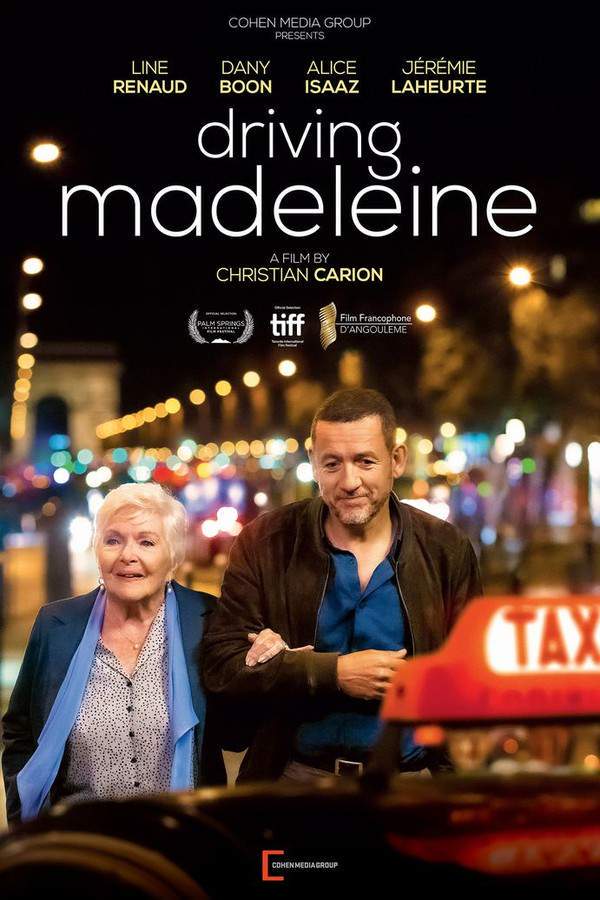
Driving Madeleine (2024) movie poster

Plot Summary

Driving Madeleine (2024) Plot Summary Explained

Release, runtime and language
2024 · 1 h 31 m · French
Echo score 79
Loading streaming availability…
Directed by
Christian Carion
Starring
Dany Boon, Alice Isaaz, Christophe Rossignon, Line Renaud, Jérémie Laheurte, Gwendoline Hamon
Budget
$2.9M

A taxi ride through Paris becomes an unexpected journey of self-discovery for Charles, a driver battling personal struggles. After picking up the mysterious Madeleine, a seemingly ordinary conversation unveils a shared history of secrets and pain, compelling them both to face difficult truths about their lives.

On this page (5)
  1. 1 Where to watch
  2. 2 What happens: full plot
  3. 3 Plot questions answered
  4. 4 Movie threads
  5. 5 Every angle
Loading streaming availability…

Full plot summary · contains spoilers

What Happens in Driving Madeleine: Full Plot Summary

The whole story of Driving Madeleine (2024) explained, from the opening scene to the final frame: every key event, every twist and what it all adds up to. Read it as a quick recap before the sequel, to check a scene you missed, or to finally understand what really happened.

Charles Hauffman, played by Dany Boon, is a hardworking taxi driver based in Paris who finds himself in a precarious financial position. Struggling with mounting debts and facing the very real possibility of losing his professional driving license, Charles is desperate for a turning point. This arrives in the form of a request to pick up a client named Madeleine Keller, played by Line Renaud in her elder years.

The 92-year-old Madeleine needs transportation from Bry-sur-Marne to a retirement home located in Courbevoie. Interestingly, the instructions for the trip are unusual, as Charles is told to begin the meter reading immediately, even before he has officially arrived at the pickup location in Bry-sur-Marne. However, once they are together, Madeleine requests a detour. Rather than taking the direct route to the retirement facility, she asks Charles to drive her around the city of Paris, visiting various locations that have held deep personal significance throughout her long and tumultuous life.

As they traverse the city, the journey becomes a gateway into Madeleine's past. She reflects on her youth, played by Alice Isaaz, specifically recalling a clandestine affair she had with an American soldier during World War II. This brief but impactful relationship resulted in the birth of her son, Mathieu. As an adult, Thomas Alden portrays the son, who grew up as a photojournalist harboring deep resentment toward his mother for her long absence and imprisonment.

The narrative delves into the darker chapters of Madeleine's life, focusing on her marriage to Raymond Haguenot, also known as Ray, played by Jérémie Laheurte. Their union was far from happy, as Ray exhibited violent and abusive behavior toward her. Because of the legal constraints of the time, Madeleine found herself unable to obtain a divorce on the grounds of domestic abuse. Driven to a breaking point by the relentless torment, she eventually took violent retaliatory action that left Ray maimed. This act of desperation led to criminal proceedings and a lengthy prison sentence, presided over by the court president, Christophe Rossignon. Ironically, her imprisonment became a cause célèbre, sparking a national conversation and fighting for the marital rights of French women.

Throughout the cab ride, the interaction between the driver and his passenger is marked by several quirky and touching incidents. At one point, they cause a significant disruption in traffic just so that Madeleine can use the restroom at a restaurant run by a manager played by Sylvie Audcoeur. In another instance, Charles commits a traffic violation that threatens his already fragile business license, but Madeleine uses her wit and influence to help extricate him from the situation.

Their journey is a tapestry of history, as Madeleine recalls her experiences during the May 68 demonstrations and the geopolitical tension of the Vietnam War. They visit somber landmarks, including a memorial dedicated to the Parisians who were deported during the Second World War. Along the way, they share a meal and a growing bond of mutual respect.

By the time they finally arrive at the retirement home—where we meet the director Alexandra Mercouroff and staff members such as the nurse Tom Hudson and the maintenance agent Christian Mupondo—Charles is so deeply moved and engrossed by Madeleine's life story that he neglects to collect his fare. Shortly after the trip concludes, the narrative closes with a final communication delivered to Charles by Madeleine's barrister, serving as a poignant conclusion to their unexpected connection.
Last updated: October 18, 2026 at 17:33

Was this helpful?

Plot questions answered

Driving Madeleine Plot Explained: Your Questions Answered

The questions people ask most about Driving Madeleine (2024): what happens in the confusing scenes, why the characters do what they do, the twists, hidden details and what the ending means. Each answer contains spoilers.

Q1

Why did Madeleine ask Charles to drive around Paris instead of going straight to the retirement home?

Madeleine chose to turn the taxi ride into a tour of her personal history rather than a direct trip because each location in Paris was tied to a defining chapter of her life. She uses the journey to revisit places connected to her wartime romance, her abusive marriage, and decades of French upheaval, transforming a simple fare into a farewell to her past before entering the retirement home.

Foreshadowing: The unusual instruction to start the meter before arriving at Bry-sur-Marne already signals that this will not be a standard taxi ride.

  • madeleine detour
  • paris tour
  • retirement home
  • cab ride
  • personal history
Q2

Why did Madeleine maim Ray and what happened to her afterwards?

Madeleine attacked and maimed her husband Ray after years of violent abuse that she could not legally escape, since French law at the time did not allow divorce on the grounds of domestic violence. Her act of retaliation led to criminal proceedings and a lengthy prison sentence, which unexpectedly turned her case into a national rallying point for women's marital rights.

Foreshadowing: Her earlier reflections on the lack of legal protection for abused women set up the inevitability of her breaking point.

  • madeleine maimed ray
  • abusive marriage
  • domestic violence
  • prison sentence
  • desperate act
Q3

Why couldn't Madeleine get a divorce from her abusive husband Ray?

Under the legal constraints of post-war France, Madeleine had no grounds to obtain a divorce from Ray despite his violent behavior toward her. Domestic abuse was not recognized as sufficient legal justification to end a marriage at the time, which trapped her in the relationship until she took matters into her own hands.

  • french divorce law
  • abusive marriage
  • domestic abuse
  • legal constraints
  • ray haguenot
Q4

How did Madeleine's trial turn into a cause célèbre for women's rights?

Madeleine's prosecution for attacking her abusive husband drew public attention because it highlighted how French law failed to protect women trapped in violent marriages. Her case sparked a national conversation about marital rights and became a symbol for the broader fight to reform divorce laws and recognize domestic abuse as legitimate grounds for separation.

  • cause célèbre
  • women's rights
  • french law
  • marital rights
  • public debate
Q5

Why does Madeleine's son Mathieu resent her despite everything she endured?

Mathieu grew up resenting Madeleine because she was largely absent during his upbringing, first due to the social stigma of being born out of wedlock and later because of her long imprisonment for maiming Ray. As an adult photojournalist, he carries the wound of being abandoned by a mother whose suffering, while real, left him without parental support during his formative years.

Foreshadowing: The film hints at this strained bond when Madeleine avoids certain streets in Paris, suggesting places connected to her son carry emotional weight.

  • mathieu resentment
  • photojournalist
  • mother-son relationship
  • abandonment
  • absent parent
Q6

Why did Charles forget to collect his fare at the end of the ride?

Charles neglected to collect his fare because he had become so emotionally immersed in Madeleine's extraordinary life story that the transactional nature of the trip faded from his mind. The cab ride evolved from a paid service into a deeply human encounter, and his decision to let the fare go reflects how moved he was by her vulnerability and resilience.

Foreshadowing: His earlier financial desperation made the unpaid fare a meaningful sacrifice rather than a simple oversight.

  • charles neglects fare
  • taxi fare
  • emotional connection
  • retirement home arrival
Q7

How did Madeleine help Charles avoid losing his taxi licence?

When Charles committed a traffic violation during the ride that put his already precarious licence at risk, Madeleine intervened by using her wit and personal influence to defuse the situation. Her ability to navigate authority figures and social codes protects Charles from a penalty that could have ended his livelihood.

Foreshadowing: Her earlier stories about navigating hostile legal and social systems foreshadow her skill at intervening on Charles's behalf.

  • charles license
  • traffic violation
  • madeleine intervention
  • taxi licence
Q8

Why did Madeleine deliberately disrupt traffic just to use a restaurant restroom?

Madeleine orchestrated the traffic disruption as a lighthearted act of rebellion during a deeply emotional day of revisiting painful places. At 92 years old, she knew she might not return to these streets, and the chaotic restroom stop becomes a small, joyful assertion of control in a life that was largely shaped by forces beyond her control.

Foreshadowing: Her growing ease with Charles throughout the ride sets up the playful detour rather than a purely somber one.

  • restaurant stop
  • traffic disruption
  • restroom
  • quirky moment
  • paris streets
Q9

Why was Charles told to start the meter before arriving at Bry-sur-Marne?

Charles was instructed to begin the meter immediately to account for the long drive from his position in Paris to Bry-sur-Marne, where Madeleine was waiting. This ensured that his travel time and fuel costs to reach her were included in the fare, reflecting that this was an unusual, pre-arranged assignment rather than a standard street pickup.

Foreshadowing: The early meter instruction is the first signal that this assignment will be unconventional.

  • meter reading
  • bry-sur-marne
  • unusual instruction
  • taxi assignment
Q10

What was the final communication from Madeleine's barrister to Charles?

After the ride ends, Madeleine's barrister tracks down Charles to deliver a final message from her, which serves as a poignant coda to their encounter. The communication implies closure, gratitude, or a final piece of her story, leaving the emotional weight of their day to settle between them without further words.

Foreshadowing: Madeleine's careful planning of the entire route, including the early meter instruction, hints that she had orchestrated a meaningful farewell rather than a random taxi ride.

  • barrister communication
  • madeleine final message
  • poignant conclusion
Q11

What is the significance of visiting the deportation memorial during the ride?

The visit to the memorial dedicated to Parisians deported during World War II connects directly to Madeleine's wartime memories, including her affair with an American soldier and the broader trauma of the Nazi occupation. Stopping there forces both her and Charles to confront the human cost of history, deepening the emotional weight of the journey.

Foreshadowing: Madeleine's earlier recollections of her WWII romance lead naturally to the memorial, which represents the darker side of that same era.

  • deportation memorial
  • world war ii
  • paris history
  • wartime memories
Q12

How does Madeleine's story change Charles during the cab ride?

Charles begins the day as a financially desperate driver focused only on survival, but listening to Madeleine's decades of suffering, resilience, and quiet rebellion reframes his own struggles. By the time he drops her at the retirement home without collecting his fare, he has been emotionally opened up, recognizing that hardship is shared and that human connection matters more than the money he almost lost his licence over.

Foreshadowing: Charles's willingness to accept the unusual detour signals an openness that allows Madeleine's story to truly land.

  • charles transformation
  • self-discovery
  • emotional journey
  • personal struggles
Q13

Why does Madeleine revisit Paris landmarks connected to her past instead of just telling her story?

Madeleine returns to the physical sites of her memories because places hold the emotional truth of her life in a way that words alone cannot convey. Standing again in the streets where she loved, suffered, and fought back allows her to pass on not just facts but the felt reality of her history to someone willing to listen before she enters the retirement home for good.

  • madeleine memories
  • paris landmarks
  • physical sites
  • emotional truth
  • storytelling

Movie threads

More Movies Like Driving Madeleine, by Mood & Story

Curated lists built around what makes Driving Madeleine tick: the same mood, the same kind of story or the same emotional payoff. Each list explains why these movies belong together.

Contained journey, unfolding life stories like in Driving Madeleine

When one short trip unlocks decades of memory, regret, and quiet revelation. Movies like Driving Madeleine that use a single confined setting or journey as a stage for a sweeping personal history. These films unfold decades of memory through quiet conversation and reflective pacing. If you liked Driving Madeleine's taxi-ride structure and layered revelations, these contained dramas will feel just right.

  • contained
  • reflective
  • memory-driven
  • slow reveal
  • intimate
  • bittersweet
  • Tone: bittersweet, contemplative, slowly revealing
  • Pacing: steady, conversational, reflective
Why these movies?

The story pattern: Films in this thread typically use a restricted setting, be it a taxi, a train compartment, a hospital room, or a long drive, as a frame within which a much larger life story is told. The present-day encounter acts as a trigger for flashbacks, remembered places, and long-held confessions. Characters begin as strangers or barely connected acquaintances and gradually reveal shared or divergent histories. Time periods shift fluidly, but the pacing remains anchored in the present-day conversation or movement. The structure trades wide plotting for depth of interior revelation.

Why they belong together: These films share a unique narrative architecture where an ordinary, contained moment contains extraordinary emotional scope. The pacing is reflective and dialogue-driven, the tension comes from accumulating revelations rather than action, and the emotional payoff often hinges on small gestures, glances, or final unspoken understandings. The contained setting becomes a pressure cooker for truth, and the journey's end allows characters to step out changed, however slightly.

Generational trauma stories with warmth like in Driving Madeleine

Stories where a broken history meets an unexpected kindness, and both leave changed. Movies like Driving Madeleine that weave together heavy themes of war, family abuse, and historical memory with moments of genuine human connection. These bittersweet dramas balance dark subject matter with touching encounters and hopeful possibilities. If you were moved by Driving Madeleine's mix of pain and tenderness, these similar films will resonate deeply.

  • bittersweet
  • trauma-informed
  • generational
  • historical
  • tender
  • wounded
  • Tone: bittersweet, tender, melancholic, hopeful
  • Pacing: steady, reflective, unhurried
Why these movies?

The story pattern: Narratives in this thread move through darkness; through war, displacement, domestic violence, or family rupture, but they resist becoming purely bleak. Characters often meet in the present day and slowly discover that their pains echo each other across decades. Old wounds related to WWII, post-war repression, authoritarian households, or patriarchal cruelty are revisited not for shock value but for healing. The present-day encounter, however brief, provides a kind of closure that ordinary life denied, and endings tend to be bittersweet: wounded but acknowledged, wounded but witnessed.

Why they belong together: These films share a tone that refuses easy despair. They honor the weight of historical and personal trauma while insisting on warmth, wit, and connection as counterforces. The humor is gentle and observational, never defusing the darkness but existing alongside it. They tend to feature older protagonists reckoning with long-buried pasts, or younger protagonists who encounter their elders' histories in unexpected ways. The narrative is more reflective than dramatic, with emotionally heavy subjects handled through quiet conversation rather than spectacle.

Every angle

Driving Madeleine (2024) Explained: Plot, Timeline & Characters

Everything about Driving Madeleine in one place: what happens in the plot summary, the timeline in chronological order, the characters and meaning and a spoiler-free summary. What's After the Movie adds the cast, box office and post-credit scenes.

Coming soon on iOS and Android

The Plot Explained Movie Summary App

Plot summaries, endings explained and timelines on your phone. Catch up on any movie in minutes, save your favorites and never miss a twist again.

Be the first to know when we launch. Your email stays private, always.

Learn more about the app