Plot Explained Spoilers guaranteed!
Plot Explained

Browse by genre

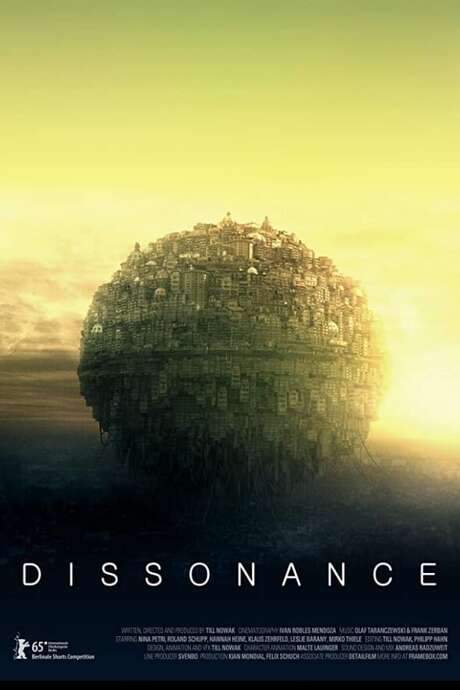
Dissonance (2015) movie poster

Plot Summary

Dissonance (2015) Plot Summary Explained

Release, runtime and language
2015 · 15 mins · German
Loading streaming availability…
Directed by
Till Nowak
Starring
Nina Petri, Leslie Barany, Mirko Thiele, Roland Schupp, Hannah Heine, Klaus Zehrfeld

A pianist finds himself in a surreal situation, performing in a vast theatre with a unique cylindrical piano rotated by his diminutive assistant, all within a colossal spherical city. However, this dreamlike reality shifts as he awakens to discover he's a street musician burdened by a restraining order. Determined to connect with his daughter, he’s driven to teach her the intricacies of playing the piano, hoping to bridge the gap between them.

On this page (5)
  1. 1 Where to watch
  2. 2 What happens: full plot
  3. 3 Plot questions answered
  4. 4 Movie threads
  5. 5 Every angle
Loading streaming availability…

Full plot summary · contains spoilers

What Happens in Dissonance: Full Plot Summary

The whole story of Dissonance (2015) explained, from the opening scene to the final frame: every key event, every twist and what it all adds up to. Read it as a quick recap before the sequel, to check a scene you missed, or to finally understand what really happened.

In a surreal, floating animated world, a genius musician Roland Schupp lives a lonely life, spending each day at a tube-shaped piano in a vast, empty concert hall. As the piano spins, his fingers coax delicate melodies from the keys, and the air fills with music that feels both intimate and boundless. One day, the dreamlike landscape begins to crack and reality breaks in, reshaping the scene from animation into live action. Through this transition, the musician harbors a single, precious wish: to play for his daughter Hannah Heine. In the real world, she peers down from a street-facing window as the Mother Nina Petri urges calm and warns her away, hinting at a truth darker than the music could ever reveal.

In the new, reckless light of the street, the musician searches for a crowd and for meaning in the sound he can craft, only to be met with indifference and rebuffs. He finds himself drawn to the display of traditional pianos in a shop window, a reminder of the world he longs to belong to, and the sight drains him so completely that he faints. A Doctor Klaus Zehrfeld steps in to diagnose the collapse of his grip on reality, describing a condition he calls the delusional fantasy of "Spherical Dissonance" and suggesting that the way forward is to escape the vivid fantasy and face the ordinary world. Yet the lure of the dissonance—of the music that seems to float apart from reality—keeps pulling at him, resisting the doctor’s counsel.

The Narrator voices—Leslie Barany (English) and Mirko Thiele (German)—thread through the narrative, guiding our senses as the two realms tilt and blur, reminding us that what we see depends on where we stand. Back at home, the Mother speaks on the phone about a restraining order that is proving useless, while the Daughter slips away from the street and goes to her father on the sidewalk outside. She leads him back into the house, where he sits at the traditional piano and begins to play for her, letting the familiar notes wash over the room with a quiet tenderness. The Mother’s ears catch the music, and she confronts the musician with a mixture of fear, concern, and a protective love that feels almost as old as the melody itself. In a symbolic gesture that binds memory to fate, he nails a small music box to the piano and, with a heavy sigh, steps back into the world outside. The momentary glow of the spherical dissonance returns to him before he finally chooses to walk away, accepting the weight of reality and the distance it imposes between him and the dream of playing for his daughter.
Last updated: February 24, 2026 at 14:14

Was this helpful?

Plot questions answered

Dissonance Plot Explained: Your Questions Answered

The questions people ask most about Dissonance (2015): what happens in the confusing scenes, why the characters do what they do, the twists, hidden details and what the ending means. Each answer contains spoilers.

Q1

Why does the musician live in two different worlds?

The animated world represents his delusional fantasy, a mental escape from his painful reality. He suffers from a condition called 'Spherical Dissonance,' which allows him to inhabit an idealized world where he's a successful concert pianist. When the animated world collapses, it signifies his grip on this fantasy slipping, forcing him to confront the harsh truth that he's actually a struggling street musician estranged from his family.

Foreshadowing: The animated world begins cracking long before the full transition, hinting at the instability of his mental state.

  • spherical dissonance
  • delusional fantasy
  • mental illness
  • escape
  • animation to live action
Q2

What is Spherical Dissonance?

Spherical Dissonance is the doctor's term for the musician's delusional fantasy, a vivid alternate reality where he performs in a grand concert hall with a cylindrical piano. The doctor diagnoses it as a mental health condition where the patient retreats into imaginative worlds to escape painful realities. The 'spherical' aspect refers to the circular, self-sustaining nature of his delusion.

  • spherical dissonance
  • mental illness
  • delusion
  • doctor
  • fantasy world
Q3

Why does the father have a restraining order from his daughter?

The mother mentions the restraining order is useless, suggesting the father (Roland) has a history of intrusive behavior toward his family. Combined with the mother's warnings about danger and police, it implies his mental instability and obsessive pursuit of connection through music created a threatening situation. The order represents the family's attempt to protect themselves from his unpredictable behavior while he was lost in his delusion.

Foreshadowing: The mother's warning that 'the father may not be as harmless as she imagines' hints at why the legal barrier exists.

  • restraining order
  • daughter
  • mother
  • family separation
  • police
Q4

Why does the musician faint at the piano shop?

He faints because the sight of conventional pianos in the shop window triggers an overwhelming realization of the gap between his delusion and reality. In his fantasy world, he plays a magnificent tube-shaped instrument in a grand hall, but in reality, he's只是一个街头音乐人,连一台普通钢琴都没有。这种对比太残酷了,他的心理防线彻底崩溃。

Foreshadowing: His earlier struggles on the street, rejected by crowds, have already been weakening his grip on the fantasy.

  • faint
  • piano shop
  • reality shock
  • breakdown
  • emotional collapse
Q5

What does nailing the music box to the piano symbolize?

Nailing the music box to the piano is a symbolic act of closure and acceptance. The music box represents his lifelong pursuit of music and his dream of connecting with his daughter through it. By permanently attaching it to the piano, he essentially 'locks in' that dream while acknowledging he cannot stay in their lives. It's both a gesture of love, leaving something of himself, and a resignation that his presence brings more harm than good.

  • music box
  • symbol
  • piano
  • closure
  • acceptance
  • sacrifice
Q6

Why does he leave after playing piano with his daughter?

After finally achieving his main goal, playing for his daughter, he chooses to leave because he recognizes his presence threatens the stability of their household. The mother's confrontation shows the tension his involvement creates. By walking away, he accepts that loving someone sometimes means removing yourself from their life. He chooses his daughter's safety over his own desire to stay, accepting reality over fantasy.

Foreshadowing: The mother's protective fear during the confrontation foreshadows why he must ultimately leave.

  • leave
  • daughter
  • sacrifice
  • acceptance
  • reality vs fantasy
Q7

What is the dark truth the mother hints at?

The dark truth involves the father's potential danger when lost in his delusion. The mother warns the daughter that the father may not be 'as harmless as she imagines' and references police involvement. This suggests Roland's mental breakdown led to behavior that scared his family enough to seek a restraining order. His obsessive quest to 'play for his daughter' in his fantasy state likely manifested as disturbing real-world behavior.

Foreshadowing: The mother's immediate fear upon hearing piano music indicates past trauma associated with his presence.

  • dark truth
  • mother
  • danger
  • warning
  • restraining order
Q8

Why is the mother so protective of the daughter around the father?

The mother's protective behavior stems from genuine fear for her daughter's safety. She warns the daughter away from the window, mentions the restraining order, and cautions that the father could be dangerous. This suggests the father's mental illness and delusional behavior created a volatile home environment. Her protective stance is maternal instinct, she'd rather the daughter have no relationship with him than risk exposure to his instability.

  • mother
  • protective
  • daughter
  • danger
  • family
Q9

Is the ending of Dissonance happy or sad?

The ending is bittersweet, he temporarily achieves his dream of playing piano for his daughter, experiencing a genuine moment of connection. However, he immediately chooses to walk away, accepting the painful reality that he cannot be part of their lives. The brief return of the spherical dissonance represents one last temptation to escape into fantasy, but he rejects it and faces reality. It's a victory tempered by loss: he grows as a person but remains alone.

Foreshadowing: The earlier doctor advice to 'escape the dream and embrace reality' culminates in this choice.

  • ending
  • bittersweet
  • resolution
  • sacrifice
  • reality
Q10

What causes the animated world to collapse into reality?

The animated world collapses because his mental condition, Spherical Dissonance, is deteriorating. The fantasy can no longer sustain itself against reality. The cracks in the floating world represent his weakening grip on the delusion. The transition is triggered by his increasing exposure to real-world stimuli and his deep, unresolved wish to see his daughter, which pulls him back toward truth.

Foreshadowing: The cracks appear gradually, showing the fantasy was already failing before the complete transition.

  • animated world
  • collapse
  • transition
  • reality
  • mental breakdown
Q11

Why is playing for his daughter so important to the musician?

Playing for his daughter represents his deepest desire for connection and redemption. Music is his only form of expression and the only bridge he believes he can build between himself and his estranged family. In his fantasy, this wish sustains the entire animated world. It's the single, precious wish he clings to during the transition. The piano becomes a metaphor for love, healing, and the possibility of reconciliation.

Foreshadowing: The opening establishes the wish to play for his daughter as the core emotional motivation throughout both worlds.

  • daughter
  • music
  • connection
  • redemption
  • love
  • wish

Movie threads

More Movies Like Dissonance, by Mood & Story

Curated lists built around what makes Dissonance tick: the same mood, the same kind of story or the same emotional payoff. Each list explains why these movies belong together.

Surreal journeys through internal landscapes like in Dissonance

Stories where dreamlike fantasies represent a character's emotional struggle. Explore movies like Dissonance that use surreal animation and dreamlike sequences to portray a character's mental state and struggle with reality. These films often deal with themes of escapism, mental health, and the search for connection.

  • surreal
  • dreamlike
  • melancholic
  • introspective
  • lonely
  • longing
  • Tone: melancholic, dreamlike, introspective
  • Pacing: slow, atmospheric
Why these movies?

The story pattern: Narratives in this thread typically revolve around a protagonist who retreats into an intricate, controlled fantasy world as a coping mechanism for a painful reality. The story unfolds by contrasting these two worlds, often leading to a moment of choice between fantasy and a harsh truth.

Why they belong together: These movies are grouped by their unique blend of animation or surreal visual styles with live-action drama, creating a poignant metaphor for internal conflict. They share a melancholic tone and a focus on introspection rather than external action.

Movies about reconnecting through art like in Dissonance

Characters use a shared artistic talent to bridge emotional distance with estranged family. Discover films like Dissonance where a parent uses a shared passion, like music, to overcome estrangement and rebuild a relationship with their child. These emotional dramas often feature complex characters and bittersweet endings.

  • bittersweet
  • melancholic
  • hopeful
  • longing
  • father-daughter
  • redemption
  • Tone: melancholic, bittersweet, hopeful
  • Pacing: slow, character-driven
Why these movies?

The story pattern: The narrative follows a parent, often burdened by past mistakes or a restraining order, who seeks redemption by teaching their child a specific art form. The shared creative process becomes the fragile bridge across a chasm of hurt and separation.

Why they belong together: They are connected by the powerful theme of art as a healing force in fractured family relationships. The focus is on character-driven emotional journeys with medium emotional weight and a payoff that is impactful but not purely happy.

Every angle

Dissonance (2015) Explained: Plot, Timeline & Characters

Everything about Dissonance in one place: what happens in the plot summary, the timeline in chronological order, the characters and meaning and a spoiler-free summary. What's After the Movie adds the cast, box office and post-credit scenes.

Coming soon on iOS and Android

The Plot Explained Movie Summary App

Plot summaries, endings explained and timelines on your phone. Catch up on any movie in minutes, save your favorites and never miss a twist again.

Be the first to know when we launch. Your email stays private, always.

Learn more about the app