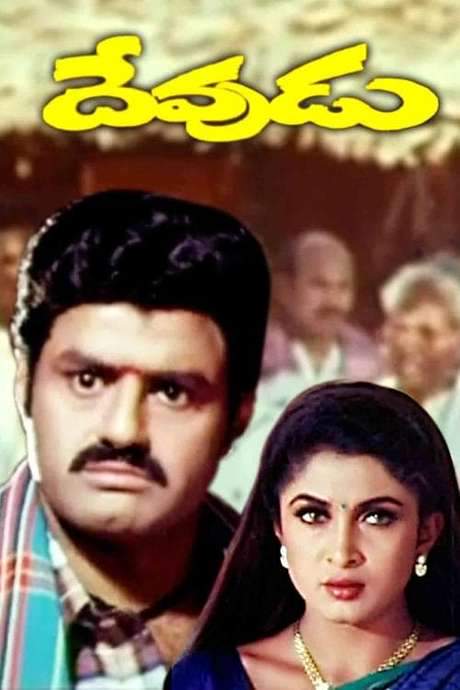
The film opens with a desperate moment at a temple when a couple secretly abandons their newborn, fearing a congenital abnormality will claim the child. Yet the Goddess blesses the baby with a miraculous survival, and Rayudu Kaikala Satyanarayana, a compassionate leader who cares deeply for the people, steps in to give him a new life. He adopts the child and names him Devudu Nandamuri Balakrishna, entrusting him to grow up in a village where his presence becomes a beacon of hope and kindness. Devudu embodies warmth and simplicity, endearing himself to everyone around him, from elders to children, and earning a beloved place in the hearts of the villagers. Yet beneath his sunny exterior lies a profound fear of marriage, a fear rooted in the memory of his parents’ decision to abandon him, which makes him wary of lifelong commitments despite his generous nature.
Across the valley, Ganga Raju Kota Srinivasa Rao nurses resentment toward Rayudu for ostracizing his brother Linga Raju over a second marriage, and this bitterness fuels a calculated plan for revenge that threads through the village’s politics and personal lives. In the city, Devudu’s path crosses with Madhavi Ruchita Prasad, a kind-hearted young woman who becomes a friend and ally after he saves her from a group of goons. Their budding friendship highlights Devudu’s goodness, even as he remains cautious about romantic entanglements. Around the same time, Rayudu refuses to lend his support to Sarweswara Rao Kitty, an MLA running for re-election whose reputation is waning. Sarweswara Rao, long eager to regain power, hatches a plan that will pull Devudu into a web of political manipulation, using his own daughter Santhi Ramya Krishnan as a pawn to sway Rayudu’s influence.
Santhi arrives at Rayudu’s home under the pretense of seeking shelter, unaware of her father’s devious scheme. She is drawn to Devudu’s innocence and virtue, and as she grows closer to him, she begins to see through her father’s duplicity. After Sarweswara Rao wins the election, his promises fade into thin air, and Santhi confronts the truth of her father’s exploitation. In a crucial moment, she convinces Devudu to tie a sacred wedding chain around her neck to safeguard her dignity. He does so, believing it to be a divine safeguard rather than recognizing the political trap unfolding around him.
The truth about Madhavi’s lineage comes to light—she is Sarweswara Rao’s other daughter—creating a new layer of tension as Santhi and Devudu devise a plan to reveal the villain’s cruelty and reunite Madhavi with her rightful place in the village. Madhavi, realizing her father’s malice, reconciles with Santhi and agrees to return to the village, where she and Devudu’s bond deepens. The plot thickens as Sarweswara Rao seeks to secure Madhavi’s hand for his own political ends, arranging for Madhavi to marry Pundarikakshayya’s son Maharshi Raghava while dispatching henchmen to seize Madhavi and eliminate Devudu.
To safeguard Madhavi, Devudu again takes decisive action by tying a wedding chain around Madhavi, a gesture that further entangles him in accusations of bigamy by Ganga Raju. The village rises in his defense, recognizing his integrity and steadfastness even as the conflict escalates. In a dramatic turn, Sarweswara Rao kidnaps Rayudu and Madhavi, attempting to force Madhavi into a marriage that would cement his political control. Guided by a sense of divine purpose and the support of the villagers, Devudu confronts Sarweswara Rao and his henchmen in a climactic showdown. In a selfless act of courage, Santhi sacrifices her life to save Devudu, sealing the couple’s destined union with Madhavi and restoring balance to the village.
The film closes on a note of justice and peace, with Devudu’s destiny fulfilled as he and Madhavi are united, supported by a community that stood by him despite the trials. The story blends faith, family, and political intrigue into a heartfelt saga about kindness overcoming deception, and the quiet power of steadfast love that binds a village together.