Plot Explained Spoilers guaranteed!
Plot Explained

Browse by genre

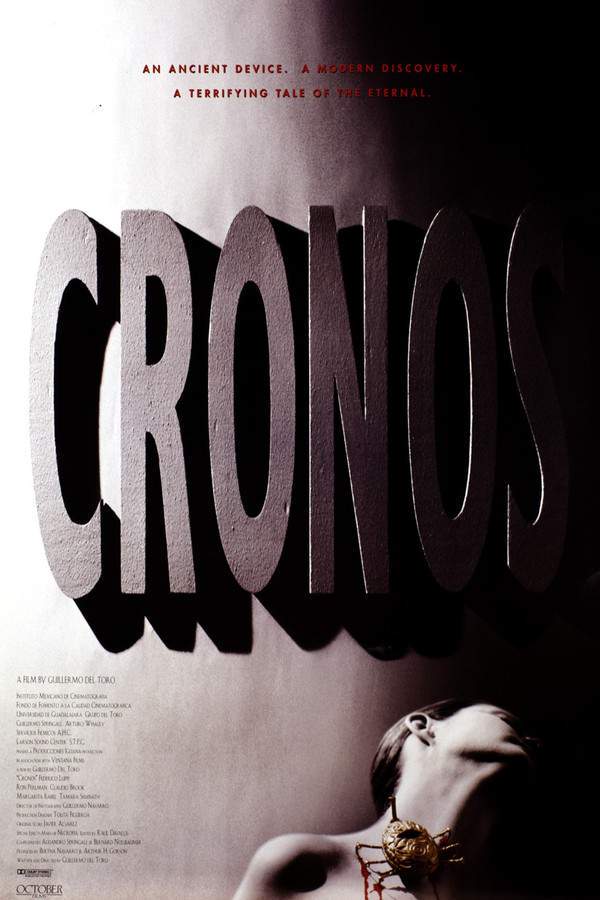
Cronos (1994) movie poster

Timeline

Cronos (1994) Timeline Explained – Every Event in Order

Release, runtime and language
1994 · 94 min · English
Loading streaming availability…
Directed by
Guillermo del Toro
Starring
Ron Perlman, Federico Luppi

An aging antique dealer unexpectedly acquires an ancient artifact, the Cronos scarab, which grants him the gift of eternal youth and incredible vitality. However, his newfound life comes with a dark side – an insatiable thirst for blood. As he struggles to control his condition and enjoy his extended lifespan, he finds himself hunted by those who seek to take the scarab back, forcing him to confront the dangerous consequences of immortality.

On this page (6)
  1. 1 Where to watch
  2. 2 Events in order (14)
  3. 3 Timeline questions answered
  4. 4 Movie threads
  5. 5 Movies like Cronos
  6. 6 Every angle
Loading streaming availability…

14 events in order · contains spoilers

Cronos Timeline: Events in Chronological Order

Every key event of Cronos (1994) in order, scene by scene, with when and where it takes place. Use it to untangle flashbacks, time jumps and parallel storylines, to refresh your memory before the sequel or to find the exact scene you are thinking of.

  1. Humberto Oganelli Arrives in Veracruz

    In 1536, the alchemist Humberto Oganelli arrives in Veracruz, Mexico, fleeing from the Inquisition that threatens his life. Seeking refuge, he quickly establishes himself as the official watchmaker for the viceroy, setting the stage for his remarkable inventions.

    When
    1536
    Where
    Veracruz, Mexico
  2. The Quest for the Cronos Device Begins

    While in Veracruz, Oganelli embarks on an ambitious quest to perfect his invention known as the Cronos device. He believes it can unlock the secret to eternal life, a goal that consumes his thoughts and drives his every action.

  3. Building Collapse Reveals a Mystery

    Fast forward to 1937, a tragic event occurs when a building collapses, leading to the discovery of a man with skin like marble, mortally wounded. This man, revealed to be Oganelli, utters the mysterious words 'Sua tempore' as he dreams of eternal life.

    When
    1937
  4. The Grisly Scene is Discovered

    Authorities are horrified by the gruesome scene of a human male found hanging upside down, his blood draining into a basin. This shocking discovery raises numerous questions about the circumstances surrounding Oganelli's death and the Cronos device.

  5. De la Guardia's Obsession

    De la Guardia, a millionaire and collector of archangel statues, unknowingly seeks the Cronos device, which he has dedicated his life to finding. His obsession leads him to track down the potential key to his immortal desires.

  6. The Archangel Statue Appears

    The coveted archangel statue, containing the hidden Cronos device, comes into the possession of Jesús Gris. Unbeknownst to Jesús, this statue holds the key to power and immortality, setting him on a dark path of discovery.

  7. Activation of the Cronos Device

    When Jesús accidentally activates the Cronos device, he experiences horrific consequences. Mechanized claws emerge, inflicting agonizing wounds on his hand, marking the beginning of his agonizing transformation.

  8. Ángel De la Guardia's Desperate Mission

    Ángel de la Guardia, the nephew of De la Guardia, is sent to retrieve the archangel statue. His desperation leads him to commit murder, showcasing the lengths to which he will go to acquire the powerful device.

  9. Jesús's Transformation

    As Jesús grapples with the effects of activating the Cronos device, he discovers that it grants him immortality at a terrible cost. He develops an insatiable thirst for blood, and his physical appearance begins to transform, revealing a marble-like skin.

  10. Climactic Showdown

    In a climactic confrontation, Jesús, De la Guardia, and Ángel battle for control over the Cronos device. Though Jesús ultimately vanquishes his adversaries, he is left to deal with the terrifying realization of what he has unleashed.

  11. Destruction of the Cronos Device

    In a moment of profound clarity, Jesús decides to destroy the Cronos device, thereby rejecting the path to immortality it offers. This act symbolizes his ultimate choice between life and love versus the seductive power of eternal life.

  12. A Heartbreaking Farewell

    After destroying the device, Jesús prepares to return home to his granddaughter Aurora and his girlfriend Mercedes. He faces the tragic reality of his decisions, realizing that he must bid farewell to life as he knows it.

  13. Jorge's Narration

    The story is recounted by Jorge Martínez de Hoyos, who reflects on Oganelli's tale and the mysteries surrounding the Cronos device. His narration ties together the themes of sacrifice, love, and the heavy toll of immortality.

  14. Reflection on Transformation

    As Jesús acknowledges the transformation he has undergone, he feels the weight of his actions. His final declaration of 'NO!' resonates as he confronts the irreversible nature of his choices leading to tears and sorrow.

Last updated: November 04, 2024 at 00:13

Was this helpful?

Timeline questions answered

Cronos Timeline Explained: Your Questions Answered

When does it happen, and why in that order? The questions people ask about the chronology of Cronos (1994): time jumps, flashbacks, cause and effect between scenes and the correct order of events, each answered with spoilers.

Q1

Why does Jesús need blood after activating the Cronos device?

The Cronos device grants immortality by draining life force from others. When Jesús activates it, he develops an insatiable thirst for human blood because the device sustains his eternal life by consuming the blood of living people. This is the price of the immortality it provides, the device transforms him into something that must feed on others to survive.

Foreshadowing: The 1937 scene hints at this: Oganelli was found hanging upside down with his blood draining into a basin, showing the device's blood requirement.

  • blood hunger
  • cronos device
  • immortality cost
  • jesus gris transformation
Q2

How did the alchemist Oganelli die in 1937?

In 1937, Oganelli died when a building collapsed. The authorities discovered a gruesome scene: a man hanging upside down with his blood draining into a basin. This was Oganelli, still alive but mortally wounded with a fatal chest wound. He uttered "Sua tempore" before dying, revealing he had been using the Cronos device for centuries but finally succumbed to its physical toll.

Foreshadowing: The device's quest for eternal life began in 1536, suggesting centuries of use wore his body down.

  • humberto oganelli
  • 1937 building collapse
  • death scene
  • sua tempore
Q3

Why did Ángel kill someone to get the archangel statue?

Ángel de la Guardia was sent by his uncle De la Guardia to retrieve the archangel statue containing the Cronos device. When he arrived at the shop and discovered the statue was missing, because Jesús had already taken it, Ángel killed someone in his desperation to obtain the device. His brutal nature and desperation to fulfill his uncle's mission drove him to murder.

Foreshadowing: The narrative establishes Ángel as ruthless early on, showing he'll do anything to please his uncle.

  • angel de la guardia
  • murder
  • archangel statue
  • cronos device
Q4

What does "Sua tempore" mean and why does Oganelli say it?

"Sua tempore" is Latin for "in his time" or "in its time." Oganelli spoke these words as he lay dying in 1937, perhaps referring to the device's cycle of use and the inevitability of death despite immortality. The phrase reflects his long life and acceptance that even eternal life has its limits, his time with the device had finally ended.

Foreshadowing: This Latin phrase appears in the 1937 scene, hinting at the cyclical nature of the device's power.

  • sua tempore
  • latin phrase
  • humberto oganelli
  • dying words
Q5

How did the Cronos device end up inside the archangel statue?

Oganelli hid the Cronos device inside the archangel statue to protect it from the Inquisition and preserve it for future use. As an alchemist in 1536, he concealed his invention within religious artwork, a common practice to hide valuable or forbidden objects. The statue remained hidden for centuries until it surfaced in Jesús Gris's antique shop in the 1990s.

Foreshadowing: Oganelli fled the Inquisition in 1536, suggesting he needed to hide his invention carefully.

  • hidden device
  • archangel statue
  • concealment
  • alchemist oganelli
Q6

Why does Jesús destroy the Cronos device at the end?

Jesús destroys the Cronos device because he recognizes the horrifying transformation it has caused in him, the insatiable bloodlust and marble-like skin reveal he's becoming a monster. Despite offering immortality, the cost is too great: he would have to kill innocent people to survive. Choosing love and humanity over eternal cursed life, he shatters the device, accepting his eventual death.

Foreshadowing: Throughout the film, Jesús struggles with his growing bloodlust and physical transformation, showing his internal conflict.

  • destroy device
  • jesus choice
  • immortality reject
  • humanity over immortality
Q7

What is Ángel's relationship to De la Guardia?

Ángel de la Guardia is the nephew of De la Guardia, the wealthy millionaire who has spent his life searching for the Cronos device. Ángel serves as his ruthless enforcer, carrying out the dangerous missions to acquire the device. De la Guardia sends Ángel to retrieve the archangel statue, and Ángel's willingness to kill demonstrates his loyalty to his uncle's obsessive quest.

Foreshadowing: De la Guardia's lifelong search for the device establishes why he'd send his trusted nephew on this mission.

  • angel nephew
  • de la guardia uncle
  • family relationship
  • enforcer
Q8

Why does Jesús' skin turn marble-like after activating the device?

The marble-like skin is a physical side effect of the Cronos device's life-giving power. When Oganelli used the device for centuries, he developed the same appearance, skin resembling marble. This transformation signifies the body being preserved beyond natural limits, turning living tissue into something stone-like and eternal. Jesús experiences the same deterioration as he uses the device.

Foreshadowing: The 1937 scene describes Oganelli with skin like marble, foreshadowing Jesús' same fate.

  • marble skin
  • physical transformation
  • cronos effects
  • jesus appearance
Q9

Why does De la Guardia want the Cronos device so badly?

De la Guardia is a dying millionaire who has spent his entire life collecting archangel statues in search of the Cronos device. Facing mortality, he desperately wants the device's power of eternal youth and immortality. His obsession stems from wanting to escape death and live forever, making him willing to kill and hunt down anyone who possesses the device.

Foreshadowing: The wealthy collector's obsession with archangel statues throughout the film establishes his single-minded pursuit.

  • de la guardia motivation
  • immortality desire
  • wealthy collector
  • eternal youth
Q10

How does the Cronos device actually work?

The Cronos device is an ancient alchemical invention that grants eternal life and youth. When activated, mechanical claws emerge and wound the user, seemingly transferring life force into their body. However, this comes at a terrible cost, the user develops an insatiable thirst for human blood to sustain their immortal state, and their physical body gradually transforms into a marble-like substance.

Foreshadowing: The activation scene shows the mechanical claws gripping Jesús and wounding him, initiating the transformation.

  • device mechanism
  • how it works
  • eternal life machine
  • alchemical invention
Q11

What happens to Jesús at the end of the movie?

After destroying the Cronos device, Jesús returns home to his granddaughter Aurora and girlfriend Mercedes. However, he knows his fate is sealed, without the device sustaining him and with his body already transformed, he will eventually die. His final tearful farewell to Aurora represents his choice to be human rather than live forever as a bloodthirsty monster.

Foreshadowing: Jesús' earlier reluctance to use the device and his horror at his transformation set up this tragic choice.

  • jesus death
  • farewell aurora
  • tragic ending
  • reject immortality

Movie threads

More Movies Like Cronos, by Mood & Story

Curated lists built around what makes Cronos tick: the same mood, the same kind of story or the same emotional payoff. Each list explains why these movies belong together.

Movies about cursed immortality like Cronos

Stories where the gift of eternal life becomes a horrifying burden. If you liked Cronos for its tragic take on eternal life, explore these movies where the pursuit of immortality leads to horror. These films share themes of moral corruption, body horror, and the heavy price of power, offering similar dark and melancholic stories about the burden of living forever.

  • gothic
  • tragic
  • body horror
  • melancholic
  • unsettling
  • atmospheric
  • Tone: dark, tragic, melancholic
  • Pacing: steady, methodical
Why these movies?

The story pattern: The narrative typically follows a protagonist who gains immortality or extreme longevity through an ancient artifact, pact, or accident. Initially a boon, this power soon reveals a horrific downside, corrupting the user and forcing them into a desperate struggle to control their new nature or find a way out, often culminating in a tragic sacrifice.

Why they belong together: Movies in this thread are united by their bleak exploration of immortality as a source of horror rather than wonder. They share a dark tone, high emotional weight, and a focus on the physical and psychological decay that accompanies the rejection of natural death, creating a consistent vibe of tragic grandeur.

Gothic body horror movies with a slow burn like Cronos

Atmospheric tales where dread and physical transformation unfold slowly. Fans of Cronos's atmospheric dread and grotesque transformation will appreciate these movies. This selection focuses on stories with a gothic feel, a steady pacing that builds unease, and a central theme of bodily decay or change, all wrapped in a layer of profound melancholy.

  • atmospheric
  • unsettling
  • melancholic
  • body horror
  • gothic
  • tragic
  • Tone: dark, melancholic, unsettling
  • Pacing: steady, atmospheric slow burn
Why these movies?

The story pattern: These stories often unfold at a deliberate pace, allowing the atmosphere and sense of unease to build. The central conflict is frequently internal, as a character undergoes a physical metamorphosis that mirrors a psychological or spiritual decline. The setting is often decaying or antiquated, enhancing the themes of mortality and loss.

Why they belong together: These films are grouped by their unique blend of a gothic aesthetic, a steady and atmospheric pacing, and a focus on body horror as a source of tragic melancholy. The shared mood is one of deep unease and sorrow, making the viewing experience consistently heavy and contemplative.

If you liked this

Movies Like Cronos

Similar movies to Cronos: the same genre, themes or kind of story. Each one comes with its own plot summary, timeline and ending explained.

Browse all movie summaries

Every angle

Cronos (1994) Explained: Plot, Timeline & Characters

Everything about Cronos in one place: what happens in the plot summary, the timeline in chronological order, the characters and meaning and a spoiler-free summary. What's After the Movie adds the cast, box office and post-credit scenes.

Coming soon on iOS and Android

The Plot Explained Movie Summary App

Plot summaries, endings explained and timelines on your phone. Catch up on any movie in minutes, save your favorites and never miss a twist again.

Be the first to know when we launch. Your email stays private, always.

Learn more about the app