Year: 1975
Runtime: 101 mins
Language: English
Director: Steve Carver
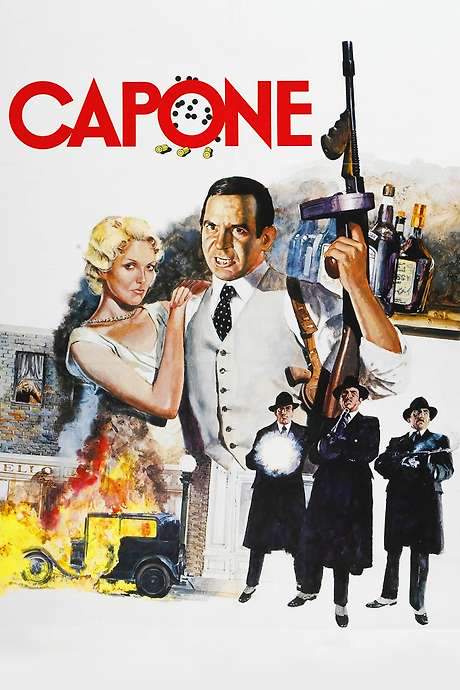
Young Al Capone draws the attention of Johnny Torrio, a visiting Chicago gangster. Torrio brings him to Illinois to oversee a Prohibition‑era alcohol racket during the 1920s. Capone rapidly ascends Torrio’s crew, eventually seizing control, eliminating rivals, rigging elections and amassing wealth, while courting the principled Iris Crawford.
Find where to stream, rent, or buy Capone (1975) in the US with current JustWatch availability, up-to-date pricing, and platform listings for subscription, rental, and digital purchase options.
Warning: spoilers below!
Haven’t seen Capone yet? This summary contains major spoilers. Bookmark the page, watch the movie, and come back for the full breakdown. If you're ready, scroll on and relive the story!
Trace every key event in Capone (1975) with our detailed, chronological timeline. Perfect for unpacking nonlinear stories, spotting hidden connections, and understanding how each scene builds toward the film’s climax. Whether you're revisiting or decoding for the first time, this timeline gives you the full picture.
Last updated: October 09, 2025 at 11:25
Find frequently asked questions about the Capone (1975) timeline, including chronological order, nonlinear jumps, cause-and-effect links, and scene sequence clarifications. This timeline FAQ helps explain when key events happen, how moments connect, and why the story unfolds in that specific order.
Capone killed Jim Colosimo in the back of a restaurant to remove a roadblock to Johnny Torrio's bootlegging plans. Colosimo was an old-school boss who resisted the shift to Prohibition-era alcohol smuggling, so Torrio and Capone orchestrated his elimination so they could move forward with their more profitable criminal enterprise.
The decision to recruit Capone to Chicago was specifically to enforce the bootlegging operation that Colosimo opposed.
Iris Crawford was a dancer and barmaid who was romantically involved with Capone and helped him rise in the Chicago underworld. She was killed during a Moran attack on Capone's bistro on February 7, 1929. Her death devastated Capone and intensified his resolve to destroy Moran's organization, leading directly to the warehouse massacre shortly after.
Iris had been a key figure in Torrio and Capone's operations since the early bootlegging days.
Capone was convicted of multiple federal tax evasion charges in 1931, not for the murders or bootlegging he was known for. Federal authorities couldn't build cases on his criminal activities due to widespread corruption, so they prosecuted him for failing to pay taxes on his illegal income. He received an eleven-year sentence and was sent to Alcatraz, marking the end of his dominance in Chicago.
Throughout the film, Capone boasted he was untouchable as long as corruption protected him.
Johnny Torrio decided to leave America for Italy after surviving an ambush shooting in January 1925. With Capone's heat growing and constant threats targeting the organization, Torrio chose to step away rather than continue living under constant danger. He handed control of the Chicago Outfit to Capone, who then consolidated power as the new leader.
Torrio had been shot at before and faced mounting pressure from rival gangs and law enforcement.
On February 14, 1929, Capone's men dressed as police officers and executed seven members of Bugs Moran's North Side gang at a warehouse on Chicago's North Side, including the Gusenberg brothers. This brutal attack was Capone's retaliation for Moran's escalating feud and Iris Crawford's death. The massacre marked the pinnacle of Capone's ruthlessness and ultimately provided the evidence authorities needed to pursue him more aggressively.
The feud had been building since O'Banion's death and Moran's challenges to Capone's authority.
Hymie Weiss was killed in a rooftop shooting on September 20, 1926, ordered by Capone as retaliation for a drive-by shooting on Capone's hotel. Weiss had been a key rival and his death represented a major escalation in the gang wars. After the attempted drive-by, Capone responded with the hit that eliminated Weiss and his men, cementing Capone's dominance over Chicago's underworld.
Weiss had been a persistent threat since the early territorial disputes following the Joliet ambush.
The feud between Capone and Bugs Moran began after the death of Dion O'Banion, who Moran had allied with. As Capone consolidated power, Moran emerged as the primary challenger for control of Chicago's North Side. The conflict escalated with mutual attacks, culminating in Moran's role in Iris Crawford's death and Capone's subsequent warehouse massacre that decimated Moran's organization.
The territorial divisions established after the Joliet ambush created lasting rivalries.
Capone maintained that he was untouchable as long as he could buy off politicians and law enforcement. He cultivated relationships with corrupt officials, including District Attorney Robert E. Crowe, whom he repeatedly humiliated by hinting at exposing his corruption. This network of bribery and political protection allowed him to operate openly despite numerous crimes, until federal tax evasion charges finally circumvented local corruption.
Multiple scenes show Capone taunting authorities with his immunity from local prosecution.
Capone contracted syphilis earlier in his life, and by the late 1930s while imprisoned in Alcatraz, doctors confirmed the disease had progressed and would erode his mind. The diagnosis explained his deteriorating mental state, memory loss, and behavioral changes. By the time he reached Palm Island for his final decline, his health had completely deteriorated due to the untreated illness.
The film depicts Capone's increasing mental confusion in the final chapters.
Joe Aiello refused to work with Capone and instead allied with Bugs Moran against the Chicago Outfit. Nitti, Capone's trusted enforcer, planted a car bomb that killed Aiello on September 21, 1926. This eliminated another rival and reinforced Nitti's role as Capone's most loyal and ruthless lieutenant in the ongoing war for control of Chicago's criminal empire.
Nitti had already proven his loyalty through multiple crucial operations for Capone.
Discover curated groups of movies connected by mood, themes, and story style. Browse collections built around emotion, atmosphere, and narrative focus to easily find films that match what you feel like watching right now.
Chroncling the brutal ascent and inevitable, lonely downfall of a criminal kingpin.If you liked the intense, tragic story of Al Capone's rise and fall, explore more movies like it. This collection features similar gritty crime dramas about ambitious gangsters who build empires only to face a bleak and inevitable downfall, perfect for fans of heavy, character-driven organized crime stories.
The narrative typically follows a linear or biographical path, tracing the protagonist's climb from obscurity to immense power. This rise is often fueled by ruthless tactics, strategic violence, and political corruption. The second half of the story focuses on the empire's instability, internal betrayals, and the protagonist's physical or moral collapse, culminating in a sad or bleak ending that underscores the futility of their quest for power.
Movies in this thread are united by their focus on the tragic arc of a single powerful figure within a criminal underworld. They share a dark tone, high intensity from constant power struggles, and a heavy emotional weight stemming from the protagonist's moral and physical decay. The pacing is often fast, driven by a relentless series of strategic moves and violent conflicts.
Stories where the pursuit of power corrupts absolutely, leading to a dark end.For viewers who appreciated the dark and heavy tone of Capone, this section collects movies with a similar vibe. Discover films that explore the corrosive nature of power, featuring fast-paced narratives, high-stakes violence, and characters whose ambitions lead them into profound moral decay, resulting in a somber conclusion.
These stories often depict a protagonist's gradual or rapid loss of ethical boundaries in their quest for dominance. The plot is driven by escalating conflicts, betrayals, and acts of violence that erode the character's humanity. The central conflict is internal as much as external, charting a psychological descent into ruthlessness that culminates in a hollow victory or a complete personal downfall.
These films are grouped by their shared exploration of corruption and the heavy price of power. They create a cohesive experience through a consistently dark tone, high emotional intensity, and fast pacing that mirrors the protagonist's chaotic ascent. The unifying element is the focus on the psychological and moral unraveling of a central figure.
Don't stop at just watching - explore Capone in full detail. From the complete plot summary and scene-by-scene timeline to character breakdowns, thematic analysis, and a deep dive into the ending - every page helps you truly understand what Capone is all about. Plus, discover what's next after the movie.
Read a complete plot summary of Capone, including all key story points, character arcs, and turning points. This in-depth recap is ideal for understanding the narrative structure or reviewing what happened in the movie.
Discover the characters, locations, and core themes that shape Capone. Get insights into symbolic elements, setting significance, and deeper narrative meaning - ideal for thematic analysis and movie breakdowns.