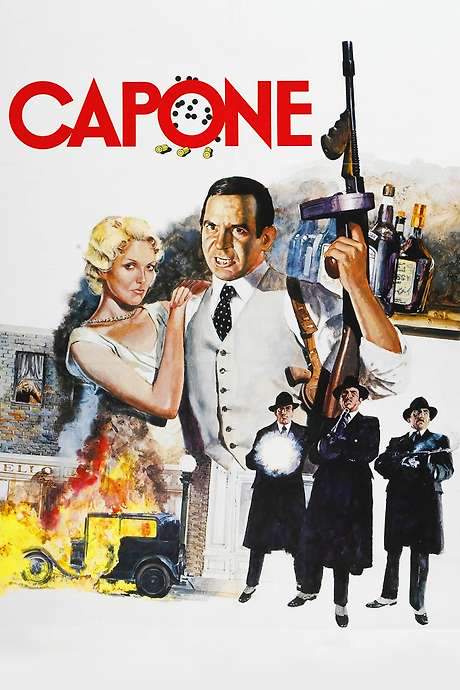
Year: 1975
Runtime: 101 mins
Language: English
Director: Steve Carver
Young Al Capone draws the attention of Johnny Torrio, a visiting Chicago gangster. Torrio brings him to Illinois to oversee a Prohibition‑era alcohol racket during the 1920s. Capone rapidly ascends Torrio’s crew, eventually seizing control, eliminating rivals, rigging elections and amassing wealth, while courting the principled Iris Crawford.
Find where to stream, rent, or buy Capone (1975) in the US with current JustWatch availability, up-to-date pricing, and platform listings for subscription, rental, and digital purchase options.
Warning: spoilers below!
Haven’t seen Capone yet? This summary contains major spoilers. Bookmark the page, watch the movie, and come back for the full breakdown. If you're ready, scroll on and relive the story!
Explore the full timeline and setting of Capone (1975). Follow every major event in chronological order and see how the environment shapes the story, characters, and dramatic tension.
Last updated: October 04, 2025 at 15:29
Meet the key characters of Capone (1975), with detailed profiles, motivations, and roles in the plot. Understand their emotional journeys and what they reveal about the film’s deeper themes.
Last updated: October 04, 2025 at 15:29
Explore the central themes of Capone (1975), from psychological, social, and emotional dimensions to philosophical messages. Understand what the film is really saying beneath the surface.
Last updated: October 04, 2025 at 15:29
Browse frequently asked questions about Capone (1975) focused on characters, relationships, themes, symbols, setting, and story context. This movie info FAQ gives spoiler-aware explanations for character arcs, world details, and thematic interpretation so readers can better understand what the film is really about.
The movie primarily takes place in Chicago, following Capone's rise in the Prohibition-era underworld. It also shows earlier scenes in Brooklyn where Capone begins his criminal activities, along with nearby towns like Joliet and Cicero. The story then moves to Alcatraz for his imprisonment and concludes on Palm Island, Florida, where he spends his final years.
The film spans from 1918 through 1946, covering Capone's emergence in the early Prohibition era of the 1920s, his rise to power, his 1931 tax evasion trial, imprisonment at Alcatraz, and his eventual death in 1946. The narrative captures the entire arc of his criminal empire and its collapse.
The movie explores three core themes: Power, depicting how Capone builds influence through fear and strategic violence; Law vs. Crime, showing the legal battle culminating in his tax evasion case; and Violence & Rivalry, depicting the brutal gang warfare and turf conflicts that define his ascent and eventual downfall.
Al Capone (played by Ben Gazzara) is portrayed as a ruthless, calculating mob boss who rises from street-level crime in Brooklyn to control the Chicago Outfit. He uses brutality, political corruption, and strategic violence to build his bootlegging empire, with personal loyalty and revenge driving many of his decisions.
Frank Nitti (Sylvester Stallone) is Capone's trusted enforcer and eventual successor. He coordinates the Outfit's operations, maintaining order among the gang while navigating threats from rivals and authorities. His role represents the loyal lieutenant who carries out Capone's directives and eventually inherits leadership of the organization.
Johnny Torrio (Harry Guardino) is Capone's mentor and the boss who brings him to Chicago. He organizes alliances and orchestrates violence with cold pragmatism, paving the way for Capone's rise by consolidating bootlegging operations. His strategic approach enables the transition of power from the old guard to Capone's leadership.
Iris Crawford (Susan Blakely) is a dancer and barmaid who becomes Capone's central companion. She represents a personal anchor amid the violence of the criminal world and later becomes a casualty of the gang wars. Her relationship adds emotional weight and illustrates the human cost of Capone's ambitions.
Prohibition serves as the economic engine driving the entire narrative. The ban on alcohol creates the bootlegging industry that makes Capone's fortune possible. The era's political corruption allows his empire to flourish, while the eventual repeal of Prohibition in 1933 weakens his business model and contributes to his legal downfall through tax evasion charges.
The Power theme examines how Capone builds influence through fear, strategy, and control of territory. It emphasizes the personal costs of seeking power and shows how authority built on violence and intimidation is ultimately brittle. The narrative demonstrates that power attained through brutality creates unstable foundations that eventually crumble.
The Law vs. Crime theme depicts the legal system's struggle against organized crime, showing how prosecutors eventually topple Capone through a tax evasion case rather than direct charges for his crimes. It illustrates how the system can mobilize to challenge even powerful criminals when traditional prosecution fails, highlighting the blurry line between justice and criminality.
Chicago represents the epicenter of Prohibition-era organized crime, where bootlegging and turf wars define power dynamics. The city's political corruption and violent gang landscape create the perfect environment for Capone's ascent. Chicago also symbolizes both the height of his power and the arena where his empire ultimately crumbles through relentless violence and rivalry.
Discover curated groups of movies connected by mood, themes, and story style. Browse collections built around emotion, atmosphere, and narrative focus to easily find films that match what you feel like watching right now.
Chroncling the brutal ascent and inevitable, lonely downfall of a criminal kingpin.If you liked the intense, tragic story of Al Capone's rise and fall, explore more movies like it. This collection features similar gritty crime dramas about ambitious gangsters who build empires only to face a bleak and inevitable downfall, perfect for fans of heavy, character-driven organized crime stories.
The narrative typically follows a linear or biographical path, tracing the protagonist's climb from obscurity to immense power. This rise is often fueled by ruthless tactics, strategic violence, and political corruption. The second half of the story focuses on the empire's instability, internal betrayals, and the protagonist's physical or moral collapse, culminating in a sad or bleak ending that underscores the futility of their quest for power.
Movies in this thread are united by their focus on the tragic arc of a single powerful figure within a criminal underworld. They share a dark tone, high intensity from constant power struggles, and a heavy emotional weight stemming from the protagonist's moral and physical decay. The pacing is often fast, driven by a relentless series of strategic moves and violent conflicts.
Stories where the pursuit of power corrupts absolutely, leading to a dark end.For viewers who appreciated the dark and heavy tone of Capone, this section collects movies with a similar vibe. Discover films that explore the corrosive nature of power, featuring fast-paced narratives, high-stakes violence, and characters whose ambitions lead them into profound moral decay, resulting in a somber conclusion.
These stories often depict a protagonist's gradual or rapid loss of ethical boundaries in their quest for dominance. The plot is driven by escalating conflicts, betrayals, and acts of violence that erode the character's humanity. The central conflict is internal as much as external, charting a psychological descent into ruthlessness that culminates in a hollow victory or a complete personal downfall.
These films are grouped by their shared exploration of corruption and the heavy price of power. They create a cohesive experience through a consistently dark tone, high emotional intensity, and fast pacing that mirrors the protagonist's chaotic ascent. The unifying element is the focus on the psychological and moral unraveling of a central figure.
Don't stop at just watching - explore Capone in full detail. From the complete plot summary and scene-by-scene timeline to character breakdowns, thematic analysis, and a deep dive into the ending - every page helps you truly understand what Capone is all about. Plus, discover what's next after the movie.
Read a complete plot summary of Capone, including all key story points, character arcs, and turning points. This in-depth recap is ideal for understanding the narrative structure or reviewing what happened in the movie.
Track the full timeline of Capone with every major event arranged chronologically. Perfect for decoding non-linear storytelling, flashbacks, or parallel narratives with a clear scene-by-scene breakdown.