Plot Explained Spoilers guaranteed!
Plot Explained

Browse by genre

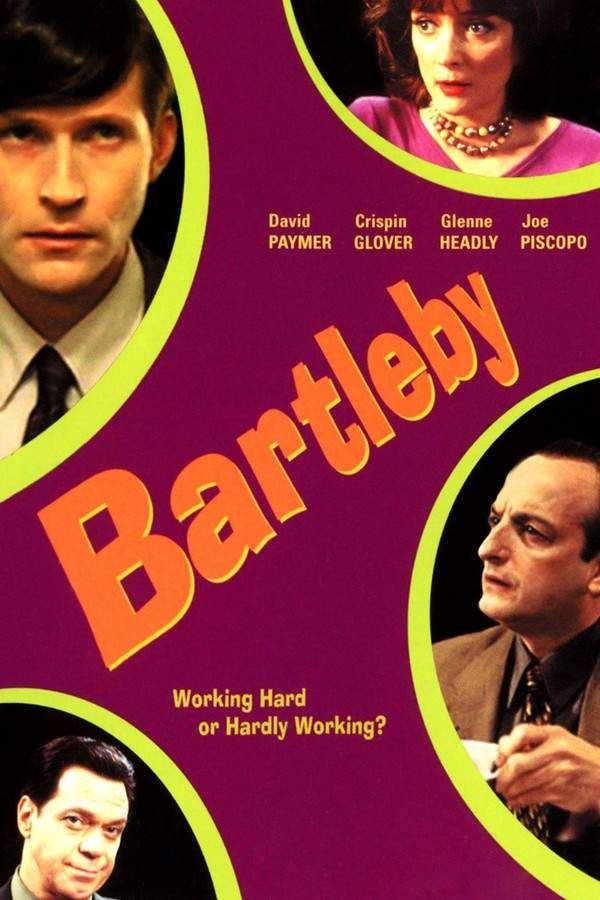
Bartleby (2002) movie poster

Plot Summary

Bartleby (2002) Plot Summary Explained

Release, runtime and language
2002 · 83 min · English
Loading streaming availability…
Directed by
Jonathan Parker
Starring
David Paymer, Crispin Glover

A meticulous manager's orderly existence is disrupted by a newly hired employee who initially impresses with his diligence. However, the worker soon begins to resist assigned tasks, declaring his inability to comply. This unusual situation challenges the manager's understanding of productivity and raises questions about the nature of work itself, leading to an increasingly tense and bizarre relationship.

On this page (7)
  1. 1 Where to watch
  2. 2 What happens: full plot
  3. 3 Plot questions answered
  4. 4 The book behind the movie
  5. 5 Movie threads
  6. 6 Movies like Bartleby
  7. 7 Every angle
Loading streaming availability…

Full plot summary · contains spoilers

What Happens in Bartleby: Full Plot Summary

The whole story of Bartleby (2002) explained, from the opening scene to the final frame: every key event, every twist and what it all adds up to. Read it as a quick recap before the sequel, to check a scene you missed, or to finally understand what really happened.

On a routine drive to work, the Boss David Paymer—the unnamed manager of a public records office perched on a hill that’s completely inaccessible by foot—spots a man standing on an overpass. His office sits in a building atop that steep hill, and his small staff includes Ernest, an overweight, neurotic klutz; Rocky, who dresses and acts like a stereotypical mobster; and Vivian, a verbose, flirtatious, bluntly honest receptionist. To prepare for a predicted rise in workload, the Boss posts a fourth job, and the only applicant who shows up is the man from the overpass: Bartleby Crispin Glover.

Bartleby explains that he worked at a dead letter office for eight years until the office moved, but otherwise gives vague answers to the Boss’s questions. Bartleby’s quiet, off‑kilter demeanor unsettles the Boss, yet with no other options, he hires him. At first, Bartleby is a model employee, completing a week’s worth of work in just a few days. However, when asked to verify important documents, he refuses, delivering his signature refrain: “I would prefer not to.” The staff grow irritated as Bartleby stubbornly confines himself to the one task of filing papers and stares for long stretches at a vibrating vent above his desk. When the Boss brings a date to the office late one night, Bartleby walks in on them, and the Boss discovers that Bartleby has begun living there.

The Boss makes several attempts to reason with Bartleby and to learn something about his life, while noticing that the word “prefer” has crept into the staff’s vocabulary as well. Bartleby soon refuses to do any more filing, insisting that he has “given up working,” and the Boss fires him, giving him until Friday night to leave. When the Boss returns Monday morning, Bartleby has not left, and tension rises as one of the Boss’s associates wonders why Bartleby is still there but not working. Realizing that Bartleby threatens his reputation, the Boss relocates his office to another building, hoping to rid himself of the problem, and, before leaving, provides Bartleby with a letter of recommendation while a repairman removes a dead bird from the vent above Bartleby’s desk.

A few days later, the new owner of the old office and the Boss’s former landlord arrive, insisting that someone help with Bartleby; though he is now out of a job, Bartleby remains, sleeping in the hallway. The Boss insists that Bartleby is no longer his problem but concedes under pressure. He tries again to reason with him, offering help to find a job Bartleby would enjoy, but Bartleby declines every suggestion. After the Boss leaves, Bartleby is arrested and then released onto the streets.

Learning that Bartleby is wandering the city, the Boss searches for him and finds him weak and delirious from starvation in a homeless camp, having “preferred not to” eat anymore. In an unexpected turn, the Boss invites Bartleby to come live with him until they can make better arrangements, but Bartleby refuses this offer as well. The Boss then hurries to a nearby soup kitchen to persuade a cook to feed Bartleby, but the cook remains uncompassionate and makes him wait in a long line. By the time the Boss returns with food, Bartleby has died. Finding Bartleby’s letter of recommendation in his coat, the Boss realizes that it, too, is a dead letter and walks away in despair toward the old overpass.

Sometime later, the Boss has resigned from his job and written a memoir about his time with Bartleby. When he pitches the manuscript to a publishing agent, she finds the subject matter too depressing and refuses to publish. In a moment of defiance, the Boss demands that Bartleby’s story be told, and when the agent tells him to leave, he retorts “I would prefer not to!” The agent simply tells him to stay, and as the film ends, his gaze drifts to a vibrating vent and the image of several isolated office buildings perched atop hills like the Boss’s former home.
Last updated: October 09, 2025 at 15:37

Was this helpful?

Plot questions answered

Bartleby Plot Explained: Your Questions Answered

The questions people ask most about Bartleby (2002): what happens in the confusing scenes, why the characters do what they do, the twists, hidden details and what the ending means. Each answer contains spoilers.

Q1

Why does Bartleby refuse to work?

Bartleby's refusal stems from his previous job at a dead letter office, where he spent eight years handling undeliverable mail. This experience seems to have broken his sense of purpose, he's already experienced the futility of labor that leads nowhere. When he says he 'prefers not to' perform tasks, he's not being defiant; he's genuinely unable to engage with work that he perceives as meaningless. His refusal escalates until he claims to have 'given up working' entirely.

Foreshadowing: Early in the film, Bartleby's background at a dead letter office hints at his eventual complete withdrawal from work.

  • bartleby refusal work motivation dead letter office
Q2

What does Bartleby's phrase 'I would prefer not to' mean?

The phrase is Bartleby's polite but absolute refusal to engage with any task. Unlike a direct refusal, 'prefer' suggests a personal limitation rather than defiance. The Boss initially interprets it as negotiable, but the phrase becomes increasingly absolute, Bartleby eventually uses it to refuse food and shelter. The phrase spreads to the office staff, showing how Bartleby's passive resistance infects the workplace culture.

Foreshadowing: Bartleby's first use of the phrase when asked to verify documents establishes his pattern of non-engagement.

  • i would prefer not to bartleby phrase refusal meaning
Q3

Why does the Boss continue caring about Bartleby even after firing him?

The Boss cannot let go because Bartleby represents a failure in his identity as a manager and his belief in productivity. After firing Bartleby, the Boss relocates his office hoping to escape the problem, but when the new owner and landlord demand help with Bartleby, he returns. The Boss feels personally responsible, even after Bartleby is arrested and released, he searches for him and invites him to live together. The Boss's obsession with resolving the situation stems from needing to prove his control over his own life and workplace.

Foreshadowing: The Boss's early decision to hire Bartleby despite his unsettling demeanor shows his tendency to take responsibility for situations others would reject.

  • boss bartleby responsibility firing guilt management
Q4

Why does Bartleby start living in the office?

Bartleby appears to have nowhere else to go. After being fired and given until Friday to leave, he remains in the building, sleeping in the hallway. The office has become his entire world, he fixates on the vibrating vent and has no apparent connections outside work. His living there isn't a power play but rather a continuation of his disconnection from normal life; the office represents both his last anchor to productivity and his only shelter.

Foreshadowing: Bartleby's vague answers about his past and his lack of other job prospects hint at his social isolation.

  • bartleby living office homeless shelter isolation
Q5

Why does the Boss move his office but still feel responsible for Bartleby?

The Boss attempts to solve the problem physically, by relocating, but this fails because the problem is psychological and ethical, not spatial. When the new owner and his former landlord arrive demanding help with Bartleby, the Boss realizes he cannot escape the moral weight of his connection to Bartleby. His move is an avoidance mechanism that doesn't address his underlying guilt about hiring Bartleby and failing to understand him.

Foreshadowing: The Boss's move mirrors his earlier attempt to manage problems through logistics rather than confrontation.

  • boss moves office responsibility guilt escape
Q6

Why does Bartleby refuse the Boss's offer to live with him?

Bartleby's refusal represents the final stage of his withdrawal from existence. He has 'preferred not to' engage with everything, work, food, shelter, and this offer is simply another task he cannot bring himself to accept. His inability to accept help isn't ingratitude but a complete cessation of desire. The Boss's invitation comes too late; Bartleby has already decided to stop participating in life.

Foreshadowing: Bartleby's earlier statement that he has 'given up working' foreshadows his eventual giving up on living altogether.

  • bartleby refuses help death starvation withdrawal
Q7

What is the significance of Bartleby's previous job at the dead letter office?

The dead letter office handles mail that cannot be delivered, letters addressed to nonexistent places or people. Bartleby spent eight years processing these undeliverable messages, a job that literally dealt with failures to communicate. This experience shaped his worldview: work that produces nothing, efforts that lead nowhere, and correspondence that never reaches its destination. The Boss later finds the letter of recommendation he wrote for Bartleby has also become a 'dead letter', another undeliverable message in a film full of failed connections.

Foreshadowing: The dead letter office establishes the film's theme of futility and failed communication that recurs throughout.

  • dead letter office bartleby past work futility meaning
Q8

Why does Bartleby starve himself to death?

Bartleby starves himself because he has withdrawn from all participation in life, not just work. When the Boss finds him at the homeless camp, Bartleby explains he has 'preferred not to' eat anymore. His refusal is consistent, saying no to everything, including the basic act of survival. His death isn't suicide in the dramatic sense but the logical endpoint of his philosophy: if nothing matters, neither does eating. The Boss's attempt to save him by waiting in the soup kitchen line comes too late.

Foreshadowing: Bartleby's statement that he has 'given up working' foreshadows his giving up on life entirely.

  • bartleby starvation death homeless refusal food
Q9

What does the ending mean when the Boss says 'I would prefer not to'?

In the final scene, after his memoir is rejected, the Boss defiantly shouts Bartleby's phrase at the publishing agent. This moment shows that Bartleby's influence has completely consumed him. By adopting Bartleby's refusal, the Boss rejects the publishing world's rejection of his story, but also rejects engagement entirely. His gaze drifting to a vibrating vent shows he's internalized Bartleby's passive withdrawal. The ending suggests the Boss has become Bartleby, trapped in his own office of the mind, unable to escape the philosophical prison their relationship created.

Foreshadowing: The Boss's growing use of 'prefer' throughout the film builds to this complete adoption of Bartleby's philosophy.

  • boss ending i would prefer not to adoption influence
Q10

What is the significance of the vibrating vent that Bartleby stares at?

The vibrating vent represents the only thing that captures Bartleby's attention after he stops working. It becomes a metaphor for meaningless stimulus, something that moves and makes noise but produces nothing. The Boss later fixates on the same vent in the closing shot, suggesting the vent symbolizes the empty grind of office life that both characters are trapped in. The repairman removing a dead bird from the vent before the Boss moves adds a layer: the vent is where dead things end up, just as Bartleby eventually dies.

Foreshadowing: Bartleby's prolonged staring at the vent early in the film establishes it as a key symbol that recurs at the end.

  • vibrating vent symbol office meaninglessness dead bird
Q11

Why does the Boss resign and write a memoir about Bartleby?

The Boss resigns because his experience with Bartleby destroys his previous understanding of work and productivity. He can no longer function in the office system that his former life was built around. Writing the memoir is his attempt to make meaning from the encounter, to transform the unresolved situation into something concrete. When the agent rejects it as too depressing, the Boss's angry use of Bartleby's phrase shows he hasn't found peace with the experience.

Foreshadowing: The Boss's obsession with understanding Bartleby throughout the film leads naturally to his attempt to document it.

  • boss memoir resignation bartleby story publish
Q12

Why does the Boss walk toward the overpass at the end?

The Boss returns to the same overpass where he first saw Bartleby standing, completing a circular journey. This return signifies his inability to move past the encounter, he is literally walking back to where it began. The overpass, like Bartleby, represents a liminal space between worlds, neither here nor there. The Boss's final position mirrors his employee's initial one, suggesting he has become trapped in the same philosophical space Bartleby occupied.

Foreshadowing: The opening scene establishes the overpass as the site where their connection began, making the return thematically inevitable.

  • boss overpass ending return circular journey

Movie threads

More Movies Like Bartleby, by Mood & Story

Curated lists built around what makes Bartleby tick: the same mood, the same kind of story or the same emotional payoff. Each list explains why these movies belong together.

Existential Office Satire Like Bartleby

Stories where the absurdity of modern work reveals deeper existential crises. Find more movies like Bartleby that blend strange workplace comedy with heavy existential themes. If you enjoyed the bizarre quietude and slow-building absurdity of Bartleby's rebellion, you'll appreciate these similar satirical dramas about alienation at work.

  • absurd
  • melancholic
  • quirky
  • oppressive
  • reflective
  • bizarre
  • Tone: melancholic, absurd
  • Pacing: slow, deliberate
Why these movies?

The story pattern: Stories in this thread typically involve a stable, orderly world—often a corporate or bureaucratic setting—being disrupted by an inexplicable event or an enigmatic individual. The disruption is rarely violent or loud, but instead manifests as a quiet, passive resistance that forces the protagonist to question their own role within the system, leading to a psychological and philosophical unraveling.

Why they belong together: These films are grouped together by their unique blend of dry, often absurd humor with a pervasive sense of melancholy and existential weight. They share a focus on the dehumanizing aspects of modern labor, feature characters grappling with profound passivity or nonconformity, and maintain a slow, deliberate pacing that allows the psychological tension to build.

Quiet Character Studies Like Bartleby

Character-driven stories exploring the tragic lives of enigmatic nonconformists. Discover more melancholic dramas like Bartleby that focus on enigmatic, socially alienated characters. If you were captivated by the quiet tragedy of Bartleby's nonconformity and the heavy emotional weight of his story, these films offer similar poignant explorations of outsiders.

  • melancholic
  • desolate
  • reflective
  • quiet
  • tragic
  • lonely
  • Tone: melancholic, desolate
  • Pacing: slow, reflective
Why these movies?

The story pattern: The narrative follows an observer or a more conventional character as they encounter an enigmatic figure who defies easy explanation. The story is less about the outsider's internal perspective and more about the ripple effects of their presence and the futile attempts to 'save' or understand them, often culminating in a bleak or tragic outcome that highlights the fragility of human connection.

Why they belong together: These movies share a deep focus on character over plot, particularly characters who exist on the fringes. They are united by a melancholic tone, a slow pace that allows for contemplation, and a heavy emotional weight derived from themes of mental health, homelessness, and the ultimate loneliness of being fundamentally different.

If you liked this

Movies Like Bartleby

Similar movies to Bartleby: the same genre, themes or kind of story. Each one comes with its own plot summary, timeline and ending explained.

Browse all movie summaries

Every angle

Bartleby (2002) Explained: Plot, Timeline & Characters

Everything about Bartleby in one place: what happens in the plot summary, the timeline in chronological order, the characters and meaning and a spoiler-free summary. What's After the Movie adds the cast, box office and post-credit scenes.

Coming soon on iOS and Android

The Plot Explained Movie Summary App

Plot summaries, endings explained and timelines on your phone. Catch up on any movie in minutes, save your favorites and never miss a twist again.

Be the first to know when we launch. Your email stays private, always.

Learn more about the app