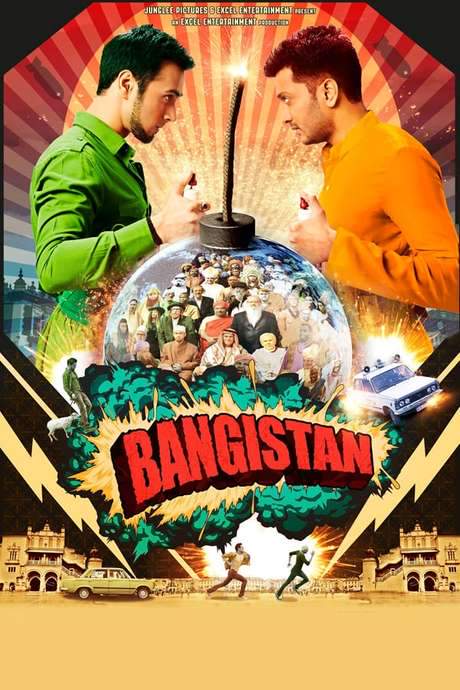
Bangistan
Year: 2015
Runtime: 135 mins
Language: Hindi
Director: Karan Anshuman
Two Aspiring Terrorists. One Identical Plan. No Damn Clue! Two blundering terrorists with lofty ideologies, but ordinary talent, on a mission to change the world.
Where to Watch Bangistan?
Find where to stream, rent, or buy Bangistan (2015) in the US with current JustWatch availability, up-to-date pricing, and platform listings for subscription, rental, and digital purchase options.



Streaming availability powered by 
Warning: spoilers below!
Haven’t seen Bangistan yet? This summary contains major spoilers. Bookmark the page, watch the movie, and come back for the full breakdown. If you're ready, scroll on and relive the story!
Bangistan (2015) – Full Plot Summary & Ending Explained
Read the complete plot breakdown of Bangistan (2015), including all key story events, major twists, and the ending explained in detail. Discover what really happened, and what it all means.
Bangistan, a fictional country split between Muslims in the north and Hindus in the south, sets the stage for a tense and entwined tale. Hafeez Bin Ali, Ritesh Deshmukh, is a Muslim call center worker who quits his job and becomes a terrorist after an imam persuades him to reach heaven through a suicide bombing at the World Religious Conference in Kraków, Poland. To cover his identity and his relationship with the cleric, Hafeez enters Poland as a Hindu named Ishwarchand Sharma.
Praveen Chaturvedi, Pulkit Samrat, is a Hindu kar sevak who holds deep reverence for godman Guruji, and he would not hesitate to use force against anyone who insults him. Tasked by Guruji, Kumud Mishra to attack the World Religious Conference, Praveen assumes the identity of a Muslim, Allah Rakha Khan. In Kraków, the two men quickly become friends, sharing a hotel room and, unexpectedly, falling in love with Rosie, an Indian waitress they meet in a bar, played by Jacqueline Fernandez.
The pair procure explosives—Hafeez from Polish sources and Praveen from Chinese dealers—and begin making bombs in their hotel rooms. When Praveen realizes Hafeez’s intent aligns with his own, the two men team up, while acknowledging the influence of their respective bosses. Yet tension erupts as they reveal each other’s true identities, a scuffle ensues, and the bomb is accidentally triggered, leading to their arrest.
Meanwhile, back in Bangistan, Guruji and the imam learn of the developing crisis and decide to press ahead with their own plan to carry out an attack. The imam sends a hitman to kill Hafeez in the hospital, while police move Hafeez and Praveen toward prison before they escape along the way. The two men choose to halt the bombing, unaware that the other remains in contact with Guruji.
At the World Religious Conference, Hafeez witnesses Praveen tying bombs to his body, unleashing another chaotic exchange that ends with a tense, mostly peaceful resolution. Hafeez manages to grab another bomb from a separate terrorist sent by the imam, but police intervene. The other terrorist reclaim his device and detonates it as Hafeez and Praveen leap to safety. The blast proves insufficient to kill them, and the moment is punctuated by the sly laughter of a Polish arms dealer on television: > "Useless bomb, must be Chinese" — a line that turns out to be true.
Last updated: October 03, 2025 at 06:45
Bangistan (2015) Plot Questions Answered – Summary FAQ
Explore frequently asked questions about Bangistan (2015) with spoiler-rich answers covering the full plot summary, major story beats, character motivations, hidden details, and ending meaning. This movie summary FAQ helps explain confusing scenes, plot twists, and narrative decisions in clear, searchable detail.
Why did Hafeez Bin Ali become a terrorist in Bangistan?
Hafeez was a Muslim call center worker who quit his job after an imam persuaded him that carrying out a suicide bombing at the World Religious Conference in Kraków would help him reach heaven. The imam manipulated him with religious ideology, convincing him that dying for this cause would guarantee paradise.
Why did Praveen Chaturvedi agree to attack the conference?
Praveen was a Hindu kar sevak who held deep reverence for Guruji, a godman. Guruji directly tasked him with attacking the World Religious Conference, and Praveen was willing to use force against anyone who insulted his beliefs. He assumed the Muslim identity Allah Rakha Khan to blend in with the expected attendees.
How did Hafeez and Praveen meet and become friends in Kraków?
Both terrorists arrived in Kraków under false identities, Hafeez as Hindu Ishwarchand Sharma and Praveen as Muslim Allah Rakha Khan. They were assigned to the same hotel room and quickly bonded over their shared mission, eventually discovering each other's true identities while falling in love with Rosie, an Indian waitress they met at a bar.
Their friendship begins immediately upon arrival in Kraków, hiding the gravity of their respective missions.
What caused the bomb to explode prematurely in the hotel?
Tension erupted when Hafeez and Praveen revealed each other's true religious identities, triggering a physical altercation. During the scuffle, the bomb they were building accidentally detonated, leading to their arrest by Polish police. The premature explosion was purely accidental, resulting from their fight rather than any planned sequence.
Why did Hafeez and Praveen decide to stop the bombing?
After bonding as friends and falling for Rosie, both men developed second thoughts about carrying out the attack. Their personal connection and the reality of what they were planning outweighed their ideological motivations. However, each remained unaware that the other was still secretly in contact with their respective spiritual leaders, Guruji and the imam.
Their friendship and shared romance with Rosie gradually shift their priorities away from the mission.
Who sent the hitman to kill Hafeez in the hospital?
The imam from Bangistan dispatched a hitman to kill Hafeez in the hospital. This occurred after the imam learned about the developing crisis in Kraków and decided to eliminate Hafeez, presumably to prevent him from revealing information about the terrorist plot or their connection.
What happened at the World Religious Conference in Bangistan?
At the conference, Hafeez witnessed Praveen tying bombs to his body, causing chaos. Security forces intervened as both men tried to communicate their intentions. A separate terrorist sent by the imam also attempted an attack. The situation devolved into confusion, with Hafeez attempting to grab another bomb device while police rushed to intervene.
How did Hafeez and Praveen survive the final bomb explosion?
The bomb planted by the other terrorist was detonated as Hafeez and Praveen jumped to safety. The explosion was insufficient to kill them, largely because the bomb turned out to be Chinese-made and therefore ineffective. The absurdity of their survival underscores the film's comedic tone.
What was the significance of the Chinese bomb joke at the end?
After the explosion, a Polish arms dealer appeared on television laughing that the bomb was "useless" and "must be Chinese", a line that proved accurate when the bomb failed to kill Hafeez and Praveen. This joke serves as the film's final twist, confirming the arms dealer's cynical observation and reinforcing the satirical nature of the story.
Why did Hafeez and Praveen use false religious identities?
Hafeez entered Poland as a Hindu named Ishwarchand Sharma to cover his identity as a Muslim terrorist and hide his relationship with the imam. Praveen assumed the Muslim identity Allah Rakha Khan to blend in with attendees at the World Religious Conference. Their reverse identities created the comedic foundation for their eventual friendship.

Explore Movie Threads
Discover curated groups of movies connected by mood, themes, and story style. Browse collections built around emotion, atmosphere, and narrative focus to easily find films that match what you feel like watching right now.
Satirical comedies with bumbling characters like Bangistan
Chaotic comedies where hopelessly incompetent characters attempt grand schemes.If you liked the hilarious ineptitude in Bangistan, you'll enjoy these movies featuring characters whose grandiose plans are thwarted by their own clumsiness. This collection highlights comedies and satires where the journey is a chaotic mess of accidental successes and failures, celebrating the humor in misguided ambitions.

Delta Farce
2007

2001: A Space Travesty
2000

Mission London
2010

Dutiful But Dumb
1941

Screwed
2000

Mortadelo & Filemon: Mission Implausible
2014

Get Smart’s Bruce and Lloyd Out of Control
2008

Idiots
2012

What's the Worst That Could Happen?
2001
Idiocracy
2006

The Adventures of a Rookie
1943

An Ache in Every Stake
1941

Going Overboard
1989

The Strange Case of the End of Civilization as We Know It
1977

Black Sheep
1996
Narrative Summary
Stories in this thread follow a linear path of escalating chaos. A protagonist or duo sets a lofty goal, but their complete lack of skill or foresight leads to a series of unintended consequences and slapstick mishaps. The plot is driven by these accidents, building to a climax where their plan spectacularly fails in a way that reinforces the satirical message, often resulting in an ironically positive outcome.
Why These Movies?
These movies are grouped by their shared comedic tone rooted in character incompetence. They blend fast-paced, chaotic events with a lighthearted and absurd mood, ensuring the viewing experience remains fun and farcical even when tackling darker subject matter through a satirical lens.
Absurdist satire movies like Bangistan that tackle dark topics
Using ridiculous humor and absurd situations to critique weighty societal issues.For viewers who enjoyed how Bangistan used comedy to explore religious extremism, this section features similar movies. Discover films that use absurd humor and farcical plots to provide sharp cultural commentary on serious subjects, making complex issues accessible and funny without losing their critical edge.

The Dictator
2012
Idiocracy
2006

Apocalypse Clown
2024

Quasi
2023

South Park: Bigger Longer & Uncut
1999

Zoolander
2001

Tere Bin Laden Dead or Alive
2016

The Campaign
2012
Death at a Funeral
2007
Bangistan
2015
Nerdland
2016

Fifty Shades of Black
2016

An Alan Smithee Film: Burn, Hollywood, Burn
1997

Anchorman 2: The Legend Continues
2013

Special Correspondents
2016
Narrative Summary
The narrative pattern involves taking a sobering real-world issue and placing it in a heightened, illogical reality. The characters are often exaggerated archetypes whose actions illuminate the flaws of the system or ideology being satirized. The plot unfolds through a series of increasingly absurd events that logically, yet hilariously, deconstruct the central theme, leading to a conclusion that underscores the satire's message.
Why These Movies?
These films share a unique blend of tone and thematic focus. They maintain a light, comedic vibe despite their dark premises by prioritizing absurdity and caricature over realism. The pacing is typically fast to keep the satire sharp and engaging, creating a coherent experience of thoughtful laughter.
Unlock the Full Story of Bangistan
Don't stop at just watching - explore Bangistan in full detail. From the complete plot summary and scene-by-scene timeline to character breakdowns, thematic analysis, and a deep dive into the ending - every page helps you truly understand what Bangistan is all about. Plus, discover what's next after the movie.
Bangistan Timeline
Track the full timeline of Bangistan with every major event arranged chronologically. Perfect for decoding non-linear storytelling, flashbacks, or parallel narratives with a clear scene-by-scene breakdown.

Characters, Settings & Themes in Bangistan
Discover the characters, locations, and core themes that shape Bangistan. Get insights into symbolic elements, setting significance, and deeper narrative meaning - ideal for thematic analysis and movie breakdowns.


