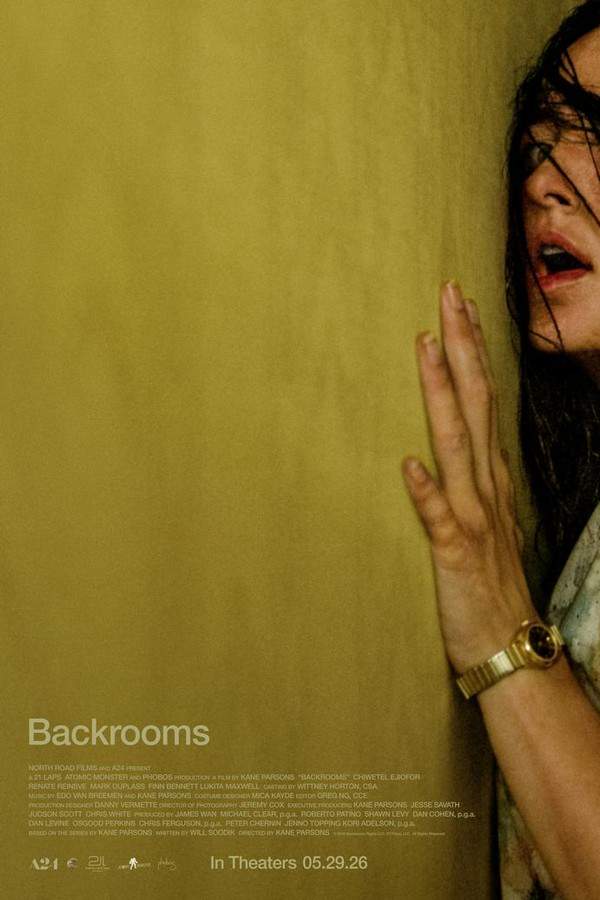
The film unfolds as two interwoven threads that circle around memory, obsession, and the uncanny topology of the Backrooms. It opens with a retro-theatrical pulse: a video tape from the 1990s and an unseen scientist, Naren Warne, wandering through a labyrinthine, liminal space. The camera wanders past scattered furniture in vast, empty halls, as Naren records everything he sees and radios for help. The tension builds as he discovers a room crowded with video and camera gear, and a sudden intrusion of a seagull shatters the silence. Naren presses on, pursued by a growling, ominous presence that thunders toward him. He stalls, he tries to escape, but the sequence ends in a brutal attack by an otherworldly entity and a cut to black, leaving the scientists who watch the footage with a gnawing ambiguity about what they have witnessed and what must remain unsaid.
The narrative then shifts to Clark, a furniture-store owner fighting to hold his business together in a cutthroat market. His storefront, Cap’n Clark’s Ottoman Empire, is a stage for conflict—between competition, alcohol-fueled frustration, and the pressure of keeping a life intact after a divorce. Clark seeks help from Dr. Mary Kline, a therapist who herself wrestles with memories of a destroyed childhood home and a mother institutionalized nearby. Their sessions bleed into the body of the story as Clark performs a kind of role-play with Mary, revisiting the fractures that shaped his marriage, his bitterness, and his simmering anger. The therapy sessions are both mirror and engine: they expose Clark’s vulnerabilities while pushing him toward a reckless certainty that he can reclaim something through action, even if it’s dangerous or unhinged.
In a bid to stage a promotional video for his store, Clark recruits Kat Taylor, his assistant manager, and her boyfriend Bobby Roberts. The shoot goes awry when a chair collapses beneath Clark, exposing a fragility beneath his swagger. Electrical problems in the store complicate matters, and an electrician’s foray into the basement reveals an ominous trio of diagonal switches that do not connect to the normal wiring of the shop. That moment foreshadows a door being opened—literally—between Clark’s world and a deeper, more unsettling space.
Late at night, Clark remains in the store, and the television he watches is interrupted by a broadcast from the Backrooms. Compelled, he returns to the basement, where a patch of light behind a wall invites him through. He steps into the Backrooms, a sprawling and disorienting expanse where the familiar becomes uncanny. He wanders in a state of shock until he happens upon a room containing a cardboard cutout of a man, voices speaking in many languages, and a floor thick with artifacts fused into the surface. Among these relics he discovers Naren’s badge, a chilling clue that makes the Backrooms feel both personal and historical. The encounter with the monstrous creature he glimpsed earlier pushes him into a frantic scramble back toward the store’s basement.
Back at Async Research Institute, a corporate entity bearing down on the project is Phil, who watches a recording of Clark in the Backrooms. The corporate angle injects a tone of calculated curiosity into the affair: behind the sensational sights lies a systematic motive to map, measure, and perhaps weaponize the unknown. Clark’s report of the Backrooms is dismissed by Mary as the product of alcohol withdrawal, a reaction she recognizes but cannot ignore. Yet Clark’s resolve hardens; he vows to return with proof and recruit Kat and Bobby to help collect data, to document what lies beyond the ordinary world.
Clark’s expedition into the Backrooms is more than a physical journey; it becomes a test of relationships and trust. He tapes off a boundary around the space and, with Kat and Bobby in tow, steps back into the otherworldly corridor. The descent is visceral: Bobby is lowered into a space of discarded clothing and blood-streaked fabric, a terrifying spectacle that underscores the danger lurking in the folds of the Backrooms. The creature’s pull drags Bobby into a hidden void, and Kat, driven by loyalty and fear, follows. In one chamber, Clark glimpses a room lit by a Christmas tree and encounters two humanoid figures—the Still Life—moving with a disturbing, mechanical purpose. The creature, a relentless force, seizes Clark’s camera as if reclaiming a memory that does not belong to him, and the trio is driven to a desperate, disjointed retreat.
Meanwhile, a voicemail from Clark reaches Mary, hinting at his disappearance with an ominous line: he says he is “never coming back.” The ominous import of that line deepens as Phil—now a witness at a different vantage—watches a Clark promotional spot on television and recognizes the man he has been following in a different light. Mary’s curiosity grows, and she ventures to Clark’s store, drawn by worry and an instinct to uncover the truth behind the strange omens she has sensed.
In the basement Mary finds a doorway to the Backrooms, a threshold that offers both danger and revelation. She enters a space that echoes her own psyche, where creepy drawings and the presence of the Still Life intensify the sense that the Backrooms are curated repositories of memory. Clark reappears in a horrifying re-creation—a dining room that looks like a stage set—where the Still Life have multiplied and filled the space with copies of ordinary lives. Clark tries to appeal to the grotesque version of himself in the form of Cap’n Clark, a final attempt to bargain with the powers of this liminal world. The Still Life, however, consumes him, leaving Mary to witness the collapse of his reality.
Mary’s flight through the Backrooms is a chase across a landscape drawn from her own past. She navigates a sequence of rooms that mimic her old neighborhood, finally emerging into a version of the store’s lobby. The Still Life persistently pursues her, and she counters with a resourceful, almost ritual act: she breaks the creature’s wooden leg and wields a rock—a tool she has kept since childhood, a remnant from the old driveway where she once made her hands leave prints. The encounter culminates in an alarm and a gas release, buying her the chance to escape back to the entry point she first used to enter the Backrooms. She is found by the scientists and brought to Async for interrogation.
In the interrogation room, Phil asks Mary to verify what she saw. She cannot fully articulate it, yet a quiet, unsettling smile remains on her face. The film closes by revealing that inside the Backrooms, spaces continue to be rebuilt from Mary’s memories, including a Still Life version of her sitting in that interrogation room. The story leaves the impression that the Backrooms are not just a place but a shadow archive of remembered people and moments, constantly reshaped by the memories of those who encounter them.
Overall, the film blends a thriller’s tension with a meditative meditation on memory, loss, and the ways in which personal histories can be weaponized or exploited by inhuman spaces. It keeps the pulse of a mystery while threading through it the intimate, domestic anxieties of Clark, Mary, and the others whose lives brush against the unknown. The Backrooms emerge not merely as a setting but as a living, changing archive, where the past continually resurfaces as new rooms, new echoes, and new versions of the people who cross its thresholds.