Plot Explained Spoilers guaranteed!
Plot Explained

Browse by genre

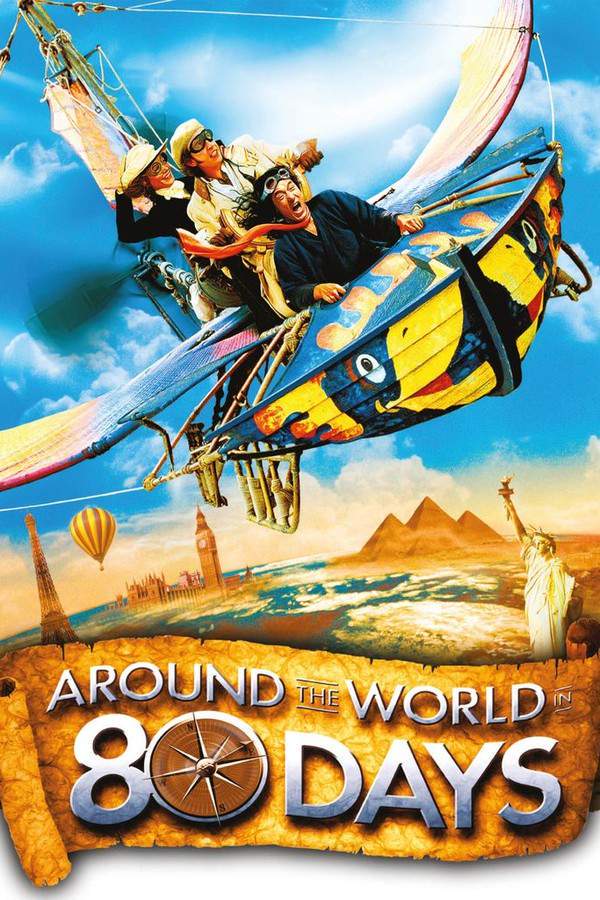
Around the World in 80 Days (2004) movie poster

Plot Summary

Around the World in 80 Days (2004) Plot Summary Explained

Release, runtime and language
2004 · 120 min · English
Loading streaming availability…
Directed by
Frank Coraci
Starring
Jackie Chan, Jim Broadbent, Steve Coogan
Budget
$110M

A wealthy British inventor wagers he can circumnavigate the globe in just 80 days. Joined by his resourceful valet and a determined French police detective, he embarks on a fast-paced and exciting journey filled with unexpected challenges and colorful characters as they race against the clock across continents.

On this page (7)
  1. 1 Where to watch
  2. 2 What happens: full plot
  3. 3 Plot questions answered
  4. 4 The book behind the movie
  5. 5 Movie threads
  6. 6 Movies like Around the World in 80 Days
  7. 7 Every angle
Loading streaming availability…

Full plot summary · contains spoilers

What Happens in Around the World in 80 Days: Full Plot Summary

The whole story of Around the World in 80 Days (2004) explained, from the opening scene to the final frame: every key event, every twist and what it all adds up to. Read it as a quick recap before the sequel, to check a scene you missed, or to finally understand what really happened.

A Chinese man named Lau Xing, played by Jackie Chan, finds himself in a precarious situation after robbing the Bank of England. As he looks out from a window in desperation, he witnesses two police officers in pursuit of him, prompting him to cleverly assume a new identity as "Passepartout" (pronounced Pass-par-too). He cleverly becomes the valet to the brilliant scientist Phileas Fogg, portrayed by Steve Coogan, who has an ambitious goal of breaking the elusive 50-mph speed limit.

After successfully pushing the boundaries of speed, the duo heads towards the Royal Academy of Science, where they are met with skepticism from the self-satisfied Lord Kelvin, magnificently portrayed by Jim Broadbent. Kelvin dismisses the significance of new discoveries, proclaiming that the age of innovation is over. In this heated gathering, the recent bank robbery becomes a hot topic, igniting Fogg's rage. “I’m glad the bank was robbed!” he declares vehemently, branding it a relic of the past. He embarks on a daring wager to circumvent the globe in 80 days, with the stakes being his potential appointment as Minister of Science—should he fail, he vows to dismantle his lab and abandon his dreams of invention.

After this pivotal moment, Passepartout and Fogg make a hasty departure from London. Their journey is far from straightforward; they encounter Inspector Fix, a corrupt officer intent on thwarting their ambitious quest. Their adventure takes them to Paris where Passepartout faces off against the dangerous minions dispatched by the ruthless General Fang, who is hunting for a stolen artifact—the Jade Buddha, a symbol of prosperity that Fang had previously gifted to Lord Kelvin in exchange for military backing in her schemes to conquer Lau Xing’s village.

To divert Phileas’s attention from the peril they face, Passepartout cleverly leads him to an Art School under the false pretense of attending a convention featuring Thomas Edison. Here, Fogg meets Monique, brilliantly played by Cécile De France, a budding impressionist whose artwork captures "impossible things," stirring the scientist's dreams of flight. In a comedic whirlwind, Passepartout uses his surroundings—canvases and paint buckets—as defense against their pursuers while Phileas finds inspiration in Monique’s art. Their escape in a hot-air balloon leads them toward the next leg of their adventure in Turkey.

Upon arriving in Turkey, they are welcomed by the flamboyant Prince Hapi, played by Arnold Schwarzenegger. However, the prince’s infatuation with Monique brings complications as he intends for her to become his seventh wife, which leads to a clever negotiation involving a statue that humorously mimics Rodin's 'The Thinker'. Despite their unorthodox tactics, they manage to escape from the prince’s clutches.

As word of the bank heist travels and with tensions rising, Lord Kelvin orchestrates a scheme to capture Fogg and his crew in India, where Passepartout learns of a bounty on his head. Through clever disguises, they slip past the authorities, only to find themselves under attack from Fang's mercenaries. Using quick wit and makeshift weapons, the trio manages to evade capture and reaches China.

Once in China, Lau Xing's true identity surfaces as a local warrior, transforming their quest into a deeper struggle regarding the Jade Buddha amidst the looming threat of General Fang's militia, the Black Scorpions. After a fierce battle, they find temporary refuge in Lau Xing’s village. However, when the village comes under siege, the tides of fate change as Lau Xing takes up the challenge against Fang’s forces, leading to a triumphant yet tumultuous victory.

As Phileas grapples with disappointment in his friends' hidden identities, he embarks alone to San Francisco, where he encounters trickery that leaves him penniless. Yet fate has other plans as he is reunited with Lau Xing and Monique. The trio continues their adventures, eventually discussing the revolutionary concept of flight with the Wright brothers, who share their unconventional designs.

Their journey culminates in New York, amidst bustling crowds and last-minute treachery as they attempt to board a ship back to London. Their final confrontation against General Fang’s minions leads to chaos, with stakes higher than ever as the clock ticks ominously. Ultimately, Phileas sacrifices his chance to board the ship to help his friends, who champion the bond of loyalty forged through shared trials.

Just when all seems lost, an old sailor offers them a vessel at sea, on which Phileas ingeniously constructs a flying machine using the remnants from the ship. With his friends, they embark on one final flight back to London, navigating through an intricate dance of fate against Lord Kelvin's machinations.

As they near the Royal Academy of Science, time hangs in peril, with Lord Kelvin confidently claiming his victory. However, as the truth about his deceit comes to light, justice prevails. In a spectacular twist, Phileas proves to be a day early due to the international date line, leading to a heartfelt reunion with Monique and a celebratory triumph over a remarkable journey that forever changes their destinies.
Last updated: January 13, 2025 at 13:49

Was this helpful?

Plot questions answered

Around the World in 80 Days Plot Explained: Your Questions Answered

The questions people ask most about Around the World in 80 Days (2004): what happens in the confusing scenes, why the characters do what they do, the twists, hidden details and what the ending means. Each answer contains spoilers.

Q1

Why did Phileas Fogg wager to travel around the world in 80 days?

Phileas Fogg made the wager in a moment of rage at the Royal Academy of Science. When Lord Kelvin dismissed new discoveries and the bank robbery was being discussed, Fogg declared he was glad the bank was robbed because it was a relic of the past. He then challenged the notion that the age of innovation was over by betting that he could circumnavigate the globe in 80 days, with the stakes being the position of Minister of Science.

Foreshadowing: This wager was foreshadowed by Fogg's earlier achievement of breaking the 50-mph speed limit, proving he was capable of impossible inventions.

  • phileas fogg
  • wager
  • 80 days
  • lord kelvin
  • bet
  • royal academy
Q2

How did Lau Xing become Passepartout?

After robbing the Bank of England, Lau Xing found himself trapped with police searching for him. He cleverly adopted the alias 'Passepartout' and assumed the role of a valet to Phileas Fogg, using the new identity to escape detection while working for the wealthy scientist.

Foreshadowing: The name 'Passepartout' (meaning 'passes through everything') hints at his ability to escape any situation.

  • lau xing
  • passepartout
  • valet
  • alias
  • bank robbery
  • disguise
Q3

Why is Lord Kelvin against Phileas Fogg?

Lord Kelvin is a self-satisfied scientist who proclaims the age of innovation is over. He dismisses Fogg's inventions and is threatened by new discoveries. Beyond professional jealousy, Kelvin has a secret connection to General Fang, he received the Jade Buddha from her in exchange for military backing to help her conquer Lau Xing's village. When Fogg threatens his plans, Kelvin orchestrates schemes to capture Fogg and steal his glory.

Foreshadowing: Kelvin's dismissal of Fogg's achievements at the Royal Academy hints at his deeper antagonism.

  • lord kelvin
  • general fang
  • jade buddha
  • villain
  • conspiracy
Q4

What is the Jade Buddha and why is it important?

The Jade Buddha is a stolen artifact that General Fang had previously gifted to Lord Kelvin in exchange for military support to conquer Lau Xing's village. It symbolizes prosperity and is central to the conflict between Fang and Lau Xing's community. The stolen Buddha becomes a key motivation driving the action in China and the final showdown.

Foreshadowing: The Jade Buddha's significance is revealed when they reach China and learn about the local conflict.

  • jade buddha
  • general fang
  • artifact
  • stolen
  • village
  • china
Q5

How did Phileas Fogg arrive a day early to win the bet?

Phileas Fogg won the bet because he crossed the international date line during his journey. When traveling eastward around the world, you gain a day. This meant that when he arrived in London, it was actually one day earlier than he calculated. This surprising twist allowed him to win the wager despite everyone believing he had failed.

Foreshadowing: The complexity of international travel and time zones was hinted at throughout the journey.

  • international date line
  • early arrival
  • time zones
  • win bet
  • twist
Q6

Why did Phileas sacrifice his chance to board the ship in New York?

In New York, as they attempted to board a ship back to London, they faced a final confrontation with General Fang's minions. Despite the clock ticking and their chances of winning the bet diminishing, Phileas chose to help his friends during the battle, sacrificing his own opportunity to secure passage. This act demonstrated his loyalty and the bond forged through their shared trials.

Foreshadowing: Their earlier conversations about friendship and loyalty foreshadowed this sacrifice.

  • phileas fogg
  • sacrifice
  • ship
  • new york
  • loyalty
  • friends
Q7

How did Phileas Fogg build a flying machine at sea?

After missing their ship in New York, an old sailor offered them a vessel at sea. Using remnants and materials from the ship, Phileas ingeniously constructed a makeshift flying machine. His skills as an inventor and the inspiration from his conversations with the Wright brothers about flight designs enabled him to create this final desperate attempt to reach London in time.

Foreshadowing: Phileas's earlier meeting with the Wright brothers and his inventive nature set this up.

  • flying machine
  • ship
  • sea
  • aircraft
  • wright brothers
  • invention
Q8

Why is Inspector Fix chasing Phileas Fogg and Passepartout?

Inspector Fix is a corrupt police officer who is intent on stopping their journey. After the bank robbery at the beginning of the film, Fix becomes determined to thwart their adventure, partly due to his own motivations and partly because word of the heist spreads. He pursues them across multiple continents, often working against them despite their innocence.

Foreshadowing: Fix appears early, establishing his antagonistic role from the start.

  • inspector fix
  • police
  • chase
  • bank robbery
  • pursuit
Q9

Why is General Fang hunting Lau Xing?

General Fang is hunting Lau Xing because he is a local warrior from the village she plans to conquer. She possesses the Jade Buddha, which she gave to Lord Kelvin in return for military backing. Lau Xing stands as a threat to her plans, making him a primary target. Her militia, the Black Scorpions, is sent to capture or eliminate him throughout their journey.

Foreshadowing: The film establishes Fang's threat early through mentions of her minions pursuing Passepartout.

  • general fang
  • lau xing
  • black scorpions
  • village
  • hunt
  • militia
Q10

Why does Monique join Phileas Fogg's journey?

Monique, an aspiring impressionist artist in Paris, joins the journey after meeting Phileas at the fake Edison convention. Her artwork captures 'impossible things,' which inspires Fogg's dreams of flight. She becomes romantically involved with Fogg and becomes an integral part of the team, contributing to their adventures across multiple continents.

Foreshadowing: Her artistic vision of impossible things foreshadows the flying machine's creation.

  • monique
  • artist
  • paris
  • impressionist
  • join journey
  • love interest
Q11

Why did Prince Hapi want Monique to become his wife?

In Turkey, Prince Hapi became infatuated with Monique upon meeting her. He intended to make her his seventh wife, creating a complication for the group. Passepartout and Fogg had to negotiate her release using a statue that humorously mimics Rodin's 'The Thinker' as leverage.

Foreshadowing: This subplot adds comedic tension while testing the group's problem-solving abilities.

  • prince hapi
  • turkey
  • monique
  • seventh wife
  • marriage
Q12

Why did Phileas Fogg travel alone to San Francisco?

After a disagreement stemming from discovering his friends' hidden identities, Phileas Fogg traveled alone to San Francisco. However, he was quickly tricked and robbed, leaving him penniless. Fortunately, he was reunited with Lau Xing and Monique, who helped him continue their adventure together.

Foreshadowing: The tension about hidden identities was building throughout their journey.

  • san francisco
  • alone
  • tricked
  • robbed
  • reunion

Movie threads

More Movies Like Around the World in 80 Days, by Mood & Story

Curated lists built around what makes Around the World in 80 Days tick: the same mood, the same kind of story or the same emotional payoff. Each list explains why these movies belong together.

Movies with globe-trotting adventure races like Around the World in 80 Days

High-stakes, fast-paced journeys across continents against a ticking clock. If you enjoyed the frantic pace and international escapades of Around the World in 80 Days, you'll like these movies. They feature high-stakes journeys, eccentric characters met along the way, and a constant push to beat the clock, offering a similar feel of lighthearted, fast-paced excitement.

  • adventurous
  • fast-paced
  • exciting
  • humorous
  • escapist
  • globetrotting
  • Tone: light, adventurous, humorous
  • Pacing: fast, relentless
Why these movies?

The story pattern: The narrative is driven by a high-concept premise, typically a bet or a challenge, that forces characters to travel the world at high speed. The plot is a linear sequence of action-packed set pieces in diverse locations, with obstacles solved through wit and improvisation. Character development is secondary to the forward momentum of the race.

Why they belong together: Movies in this thread share a core structure of a time-sensitive global quest. They are united by a light, adventurous tone, fast pacing that mirrors the urgency of the journey, and a focus on spectacle, humor, and the sheer fun of seeing characters overcome one improbable challenge after another.

Whimsical steam-punk adventure movies like Around the World in 80 Days

Eccentric inventors and fantastical contraptions in a slightly anachronistic world. Fans of the quirky inventor and fantastical vehicle elements in Around the World in 80 Days will enjoy these films. They share a lighthearted, optimistic tone and a world where anachronistic technology drives the adventure, creating a sense of wonder and humorous spectacle.

  • whimsical
  • inventive
  • quirky
  • optimistic
  • steampunk
  • lighthearted
  • Tone: whimsical, lighthearted, optimistic
  • Pacing: fast, steady
Why these movies?

The story pattern: The narrative often follows a brilliant but eccentric protagonist who uses their unconventional inventions to achieve an impossible goal or solve a major problem. The conflict is typically less about genuine danger and more about proving a point or winning a bet, resolved through cleverness and resourcefulness in a visually distinctive world.

Why they belong together: This thread groups movies based on their unique aesthetic—a blend of historical charm and speculative technology—and their light, whimsical tone. They share a sense of optimistic escapism, where intelligence and creativity triumph, and the world itself is a character full of visual marvels and humorous anachronisms.

If you liked this

Movies Like Around the World in 80 Days

Similar movies to Around the World in 80 Days: the same genre, themes or kind of story. Each one comes with its own plot summary, timeline and ending explained.

Browse all movie summaries

Every angle

Around the World in 80 Days (2004) Explained: Plot, Timeline & Characters

Everything about Around the World in 80 Days in one place: what happens in the plot summary, the timeline in chronological order, the characters and meaning and a spoiler-free summary. What's After the Movie adds the cast, box office and post-credit scenes.

Coming soon on iOS and Android

The Plot Explained Movie Summary App

Plot summaries, endings explained and timelines on your phone. Catch up on any movie in minutes, save your favorites and never miss a twist again.

Be the first to know when we launch. Your email stays private, always.

Learn more about the app