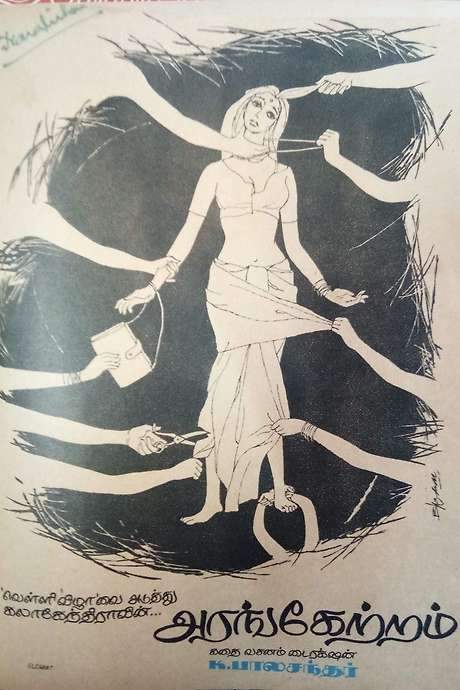
Ramu Shastrigal, S. V. Subbaiah, is a poor priest who lives with his wife Visalam and their eight children. His rigid principles and obstinate demeanor cast long shadows over their daily life, making it hard for the family to progress despite their efforts. When his spendthrift sister, Janaki, arrives with her daughter, the household’s already strained resources tighten further, amplifying the sense of penury that clings to them.
The eldest daughter, Lalitha, is full of energy and a desire to contribute to the family’s fortunes, but her father refuses to let her work. She forms a connection with the neighborhood elder Nadesa Udayar and his son Thangavelu. Thangavelu openly declares his love for Lalitha and hopes to marry her, but Udaiyaar refuses the match, and Thangavelu leaves in disappointment. Tragedy soon strikes when Thangavelu dies in a military conflict, leaving Lalitha and the family to cope with the loss.
Poverty gnaws at the family, and nights grow cold with hunger. Lalitha, moved by need, defies her father’s orders and, with Udaiyaar’s support, finds employment. Her income begins to lift the family’s spirits and improve their situation. Thyagu, Lalitha’s brother who aspires to become a doctor, pushes hard to secure a seat in a medical college, and Lalitha scrambles to help him realize that dream. In Madras, she encounters a man who takes advantage of her desperation for personal gain; he rapes her, a brutal violation she keeps to herself. Undeterred, she returns to work and later relocates to Hyderabad, where she earns a promotion and a higher salary. When she asks her employer for a salary advance to fund Thyagu’s admission, the same man reneges on his offer, demanding her sexual favors in return. Cornered by circumstance, Lalitha yields, and the man provides the money, a betrayal that deepens her sense of vulnerability.
As demands from her family mount, Lalitha makes the painful choice to supplement the meager earnings by turning to prostitution. While her family’s fortunes grow, she endures her suffering in silence. One day, Thangavelu arrives at Lalitha’s home under the guise of seeking a prostitute; the two are stunned to see each other. Thangavelu, who had faked his own death to provoke his father, is shaken to discover how far Lalitha has fallen, and he leaves in distress.
Years pass, and the siblings begin to prosper in their own right: Thyagu becomes a doctor, and Mangalam, Lalitha’s sister, rises as a singer. Devi, the younger sister, falls in love with Pasupathy, the son of a landlord, and their marriage is arranged. Lalitha returns home to a warm reception, but she is plagued by depression as she watches her mother become pregnant again and observes her parents’ perceived irresponsibility. On the day of Devi’s wedding, Lalitha faces a painful shock: Pasupathy, the Hyderabad client, is the groom. He goes through the ceremony in a mechanical fashion, and the wedding proceeds with a restrained, uneasy mood. Lalitha and Pasupathy share a private moment and vow to forget the past, moving forward in a fragile truce.
When Udaiyaar is about to perform the thevasam for his son, Lalitha intervenes and reveals that Thangavelu is alive, though she does not disclose the exact circumstances that connected them. Thyagu then falls in love with Bhama, a Tehsildar’s daughter, and their engagement is arranged. At Udaiyaar’s house, Lalitha’s parents confront Thangavelu about where he met Lalitha; he remains silent, but later confesses to his father what he knows. News of Lalitha reaches her parents, who are shocked and ultimately disown her. Udaiyaar, a man who understands her sacrifices, steps in to take Lalitha into his home and offer her dignity. He asks Thangavelu to marry her, and Thangavelu accepts. The weddings of Thangavelu and Lalitha and of Thyagu and Bhama proceed in parallel. Yet the enduring trauma Lalitha has endured leaves an indelible mark, and she finds herself sliding into insanity despite the generosity shown by Udaiyaar and Thangavelu.