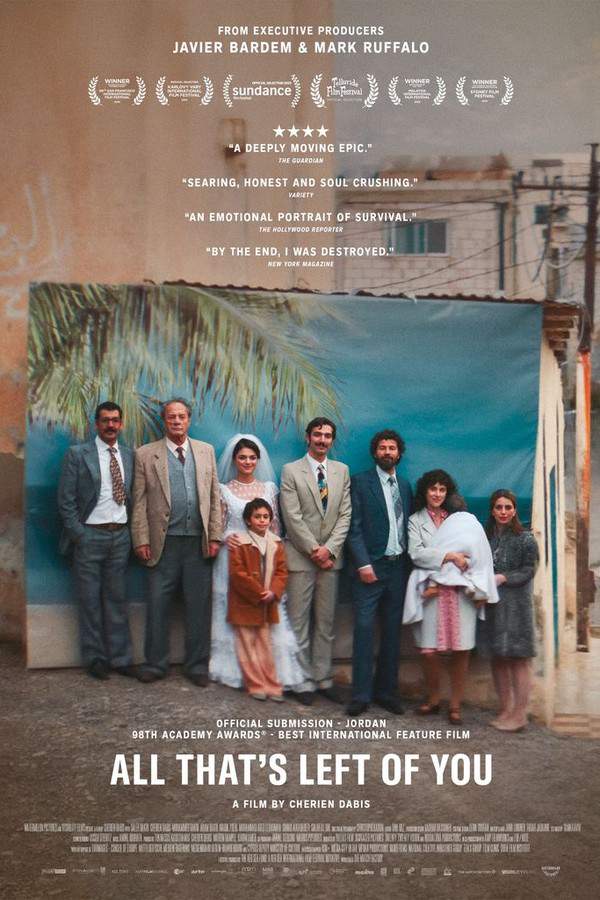
Following a tense confrontation between a Palestinian teenager and Israeli soldiers during a West Bank protest, his mother reflects on the events that brought him to that point. Her memories trace back to her father’s displacement, revealing a complex history of loss and resilience that has shaped their family’s experiences across generations.
Warning: spoilers below!
Haven’t seen All That’s Left of You yet? This summary contains major spoilers. Bookmark the page, watch the movie, and come back for the full breakdown. If you're ready, scroll on and relive the story!
Trace every key event in All That’s Left of You (2025) with our detailed, chronological timeline. Perfect for unpacking nonlinear stories, spotting hidden connections, and understanding how each scene builds toward the film’s climax. Whether you're revisiting or decoding for the first time, this timeline gives you the full picture.
Last updated: May 19, 2026 at 05:53
Find frequently asked questions about the All That’s Left of You (2025) timeline, including chronological order, nonlinear jumps, cause-and-effect links, and scene sequence clarifications. This timeline FAQ helps explain when key events happen, how moments connect, and why the story unfolds in that specific order.
Sharif chose to stay behind because he wanted to negotiate with the approaching Israeli forces to save his ancestral home. He believed he could reason with them and protect his land, but instead he was forcibly expelled and imprisoned. His stubborn hope was that his family ties to the land would outlast the conflict, even if it meant risking his own safety.
Earlier scenes show Sharif's deep attachment to Jaffa, hinting at his refusal to abandon his homeland.
Sharif was sent to a work camp where he endured months of hard labor under harsh conditions. He suffered a heart attack during this brutal ordeal, but was eventually allowed to reunite with his family. The experience hardened his resolve to safeguard his family and their heritage, shaping his character for the rest of his life.
The checkpoint scene was Noor's first direct encounter with the degrading reality of occupation. Watching his father Salim forced to degrade himself and his mother Hanan at gunpoint shattered Noor's perception of his father's cowardice. This humiliation catalyzed Noor's awakening, making him question his father's apparent submission and fueling his fierce sense of identity and resistance.
Earlier scenes show Noor as a curious child, setting up his transformation after this traumatic event.
Noor was radicalized by the checkpoint humiliation and his connection to his grandfather Sharif's unwavering patriotism. After schools closed and he was roaming the streets as a teenager, he joined the protest as a way to assert his identity and resistance. His injury reflects the deadly reality of these confrontations.
Noor's earlier skepticism of his father's cowering and his growing connection to Sharif's patriotism foreshadow his decision to join.
They feared that donating organs might help someone who could harm their people, but they also recalled that Salim's mother died from a kidney shortage. After seeking counsel from a sheikh, they decided to donate Noor's organs out of hope rather than fear. Their choice saved six children's lives, transforming their personal tragedy into medical mercy across divides.
Ari, as the heart recipient, represents the complex intersection of lives touched by conflict. He is wary of the intimate connection to Noor's story and speaks little during the encounter. His reservation reflects the lingering tensions between the two sides and the difficulty of processing personal histories intertwined with political struggle.
Finding Sharif's dilapidated ancestral home represents the endurance of memory and roots despite decades of exile. The house serves as a symbol of the family's displaced history and the stubborn persistence of identity across generations. It connects the present family to their past, making the missing pieces of their history feel almost reachable again.
The poem represents the intergenerational transmission of memory and hope. Salim shares a poem that Sharif once spoke to him seventy-four years earlier, sealing a circle across generations of exile and strife. The closing moment binds their memories to the coastline that shaped their identity, symbolizing resilience and continuity despite loss.
Noor was gravely wounded by Israeli fire and needed specialized medical care that wasn't available locally. They rushed him to Haifa, but bureaucratic delays and delayed permits threatened to deny him life-saving treatment. This highlights the additional obstacles faced under occupation, even in medical emergencies.
The story traces a direct lineage of trauma across generations. Sharif's expulsion and suffering in 1948 set the stage for the family's ongoing struggle. Noor's death is the tragic culmination of that inherited conflict, but the organ donation and the family's eventual return to Jaffa show how the cycle of loss can transform into hope and connection across decades.
Discover curated groups of movies connected by mood, themes, and story style. Browse collections built around emotion, atmosphere, and narrative focus to easily find films that match what you feel like watching right now.
Stories where the past's wounds shape the present across decades.Discover films that, like All That’s Left of You, explore how family legacies of loss and displacement shape the present. These powerful dramas use memory to connect generations and examine the enduring impact of political conflict.
These narratives often employ non-linear structures, jumping across time to reveal how a family's history of loss, displacement, or political violence directly informs the conflicts and identities of the present generation. The story is as much about uncovering the past as it is about surviving its legacy.
They share a focus on family as a vessel for historical pain, a melancholic tone steeped in reflection, and a complex narrative structure that weaves together timelines to show cause and effect across generations.
Intense stories of survival and dignity amidst overwhelming conflict.If you liked the heavy emotional weight and political tension of All That’s Left of You, explore these similarly intense dramas about resilience, loss, and the human cost of conflict.
The plot centers on characters caught in the machinations of a larger political conflict, often facing direct violence, humiliation, or loss. Their journey is not about victory, but about enduring, preserving their humanity, and finding small acts of resilience in a seemingly hopeless situation, leading to a bittersweet or tragic conclusion.
They are united by a high intensity stemming from realistic conflict, a heavy emotional weight dealing with profound loss, and a tone that is both oppressive in its realism and poignant in its portrayal of the human spirit.
Don't stop at just watching - explore All That’s Left of You in full detail. From the complete plot summary and scene-by-scene timeline to character breakdowns, thematic analysis, and a deep dive into the ending - every page helps you truly understand what All That’s Left of You is all about. Plus, discover what's next after the movie.
Read a complete plot summary of All That’s Left of You, including all key story points, character arcs, and turning points. This in-depth recap is ideal for understanding the narrative structure or reviewing what happened in the movie.
Discover the characters, locations, and core themes that shape All That’s Left of You. Get insights into symbolic elements, setting significance, and deeper narrative meaning - ideal for thematic analysis and movie breakdowns.