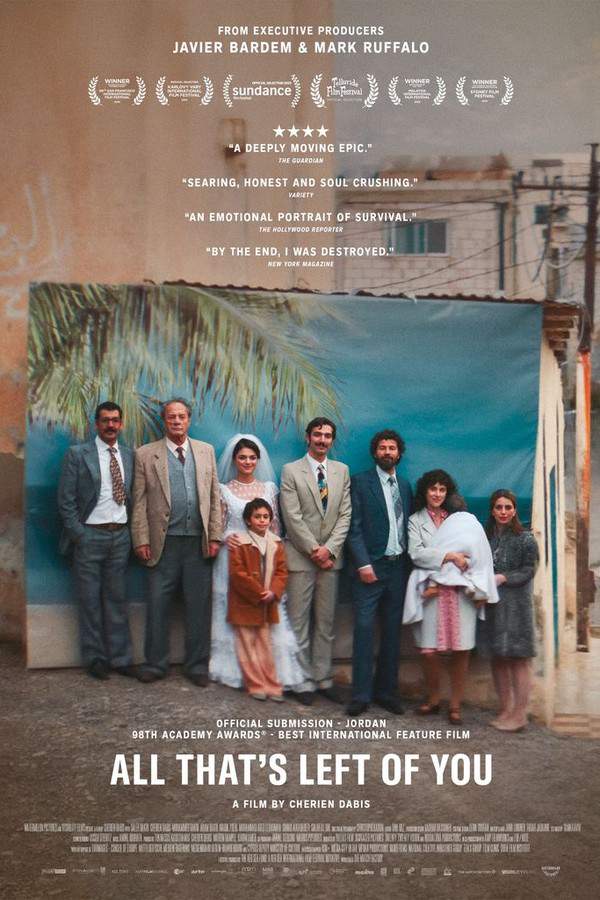
All That’s Left of You

All That’s Left of You

Year: 2025

Runtime: 145 mins

Language: Arabic

Echo Score: 83
Drama

Following a tense confrontation between a Palestinian teenager and Israeli soldiers during a West Bank protest, his mother reflects on the events that brought him to that point. Her memories trace back to her father’s displacement, revealing a complex history of loss and resilience that has shaped their family’s experiences across generations.

Warning: spoilers below!

Haven’t seen All That’s Left of You yet? This summary contains major spoilers. Bookmark the page, watch the movie, and come back for the full breakdown. If you're ready, scroll on and relive the story!

Timeline & Setting – All That’s Left of You (2025)

Explore the full timeline and setting of All That’s Left of You (2025). Follow every major event in chronological order and see how the environment shapes the story, characters, and dramatic tension.

Time period

1948–2022

The timeline begins with the 1948 bombardment of Jaffa, then jumps across decades: a 30-year gap showing a widowed Sharif, a 10-year advance, and a 34-year leap to the 2020s. It tracks Noor’s teenage activism, his death, and the organ-donation decision, culminating in a reunion in the early 2020s. This span highlights how history shapes personal lives across generations.

Location

Jaffa, Nablus, West Bank, Haifa, Tirat Carmel, Tel Aviv, Toronto, Amman

The film unfolds across a network of places in the Mediterranean region, beginning in Jaffa in 1948 and extending through Nablus and the wider West Bank. It later moves through Haifa and Tirat Carmel, then to Tel Aviv and the city’s Jaffa area, before the narrative travels to Toronto and Amman as the family rebuilds their lives. The geography mirrors displacement, diaspora, and the enduring ties to home that persist across generations.

🏙️ Middle East 🕊️ Conflict and displacement 🌍 Cross-border journeys

Last updated: May 19, 2026 at 05:53

Was this helpful?

Main Characters – All That’s Left of You (2025)

Meet the key characters of All That’s Left of You (2025), with detailed profiles, motivations, and roles in the plot. Understand their emotional journeys and what they reveal about the film’s deeper themes.

Salim (Saleh Bakri)

Sharif's son, a bridge between the older generation and the younger one, who bears the burden of protecting family and home. He endures the 1948 curfew incident where soldiers coerce him to degrade his wife in front of his son, an act that seeds Noor’s resentment and later radicalization. Over the years he remains a steadfast presence in the family, balancing fear, duty, and loyalty to his father’s memory.

👨‍👦 Family bond 💪 Resilience 🏳️ Patriotism

Young Sharif (Adam Bakri)

The younger version of Sharif, portrayed as a determined guardian of the family legacy who fights to protect their ancestral home. His efforts to negotiate with approaching Israeli forces underscore a resolve to keep the family together. His later experiences, including captivity, shape the enduring sense of duty that defines the family arc.

👨 Family duty 🛡️ Protection 🗺️ Heritage

Hanan (Cherien Dabis)

Salim’s wife and Noor’s mother, a pillar of resilience through tragedy. She endures the violence and the forced dispersions that mark the family’s life, and she participates in the fraught decision to donate Noor’s organs. Her arc moves from immediate loss to the long-term implications of Noor’s gift, including a poignant reunion in Toronto with the donor’s family.

👩‍👦 Family resilience 💪 Strength 🕊️ Faith

Teenage Noor (Muhammad Abed Elrahman)

The spirited son whose life is upended by political violence; his subsequent brain death becomes the central organ-donation decision. Noor’s growing disillusionment with his father’s perceived cowardice catalyzes his teenage radicalization, contrasting his vitality with the trauma surrounding him. His eventual legacy lives on through the lives saved by his organs.

🫶 Rebellion 💔 Loss 🧭 Identity

Ari (Dominik Maringer)

The only surviving Israeli recipient of Noor’s heart, Ari embodies the uneasy personal connections that can emerge across conflict lines. He is quiet, apprehensive, and does not speak readily, reflecting a cautious, non-confrontational path after receiving Noor’s organ. His relationship with Noor’s memory becomes a quiet counterpoint to the family’s struggle.

👤 Recipient 🫀 Healing 🤝 Connection

Older Sharif (Mohammad Bakri)

The elder patriarch whose legacy anchors the family’s memory of homeland and resistance. His passing marks a transition in the family’s life, yet his influence persists in guiding the younger generation’s sense of belonging and duty. His memories provide the emotional compass for the family’s later choices.

🕊️ Legacy 🧭 Guidance 🏞️ Homeland

Munira (Maria Zreik)

Sharif’s wife and matriarch whose presence spans the decades of displacement and reunion. She embodies the continuity of family memory across generations, shaping how the living carry forward the stories of the past. Munira’s role anchors the emotional depth of the family’s experience.

👩 Matriarch 🧶 Memory 💞 Family

Layla (Hayat Abu Samara)

Salim’s pregnant wife, a figure of continuity and hope amid hardship. She experiences the curfew and the strains of occupation, representing the generational thread that connects present struggles with past experiences. Layla embodies endurance and the promise of new life within a fractured landscape.

🤰 Expecting mother 🛡️ Support 🕊️ Hope

Young Amira (Julia Hamdan)

A younger member of the family, representing the next generation’s potential amid diaspora. Amira’s presence highlights the film’s theme of memory carrying forward into new lives abroad. Her arc underscores how youth inherit a legacy that must be navigated in a changed world.

👶 Child 🌍 Diaspora 🧭 Growth

Imam (Ismail Habbash)

A religious guide who offers counsel on Noor’s organ donation, helping the family navigate moral and spiritual considerations. The Imam’s presence frames the decision within a community’s values, offering a bridge between personal grief and collective ethics. His guidance reinforces the film’s exploration of faith and humanity.

🕋 Spiritual guidance 🙏 Faith 🗣️ Guidance

Last updated: May 19, 2026 at 05:53

Was this helpful?

Major Themes – All That’s Left of You (2025)

Explore the central themes of All That’s Left of You (2025), from psychological, social, and emotional dimensions to philosophical messages. Understand what the film is really saying beneath the surface.

🏚️ Displacement

Displacement drives the narrative as Sharif’s family is forced to leave their ancestral home in 1948 and navigate life across contested spaces. The film uses geography to show how homes become memories and people become migratory between communities. Across generations, the sense of loss and the struggle to hold onto a homeland shape choices and loyalties.

💭 Memory

Memory functions as a bridge between generations, preserving stories of sacrifices and the homeland. Noor, Ari, and the older generation carry memories of displacement, courage, and loss into new lives in Toronto and Jaffa. The past is continually re-told to inform present choices and to keep cultural identity alive.

🫀 Organ Donation

Organ donation becomes a moral and emotional test that transcends conflict, linking lives across communities. Noor’s heart saves a child in Israel, creating a human connection between former enemies. The family weighs survival against political identities, reframing Noor’s legacy as a shared gift rather than a simple tragedy.

Last updated: May 19, 2026 at 05:53

Was this helpful?

All That’s Left of You (2025) Character & Theme Questions Answered – Info FAQ

Browse frequently asked questions about All That’s Left of You (2025) focused on characters, relationships, themes, symbols, setting, and story context. This movie info FAQ gives spoiler-aware explanations for character arcs, world details, and thematic interpretation so readers can better understand what the film is really about.

Q1

Where is the movie set?

A.

The film spans multiple locations across the Mediterranean region and diaspora. It begins in Jaffa in 1948 during the bombardment, then moves through Nablus and the West Bank, followed by Haifa and Tirat Carmel. The story also travels to Tel Aviv's Jaffa area, and later to Toronto and Amman as the family rebuilds their lives across generations.

settinglocationsJaffaNablusWest BankTorontodiaspora
Q2

What time period does the movie cover?

A.

The narrative spans 74 years, starting from the 1948 bombardment of Jaffa and extending into the early 2020s. It jumps across decades with a 30-year gap showing Sharif as a widower, a 10-year advance, and a 34-year leap to the 2020s, tracking Noor’s teenage activism, his death, and the eventual family reunion.

time period19482020stimelinedecades
Q3

What are the main themes of the film?

A.

The movie explores three interconnected themes: Displacement, which shows how families are forced from ancestral homes and navigate contested spaces across generations; Memory, which functions as a bridge between generations preserving stories of sacrifice and homeland; and Organ Donation, which becomes a moral test linking lives across conflict lines and transcending political identities.

themesdisplacementmemoryorgan donationinheritance
Q4

What does the movie say about displacement?

A.

Displacement drives the narrative as Sharif’s family is forced to leave their ancestral home in 1948 and navigate life across contested spaces. The film uses geography to show how homes become memories and people become migratory between communities. Across generations, the sense of loss and the struggle to hold onto a homeland shape choices and loyalties.

displacementhomeland1948Nakbarefugee
Q5

Who is Noor in the story?

A.

Noor is the spirited Palestinian teenager whose life is upended by political violence. The son of Hanan and Salim, he becomes disillusioned with his father’s perceived cowardice, leading to his teenage radicalization. His subsequent brain death becomes the central organ-donation decision, and his legacy lives on through the lives saved by his organs.

Noorteenagerprotagonistradicalizationorgan donation
Q6

Who is Ari in the movie?

A.

Ari is the only surviving Israeli recipient of Noor’s heart. He is quiet, apprehensive, and does not speak readily, reflecting a cautious path after receiving the organ. His relationship with Noor’s memory becomes a quiet counterpoint to the family’s struggle, representing the human connections that can emerge across conflict lines.

AriIsraelirecipientheartreconciliation
Q7

What is the family's origin in the film?

A.

The family originates from Jaffa, where they lived in their ancestral home before the 1948 bombardment forced them to flee. Sharif, the patriarch, fought to protect the family and later experienced captivity. The family then dispersed across Nablus, Haifa, Toronto, and Amman, carrying memories of displacement across generations.

familyoriginJaffa1948ancestors
Q8

What does organ donation represent in the movie?

A.

Organ donation becomes a moral and emotional test that transcends conflict. Noor’s heart saves a child in Israel, creating a human connection between former enemies. The family weighs survival against political identities, reframing Noor’s legacy as a shared gift rather than a simple tragedy, a decision guided by the Imam within community values.

organ donationheartreconciliationmoralitysacrifice
Q9

How does the movie portray generational trauma?

A.

The film shows how historical trauma shapes personal lives across generations. The 1948 displacement and the humiliation of the curfew scene, where soldiers coerced Salim to degrade his wife in front of his son, seeds Noor’s resentment and later radicalization. Memory functions as both a burden and a bridge, with past stories continually retold to inform present choices.

generational traumamemoryinheritancefamily historypsychology
Q10

How does the setting shape the film's story?

A.

The geography mirrors displacement, diaspora, and the enduring ties to home that persist across generations. Moving between Jaffa, Nablus, Haifa, Tel Aviv, Toronto, and Amman shows how the characters navigate contested spaces. The physical locations reflect the emotional journey of a family trying to maintain identity while being scattered across borders.

settinggeographydiasporabordersidentity
Q11

Who is Sharif in the family?

A.

Sharif is the elder patriarch whose legacy anchors the family’s memory of homeland and resistance. Appearing in both younger and older versions, he is portrayed as a determined guardian of the family legacy who fought to protect their ancestral home. His passing marks a transition, yet his influence persists in guiding the younger generation’s sense of belonging and duty.

Sharifpatriarchfatherelderlegacy
Q12

What is the overall tone of the movie?

A.

The dominant tone is melancholic, defined by a persistent undercurrent of loss and reflection on past trauma. The intensity is high due to constant political violence, traumatic expulsions, and the emotional devastation of a child's death. However, it is not fully bleak, the ending is bittersweet, offering a moment of quiet connection and return to ancestral land, showcasing resilience despite overwhelming losses.

tonemelancholyendingresilienceemotional
Mobile App Preview

Coming soon on iOS and Android

The Plot Explained Mobile App

From blockbusters to hidden gems - dive into movie stories anytime, anywhere. Save your favorites, discover plots faster, and never miss a twist again.

Sign up to be the first to know when we launch. Your email stays private, always.

Explore Movie Threads

Discover curated groups of movies connected by mood, themes, and story style. Browse collections built around emotion, atmosphere, and narrative focus to easily find films that match what you feel like watching right now.

Movies about intergenerational trauma like All That’s Left of You

Stories where the past's wounds shape the present across decades.Discover films that, like All That’s Left of You, explore how family legacies of loss and displacement shape the present. These powerful dramas use memory to connect generations and examine the enduring impact of political conflict.

somberreflectivegrievingnostalgictragicresilient

Narrative Summary

These narratives often employ non-linear structures, jumping across time to reveal how a family's history of loss, displacement, or political violence directly informs the conflicts and identities of the present generation. The story is as much about uncovering the past as it is about surviving its legacy.

Why These Movies?

They share a focus on family as a vessel for historical pain, a melancholic tone steeped in reflection, and a complex narrative structure that weaves together timelines to show cause and effect across generations.


Intense political dramas like All That’s Left of You

Intense stories of survival and dignity amidst overwhelming conflict.If you liked the heavy emotional weight and political tension of All That’s Left of You, explore these similarly intense dramas about resilience, loss, and the human cost of conflict.

tenseoppressivetragicresilientgrievingsomber

Narrative Summary

The plot centers on characters caught in the machinations of a larger political conflict, often facing direct violence, humiliation, or loss. Their journey is not about victory, but about enduring, preserving their humanity, and finding small acts of resilience in a seemingly hopeless situation, leading to a bittersweet or tragic conclusion.

Why These Movies?

They are united by a high intensity stemming from realistic conflict, a heavy emotional weight dealing with profound loss, and a tone that is both oppressive in its realism and poignant in its portrayal of the human spirit.

Unlock the Full Story of All That’s Left of You

Don't stop at just watching - explore All That’s Left of You in full detail. From the complete plot summary and scene-by-scene timeline to character breakdowns, thematic analysis, and a deep dive into the ending - every page helps you truly understand what All That’s Left of You is all about. Plus, discover what's next after the movie.

All That’s Left of You Summary

Read a complete plot summary of All That’s Left of You, including all key story points, character arcs, and turning points. This in-depth recap is ideal for understanding the narrative structure or reviewing what happened in the movie.

All That’s Left of You Summary

All That’s Left of You Timeline

Track the full timeline of All That’s Left of You with every major event arranged chronologically. Perfect for decoding non-linear storytelling, flashbacks, or parallel narratives with a clear scene-by-scene breakdown.

All That’s Left of You Timeline

All That’s Left of You Spoiler-Free Summary

Get a quick, spoiler-free overview of All That’s Left of You that covers the main plot points and key details without revealing any major twists or spoilers. Perfect for those who want to know what to expect before diving in.

All That’s Left of You Spoiler-Free Summary

More About All That’s Left of You

Visit What's After the Movie to explore more about All That’s Left of You: box office results, cast and crew info, production details, post-credit scenes, and external links - all in one place for movie fans and researchers.

More About All That’s Left of You