Plot Explained Spoilers guaranteed!
Plot Explained

Browse by genre

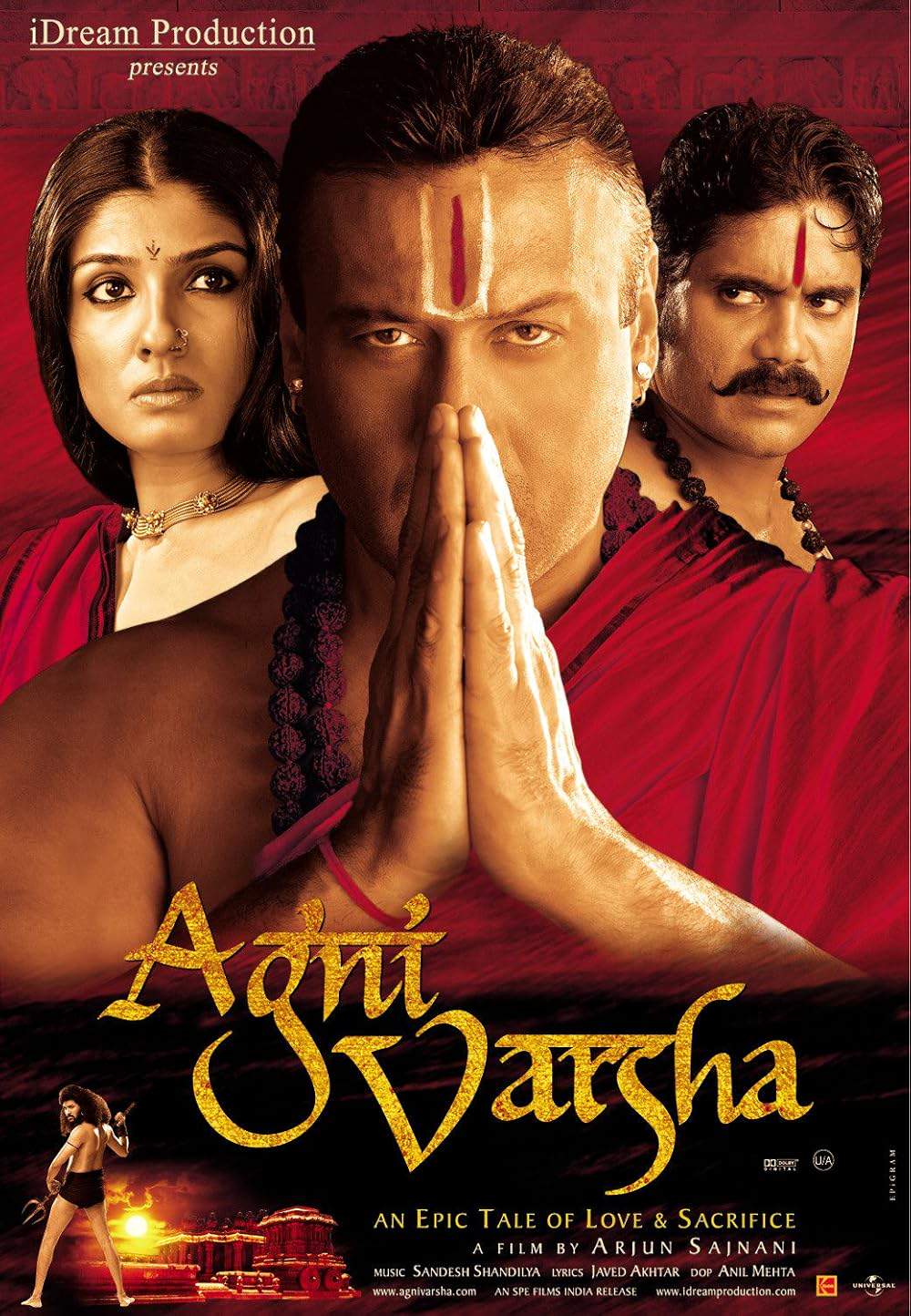
Agni Varsha (2002) movie poster

Characters & Themes

Agni Varsha (2002) Characters, Setting & Themes Explained

Release, runtime and language
2002 · 130 mins · Hindi
Directed by
Arjun Sajnani
Starring
Mohan Agashe, Amitabh Bachchan, Nagarjuna Akkineni, Sonali Kulkarni, Prabhu Deva, Jackie Shroff

Based on a Mahabharata episode and Girish Karnad’s play Fire in the Rain, the drama follows priest Puravasu (Jackie Shroff) whose unfaithful wife (Raveena) loves rival priest Yavakri (Nagarjuna). Amitabh Bachchan appears as Lord Indra. Prabhu Deva plays a demon who kills Yavakri. Milind Soman is Puravasu’s younger brother Aravasu, opposite Sonali Kulkarni.

On this page (7)
  1. 1 Characters explained (8)
  2. 2 Where & when it takes place
  3. 3 Themes & meaning (4)
  4. 4 Character & meaning questions
  5. 5 Movie threads
  6. 6 Movies like Agni Varsha
  7. 7 Every angle

8 main characters · contains spoilers

Agni Varsha Characters Explained: Who Is Who

The main characters of Agni Varsha (2002), heroes and villains: what drives them, how they change over the course of the story and what each of them reveals about the film's bigger ideas.

  • Arvasu (Milind Soman)

    A young Brahman whose love for Nittilai and his sense of justice push him into conflict with a tradition-bound village. He acts as a catalyst for the tragedy, challenging loyalties and ritual norms. In the end, his mercy-driven wish to free the demon’s soul leads to rain and a measure of redemption.

    • 💫 Protagonist
    • ❤️ Lover
    • 🧭 Idealist
  • Nittilai (Sonali Kulkarni)

    A tribal woman whose love for Arvasu defies tribal norms and marriage laws. She embodies resilience under social pressure and pays a heavy price for honesty. Her fate propels the community toward reckoning with its codes and consequences.

    • 🌿 Tribal Woman
    • 🕊️ Resilient
  • Vishakha (Raveena Tandon)

    Paravasu’s wife who becomes entangled with Yavakri, sparking jealousy and suspicion within the family. Her choices are constrained by circumstance, yet she asserts defiance in the face of social judgment. Her actions precipitate a chain of events leading to tragedy.

    • 🌺 Complex Woman
    • 🪷 Catalyst
  • Yavakri (Nagarjuna Akkineni)

    A prince pursuing Brahma Jnana who returns after years in the jungle to pursue Vishakha. His quest for spiritual power and love clashes with family loyalties, culminating in a fatal confrontation with the Rakshasa. His fate underscores the peril of pride and desire.

    • 👑 Prince
    • 🕊️ Pursuer
  • Paravasu (Jackie Shroff)

    Arvasu’s brother who navigates love, power, and violence. He murders his own father in a moment of betrayed trust and later confronts the consequences of his actions. His arc ends dramatically on the yajna pyre, a symbol of passion turned to ruin.

    • 🗡️ Brother
    • 🔥 Impulsive
  • Raibhya (Mohan Agashe)

    The wary father who distrusts both his sons and Vishakha, driven by pride and fear. His suspicion drives him to summon the Rakshasa and to test loyalties within his family and village. His actions catalyze the central tragedy and the moral questions the film raises.

    • 👨‍🏫 Father
    • 🗝️ Ruler
  • Rakshasa (Prabhu Deva)

    The dark force conjured by Raibhya to kill Yavakri. He becomes a tragic and misunderstood figure who seeks release rather than destruction. His clash with mortal vows highlights the fragility of power when faced with inexorable fate.

    • 👹 Demon
    • 🗝️ Enigma
  • Indra (Amitabh Bachchan)

    The rain god Devraj Indra, who incarnates as a divine presence at the climactic moments. He grants Arvasu a single, fateful wish and determines the fate of rain and renewal. His interventions frame the film’s moral and cosmic stakes.

    • ⚡ God
    • 🌩️ Rain-Bringer

Last updated: October 03, 2025 at 14:13

Was this helpful?

Setting

Where and When Does Agni Varsha Take Place?

The setting of Agni Varsha (2002): the year and time period, the places and locations, and how they shape the characters, the mood and the tension of the story.

Time period

Ancient Mythic Era

The events unfold in an ancient, mythic period inspired by Indian epic storytelling. It features yajna sacrifices, Brahmin rituals, and the worship of Devraj Indra as the rain-bringing deity. Although not tied to a specific year, the setting evokes timeless eras when gods and mortals intersect and destinies are decided by ritual and fate.

Location

Drought-Stricken Kingdom, Jungle, Caves, Ashram

Set in a drought-stricken kingdom, the film follows a community where water scarcity drives ritual acts and social tensions. The action stretches across arid plains, a nearby jungle where lovers seek refuge, and sacred spaces like caves, an ashram, and a water well. The harsh landscape forms the backdrop for feuds, forbidden love, and divine interventions that steer the plot.

  • 🏛️ Drought-Stricken Kingdom
  • 🗺️ Ancient Setting
  • 🏞️ Rural Landscape

Last updated: October 03, 2025 at 14:13

Was this helpful?

4 major themes

Agni Varsha Meaning: Themes & Message Explained

What is Agni Varsha (2002) really about? The emotional, social and philosophical themes the film keeps returning to, its symbolism and the message beneath the surface.

  • Forbidden Love

    Two relationships outside social norms drive the narrative: Vishakha and Yavakri, and Nittilai with Arvasu. These romances collide with caste rules, marriage duties, and family honor, forcing characters to choose between personal desire and communal duty. The tension between love and social propriety leads to jealousy, betrayal, and tragedy.

  • Duty vs Desire

    Family honor and tribal law clash with individual longing as Raibhya distrusts Vishakha and contends with his sons. Yavakri’s pursuit of love and spiritual power further strains loyalties. The ensuing conflicts reveal how duty and desire can ignite violence and irreversible consequences. Characters are forced to weigh tradition against personal conviction.

  • Divine Will

    Divine forces and cosmic plans shape human actions throughout the story. Indra, the rain-bringing god, appears to determine the fate of the drought-stricken land. The ritual yajna and the appearance of the Brahma Rakshas show that mortals’ choices are interpreted and sometimes redirected by higher powers. The gods’ involvement underscores the fragility of mortal agency.

  • Redemption

    Arvasu’s final wish—to free the demon’s soul rather than seek personal vengeance—embodies mercy over desire for revenge. Nittilai’s sacrifices and Paravasu’s ultimate acts precipitate a healing rain and a fragile restoration. The ending emphasizes mercy, sacrifice, and the possibility of renewal after tragedy.

Last updated: October 03, 2025 at 14:13

Was this helpful?

Character & theme questions

Agni Varsha Characters & Meaning: Your Questions Answered

The questions people ask about Agni Varsha (2002): who the characters really are, their relationships, what the symbols mean, where it takes place and what the movie is really about. Each answer contains spoilers.

Q1

Is this movie based on a real story?

The film is based on a Mahabharata episode and Girish Karnad's play 'Fire in the Rain', drawing from ancient Indian epic traditions.

  • mahabharata
  • girish karnad
  • play
  • adaptation
  • source material
Q2

What time period is the movie set in?

The story takes place in an ancient mythic era inspired by Indian epics, featuring yajna sacrifices, Brahmin rituals, and the worship of Devraj Indra as the rain-bringing deity, evoking a timeless period when gods and mortals interact.

  • ancient era
  • mythic period
  • brahmin
  • indian epics
  • yajna
Q3

Where does the story take place?

The film is set in a drought-stricken kingdom, with action spanning arid plains, a jungle where lovers seek refuge, caves, an ashram, and a sacred water well, creating a harsh landscape that shapes the community's tensions and rituals.

  • drought kingdom
  • desert
  • jungle
  • ashram
  • caves
  • water well
Q4

What is the main theme of forbidden love in the movie?

Two forbidden romances drive the narrative: Vishakha and Yavakri, and Nittilai with Arvasu. These relationships collide with caste rules, marriage duties, and family honor, forcing characters to choose between personal desire and communal duty, leading to jealousy, betrayal, and tragedy.

  • forbidden love
  • caste
  • vishakha
  • yavakri
  • nittilai
  • arvasu
Q5

How does the movie explore duty versus desire?

Family honor and tribal law clash with individual longing as characters like Raibhya distrust their sons and contend with competing loyalties. The tension between duty and desire ignites violence and irreversible consequences, forcing characters to weigh tradition against personal conviction.

  • duty
  • desire
  • family honor
  • tradition
  • conflict
Q6

What role do gods play in the story?

Divine forces and cosmic plans shape human actions throughout. Indra, the rain-bringing god, appears to determine the fate of the drought-stricken land. The yajna ritual and the appearance of the Brahma Rakshas show that mortals' choices are interpreted and sometimes redirected by higher powers, underscoring the fragility of mortal agency.

  • indra
  • devraj
  • gods
  • divine
  • ritual
  • yajna
  • rakshasa
Q7

Does the movie have a redemption theme?

Arvasu's final wish to free the demon's soul rather than seek personal vengeance embodies mercy over desire for revenge. Combined with Nittilai's sacrifices and Paravasu's ultimate acts, this precipitates healing rain and a fragile restoration, emphasizing mercy, sacrifice, and the possibility of renewal after tragedy.

  • redemption
  • mercy
  • sacrifice
  • arvasu
  • demon
  • rain renewal
Q8

Who is Arvasu and what is his role?

Arvasu is a young Brahman played by Milind Soman whose love for tribal woman Nittilai and sense of justice push him into conflict with tradition. He acts as a catalyst for the tragedy by challenging loyalties and ritual norms, and his mercy-driven final wish leads to rain and redemption.

  • arvasu
  • milind soman
  • brahman
  • nittilai
  • justice
  • mercy
Q9

Who is Lord Indra in the movie?

Amitabh Bachchan appears as Devraj Indra, the rain god who incarnates as a divine presence at climactic moments. He grants Arvasu a single fateful wish and determines the fate of rain and renewal, framing the film's moral and cosmic stakes.

  • indra
  • amitabh bachchan
  • rain god
  • divine
  • cosmic
Q10

What role does Raibhya play in the story?

Raibhya is the wary father played by Mohan Agashe who distrusts both his sons and Vishakha, driven by pride and fear. His suspicion leads him to summon the Rakshasa to kill Yavakri, catalyzing the central tragedy and the moral questions the film raises.

  • raibhya
  • mohan agashe
  • father
  • suspicion
  • rakshasa
Q11

What is the Rakshasa character's significance?

The Rakshasa, played by Prabhu Deva, is a dark force conjured by Raibhya to kill Yavakri. He becomes a tragic figure seeking release rather than destruction, and his clash with mortal vows highlights the fragility of power when faced with inexorable fate.

  • prabhu deva
  • rakshasa
  • demon
  • tragic figure
  • release
Q12

Who is Paravasu and what happens to him?

Paravasu is Arvasu's older brother played by Jackie Shroff, who navigates love, power, and violence. He murders his own father in a moment of betrayed trust and later confronts those consequences, with his arc ending dramatically on the yajna pyre as a symbol of passion turned to ruin.

  • paravasu
  • jackie shroff
  • brother
  • patricide
  • pyre
  • yajna
Q13

How does the drought setting affect the movie's tone?

The drought-stricken kingdom creates a consistently dramatic atmosphere where water scarcity drives ritual acts and social tensions. The harsh landscape forms the backdrop for feuds, forbidden love, and divine interventions, making the quest for rain a literal and metaphorical drive that shapes every character's motivations.

  • drought
  • water scarcity
  • atmosphere
  • landscape
  • ritual tension

Movie threads

More Movies Like Agni Varsha, by Mood & Story

Curated lists built around what makes Agni Varsha tick: the same mood, the same kind of story or the same emotional payoff. Each list explains why these movies belong together.

Epic Mythic Tragedies like Agni Varsha

Stories where human failings provoke cosmic wrath, blending epic fantasy with heavy moral drama. If you were captivated by the divine conflict and moral gravity of Agni Varsha, explore movies with similar mythic frameworks. These films often feature gods intervening in human affairs, grand-scale consequences for sins, and a tone that blends fantasy with intense, tragic drama.

  • mythic
  • tragic
  • somber
  • dramatic
  • fatalistic
  • epic
  • Tone: dark, somber, mythic
  • Pacing: steady, deliberate
Why these movies?

The story pattern: Stories in this thread typically follow a pattern where human characters, driven by fatal flaws like pride or lust, disrupt the natural or divine order. This triggers a chain of events involving divine intervention, supernatural punishment, and a climactic resolution that often comes at a great personal or collective cost.

Why they belong together: Movies are grouped here for their shared foundation in mythology, their exploration of human folly against a cosmic backdrop, and their consistently high-stakes, emotionally heavy tone. They create a specific experience of watching intimate human dramas unfold on an epic, world-changing scale.


Intense Family Dramas with Forbidden Love like Agni Varsha

Intense stories where passionate betrayal fractures a family, leading to irreversible tragedy. For viewers who appreciated the devastating emotional core of Agni Varsha, this section highlights movies about illicit passions that destroy families. These films share a dark tone, heavy emotional weight, and explore the tragic consequences of adultery and revenge within a close-knit unit.

  • tragic
  • passionate
  • somber
  • dramatic
  • fatalistic
  • betrayal
  • Tone: dark, tragic, passionate
  • Pacing: steady, dramatic build
Why these movies?

The story pattern: The narrative pattern involves a secret or forbidden relationship that is discovered, sparking a cycle of vengeance and grief. The focus is on the collateral damage within a family or community, often culminating in violence, loss, and a bittersweet or outright tragic resolution.

Why they belong together: These films are united by their intense exploration of forbidden love as a catalyst for familial collapse. They share a dark, passionate mood, a steady pacing that builds dread, and a focus on the heavy emotional fallout of betrayal, making the viewing experience consistently dramatic and somber.

If you liked this

Movies Like Agni Varsha

Similar movies to Agni Varsha: the same genre, themes or kind of story. Each one comes with its own plot summary, timeline and ending explained.

Browse all movie summaries

Every angle

Agni Varsha (2002) Explained: Plot, Timeline & Characters

Everything about Agni Varsha in one place: what happens in the plot summary, the timeline in chronological order, the characters and meaning and a spoiler-free summary. What's After the Movie adds the cast, box office and post-credit scenes.

Coming soon on iOS and Android

The Plot Explained Movie Summary App

Plot summaries, endings explained and timelines on your phone. Catch up on any movie in minutes, save your favorites and never miss a twist again.

Be the first to know when we launch. Your email stays private, always.

Learn more about the app