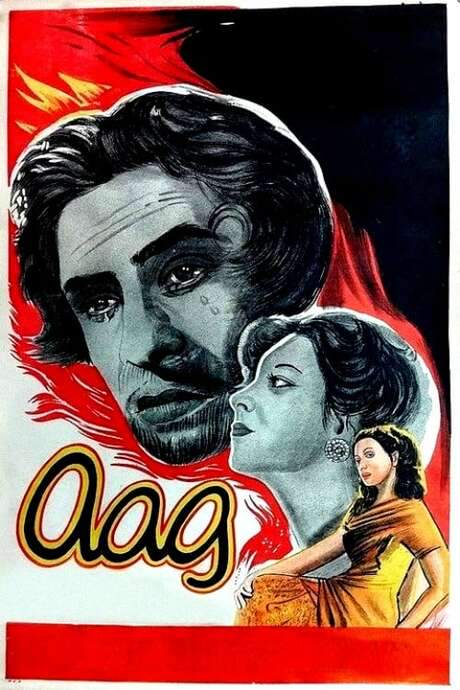
Year: 1948
Runtime: 138 mins
Language: Hindi
A man obsessed over two things, the theater and a childhood friend, recounts his life story to his new bride.
Warning: spoilers below!
Haven’t seen Aag yet? This summary contains major spoilers. Bookmark the page, watch the movie, and come back for the full breakdown. If you're ready, scroll on and relive the story!
Trace every key event in Aag (1948) with our detailed, chronological timeline. Perfect for unpacking nonlinear stories, spotting hidden connections, and understanding how each scene builds toward the film’s climax. Whether you're revisiting or decoding for the first time, this timeline gives you the full picture.
Last updated: October 09, 2025 at 10:49
Find frequently asked questions about the Aag (1948) timeline, including chronological order, nonlinear jumps, cause-and-effect links, and scene sequence clarifications. This timeline FAQ helps explain when key events happen, how moments connect, and why the story unfolds in that specific order.
Kewal sets his face on fire as a symbolic act of self-sacrifice to save his friendship with Rajan. When Kewal discovers that Rajan has become jealous and insecure about Nimmi's presence in the production, and seeing the tension destroy their partnership, Kewal uses a lit torch to literally burn away his own appearance. This desperate act destroys the theatre and leaves him disfigured, but it represents his willingness to sacrifice everything, including his looks and his dreams, for the sake of friendship.
Earlier, Kewal's childhood play was abandoned when Nimmi left, and later his college play also failed on premiere day, establishing a pattern of sacrifices tied to lost Nimmis.
Nimmi leaves Kewal on premiere day because her family moves away, first in childhood when her family relocates, and later in college when her parents arrange a marriage for her with a man in England. Both times, the departure happens suddenly and coincides with the very day their theatrical production was scheduled to open, leaving Kewal heartbroken and his plays without their lead.
The film establishes early that Kewal's theatrical dreams are consistently tied to Nimmi's presence, and losing her on key premiere days becomes a repeating trauma.
Sudha is actually the original Nimmi from Kewal's childhood, the first Nirmala he met in school who he nicknamed Nimmi. She recognizes him on their wedding night despite his disfigured face and reveals her true identity after hearing his life story. She is the woman who can accept him for who he truly is, not for his appearance, fulfilling the film's theme of being seen for one's inner essence.
Throughout the flashback, Kewal searches for the ideal Nimmi, never realizing the original Nimmi from his childhood has been with him all along.
Kewal leaves his family home because the pressure to become a lawyer despite his passion for theatre becomes unbearable. His father demands he follow the family tradition of law, and after failing his law exam and enduring repeated conflicts with his father over his creative ambitions, Kewal finally rebels. He argues with his father, defies the family legacy, and chooses to pursue his childhood dream of running a theatre company instead of continuing in law.
From childhood, Kewal is shown drawn to theatre while his family expects him to study law, establishing an ongoing conflict that eventually reaches a breaking point.
Rajan tears down the painted pictures of Nimmi that decorate the stage and walls because he has become consumed by jealousy and artistic insecurity. Though he is the financial patron of the theatre, he watches Nimmi, the lead actress, fall in love with Kewal, the writer and director. Overcome by emotion on opening night, he destroys the images of the woman he desires but cannot have, contributing to the chaos that leads to Kewal's sacrifice.
Rajan had been described as becoming 'besotted' with Nimmi earlier, and his jealousy grows as he witnesses her devotion to Kewal instead of him.
Nimmi does not truly choose Rajan over Kewal, she is actually in love with Kewal throughout. When she visits Kewal in the hospital after the fire, she is wearing an engagement ring from Rajan, but this appears to be a choice made out of practicality and circumstance rather than genuine love. Kewal, with his face bandaged and his theatre destroyed, perhaps feels he cannot offer her a future, and Nimmi respects his wishes by not fighting for a relationship at that moment.
Earlier, Nimmi explicitly tells Kewal she loves the man who created the dream she inhabits, referring to Kewal, not Rajan.
Kewal tries to persuade Nimmi to accept Rajan as a partner because he remains unaware of her true feelings for him. He sees Rajan's infatuation and believes Nimmi would be better served by a stable, wealthy patron who can provide security. Kewal's focus remains on his art and production, not recognizing the emotional currents swirling around him until it is too late.
The film establishes Kewal as oblivious to the romantic tension, more concerned with his theatre work than the relationships developing around him.
Kewal discovers the homeless woman displaced by Partition on the margins of life, she is living on the streets after being uprooted during the Partition of India. He encounters her during preparations for his new production and decides to cast her as the lead, giving her the name Nimmi in the story. This actress, played by Nargis, brings raw, lived-in depth to the role and becomes central to the theatre company's rebirth.
The timing coincides with Kewal's partnership with Rajan, who has the funding to support a production featuring an unknown lead.
When Kewal lifts the lit torch and sets his own face aflame, the fire spreads uncontrollably and consumes the entire theatre. The production is destroyed, the company is ruined, and Kewal is left with severe burns and a disfigured face. The sacrifice that was meant to save his friendship ultimately destroys everything he has built.
The torch used in the play is referred to as 'Aag' (fire), symbolizing both creative passion and destructive sacrifice throughout the film.
Kewal's shift from law to theatre is triggered by cumulative pressure: his father's relentless insistence that he become a lawyer like his ancestors, his own failed law exam, and his uncontrollable passion for theatre that he cannot suppress. After an argument with his father where tradition clashes with his creative dreams, Kewal finally chooses to leave home and pursue his childhood ambition of running a theatre company.
The film opens with young Kewal already obsessed with theatre, showing his true calling from the very beginning.
The name Nimmi becomes a symbolic motif in the film. The first Nimmi is Kewal's childhood friend Nirmala, the object of his early theatrical dreams. The second is a college student who asks him to call her Nimmi. The third is the homeless Partition refugee who becomes his lead actress. Each Nimmi represents Kewal's ideal, his muse, while also embodying the fleeting, unreachable nature of his artistic and romantic aspirations.
The recurring Nimmi figure reflects Kewal's search for his perfect artistic inspiration and the impossibility of capturing his ideal.
Discover curated groups of movies connected by mood, themes, and story style. Browse collections built around emotion, atmosphere, and narrative focus to easily find films that match what you feel like watching right now.
Films that trace an artist's entire life, blending passion with poignant loss.Find more films like Aag that chronicle an artist's life journey. These movies often use reflective storytelling to explore themes of passion, sacrifice, and memory. If you enjoyed the poignant blend of artistic drive and personal tragedy in Aag, you'll appreciate these similar character-driven dramas.
Stories in this thread typically unfold over a long period, tracing the protagonist's life from youth to maturity. They focus on the central conflict between a driving artistic passion and the demands of reality—be it love, family, or society. The narrative structure often involves a framing device, like a character recounting their past, to add a layer of reflection and melancholy.
Movies are grouped here for their shared focus on the biographical arc of an artist, their bittersweet tone balancing achievement with sacrifice, and their steady, reflective pacing that allows for deep character exploration.
Stories defined by lifelong yearning and romantic love that remains just out of reach.Discover more movies like Aag that explore the pain and beauty of unrequited love and lifelong yearning. These films capture a specific bittersweet mood, where romance is marked by separation and memory. If the poignant, tragic romance in Aag resonated with you, these stories of enduring love and loss will feel familiar.
The narrative pattern involves a central romantic connection that is established early on but is thwarted by circumstance, duty, or personal tragedy. The story follows the characters as they navigate life apart, with their longing for each other serving as a constant emotional undercurrent. The ending often brings a reunion or resolution, but it is tinged with the sorrow of lost time and sacrifice.
These films share a core emotional experience: the ache of unfulfilled love. They are united by a high romance score balanced with significant sadness, a bittersweet tone, and a focus on memory and what might have been.
Don't stop at just watching - explore Aag in full detail. From the complete plot summary and scene-by-scene timeline to character breakdowns, thematic analysis, and a deep dive into the ending - every page helps you truly understand what Aag is all about. Plus, discover what's next after the movie.
Read a complete plot summary of Aag, including all key story points, character arcs, and turning points. This in-depth recap is ideal for understanding the narrative structure or reviewing what happened in the movie.
Discover the characters, locations, and core themes that shape Aag. Get insights into symbolic elements, setting significance, and deeper narrative meaning - ideal for thematic analysis and movie breakdowns.