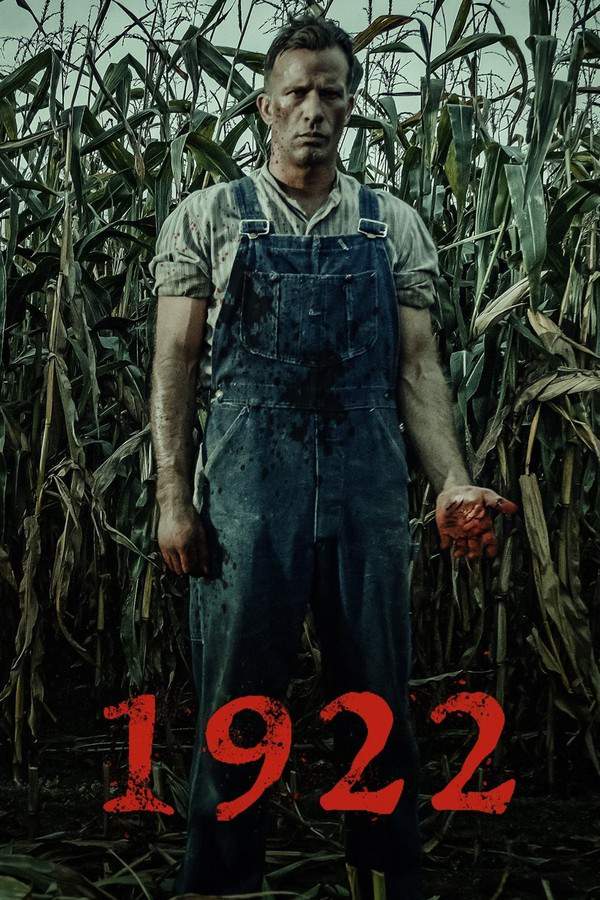
#25,9202 Year: 2017
Runtime: 102 min
Language: English
Director: Zak Hilditch
Echo Score: 69Budget: $5M
In 1922 Nebraska, Wilfred James recounts the disturbing events leading to the murder of his wife, Arlette. Following the act, a palpable sense of dread descends upon the family and their surroundings. Wilfred and his son are then haunted by what they believe to be the vengeful spirit of Arlette, though it’s increasingly unclear whether the threat is supernatural or a manifestation of their own guilt and paranoia. The unsettling atmosphere and blurring lines between reality and delusion create a chilling exploration of domestic horror.
Find where to stream, rent, or buy 1922 (2017) in the US with current JustWatch availability, up-to-date pricing, and platform listings for subscription, rental, and digital purchase options.
Warning: spoilers below!
Haven’t seen 1922 yet? This summary contains major spoilers. Bookmark the page, watch the movie, and come back for the full breakdown. If you're ready, scroll on and relive the story!
Still thinking about how 1922 (2017) ended? Here’s a full breakdown of the ending, key final moments, major twists, and the deeper meaning behind the film’s conclusion.
At the end of 1922, Wilfred's life has become a nightmare of guilt and supernatural torment. Haunted by visions of his wife Arlette and later his son Hank, accompanied by overwhelming swarms of rats, Wilfred is trapped in a never-ending cycle of regret and madness. These rats symbolize his growing conscience—corrupted, dirty, and unstoppable—mirroring the decay for which he is responsible. They serve as a tangible manifestation of his guilt, tormenting him physically and psychologically, and their increasing numbers reflect how his conscience has swollen beyond control.
As Wilfred continues to descend into paranoia and despair, he writes his story as a form of confession, but ultimately, his fate is left unresolved. The film raises the question of whether he kills himself or if the spirits of his victims claim him after death. His death could be self-inflicted, taking responsibility for his actions and accepting darkness, or it could be caused by the vengeful spirits—symbolic of judgment—that take him away due to his sins. The ambiguity emphasizes themes of guilt, belief, and the consequences of selfish choices. However, the core tragedy remains that his initial decision to murder Arlette set him on a path where everything he loved was lost, and his life was doomed from that moment onward. The rats, as relentless symbols of his guilt and the inevitable decay of his soul, underline that Wilfred’s downfall was ultimately unavoidable, driven by the selfishness and short-sightedness that led to every devastating consequence. The haunting creatures are less about ghosts and more about the inescapable burden of remorse—reminding us that guilt, once triggered, can consume a person completely, long after the physical world has faded.
Last updated: June 25, 2025 at 09:00
Read frequently asked questions about the ending of 1922 (2017), including final-scene interpretation, twist explanations, character outcomes, and the deeper meaning behind the conclusion. This ending explained FAQ is designed for viewers searching for clear spoiler-heavy answers and ending breakdown insights.
The rats are a tangible manifestation of Wilfred's guilt and conscience. They represent the corruption and decay for which he is responsible after murdering his wife Arlette. The increasing swarm of rats throughout the ending reflects how his guilt has grown beyond control, tormenting him physically and psychologically until his death.
Earlier scenes show Wilfred noticing a single rat in the house after the murder, hinting at the growing infestation of guilt that will consume him.
The film leaves Wilfred's death deliberately ambiguous. It could be interpreted as self-inflicted, Wilfred finally accepting responsibility and taking his own life, or as an act of the vengeful spirits claiming him. This uncertainty emphasizes the themes of guilt, judgment, and the consequences of his selfish choice to murder Arlette.
Wilfred's descent into paranoia and despair throughout the film sets the stage for this final, tragic moment of either self-destruction or supernatural judgment.
The film deliberately blurs the line between supernatural haunting and psychological guilt. While Arlette's spirit appears to haunt Wilfred, the rats, which represent his guilt, are described as less about actual ghosts and more about the inescapable burden of remorse. The ambiguity suggests that whether the spirits are real matters less than the psychological truth of his guilt.
The film never confirms supernatural elements definitively, keeping viewers uncertain about whether the haunting is real or a manifestation of Wilfred's deteriorating mind.
Hank, Wilfred's son, also dies as a consequence of the murder. He becomes another victim of the family's tragic fate, joining Arlette in haunting Wilfred. His death represents the complete destruction of everything Wilfred loved, the ultimate price for his selfish crime.
Hank's growing suspicion and fear of his father throughout the film foreshadows his tragic fate as the family falls apart.
Wilfred writes his confession as an attempt to unburden himself from the overwhelming guilt that has consumed him. However, the writing itself provides no redemption or escape, the rats and visions continue regardless. His confession represents his final, futile attempt to find some form of acknowledgment for his terrible act before his death.
The confession mirrors the frame narrative structure, as the entire film is presented as Wilfred's written account of the murder and its aftermath.
The ending conveys that guilt, once triggered by a violent act, becomes an inescapable force that consumes a person completely. Wilfred's decision to murder Arlette set in motion a chain of events that destroyed everything he loved. The rats symbolize how his conscience grew corrupted and unstoppable, eventually destroying him. The bleak conclusion emphasizes that his downfall was unavoidable, driven by the selfishness and short-sightedness that led to the murder.
The title "1922" itself marks the year of the murder, establishing that from this moment forward, Wilfred's fate was sealed.
Arlette's spirit appears to haunt Wilfred throughout the film, representing either actual revenge from beyond the grave or a projection of his guilt. Either way, her presence tormenting him reflects the consequences of his crime. The film suggests that her spirit, whether real or imagined, is part of the judgment that catches up with Wilfred for his selfish act of murder.
Arlette's vengeful presence is established early when Wilfred and Hank first dispose of her body, setting the tone for the supernatural or psychological torment to come.
Wilfred's statement reflects the film's central theme that one violent, selfish decision sets in motion inevitable destruction. The murder didn't just remove his wife, it corrupted everything. His guilt manifested as the rats, destroyed his relationship with his son, led to Hank's death, and left Wilfred completely alone. From the moment he chose murder, every subsequent tragedy became unavoidable.
Wilfred's initial decision to kill Arlette for selfish reasons (her land) establishes that the murder was never justified, planting the seeds of his inevitable downfall.
Discover curated groups of movies connected by mood, themes, and story style. Browse collections built around emotion, atmosphere, and narrative focus to easily find films that match what you feel like watching right now.
Stories where guilt and dread methodically consume a character from within.If you liked the methodical psychological unraveling in 1922, explore more movies like it. This collection features slow burn dramas and thrillers where characters are consumed by guilt and paranoia, leading to a bleak and haunting conclusion. These films share a heavy emotional weight and a dark, oppressive tone.
These narratives typically follow a linear, confessional-style structure, chronicling the long-term consequences of a morally reprehensible choice. The central conflict is internal, as the protagonist battles their own guilt, which manifests as external hauntings or a pervasive sense of doom, culminating in complete physical and mental destruction.
Movies are grouped here for their shared commitment to a slow, atmospheric pacing that mirrors the protagonist's mental decay. They possess a uniformly dark tone, high emotional intensity, and a focus on the psychological aftermath of violence rather than the act itself, creating a deeply unsettling and immersive experience.
Horror and tragedy festering in the stark silence of the countryside.For viewers who enjoyed the rural Nebraska setting of 1922, this list features similar movies where isolation breeds horror. Discover thrillers and dramas set in remote locations where characters face psychological unraveling, moral collapse, and supernatural dread, all amplified by their lonely surroundings.
The narrative pattern involves characters, often families, whose conflicts are intensified by their geographic and social separation from the outside world. The vast, empty spaces create a sense of entrapment rather than freedom, leading to domestic violence, madness, and a confrontation with primal fears, whether supernatural or human.
These films are united by their use of a rural setting as a primary source of tension. They share a slow, deliberate pace that lets the atmosphere of isolation sink in, a dark or bleak tone, and themes of family secrets, guilt, and the breakdown of morality in a contained environment.
Don't stop at just watching - explore 1922 in full detail. From the complete plot summary and scene-by-scene timeline to character breakdowns, thematic analysis, and a deep dive into the ending - every page helps you truly understand what 1922 is all about. Plus, discover what's next after the movie.
Read a complete plot summary of 1922, including all key story points, character arcs, and turning points. This in-depth recap is ideal for understanding the narrative structure or reviewing what happened in the movie.
Track the full timeline of 1922 with every major event arranged chronologically. Perfect for decoding non-linear storytelling, flashbacks, or parallel narratives with a clear scene-by-scene breakdown.
Discover the characters, locations, and core themes that shape 1922. Get insights into symbolic elements, setting significance, and deeper narrative meaning - ideal for thematic analysis and movie breakdowns.
Discover movies like 1922 that share similar genres, themes, and storytelling elements. Whether you’re drawn to the atmosphere, character arcs, or plot structure, these curated recommendations will help you explore more films you’ll love.
1922 (2017) Plot Summary & Movie Recap
1922 (2017) Scene-by-Scene Movie Timeline
1922 (2017) Movie Characters, Themes & Settings
1922 (2017) Spoiler-Free Summary & Key Flow
Movies Like 1922 – Similar Titles You’ll Enjoy
Things Heard & Seen (2021) Full Summary & Key Details
Dead Silence (2007) Full Movie Breakdown
We Are What We Are (2011) Full Summary & Key Details
The Night of the Hunter (1955) Full Movie Breakdown
Willard (2003) Detailed Story Recap
The Other (1972) Complete Plot Breakdown
Niagara (1953) Ending Explained & Film Insights
The Ravine (2022) Ending Explained & Film Insights
1920: Horrors of the Heart (2023) Full Movie Breakdown
Fear in the Night (1947) Movie Recap & Themes
Night of Dark Shadows (1971) Complete Plot Breakdown
1920 (2008) Detailed Story Recap
The Red House (1947) Full Movie Breakdown
Two on a Guillotine (1965) Plot Summary & Ending Explained
10 Rillington Place (1971) Movie Recap & Themes