Plot Explained Spoilers guaranteed!
Plot Explained

Browse by genre

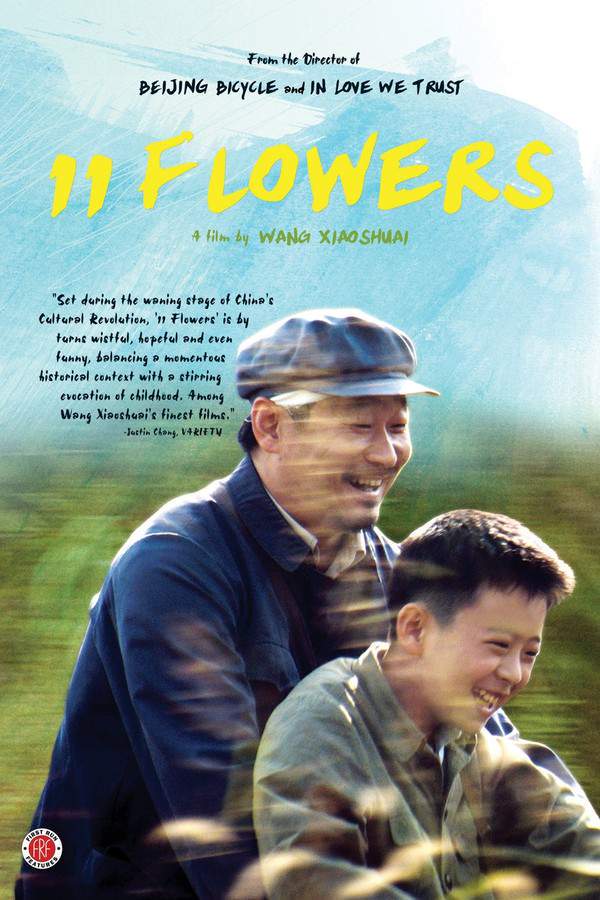
11 Flowers (2013) movie poster

Timeline

11 Flowers (2013) Timeline Explained – Every Event in Order

Release, runtime and language
2013 · 110 min · Chinese
Loading streaming availability…
Directed by
Xiaoshuai Wang

In 1975 China, a young boy's peaceful existence is disrupted when he encounters a clever fugitive. The thief takes more than just a cherished shirt, unexpectedly involving the boy in a risky escape. As they journey together, their morals are challenged and their sense of loyalty tested, leading to unexpected consequences and a coming-of-age story set against a backdrop of societal change.

On this page (6)
  1. 1 Where to watch
  2. 2 Events in order (13)
  3. 3 Timeline questions answered
  4. 4 Movie threads
  5. 5 Movies like 11 Flowers
  6. 6 Every angle
Loading streaming availability…

13 events in order · contains spoilers

11 Flowers Timeline: Events in Chronological Order

Every key event of 11 Flowers (2013) in order, scene by scene, with when and where it takes place. Use it to untangle flashbacks, time jumps and parallel storylines, to refresh your memory before the sequel or to find the exact scene you are thinking of.

  1. Wang Han's Leadership Role

    Wang Han, an 11-year-old boy, is selected by his teacher to lead the school's morning exercises. This moment marks a significant point in Wang's journey, as he feels a sense of responsibility and pride in taking on this role.

    When
    1975
    Where
    School
  2. Mother Makes a Special Shirt

    Determined to perform well, Wang Han asks his mother to make him a special white shirt for the occasion. His mother, initially hesitant due to the cost, eventually sacrifices a year's worth of fabric coupons to craft the shirt, symbolizing her love and support.

    Where
    Home
  3. Lost Shirt Incident

    While playing by the river with his friends, Wang Han loses the treasured shirt in the water. As he dives in to retrieve it, he encounters Xie Jueqiang, a fugitive murderer, which sets off a chain of dramatic events.

    Where
    River
  4. Meeting the Fugitive

    Wang Han meets Xie Jueqiang, who is wounded and desperate. Xie takes the shirt to stop his bleeding, which complicates Wang's situation and leads him into an unexpected alliance with the fugitive.

    Where
    Forest
  5. Bargain with Xie

    In the forest, Xie threatens Wang Han to keep his location a secret and demands help in finding herbs to treat his wound. This encounter deepens the tension as Wang is torn between fear and empathy.

    Where
    Forest
  6. Lying to His Mother

    To cover for the lost shirt, Wang Han lies to his mother about its whereabouts, claiming it was lost to the river. This lie leads to growing internal conflict for Wang, highlighting themes of innocence and deception.

    Where
    Home
  7. Revealing the Secret

    To reconcile with his friends after feeling guilty, Wang Han reveals Xie's hiding place. This decision leads to a series of consequences that he did not fully anticipate, showcasing the repercussions of betrayal.

    Where
    School
  8. Police Search

    The revelation of Xie's whereabouts prompts the teacher to alert the police, leading to a search in the forest. However, despite their efforts, the police are unable to capture Xie, underscoring the challenges of law enforcement during this turbulent period.

    Where
    Forest
  9. Xie's Capture

    After a series of events, Xie is eventually caught following a desperate act of setting a fire. He faces severe consequences for his actions, leading to a future that will impact Wang Han deeply.

    Where
    Forest
  10. Death Sentence

    Xie is sentenced to death for murder and arson, a harsh fate that reflects the brutal realities of the era. His impending execution sends ripples through the community, profoundly affecting Wang Han's emotional landscape.

    Where
    Prison
  11. A Promise Fulfilled

    Before his execution, Xie keeps his promise to Wang Han by arranging for a white shirt to be sent to him from prison. This gesture serves as a poignant reminder of their complicated relationship.

    Where
    Prison
  12. Broadcast of Execution

    As the film nears its climax, Wang Han and his friends listen to a broadcast announcing the public execution of criminals. The chilling announcement underscores the harsh reality of life during the Cultural Revolution.

    Where
    Town
  13. Emotional Revelation

    Wang Han's emotional turmoil reaches its peak as he runs towards the execution site, only to stop abruptly upon hearing Xie’s name. This moment encapsulates his internal struggle between childhood innocence and the harsh realities of adult decisions.

    Where
    Execution Site

Last updated: May 13, 2025 at 20:30

Was this helpful?

Timeline questions answered

11 Flowers Timeline Explained: Your Questions Answered

When does it happen, and why in that order? The questions people ask about the chronology of 11 Flowers (2013): time jumps, flashbacks, cause and effect between scenes and the correct order of events, each answered with spoilers.

Q1

Why did Xie Jueqiang take Wang Han's shirt?

Xie Jueqiang was badly wounded and bleeding from his injuries. He took the white shirt to use as a makeshift bandage to stop the bleeding. The shirt was the only available material he could use in the forest to treat his wound.

  • xie jueqiang
  • white shirt
  • wound
  • bandage
  • fugitive
Q2

Why did Wang Han agree to help Xie find herbs?

Wang Han was primarily motivated by the desire to get his shirt back. Xie promised to replace the shirt once his wound was treated, so Wang Han reluctantly agreed to help find herbs while keeping Xie's location secret. Additionally, Xie threatened the boy to ensure his cooperation.

  • wang han
  • xie jueqiang
  • herbs
  • promise
  • threat
Q3

Why did Wang Han tell his friends where Xie was hiding?

Wang Han felt guilty about keeping the secret from his friends, who had stopped trusting him. To reconcile with them and ease his conscience, he revealed Xie's hiding place in the forest. This decision was driven by his desire to belong with his peers rather than any loyalty to the fugitive.

  • wang han
  • friends
  • betrayal
  • secret location
  • forest
Q4

Why did Xie Jueqiang set a fire?

Xie set the fire as a desperate act that led to his capture. While the exact motivation isn't explicitly stated in the summary, it appears to be a final desperate attempt, possibly to distract authorities or create an opportunity to escape, that instead resulted in him being apprehended.

  • xie jueqiang
  • fire
  • capture
  • desperation
  • arrest
Q5

Why did Xie send a white shirt to Wang Han from prison?

Before his capture, Xie had promised Wang Han that he would replace the shirt. Despite facing execution, Xie kept his promise by arranging for a white shirt to be sent to Wang Han from prison. This act fulfilled his word to the boy and serves as a poignant moment of honor amid his crimes.

  • xie jueqiang
  • white shirt
  • prison
  • promise
  • fulfillment
Q6

Why was Xie Jueqiang sentenced to death?

Xie was sentenced to death for two crimes: murder and arson. His status as a fugitive who had committed murder, combined with the fire he set that led to his capture, resulted in the harsh capital punishment typical of the era's judicial system during the Cultural Revolution.

  • xie jueqiang
  • death sentence
  • murder
  • arson
  • execution
Q7

Why did Wang Han lie to his mother about the shirt?

Wang Han lied to his mother because he was ashamed and feared getting in trouble. He told her the shirt was lost in the river rather than admitting it was taken by a wounded fugitive. This lie reflects his youthful desire to avoid punishment and protect his reputation with his parents.

  • wang han
  • mother
  • lie
  • shirt
  • river
  • deception
Q8

What did the broadcast announce at the end of the film?

The broadcast announced a public execution of criminals in the town. This was a common practice during the Cultural Revolution era, where executions were carried out as public events. The announcement is what drew Wang Han and his friends toward the execution site.

  • broadcast
  • execution
  • public
  • criminals
  • cultural revolution
Q9

Why did Wang Han stop running when he heard Xie's name?

When Wang Han heard Xie's name mentioned in the execution broadcast, he was struck by the realization that the man he had helped, and who had kept his promise to send the shirt, was about to be executed. This moment represents the tragic collision of his childhood innocence with the harsh adult reality of the consequences Xie faced.

  • wang han
  • xie jueqiang
  • execution
  • emotional
  • name
  • realization
Q10

Why did Wang Han's mother sacrifice fabric coupons for the shirt?

Wang Han's mother initially hesitated because fabric coupons were scarce and valuable, she would need to give up a year's worth to get the material. However, she ultimately sacrificed those coupons to make the white shirt for her son because she wanted him to feel proud and presentable as he led the school exercises. It symbolizes her love and support despite the family's financial constraints.

  • mother
  • fabric coupons
  • shirt
  • sacrifice
  • love
  • school exercises
Q11

Why did the police fail to capture Xie the first time?

After Wang Han revealed Xie's location, the police conducted a search in the forest but were unable to find him. Xie, being a fugitive experienced in evading capture, successfully hid from the authorities despite the search effort. He was only later apprehended after setting the fire.

  • police
  • search
  • forest
  • xie jueqiang
  • capture
  • escape

Movie threads

More Movies Like 11 Flowers, by Mood & Story

Curated lists built around what makes 11 Flowers tick: the same mood, the same kind of story or the same emotional payoff. Each list explains why these movies belong together.

Movies where a child witnesses adult tragedy like in 11 Flowers

Stories where a child's innocence is fractured by complex adult realities. If you appreciated the unique perspective of 11 Flowers, you'll find more movies like it here. These films share a focus on coming-of-age stories told through a child's eyes, often set against a backdrop of societal upheaval, where innocence is lost to the weight of adult secrets and moral dilemmas.

  • childlike perspective
  • nostalgic
  • somber
  • anxious
  • innocence lost
  • reflective
  • Tone: melancholic, bittersweet, uneasy
  • Pacing: steady, character-driven
Why these movies?

The story pattern: The narrative follows a young protagonist whose peaceful world is invaded by an adult conflict they don't fully comprehend. Their journey involves carrying a secret, forming an unlikely bond with an adult fugitive or outcast, and ultimately facing a bittersweet or traumatic revelation that marks the end of their childhood.

Why they belong together: These movies are grouped together because they share a specific emotional and narrative focus: the use of a child's perspective to make vast societal or moral problems feel intimate and personal. The shared mood is one of nostalgia mixed with unease, where the pacing is steady and the emotional weight is medium, stemming from the contrast between childish hope and adult despair.

Dramas set during political turmoil like 11 Flowers

Personal stories of moral conflict set against a backdrop of societal change. For viewers who liked the setting of 11 Flowers, this section features similar movies about personal struggles during times of great societal change. Discover other character-driven dramas where individuals face moral tests and life-altering decisions against a historically significant and tense backdrop.

  • somber
  • anxious
  • historical
  • tense
  • moral dilemma
  • societal change
  • Tone: somber, melancholic, tense
  • Pacing: steady, linear
Why these movies?

The story pattern: The plot typically follows an ordinary person who is reluctantly drawn into a dangerous situation, often through a chance encounter with a fugitive or dissident. Their journey becomes a test of character, forcing them to question allegiances and make difficult choices that have lasting, bittersweet consequences, all while the larger political machine looms overhead.

Why they belong together: These films are connected by their shared atmospheric quality. They possess a somber, melancholic tone driven by their historical settings. The pacing is steady, focusing on character decisions under pressure rather than action. The experience is defined by a medium-intensity, persistent anxiety about the consequences of one's actions within an unforgiving system.

If you liked this

Movies Like 11 Flowers

Similar movies to 11 Flowers: the same genre, themes or kind of story. Each one comes with its own plot summary, timeline and ending explained.

Browse all movie summaries

Every angle

11 Flowers (2013) Explained: Plot, Timeline & Characters

Everything about 11 Flowers in one place: what happens in the plot summary, the timeline in chronological order, the characters and meaning and a spoiler-free summary. What's After the Movie adds the cast, box office and post-credit scenes.

Coming soon on iOS and Android

The Plot Explained Movie Summary App

Plot summaries, endings explained and timelines on your phone. Catch up on any movie in minutes, save your favorites and never miss a twist again.

Be the first to know when we launch. Your email stays private, always.

Learn more about the app