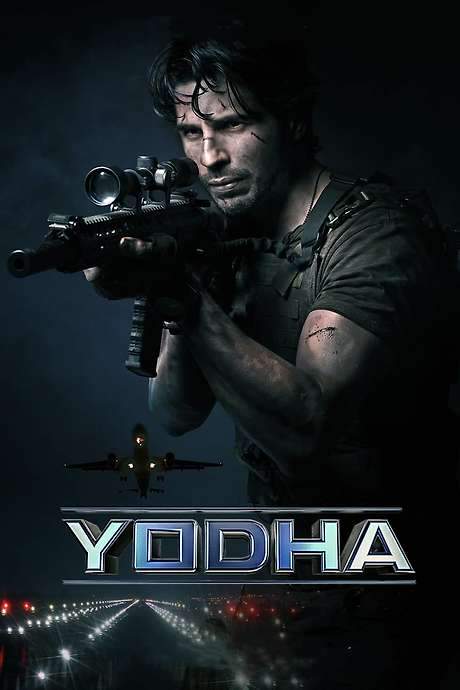
Arun Katyal, Sidharth Malhotra, the son of the martyred Major Surender Katyal, steps into the leadership of the Yodha task force after his father’s legacy, carrying the weight of duty and a sharp readiness honed by para-commando training in land, sea, and air combat. He shares a grounded home life with his intelligence-officer wife, Raashii Khanna as Priyamvada "Priya" Katyal, and a close, loyal bond with his ally and fellow officer Tanuj Virwani as Sameer Khan. After a mission that seems to go well, Arun quietly apologizes to Priya for bending orders handed down by the intelligentsia, a moment that hints at the friction between personal conscience and external command that will echo through what follows.
The drama intensifies on a mission that pairs Arun with a renowned nuclear scientist, Dr. Anuj Nair. The flight is hijacked by Lashkar-e-Taiba terrorists, and Arun fights to keep control of the situation while protecting Nair. In the scramble, he makes a selfless move to shield the scientist, but is ultimately cast out of the plane as the danger spirals. Nair’s identity is disclosed to the terrorists, and tragically, Nair is killed and his body is returned to India. The government orders an official inquiry, Yodha is suspended, and Priya—conflicted by the revelations of Arun’s alleged violations—advocates for him even as she retreats from him, taking his mother with her. The consequence is a rupture in their relationship and a public perception that casts Arun as a traitor, a label that stains his name and life.
Years drift by, and Arun’s life becomes quiet but unsettled, shadowed by a sense of unfinished business. While at an airport, a mysterious cue redirects him toward boarding another flight, and his instincts tell him something dangerous is in play. On board, he suspects a hijack and appears to fatally strike a dangerous figure he believes to be a terrorist—Amandeep Singh. Yet the illusion cracks fast: Arun is pulled into a cascade of twists when Tanya Sharma, a flight specialist aboard, and Laila Khalid, a vigilant flight attendant, reveal themselves as key players in a planned hijacking. Laila Khalid, played by Disha Patani, and her brother Ahmed, the pilot, are part of a Kashmiri secessionist circle. Amandeep Singh, it turns out, is a disguised operative, and Arun’s attempt to read the room backfires as betrayal spreads through the cabin.
What follows is a relentless high-altitude contest where alarm gives way to action. Tanya takes control of the aircraft while news leaks to the Pakistani media about a rogue Indian Army officer aiming for Islamabad, which paints Arun in a negative light just as the heads of state converge on a fragile peace summit. In the Pakistani side, Rafiq—Sunny Hinduja—appears as a figure of a consular liaison who brings the Pakistani security chief and the Indian Head of State into a control room, only to reveal his true stance later: he is opposed to the Peace Summit and turns against his own leadership to complicate the crisis. Arun must rely on quick thinking and the help of Priya, who, aware of Arun’s past and his legitimacy, becomes a crucial ally against a cascading threat.
In a dramatic turn, the plot centers on Jalal, a terrorist who surfaces as the mastermind of the crisis. Jalal manipulates events from the Pakistani Head of State’s Office, and Arun realizes the danger behind the political masquerade. The suspense heightens as Priya recognizes that Arun’s divorce papers—never signed—reveal a personal vulnerability that Jalal intends to exploit. In a tense, code-driven exchange, Arun indicates to Priya that she must stay steadfast in their bond to confront the threat together. The stakes escalate as Jalal’s plan to maintain terrorism in Kashmir is laid bare, framed as a business he cannot bear to see collapse. The dialogue captures the gravity of the moment: > "business," Jalal declares, underscoring the ruthless calculus behind the violence.
With Priya’s insight and Tanya’s measured courage, Arun confronts Jalal in a final, brutal confrontation. The two men collide in a fight that ends with Arun overpowering Jalal, then impaling him in a moment that tests the limits of fear, loyalty, and survival. Jalal taunts that peace can never prevail in Kashmir, and in a last gambit, he triggers a detonator embedded in the danger zone. Arun, steady under pressure, disables the device by snatching the detonator from Jalal’s jacket and passes it to Priya, who uses the opportunity to disable the threat. The climactic struggle culminates in a decisive duel where Arun’s resolve meets Jalal’s malevolence, and Arun emerges victorious, reuniting with Priya in a hard-won moment of personal reconciliation and professional redemption.
As the dust settles, a mid-credits moment crowns the arc: the Indian Head of State, impressed by Arun’s bravery, reinstates the Yodha task force and signals a restoration of faith in those who serve under difficult and dangerous circumstances. The saga ends on a note of renewed purpose and a reminder that heroism can emerge from the most trying trials, where duty to country intersects with duty to family and love.
Dr. Anuj Nair remains a poignant reminder of the high-cost decisions that shape the trajectory of those tasked with protecting a nation, while Sanjay Gurbaxani anchors the political stakes that accompany every act of courage in the skies above. And through it all, Disha Patani, Raashii Khanna, Sidharth Malhotra, Shivangi Bhardwaj, Mikhail Yawalkar, Sadiq Farooqui, Sunny Hinduja, and Farida Patel Venkat bring depth and dynamism to a narrative that is equal parts patriotism, peril, and personal peril, making the journey of Arun Katyal and Priya Katyal a receptor of hope amid crisis, and a testament to the complexities of modern-day heroism.