Worth

Worth

JustWatch#21,4357

Year: 2021

Runtime: 118 min

Language: English

Director: Sara Colangelo

Echo Score: 62
BiographyDramaHistory

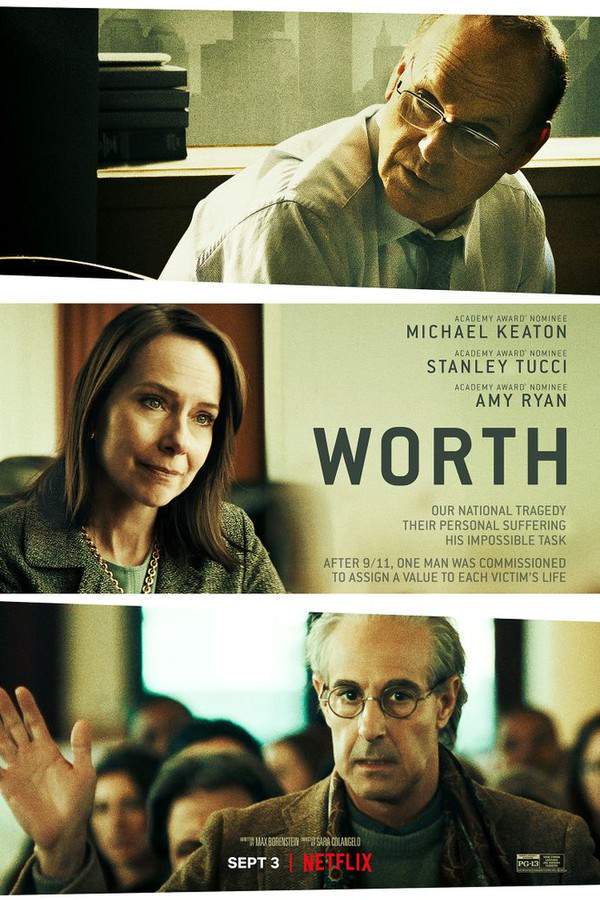
Following the 9/11 attacks, attorney Kenneth Feinberg is appointed to fairly distribute compensation funds to the victim’s families. He works alongside mediator Camille Biros, facing difficult ethical choices as he tries to balance legal processes with the immense grief of those affected. A poignant meeting with Charles Wolf, whose family suffered a terrible loss, profoundly impacts Feinberg, forcing him to deeply consider the emotional consequences of the tragedy and his role in helping the families heal.

Where to Watch Worth?

Find where to stream, rent, or buy Worth (2021) in the US with current JustWatch availability, up-to-date pricing, and platform listings for subscription, rental, and digital purchase options.

Warning: spoilers below!

Haven’t seen Worth yet? This summary contains major spoilers. Bookmark the page, watch the movie, and come back for the full breakdown. If you're ready, scroll on and relive the story!

Timeline – Worth (2021)

Trace every key event in Worth (2021) with our detailed, chronological timeline. Perfect for unpacking nonlinear stories, spotting hidden connections, and understanding how each scene builds toward the film’s climax. Whether you're revisiting or decoding for the first time, this timeline gives you the full picture.

1

Kenneth Feinberg's Lecture

The film opens with Kenneth Feinberg engaging his class at Columbia University. He offers a thought-provoking perspective on how the legal system evaluates a person's life, establishing the foundation for his subsequent actions after a national tragedy.

Columbia University
2

September 11 Attacks

The events of September 11 shock the nation, leading to immense loss and grief. This tragedy sets the stage for Feinberg's pivotal role in addressing the needs of the victims' families and the nation as a whole.

September 11, 2001 United States
3

Feinberg's Appointment

Following the attacks, Feinberg is appointed as the Special Master of the September 11th Victim Compensation Fund. This role tasks him with the difficult responsibility of managing compensation for the victims' families amidst great public scrutiny.

4

Meeting the Victims

Feinberg's first meeting with the victims is fraught with tension and hostility. His attempt to explain the fund's regulations is met with anger, but Charles Wolf steps forward to urge the crowd to listen to him, showcasing the struggles Feinberg faces.

5

Frank Donato's Plea

In a poignant moment, Frank Donato, brother of a firefighter who died in the attacks, passionately implores Feinberg to consider his brother's story. This highlights the emotional weight of the victims' experiences and the challenges of quantifying their losses within the compensation framework.

6

Graham Morris's Challenge

Camille Biros becomes emotionally involved with Graham Morris, a gay man whose partner died in the attacks. Due to Virginia’s laws, Morris finds himself ineligible for compensation, illustrating the discriminatory obstacles that persist even in tragedy.

Virginia
7

Demand for Higher Payouts

Pressure mounts as wealthy families of the victims demand larger compensation payouts from the fund. This tension threatens the stability of Feinberg's initiative and complicates the effort to provide equitable support for all victims.

8

Feinberg's Encounter at the Opera

After an illuminating discussion with Charles Wolf at the opera, Feinberg is inspired by Wolf's resilience. This encounter revitalizes Feinberg's commitment to compassionately understanding and supporting the victims' families.

Opera House
9

Reassessing Fund Criteria

With renewed determination, Feinberg and Biros decide to re-evaluate the criteria for compensation. They seek to broaden eligibility, thereby allowing more victims to receive the aid they desperately need, demonstrating their commitment to justice.

10

Creation of the Shrine

As Feinberg connects more deeply with the victims, he sets up a shrine in his office using tokens and mementos from applicants. This act symbolizes the profound impact their stories have on him and serves as a reminder of the human element in his work.

Feinberg's Office
11

Wolf's Support

Charles Wolf plays a crucial role in rallying other victims to trust Feinberg. Witnessing Feinberg's genuine empathy helps bridge the gap between the victims and those managing the fund, fostering collaboration towards a common goal.

12

Success of the Fund

As the deadline approaches, a significant number of eligible families decide to apply for compensation. Feinberg's efforts culminate in a remarkable success story, showcasing the effectiveness of their approach to the victims' needs.

By December 22, 2003
13

Emotional News for Morris

Camille Biros delivers emotional news to Graham Morris regarding the fund's support for same-sex couples. Despite his own heartbreaking circumstances, Morris learns that his community will not be neglected in the compensation effort.

14

Conclusion

The film culminates with a poignant title card, revealing that Feinberg and Biros distributed billions in government aid to 97 percent of eligible victims. Their ongoing commitment to assist others affected by similar tragedies reinforces the film's message of resilience and compassion.

Last updated: November 15, 2024 at 18:21

Was this helpful?

Worth (2021) Timeline Questions Answered – Chronology FAQ

Find frequently asked questions about the Worth (2021) timeline, including chronological order, nonlinear jumps, cause-and-effect links, and scene sequence clarifications. This timeline FAQ helps explain when key events happen, how moments connect, and why the story unfolds in that specific order.

Q1

Why was Kenneth Feinberg appointed to handle the 9/11 Victim Compensation Fund?

A.

Kenneth Feinberg was appointed as the Special Master of the September 11th Victim Compensation Fund because of his expertise in mediation and his background in evaluating wrongful death claims. As a renowned attorney who had previously handled high-profile compensation cases, he was chosen to fairly distribute government funds to victims' families while navigating the complex legal and ethical challenges of the task.

ken feinbergspecial master9/11 compensationattorneyappointment
Q2

Why did Feinberg use a formula to calculate compensation amounts?

A.

Feinberg created a stringent formula based on each victim's income because he needed an objective, defensible method to determine payout amounts for thousands of claimants. The formula was designed to be consistent and fair on paper, though it failed to account for the emotional and personal dimensions of loss that the victims' families experienced.

The film opens with Feinberg teaching his law class about how the legal system values human life, establishing his formulaic mindset early on.

formulacompensation calculationincomepayoutsformulaic approach
Q3

Why was Charles Wolf important to the compensation process?

A.

Charles Wolf, who lost his wife in the 9/11 attacks, became crucial in bridging the gap between Feinberg and the victims' families. After initially urging the hostile crowd to listen to Feinberg, Wolf met with him personally at the opera and shared his own experiences of enduring hardship. This encounter transformed Feinberg's approach from purely legal to more compassionate, ultimately helping Wolf rally other victims to trust the fund.

Wolf steps forward during Feinberg's first difficult meeting, asking the crowd to hear Feinberg out, a moment that planted the seed for their later relationship.

charles wolfvictims familiestrustmediationcompassion
Q4

Why couldn't Graham Morris receive compensation for his partner's death?

A.

Graham Morris, a gay man whose partner died in the 9/11 attacks, was denied compensation because Virginia did not recognize civil partnerships at the time. This legal technicality meant Morris had no standing to file a claim, despite being in a committed relationship with the victim. The film highlights this as an example of systemic injustice that persisted even in the wake of tragedy.

graham morrisgay couplecivil partnershipvirginia lawdiscrimination
Q5

Why did victims' families protest during Feinberg's first meeting?

A.

Victims' families protested fiercely during Feinberg's initial meeting because they viewed his formula-based approach as cold and impersonal. The families were grieving devastating losses and felt that a mathematical formula couldn't capture the true value of their loved ones. Additionally, they feared the strict regulations would prevent them from pursuing lawsuits they might otherwise win, leaving them without adequate recourse.

protestvictims familiesangerformulalegal process
Q6

How did the opera meeting change Feinberg's approach to the fund?

A.

After attending the opera with Charles Wolf, Feinberg experienced a profound shift in perspective. Wolf shared personal anecdotes about enduring hardship and resilience, which inspired Feinberg to reconnect with the emotional core of the issue. This encounter renewed his determination to use the discretion afforded by his government role to broaden eligibility criteria and approach the victims with genuine empathy rather than just legal rigidity.

operatransformationcompassioncharles wolfperspective change
Q7

What was the 80% threshold and why did it matter?

A.

The 80% threshold referred to Feinberg's goal of securing signatures from at least 80% of the estimated 7,000 victims' families. If this target wasn't met, families would be allowed to pursue lawsuits against airlines and other companies, lawsuits they might ultimately lose. Failure could have jeopardized the airline industry and triggered a financial crisis, making this threshold critical to the fund's success and broader economic stability.

80 percent thresholdlawsuitsairline industrysignaturesdeadline
Q8

Why did Feinberg create a shrine in his office?

A.

Feinberg created a shrine in his office using tokens and mementos provided by compensation applicants as a way to honor the victims and remind himself of the human impact behind every case. This physical representation of the victims' stories symbolized his growing emotional connection to the work and served as a constant reminder that behind the numbers were real people grieving real losses.

shrineofficetokensmementosmemorial
Q9

How did the fund achieve 97% participation from eligible families?

A.

The fund achieved 97% participation by combining Feinberg and Biros's revised, more flexible eligibility criteria with Charles Wolf's advocacy. After Wolf witnessed Feinberg's genuine empathy toward victims, he rallied other families to trust Feinberg's judgment. The approaching December 2003 deadline also motivated families to apply, resulting in billions being distributed to nearly all eligible claimants.

97 percentparticipationsuccesseligibilitycharles wolf
Q10

Why was the film's ending bittersweet despite the fund's success?

A.

The ending was bittersweet because while Feinberg and Biros successfully distributed billions to 97% of eligible victims, the film acknowledged that some people, like Graham Morris, were still denied full recognition due to discriminatory laws. The victory was tempered by irreversible personal losses and the acknowledgment that the legal system couldn't fully address the emotional devastation of 9/11, leaving some families without adequate closure.

bittersweet endingsuccessgrieflosslimitation
Mobile App Preview

Coming soon on iOS and Android

The Plot Explained Mobile App

From blockbusters to hidden gems - dive into movie stories anytime, anywhere. Save your favorites, discover plots faster, and never miss a twist again.

Sign up to be the first to know when we launch. Your email stays private, always.

Explore Movie Threads

Discover curated groups of movies connected by mood, themes, and story style. Browse collections built around emotion, atmosphere, and narrative focus to easily find films that match what you feel like watching right now.

Bureaucratic Dramas with Moral Weight like Worth

Stories where bureaucratic systems face immense moral and emotional challenges.Discover movies like Worth that delve into the ethical struggles within large organizations. If you enjoyed watching the legal process confront raw human grief, you'll find similar thoughtful stories here about systems under pressure, featuring steady pacing and heavy emotional themes.

thoughtfultensesomberproceduralethicalheavycompassionategrieving

Narrative Summary

Narratives typically follow a professional or a committee tasked with an impossible decision, often involving valuing human life or allocating scarce resources. The conflict arises from the collision between cold, objective rules and passionate, subjective pleas, forcing characters to confront the limits of their system and their own humanity.

Why These Movies?

These films are grouped together because they share a specific mood of somber tension, a steady, procedural pacing, and a central theme of navigating ethical mazes within powerful institutions. They appeal to viewers who appreciate character-driven stories about the moral cost of complex, real-world decisions.
Movies About Collective Grief and Healing like Worth

Films about a community navigating the painful, slow process of healing after a shared tragedy.Find films similar to Worth that explore the aftermath of tragedy and the long road to healing for a community. If you were moved by the portrayal of systemic response to personal grief, these stories offer a similar compassionate and bittersweet look at resilience and recovery.

grievingresilientcatharticsombercompassionatethoughtfulheavycommunity

Narrative Summary

The story often follows a key figure or group responsible for the official response to the tragedy, whose personal journey mirrors the community's struggle. The plot unfolds through interactions with numerous affected individuals, highlighting the diversity of grief and the challenge of finding a fair or compassionate path forward, leading to a bittersweet resolution.

Why These Movies?

This thread connects films based on their shared core theme of collective trauma and the slow, complex process of healing. They possess a heavy emotional weight, a compassionate yet somber tone, and a narrative structure that balances macro-level systems with intimate personal stories of loss.

Unlock the Full Story of Worth

Don't stop at just watching - explore Worth in full detail. From the complete plot summary and scene-by-scene timeline to character breakdowns, thematic analysis, and a deep dive into the ending - every page helps you truly understand what Worth is all about. Plus, discover what's next after the movie.

Worth Summary

Read a complete plot summary of Worth, including all key story points, character arcs, and turning points. This in-depth recap is ideal for understanding the narrative structure or reviewing what happened in the movie.

Worth Summary

Characters, Settings & Themes in Worth

Discover the characters, locations, and core themes that shape Worth. Get insights into symbolic elements, setting significance, and deeper narrative meaning - ideal for thematic analysis and movie breakdowns.

Characters, Settings & Themes in Worth

Worth Ending Explained

What really happened at the end of Worth? This detailed ending explained page breaks down final scenes, hidden clues, and alternate interpretations with expert analysis and viewer theories.

Worth Ending Explained

Worth Spoiler-Free Summary

Get a quick, spoiler-free overview of Worth that covers the main plot points and key details without revealing any major twists or spoilers. Perfect for those who want to know what to expect before diving in.

Worth Spoiler-Free Summary

More About Worth

Visit What's After the Movie to explore more about Worth: box office results, cast and crew info, production details, post-credit scenes, and external links - all in one place for movie fans and researchers.

More About Worth