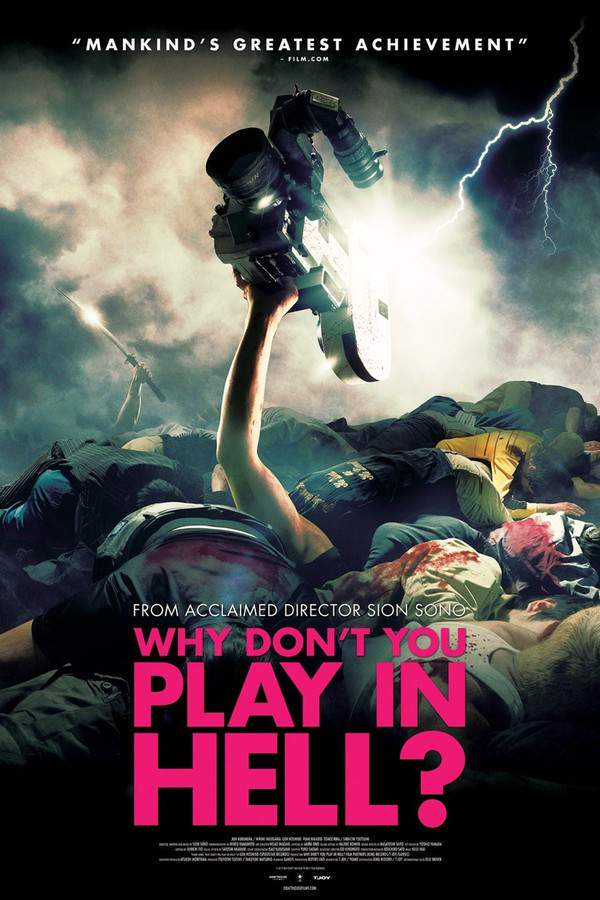
Three teenagers with a deep love for cinema, including the aspiring director Hirata, chance upon a young thug named Sasaki, whom they envision as the next Japanese Bruce Lee. Enthusiastically, they invite Sasaki to join their film-making group, the "Fuck Bombers", under the guidance of a wise, elderly projectionist specializing in 35mm film.
Meanwhile, the world of organized crime is ablaze with conflict. Boss Muto finds himself in a deadly struggle against the assassins of a rival gang who dare invade his home, threatening his wife. In a fierce act of defiance, she manages to kill nearly all of her attackers but is subsequently incarcerated. The only one who survives, Ikegami, briefly encounters Mitsuko, the 10-year-old daughter of Muto and a child star in a toothbrush commercial. Covered in blood after the violent incident, Ikegami is captured on film by the passionately dedicated Fuck Bombers. Following this chaos, Muto's yakuza clan emerges victorious, vanquishing their rivals by executing their leader. Seizing power, Ikegami proposes a truce and renames his gang headquarters with a majestic castle theme inspired by samurai films, complete with his gang members donning traditional kimonos. All the while, Hirata leaves a humble prayer at a small shrine, beseeching the God of Cinema to bless the Fuck Bombers with the creation of a memorable film.
A decade later, it seems that their aspirations have crumbled: the Fuck Bombers film club has yet to create a notable movie, and the beloved projectionist has passed away. Stricken by despair over his failures, Sasaki chooses to part ways with his friends. The yakuza war persists unattended, as Ikegami and Muto's factions continue to clash. Mitsuko, now an actress feeling stifled by her unfulfilling roles, flees from a film project that has garnered her mother's praise, who, after recouping her freedom from prison, envisioned her daughter becoming a superstar. During her desperate escape, Mitsuko hides in a phone booth, where she unexpectedly meets Koji, who has harbored feelings for her since he first spotted her in a commercial as a child. Unbeknownst to him, Mitsuko enlists him as her "boyfriend" for a day to help her evade her pursuers, and they are soon embroiled in a whirlwind of chaos.
As fate would have it, Muto learns from the director of Mitsuko's film that they can no longer afford to wait for her return, having hired a replacement. In a twist of events, Muto's men manage to capture both Mitsuko and Koji. Mistakenly believing that Koji is the one Mitsuko eloped with, Muto attempts to eliminate him. However, Mitsuko cleverly persuades her father to spare Koji by claiming he is a film director capable of bringing her vision to life. Muto, intrigued, decides to enlist Koji in creating a movie for his wife, featuring his own daughter. He procures film equipment and constructs a set with the assistance of his subordinates. A subordinate suggests that they could harmoniously combine their film project with an anticipated showdown with Ikegami.
Feeling the weight of this monumental task, Koji makes a daring escape but finds himself drawn back to the very shrine visited by the Fuck Bombers a decade prior, only to be recaptured by the yakuza. This leads to an emotional moment as he uncovers Hirata's prayer signed at that shrine. In a moment of desperation, Koji and Mitsuko seek out Hirata for guidance in directing the film. Although details are scarce, Hirata eagerly accepts the offer upon hearing of their financial backing and access to 35mm film. He rekindles his friendship with Sasaki and befriends the remaining members of Muto's yakuza, who have transformed into an impromptu film crew. Hirata persuades Ikegami, who remains infatuated with Mitsuko, to join their cinematic endeavor. With Hirata's insistence, all male participants in the film are to be armed only with katanas for authenticity.
The climactic battle unfolds, complete with professional camera, lighting, and sound crews capturing every moment. Hirata directs the fray as if it were an elaborate film, repeatedly calling for "Cut!" whenever he desires different angles, and the yakuza oblige, pausing even amid injury. The fray escalates into graphic violence: Muto is decapitated, and Koji suffers a grievous injury to his hand. Just before Koji succumbs, he and Mitsuko share a heartfelt confession of their love, only for fate to deliver a cruel blow as a katana embeds itself in his skull. Enraged over Muto's death, a member of Muto’s faction retaliates by shooting Ikegami, igniting a chaotic exchange of gunfire between the rival yakuza clans. In the ensuing melee, the camera operators are caught in the crossfire, ultimately losing their lives behind the lens.
Just when it seems all is lost, the police arrive and begin a gruesome extermination of Koji, Ikegami, Mitsuko, and Sasaki. Amidst the carnage, Hirata rises from the pile of bodies, frantically gathering the film reels scattered across Ikegami's castle. Drenched in blood and driven by fervor, he races through the streets exclaiming "Fuck Bombers!" and "We have the movie!" He envisions the triumphant revival of the cine-club, picturing the resurrected cast and crew, albeit with their injuries on full display, at the premiere of their cinematic masterpiece titled "Why Don't You Play in Hell?" as the onlookers erupt in applause. Abruptly returning to reality, Hirata continues his frantic chase, only to be interrupted by a voice yelling for a cut, revealing crew members emerging in the backdrop.