Plot Explained Spoilers guaranteed!
Plot Explained

Browse by genre

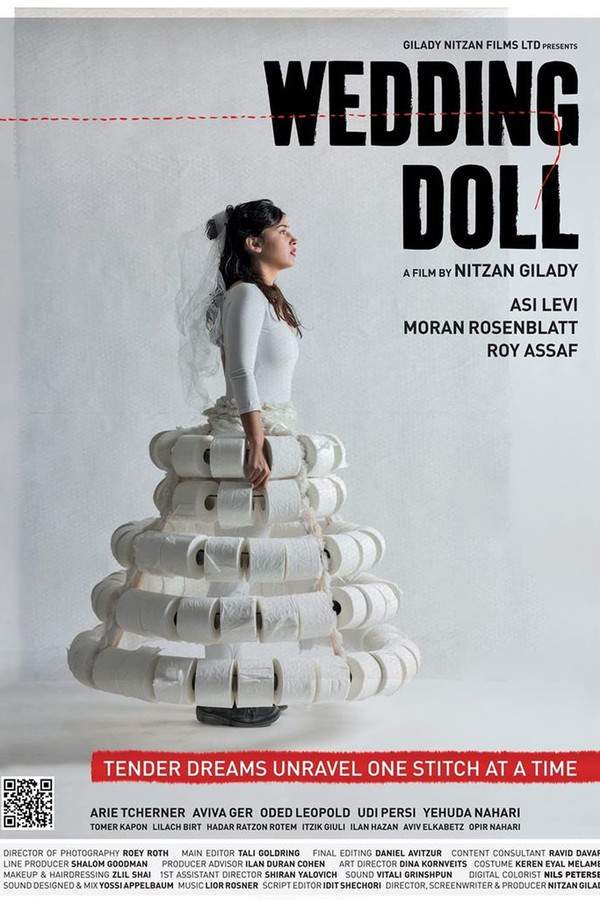
Wedding Doll (2016) movie poster

Plot Summary

Wedding Doll (2016) Plot Summary Explained

Release, runtime and language
2016 · 82 min · English
Loading streaming availability…
Directed by
Nitzan Giladi
Starring
Assi Levy, Moran Rosenblatt, Roy Assaf

A spirited young woman named Hagit seeks independence in a close-knit community centered around a toilet-paper factory. While navigating her mother Sarah's devoted care, she secretly develops a romantic connection with the factory owner's son. However, the factory's impending closure casts a shadow over their lives, forcing Hagit and Sarah to confront their own aspirations and the delicate balance of their relationships.

On this page (5)
  1. 1 Where to watch
  2. 2 What happens: full plot
  3. 3 Plot questions answered
  4. 4 Movie threads
  5. 5 Every angle
Loading streaming availability…

Full plot summary · contains spoilers

What Happens in Wedding Doll: Full Plot Summary

The whole story of Wedding Doll (2016) explained, from the opening scene to the final frame: every key event, every twist and what it all adds up to. Read it as a quick recap before the sequel, to check a scene you missed, or to finally understand what really happened.

Hagit, portrayed by Moran Rosenblatt, is a 24-year-old woman residing with her mother, Sarah, in the scenic town of Mitzpe Ramon. Living with a mild intellectual disability, which manifests in her slow speech and a somewhat stunted intellectual maturity, Hagit is constantly striving for independence. Employed at a modest toilet paper factory run by Arie (Arieh Tchernar) and his wife Pnina (Aviva Ger), she shares the workspace with Omri, the couple’s son, brought to life by Roy Assaf.

Sarah, a single mom grappling with the challenges of raising Hagit, works tirelessly as a hotel housekeeper. Her concern for Hagit’s well-being leads her to become overly protective, often frustrating her daughter who yearns to assert her independence in life. Despite Sarah’s attempts to pair her with someone of similar capabilities, like Elad (Aviv Elkabetz), Hagit’s heart is set on Omri, the object of her affection who shows her genuine kindness.

Adding complexity to their dynamic is Chen (Tomer Kapon), Hagit’s married brother, who remains distant. He believes it would be in Hagit’s best interest to transition to a group home, a sentiment echoed by Moshe, Sarah’s ex-husband.

Hagit’s burgeoning love for Omri, though tinged with the awareness of his pity, fuels her dreams of a future together. They often find solace sitting on cliffs overlooking the stunning Ramon Crater, sharing deep conversations and tender moments, such as light kisses. Hagit’s creative side shines through at the factory as she fashions a paper bride doll, while Omri crafts a groom from the same material—a beautiful representation of their growing bond.

From another angle, Sarah’s endeavors for her own romantic life are hindered by Hagit’s dependence on her. Her struggles to cultivate a relationship with Chaim (Oded Leopold) are intensified by her reluctance to leave Hagit alone for any length of time.

However, the factory’s financial woes weigh heavily on everyone involved, particularly with Arie contemplating a shutdown despite Omri’s passionate objections. In a bid to turn things around, Omri contemplates acquiring new equipment and borrows money from his friends, Eli (Yehuda Nahari Halevi) and Simon (Oudi Peri). However, Arie, upon witnessing a kiss between Hagit and Omri, insists that his son pursue studies in Canada, casting a shadow over their budding relationship.

As Omri prepares to leave, his friends organize a farewell gathering at the factory, which Hagit innocently misinterprets as a wedding celebration. Arriving in a wedding dress crafted from toilet paper rolls, she is met with mockery from Eli and Simon, while Omri, in his discomfort, fails to defend her, leading to a heart-wrenching climax where Hagit flees into the night, utterly broken.

Following a frantic search, Sarah finds Hagit on the roadside, and the two return home. In a poignant twist, Sarah resolves to place Hagit in a group home for her own safety. As they drive towards this new chapter, Hagit mournfully extends her paper bride doll out the window, watching as it drifts away—a powerful symbol of her relinquished dreams and unfulfilled yearnings for a life of love and partnership.

Last updated: December 24, 2024 at 10:01

Was this helpful?

Plot questions answered

Wedding Doll Plot Explained: Your Questions Answered

The questions people ask most about Wedding Doll (2016): what happens in the confusing scenes, why the characters do what they do, the twists, hidden details and what the ending means. Each answer contains spoilers.

Q1

Why does Sarah decide to put Hagit in a group home?

After Hagit runs away from the factory heartbroken, Sarah searches for her daughter through the night and eventually finds her on the roadside. This traumatic event, where Hagit flees in devastation after being mocked, convinces Sarah that she cannot adequately protect Hagit while maintaining her own life. Sarah recognizes that Hagit needs more support than she can provide as a single working mother, and the group home represents a safer environment where Hagit can receive consistent care while still maintaining a relationship with her mother.

Foreshadowing: Earlier, both Chen and Moshe had suggested a group home as a better option, foreshadowing this eventual decision.

  • sarah
  • hagit
  • group home
  • decision
  • safety
  • mother daughter
Q2

Why doesn't Omri defend Hagit at the farewell party?

Omri fails to defend Hagit when his friends mock her because he is embarrassed by the situation and conflicted about his feelings. Although he cares for Hagit, Omri is uncomfortable with the public spectacle of her arriving in a wedding dress made of toilet paper. His failure to stand up for her represents the fundamental power imbalance in their relationship and his inability to fully commit to her, which ultimately breaks Hagit's heart.

Foreshadowing: Omri's kindness throughout the film is noted as partly rooted in pity, suggesting he never truly sees her as an equal partner.

  • omri
  • hagit
  • defend
  • party
  • mockery
  • heartbreak
Q3

Why does Arie send Omri to Canada after seeing them kiss?

Arie witnesses a kiss between Hagit and Omri at the factory and immediately insists that his son pursue studies in Canada. This reaction suggests Arie views Hagit as an inappropriate romantic partner for Omri, likely due to her intellectual disability. Rather than address the situation directly or accept their relationship, Arie chooses to remove Omri from the environment, viewing separation as the simplest solution to prevent further involvement.

Foreshadowing: Earlier, Sarah had tried to pair Hagit with Elad, who has similar intellectual abilities, reflecting the community's expectations about whom Hagit should be with.

  • arie
  • omri
  • canada
  • kiss
  • factory
  • separation
Q4

Why does Hagit think the farewell party is a wedding?

Hagit genuinely believes the farewell party is a wedding celebration because she has been living in a fantasy about her future with Omri. Throughout the film, she imagines marrying him and building a life together. When Omri's friends organize a farewell gathering, Hagit's hopeful interpretation transforms it into what she desperately wants it to be, a wedding. Her creation of a toilet paper wedding dress reflects her sincere belief that this is her moment to become Omri's bride.

Foreshadowing: Hagit and Omri made paper bride and groom dolls together at the factory, representing their shared fantasy of marriage.

  • hagit
  • wedding
  • party
  • misunderstanding
  • dress
  • fantasy
Q5

What does the paper bride doll represent at the end?

The paper bride doll that Hagit releases out the car window symbolizes her shattered dreams of love, marriage, and independence. Throughout the film, Hagit creates this doll as a representation of her aspirations to become a bride and have a normal romantic life. When she lets it go while driving to the group home, she is symbolically releasing these unfulfilled dreams, accepting that the future she imagined with Omri will never happen.

Foreshadowing: Hagit and Omri made the paper bride and groom dolls together at the factory, establishing their romantic fantasy which the ending destroys.

  • paper bride doll
  • symbol
  • dreams
  • letting go
  • wedding
Q6

Why is Omri's kindness towards Hagit problematic?

Omri's kindness towards Hagit is problematic because it stems partly from pity rather than genuine romantic love. While Omri shows Hagit genuine attention and spends time with her, his motivation appears mixed, he enjoys being admired but may not truly envision a future with her. This imbalance becomes painfully clear when he fails to defend her at the party, prioritizing his own comfort over protecting someone who genuinely loves him.

Foreshadowing: The summary explicitly notes that Omri's kindness is "partly rooted in pity," establishing this dynamic from early in the film.

  • omri
  • hagit
  • pity
  • kindness
  • relationship
  • imbalance
Q7

Why does Hagit want to work at a bridal salon?

Hagit applies for a job at a bridal salon in Be'ersheba because it represents her dream of becoming a bride herself. Working around wedding dresses and brides would place her closer to the life she fantasizes about having with Omri. The job rejection strikes a significant blow to her self-esteem because it reinforces her sense of exclusion from the normal adult life she desperately wants.

Foreshadowing: Hagit's romantic fantasies about marrying Omri and her creation of a paper bride doll establish her deep desire for marriage.

  • hagit
  • bridal salon
  • job
  • dreams
  • marriage
  • rejection
Q8

Why does Sarah struggle to pursue a relationship with Chaim?

Sarah struggles to date Chaim because her obligations to care for Hagit prevent her from spending time away from her daughter. As a single mother with a daughter who has an intellectual disability, Sarah feels responsible for Hagit's wellbeing every moment. Her reluctance to leave Hagit alone, even briefly, severely limits her ability to cultivate a romantic relationship, leaving her own happiness secondary to her caregiving duties.

Foreshadowing: Sarah's overprotective nature toward Hagit is established early in the film, showing how her care responsibilities dominate her life.

  • sarah
  • chaim
  • dating
  • caregiver
  • responsibility
  • independence
Q9

Why does the factory closing affect Hagit and Omri's relationship?

The factory's financial troubles create the context for Omri's decision to leave for Canada. When Arie decides to close the factory, Omri attempts to save it by borrowing money from friends to buy new equipment. However, Arie's discovery of Omri and Hagit kissing leads him to push Omri toward education in Canada instead of letting him stay and potentially pursue a relationship with Hagit. The factory closure thus accelerates their separation.

Foreshadowing: Omri's passion for saving the factory shows his investment in staying, making his sudden departure more impactful.

  • factory
  • closing
  • omri
  • canada
  • separation
  • money
Q10

Why does Hagit's brother want her in a group home?

Hagit's brother Chen, who is married and has his own child, believes Hagit would be better off in a group home because he thinks Sarah cannot provide adequate care for her. Chen's distance from the family suggests he has already moved on with his own life, and he sees institutional care as a more appropriate solution for someone with Hagit's intellectual disability. This perspective conflicts with Sarah's protective instincts and highlights the family tensions around Hagit's future.

Foreshadowing: Their father Moshe echoes the same sentiment, indicating this is a recurring family debate.

  • chen
  • hagit
  • brother
  • group home
  • family
  • care

Movie threads

More Movies Like Wedding Doll, by Mood & Story

Curated lists built around what makes Wedding Doll tick: the same mood, the same kind of story or the same emotional payoff. Each list explains why these movies belong together.

Movies like Wedding Doll about stifling small-town life

Intimate dramas where a community's economic struggles mirror personal disappointments. If you liked the intimate, melancholic feel of Wedding Doll, this thread gathers similar movies about small towns and close-knit communities. These stories explore how economic hardship and social confines shape personal dreams and relationships, often with a bittersweet or sad tone.

  • melancholic
  • tender
  • oppressive
  • dreamlike
  • longing
  • quietly devastating
  • Tone: bittersweet, melancholic
  • Pacing: slow, deliberate
Why these movies?

The story pattern: Narratives in this thread typically follow characters grappling with the limitations of their environment, often a small town facing closure or decline. Personal dreams for love, independence, or a better life are tested against the unyielding reality of their circumstances, leading to poignant, character-driven conclusions.

Why they belong together: These films are grouped together for their shared focus on the intersection of personal and communal struggle. They possess a similar slow, observant pacing, a medium emotional intensity, and a tone that blends tenderness with melancholy, creating a powerfully understated emotional experience.

Movies like Wedding Doll about dreams clashing with dependency

Character-driven journeys where the desire for independence clashes with protective bonds. For viewers who appreciated the central mother-daughter dynamic and Hagit's quest for independence in Wedding Doll, this collection highlights similar films. These narratives explore the delicate, often heartbreaking balance between protective love and personal aspiration, with a straightforward, emotionally resonant focus.

  • hopeful
  • longing
  • tender
  • comfort
  • melancholic
  • family dynamics
  • Tone: bittersweet, tender
  • Pacing: slow, character-focused
Why these movies?

The story pattern: The narrative pattern involves a protagonist with a strong inner world and aspirations bumping against the practical and emotional constraints imposed by their situation and their closest relationships. The story arc is typically a straight line toward a moment of reckoning, where dreams are either painfully adjusted or a new, more complicated form of independence is won.

Why they belong together: These movies share a central thematic focus on the tension between care and control. They are united by a straightforward narrative complexity, a medium emotional weight that builds gradually, and a bittersweet or sad emotional tone that acknowledges the complexity of love and limitation.

Every angle

Wedding Doll (2016) Explained: Plot, Timeline & Characters

Everything about Wedding Doll in one place: what happens in the plot summary, the timeline in chronological order, the characters and meaning and a spoiler-free summary. What's After the Movie adds the cast, box office and post-credit scenes.

Coming soon on iOS and Android

The Plot Explained Movie Summary App

Plot summaries, endings explained and timelines on your phone. Catch up on any movie in minutes, save your favorites and never miss a twist again.

Be the first to know when we launch. Your email stays private, always.

Learn more about the app