Year: 2014
Runtime: 85 min
Language: English
Director: Joe Pearson
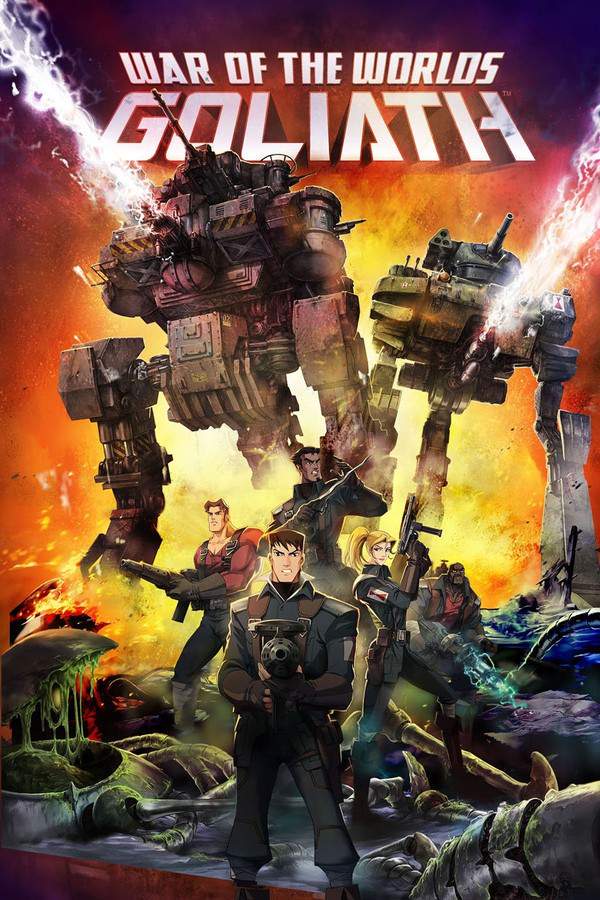
As the 15th anniversary of H.G. Wells' Martian invasion approaches, humanity prepares for a renewed threat. Leading the defense with a steam-powered arsenal of walkers, biplanes, and zeppelins is Goliath. He faces an overwhelming assault of colossal machines and flying wings in this retro-futuristic epic. Courage, conflict, and sacrifice define his journey as Earth's survival rests on his shoulders.
Warning: spoilers below!
Haven’t seen War of the Worlds: Goliath yet? This summary contains major spoilers. Bookmark the page, watch the movie, and come back for the full breakdown. If you're ready, scroll on and relive the story!
Read the complete plot breakdown of War of the Worlds: Goliath (2014), including all key story events, major twists, and the ending explained in detail. Discover what really happened, and what it all means.
In a devastated alternative version of Earth, the sky has lost its vibrant blue hue, transforming into a dull gray, marking the aftermath of the Martians’ unprovoked aggression toward humanity back in 1899. It’s been a grim fifteen years since that fateful day when Eric Wells, then merely ten years old, helplessly witnessed the destruction of his cherished Leeds at the hands of a relentless Martian Tripod. Just when it seemed that doom was imminent, fortune favored Eric as the towering monstrosity collapsed, sparing his life. The catastrophic toll of the invasion was staggering, leaving over 140 million souls lost and countless historic cities in ruins. Eventually, the Martians fell victim to Earth’s natural defenses—its bacteria—effectively rendering their advanced technology powerless against humanity.
Fast forward to 1914, amid the hustle and bustle of Manhattan, New York City, a seismic shift has reshaped the world. Yet, human perseverance is once again threatened by impending disaster—the looming Great War—as fragile alliances in Europe begin to unravel. Eric Wells, now a seasoned warrior at 25, leads a squadron of Tripods for the A.R.E.S. (Allied Resistance Earth Squadrons), an organization born from the efforts of a coalition made up of figures like Sergei Kushnirov, a Russian general who lost everything during the Martian attacks, the steadfast Secretary of War, Theodore Roosevelt, and the brilliant yet enigmatic scientist, Nikola Tesla. Eric’s diverse team includes the courageous American Lieutenant Jennifer Carter, the resourceful Irish Corporal Patrick O’Brien, the reliable Canadian Sergeant Abraham Douglas, and the strategic Malayan Lieutenant Raja Iskandar Shah.
As A.R.E.S. gears up for an uncertain future, an innovative generation of steam-powered Tripods emerges, with the most formidable of them all being the Achilles-class Battle Tripod, affectionately known as “The Goliath” among Eric’s crew. Towering at 65 feet, this formidable machine is armed with heavy machine guns, light rockets, and deadly heat rays. But just as A.R.E.S. begins to mobilize for a critical war simulation against Japanese Captain Sakai, the delicate equilibrium of power is upset by the assassination of Archduke Franz Ferdinand in Sarajevo, sending ripples of panic throughout Europe and compelling A.R.E.S. members to return home to brace for imminent conflict.
Frustrated with the shortsightedness of human leaders, Eric rallies his team to remain focused on an even graver threat—the anticipated Martian invasion. As global tensions swell and chaos looms, A.R.E.S. must confront an unsettling truth: their greatest nemesis might not solely be the Martians, but rather humanity’s own self-destructive impulses. When the Martians initiate a second, merciless onslaught, their 100-foot tall tripod battle machines wreak havoc, easily dismantling A.R.E.S.’s defenses. However, this initial blitz is merely a prelude, conceived by Kushnirov to assess Eric and his team’s tactical capabilities in simulated war games. When the genuine invasion begins, A.R.E.S. finds themselves deployed across the globe to counter the alarming threat.
Under Kushnirov’s vigilant leadership, Eric’s squad undertakes a daring mission to obliterate three rogue tripods that have diverged from the main Martian force. Aligning with local militia units, they successfully dismantle two of these colossal machines, suffering heavy losses in the process—only Eric, his core team, and Wilson, a brave militia member, escape the onslaught. Wilson’s gallantry leads them to a menacing factory, unveiling chilling revelations about the Martians’ sinister plot of seizing and exploiting human captives for their war machine.
Armed with this crucial information, Eric’s team springs into action, liberating the prisoners and obliterating the factory. However, as they brace themselves to regroup, the fearsome Leviathan, A.R.E.S.’s agile flying warship, sweeps in to extract them from danger.
In a moment of revelation, Kushnirov briefs the team on the full scope of the Martian strategy: a strategic diversion targeting New York, aimed at luring A.R.E.S. forces out and leaving their operational base vulnerable. Yet, Roosevelt, the formidable commander he is, stands resilient, fully committed to fend off the Martian siege while the Leviathan and its counterpart, Agemmon, arrive to shift the battle’s momentum. Together, they deliver a crushing blow to the Martians in New York, reclaiming the base and reviving hope among the beleaguered A.R.E.S. ranks.
As the celebration of victory begins, a colossal Martian vessel rises ominously from the murky waters of New York Harbor, casting an ominous shadow over Liberty Island. This vast alien craft unleashes a torrent of devastation upon A.R.E.S.’s base, raining down unforgiving heat rays. In a desperate counteraction, Leviathan and Agemmon retaliate, only to face overwhelming power, resulting in the obliteration of Agemmon in a blinding explosion. As the tumultuous aftermath unfolds, Leviathan attempts to close in on the Martian fortress, but a collapsing structure hampers its approach, sending it careening into nearby buildings.
In the resulting turmoil, Dimitri falls from the bridge, desperately reaching to secure himself, yet gravity proves merciless. His heart-wrenching cry, ”> I love you, Father!” lingers in the air as Kushnirov helplessly tries to rescue his son, ultimately relinquishing his grip to ensure General Kushnirov can assert control of Leviathan, steering it toward the Martian dreadnought.
With unwavering determination, Kushnirov guides the warship into a climactic collision with the alien vessel, culminating in a magnificent explosion that signifies the end of the intergalactic conflict. As the smoke clears, President Roosevelt rallies the remaining forces of humanity, urging them to rise from the ashes, rebuild their shattered world, and embark on a counter-offensive against the Martian invaders to restore their honor and reclaim Earth once and for all.
Last updated: November 19, 2024 at 11:46
Explore frequently asked questions about War of the Worlds: Goliath (2014) with spoiler-rich answers covering the full plot summary, major story beats, character motivations, hidden details, and ending meaning. This movie summary FAQ helps explain confusing scenes, plot twists, and narrative decisions in clear, searchable detail.
The Martians launch a second invasion in 1914, fifteen years after their initial attack. The first invasion was defeated when Earth's bacteria rendered their technology powerless. This time, they return with a more aggressive strategy, deploying 100-foot tall tripod machines. Their attack coincides with the assassination of Archduke Franz Ferdinand, exploiting humanity's distraction with impending World War I.
The initial Martian invasion in 1899 left Earth devastated with 140 million casualties, establishing the Martians as an existential threat that would inevitably return.
The first massive Martian tripod assault was revealed to be a war simulation conceived by General Kushnirov. The purpose was to assess Eric Wells and his A.R.E.S. team's tactical capabilities and readiness. This deception was part of Kushnirov's strategic planning to test human defenses before the real invasion began.
Kushnirov's secretive behavior and his role in orchestrating the war simulation hints at his larger strategic manipulations throughout the story.
Earth's natural defenses, specifically bacteria, ultimately defeated the Martian invasion of 1899. The Martians, despite their advanced technology, had no immunity to Earth's microorganisms. Their towering tripods collapsed as their operators succumbed to bacterial infections, allowing humanity to survive despite suffering catastrophic losses of over 140 million lives.
The gray, lifeless sky in 1914 serves as a constant reminder of the devastation the Martians caused before being defeated by Earth's simplest life forms.
During the climactic battle in New York, Dimitri falls from a bridge while reaching to secure himself. His father, General Kushnirov, desperately tries to rescue him but is forced to let go when he must take control of the Leviathan warship to complete his mission against the Martian dreadnought.
Dimitri's presence on the front lines despite being Kushnirov's son foreshadows the personal cost of the war.
General Kushnirov takes control of the Leviathan after his son Dimitri falls and is lost. Rather than pursuing rescue, Kushnirov steers the warship directly into the massive Martian dreadnought in a suicide attack. This sacrificial collision causes a massive explosion that destroys the alien vessel and turns the tide of the battle.
Kushnirov's earlier deception with the war simulation establishes his willingness to make extreme tactical decisions for humanity's survival.
Eric's team discovers that the Martians are seizing human captives and taking them to a factory. The Martians plan to exploit these humans for their war machine, likely using human labor or biological resources to support their invasion effort. This discovery motivates Eric's team to launch a rescue mission to liberate the captives.
Earlier references to the Martians' methodical destruction hint at their willingness to systematically exploit humanity.
The assassination of Archduke Franz Ferdinand in Sarajevo triggers the events leading to World War I. This historical event creates a critical distraction for world powers, pulling attention away from the Martian threat. A.R.E.S. members are forced to return to their home countries as European alliances collapse, leaving Earth's defenses split during the alien invasion.
Eric's frustration with human leaders' shortsightedness directly references their prioritization of terrestrial wars over the alien threat.
General Kushnirov reveals that the Martian attack on New York was a strategic diversion designed to lure A.R.E.S. forces away from their operational base. The Martians intended to leave the base vulnerable so they could launch a main assault elsewhere. However, President Roosevelt commits to defending New York while the Leviathan and Agemmon warships arrive to counter the invasion.
Kushnirov's revelation about the diversion comes after previous hints about his strategic deception in the war simulation.
Eric Wells leads A.R.E.S. because he witnessed the Martian destruction of Leeds in 1899 as a ten-year-old child. He survived when a tripod collapsed on him, and this traumatic experience drove him to become a warrior. By 1914, at age 25, he has risen to command a squadron within the organization formed by figures like General Kushnirov, Theodore Roosevelt, and Nikola Tesla.
The opening scene establishes Eric's childhood trauma as the primary motivation for his relentless fight against the Martians.
The Agemmon, one of A.R.E.S.'s two flying warships alongside the Leviathan, attempts to assist in the battle against the Martian dreadnought. However, it is obliterated in a blinding explosion when the Martians' overwhelming heat ray fire destroys the vessel completely.
The introduction of both Leviathan and Agemmon establishes them as humanity's primary hope, making their losses significant.
President Roosevelt, who helped form A.R.E.S. alongside General Kushnirov and Nikola Tesla, takes command of Earth's defense during the Martian invasion of New York. Despite the Martians' strategic diversion designed to draw A.R.E.S. away, Roosevelt stands resilient and commits to fending off the siege, demonstrating his commitment to humanity's survival.
Roosevelt's involvement as Secretary of War in forming A.R.E.S. establishes his leadership role in the resistance.
Discover curated groups of movies connected by mood, themes, and story style. Browse collections built around emotion, atmosphere, and narrative focus to easily find films that match what you feel like watching right now.
Stories of desperate resistance as humanity unites against a technologically superior alien foe.If you enjoyed the desperate, large-scale battle for survival in War of the Worlds: Goliath, you'll find similar films here. These movies feature humanity uniting against a superior alien force, with themes of global war, military resistance, and high-stakes action. Fans of epic sci-fi battles will appreciate this thread.
These narratives typically begin with a sudden, devastating alien attack that pushes humanity to the brink. The plot follows the formation of a global or localized resistance, often involving military and civilian cooperation. The journey is defined by mounting losses, strategic gambles, and pivotal battles that ultimately determine the fate of the human race, culminating in a hard-fought victory or a pyrrhic survival.
Movies are grouped here for their shared core premise of a defensive global war against aliens. They resonate with a specific vibe of desperate heroism, the tension of fighting a superior enemy, and the heavy emotional weight of mass casualties and sacrifice for a greater cause.
Epic conflicts fought with anachronistic technology, blending historical aesthetics with sci-fi spectacle.For viewers who loved the unique steampunk aesthetic and mechanized warfare in War of the Worlds: Goliath, this thread collects films with similar retro-futuristic technology and epic battle scenes. Discover movies where fantastical machinery like walkers and zeppelins define the conflict, offering a distinct blend of history and sci-fi.
The narrative pattern often involves a conflict—be it against other humans, monsters, or aliens—that is defined by its setting's unique technology. The plot revolves around the deployment, limitations, and sometimes the folly of these grand machines. Character arcs frequently involve pilots, engineers, or soldiers who must master this unconventional technology to overcome a powerful threat, set against a backdrop that feels both familiar and strangely advanced.
These films are united by their distinctive world-building and aesthetic. The shared experience is the spectacle of anachronistic technology in combat, creating a specific mood that blends historical grit with sci-fi wonder. The pacing is often fast due to the focus on action and large-scale set pieces.
Don't stop at just watching - explore War of the Worlds: Goliath in full detail. From the complete plot summary and scene-by-scene timeline to character breakdowns, thematic analysis, and a deep dive into the ending - every page helps you truly understand what War of the Worlds: Goliath is all about. Plus, discover what's next after the movie.
Track the full timeline of War of the Worlds: Goliath with every major event arranged chronologically. Perfect for decoding non-linear storytelling, flashbacks, or parallel narratives with a clear scene-by-scene breakdown.
Discover the characters, locations, and core themes that shape War of the Worlds: Goliath. Get insights into symbolic elements, setting significance, and deeper narrative meaning - ideal for thematic analysis and movie breakdowns.
Discover movies like War of the Worlds: Goliath that share similar genres, themes, and storytelling elements. Whether you’re drawn to the atmosphere, character arcs, or plot structure, these curated recommendations will help you explore more films you’ll love.
War of the Worlds: Goliath (2014) Scene-by-Scene Movie Timeline
War of the Worlds: Goliath (2014) Movie Characters, Themes & Settings
War of the Worlds: Goliath (2014) Spoiler-Free Summary & Key Flow
Movies Like War of the Worlds: Goliath – Similar Titles You’ll Enjoy
War of the Worlds (2005) Complete Plot Breakdown
War of the Worlds: The Attack (2023) Full Summary & Key Details
The War of the Worlds (1953) Full Summary & Key Details
War of the Worlds (2025) Full Movie Breakdown
H.G. Wells’ War of the Worlds (2005) Plot Summary & Ending Explained
The War of the Worlds (1000) Ending Explained & Film Insights
H.G. Wells’ The War of the Worlds (2005) Detailed Story Recap
The War of the Worlds: Next Century (1981) Plot Summary & Ending Explained
War of the Worlds: Annihilation (2021) Full Movie Breakdown
War of the Planets (1977) Movie Recap & Themes
Invaders from Mars (1953) Plot Summary & Ending Explained
War of the Worlds 2: The Next Wave (2008) Spoiler-Packed Plot Recap
The War of the Gargantuas (1966) Full Movie Breakdown
War of the Worlds: Extinction (2024) Detailed Story Recap
War of the Colossal Beast (1958) Story Summary & Characters