Plot Explained Spoilers guaranteed!
Plot Explained

Browse by genre

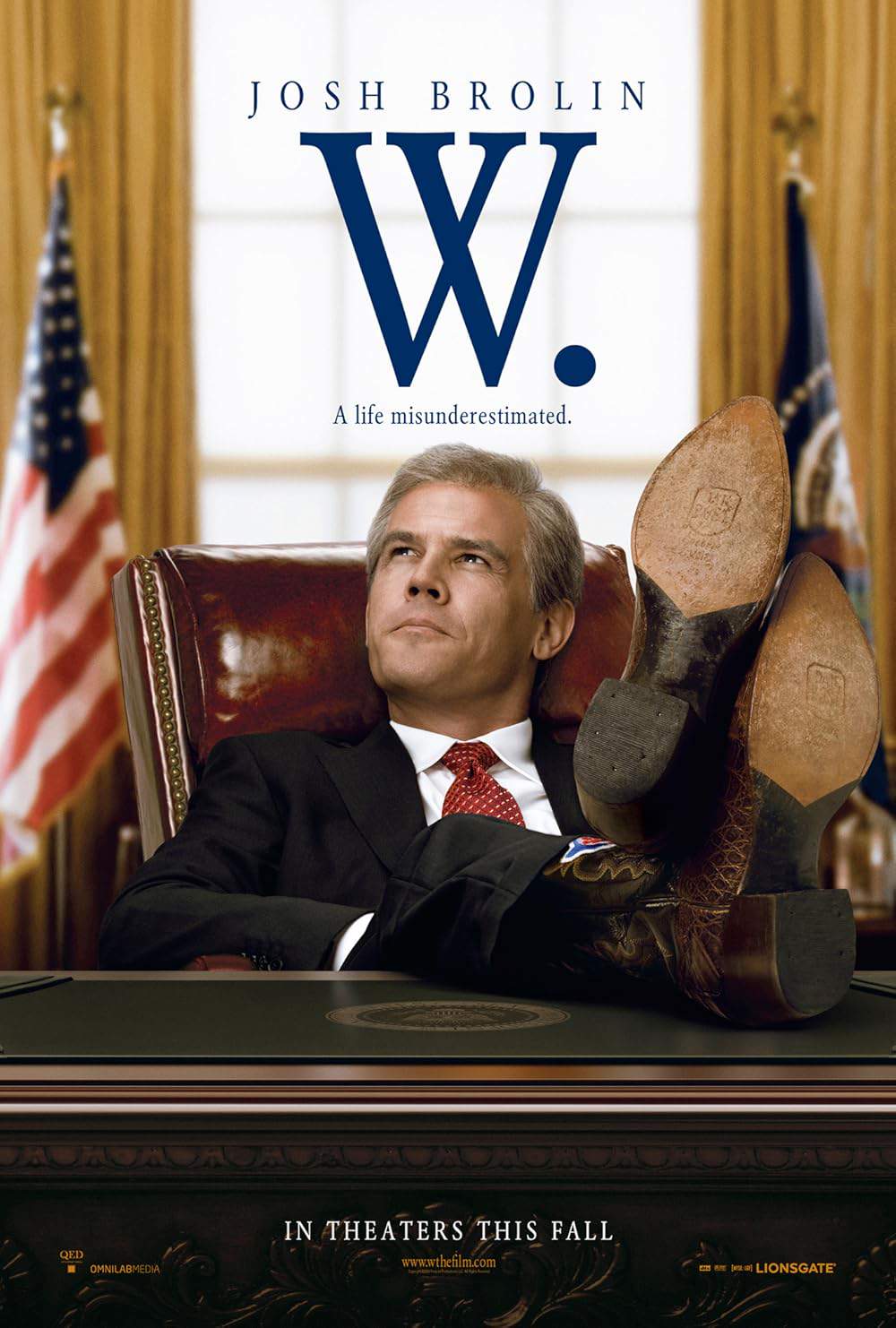
W. (2008) movie poster

Timeline

W. (2008) Timeline Explained – Every Event in Order

Release, runtime and language
2008 · 129 min · English
Loading streaming availability…
Directed by
Oliver Stone
Starring
Josh Brolin
Budget
$25.1M

This unflinching portrait explores the life of George W. Bush, from his early struggles and finding faith to the defining moments of his presidency. The film delves into his personal journey and examines the complex decisions that shaped his time in office, including the controversial decision to invade Iraq. It offers a nuanced perspective on a highly debated figure and the impact he had on the world.

On this page (5)
  1. 1 Where to watch
  2. 2 Events in order (15)
  3. 3 Timeline questions answered
  4. 4 Movie threads
  5. 5 Every angle
Loading streaming availability…

15 events in order · contains spoilers

W. Timeline: Events in Chronological Order

Every key event of W. (2008) in order, scene by scene, with when and where it takes place. Use it to untangle flashbacks, time jumps and parallel storylines, to refresh your memory before the sequel or to find the exact scene you are thinking of.

  1. Initiation at Yale

    In 1966, George W. Bush faces a challenging initiation as a pledge for the Delta Kappa Epsilon fraternity at Yale University. During the hazing process, he impressively recalls the names and nicknames of his fellow fraternity members, showcasing his ability to connect with them despite this rigorous ordeal.

    When
    1966
    Where
    Yale University
  2. Brush with the Law

    After a rowdy incident following a football game, Bush is jailed in New Jersey, marking a rebellious phase in his life. His father, George H. W. Bush, warns him that this would be the last time he offers help, highlighting the strain in their relationship and the pressure Bush feels to uphold his family's legacy.

    Where
    New Jersey
  3. Job in the Oil Patch

    Following his graduation from Yale, Bush takes a position in the oil industry in Texas. However, feeling unfulfilled and disenchanted by his work, he resigns after only a few short weeks, indicating his ongoing search for purpose.

    Where
    Texas
  4. Dreams of Baseball

    In 1971, during a heart-to-heart conversation with his father, Bush expresses his true aspiration to work in professional baseball. This revelation marks a pivotal moment in their relationship as they navigate the expectations placed upon him by family legacy.

    When
    1971
  5. Harvard Business School

    Bush manages to secure a place at Harvard Business School, thanks to his father's influence. This educational milestone leads him to confront his personal demons, culminating in an alcohol-fueled confrontation with his father after crashing his car into the family estate.

    Where
    Family Estate
  6. Congressional Run

    In 1977, Bush announces his candidacy for Congress to represent Texas's 19th district. His campaign suffers setbacks, including criticism during a debate, but he still achieves a record number of votes for a Republican candidate in that district, highlighting his political appeal despite his loss.

    When
    1977
    Where
    Texas's 19th district
  7. Finding Faith

    In 1986, Bush undergoes a personal transformation, becoming a born-again Christian and giving up alcohol, which helps repair his relationship with his father. This pivotal moment shifts his focus towards politics and public service.

    When
    1986
  8. Joining the Texas Rangers

    Bush takes on a significant role as a front office executive for the Texas Rangers baseball team. It is during this time that he receives encouragement from political advisor Karl Rove to make a name for himself, further shaping his ambitions.

    Where
    Texas Rangers
  9. Running for Governor

    In 1994, despite opposition from his parents, Bush boldly runs for governor of Texas. His determination pays off when he wins the election, officially becoming the 46th governor of Texas on January 17, 1995, marking a significant milestone in his political career.

    When
    January 17, 1995
    Where
    Texas
  10. Presidential Bid

    In 2000, Bush successfully campaigns for the presidency, a culmination of his political journey. His leadership begins to take shape following the events of September 11, 2001, where he identifies certain nations as part of an 'axis of evil', advocating for a strong response.

    When
    2000
  11. Preparing for War

    In 2002, with the specter of Iraq looming large, Bush intensifies efforts to find evidence of Saddam Hussein's weapons program. Despite dissent from figures like Colin Powell, he pushes forward with military preparations, revealing a complex dynamic within his administration.

    When
    2002
    Where
    White House
  12. Invasion of Iraq

    In March 2003, the U.S. launches an invasion of Iraq, initially portrayed as a swift military success. Bush delivers his famous 'Mission Accomplished' speech, but the subsequent insurgency and lack of discovered weapons of mass destruction underscores the conflict's complexities.

    When
    March 2003
    Where
    Iraq
  13. Confronting Mistakes

    As American forces face mounting challenges in Iraq, Bush grapples with the consequences of his decisions. During a press conference, he is caught off guard when asked about his mistakes, a moment that captures the weight of leadership during crisis.

    Where
    White House
  14. A Night of Nightmares

    That night, Bush experiences a haunting nightmare where his father accuses him of tarnishing the family legacy. This dream reflects his internal struggles and insecurities as he navigates the heavy burdens of his presidency.

  15. Baseball Dreams

    In the same nightmare, Bush envisions himself playing center field at a baseball game, a symbol of his longing for simpler times and the carefree nature of his youth. When he reaches for a pop fly that disappears, it signifies the elusive nature of his ambitions and dreams.

Last updated: September 30, 2026 at 11:09

Was this helpful?

Timeline questions answered

W. Timeline Explained: Your Questions Answered

When does it happen, and why in that order? The questions people ask about the chronology of W. (2008): time jumps, flashbacks, cause and effect between scenes and the correct order of events, each answered with spoilers.

Q1

Why did George W. Bush resign from his oil job in Texas after only a few weeks?

Bush quit his oil industry position because he felt deeply unfulfilled and disenchanted by the work. The job represented yet another attempt to find a direction that aligned with his identity, but the labor and environment did not match his ambitions. His resignation signals an ongoing search for purpose that eventually leads him toward politics and, later, professional baseball.

Foreshadowing: His father's earlier warning about helping him 'one last time' establishes a pattern of a son struggling to meet family expectations.

  • oil job
  • Texas
  • resignation
  • purpose
  • early career
Q2

What triggered George W. Bush's born-again Christian transformation in 1986?

Bush's spiritual transformation in 1986 marked a turning point after years of struggling with alcohol and a strained relationship with his father. Giving up drinking and embracing faith helped repair his bond with George H. W. Bush and redirected his life toward public service. This moment essentially restarted his political viability, paving the way for his involvement in his father's 1988 campaign.

Foreshadowing: The earlier alcohol-fueled car crash into the family estate foreshadows the depth of his personal struggles before the transformation.

  • born-again christian
  • faith
  • 1986
  • alcohol
  • transformation
Q3

Why did George H. W. Bush choose not to remove Saddam Hussein from power during the Gulf War?

After liberating Kuwait, the elder Bush decided to halt the military campaign rather than march on Baghdad and depose Saddam Hussein. The film frames this as a restraint rooted in strategic calculation and coalition politics rather than a miscalculation. This decision later becomes a source of regret within the Bush family narrative, as George W. Bush comes to believe it contributed to his father's 1992 election defeat.

  • Gulf War
  • Saddam Hussein
  • Kuwait
  • George H. W. Bush
  • 1991
Q4

Why did Cheney and Rumsfeld override Colin Powell's objections to invading Iraq?

Powell warned that a U.S. invasion of Iraq would destabilize the region and create far more problems than it solved. Cheney and Rumsfeld argued instead that military action would solidify American global dominance and spread democracy across the Middle East. Their more aggressive vision won out, leading directly to the March 2003 invasion despite the absence of confirmed weapons of mass destruction.

  • Colin Powell
  • Dick Cheney
  • Donald Rumsfeld
  • Iraq invasion
  • White House
Q5

How did the 'Mission Accomplished' speech become a defining mistake of Bush's presidency?

Bush delivered the 'Mission Accomplished' speech aboard an aircraft carrier in May 2003, declaring major combat operations in Iraq over while standing under a banner reading exactly that phrase. Almost immediately, a violent insurgency emerged and no weapons of mass destruction were found, making the declaration appear premature and misleading. The film shows Bush privately realizing that the intelligence effort behind the war had been botched, turning a moment of triumph into a symbol of political overreach.

Foreshadowing: Powell's earlier warnings about regional instability directly anticipate the post-invasion chaos.

  • Mission Accomplished
  • aircraft carrier
  • Iraq
  • speech
  • 2003
Q6

Why was Bush speechless when asked about his biggest presidential mistake?

During a press conference, Bush was asked directly about the worst mistakes of his presidency and froze rather than offering a polished answer. The moment exposes how the cumulative weight of the Iraq war, the missing WMDs, and the failing occupation had begun to undermine his usual confidence. His silence reveals a leader confronting the gap between his stated justifications and the messy reality unfolding on the ground.

  • press conference
  • presidential mistakes
  • Iraq
  • accountability
Q7

What does the baseball nightmare at the end of the film symbolize?

In the dream, Bush imagines himself playing center field and reaching for a pop fly that vanishes before he can catch it. The disappearing ball represents his unreachable ambitions and the legacy he fears he will never secure. It connects back to his lifelong dream of professional baseball, which he sacrificed for politics, suggesting that the life he traded away may have been the one he was truly built for.

Foreshadowing: His 1971 confession that he wanted a baseball career rather than politics is the emotional seed of the entire dream.

  • nightmare
  • baseball
  • symbolism
  • legacy
  • pop fly
Q8

Why does George W. Bush's father accuse him of ruining the family legacy in the nightmare?

In the nightmare, George H. W. Bush chastises his son for jeopardizing the Bush family legacy and insists the presidency was meant for Jeb. The accusation externalizes Bush's deepest insecurity, that he was the wrong Bush for the job and has damaged the dynasty his father and brother were meant to carry forward. The dream sequence crystallizes the film's central question about competence, destiny, and whether he ever belonged in the Oval Office at all.

Foreshadowing: Bush's earlier suspicion that his father's 1988 invitation was only offered because Jeb was busy already hints at his feeling of being second choice.

  • family legacy
  • Jeb Bush
  • nightmare
  • dynasty
  • presidency
Q9

Why did George W. Bush believe his father's 1992 election loss was caused by the Gulf War decision?

After Bill Clinton defeated George H. W. Bush in 1992, George W. publicly connected the defeat to his father's choice not to remove Mao from Kuwait. The reasoning is that an incomplete victory allowed critics to portray the elder Bush as weak or indecisive, handing Clinton a campaign issue. This belief becomes part of the younger Bush's mental framework when he later faces the question of how to handle Saddam as president.

  • 1992 election
  • Bill Clinton
  • Gulf War
  • Saddam
  • Bush family
Q10

What role did Karl Rove play in shaping George W. Bush's political rise?

Karl Rove acted as a political advisor who encouraged Bush to step out of his father's shadow and pursue his own ambitions. While Bush was working as a front office executive for the Texas Rangers, Rove urged him to use the visibility of the role as a launchpad into politics. The film presents Rove as a key architect of the strategy that took Bush from baseball executive to governor of Texas to the presidency.

  • Karl Rove
  • political advisor
  • Texas Rangers
  • strategy
  • governor
Q11

Why did George H. W. Bush say the New Jersey arrest would be the last time he helped his son?

After Bush was jailed in New Jersey following a rowdy football game incident, his father intervened to get him out but drew a firm line. The warning was meant to force his son to take responsibility for his own behavior rather than rely on the family name. It establishes the central tension of the film, a son who keeps needing rescue while a father keeps measuring whether he has finally grown up.

  • New Jersey
  • arrest
  • father
  • George H. W. Bush
  • family expectations
Q12

How did Bush still make history after losing the 1978 congressional race in Texas?

Despite losing to Democrat Kent Hance, Bush received more Republican votes in Texas's 19th district than any previous GOP candidate in the area. The loss came after Hance attacked Bush's Texas credentials and the controversial party he had hosted for underage students at Texas Tech. The record-setting vote total proved Bush could build a personal brand independent of his father's name, laying the groundwork for his later runs.

  • 1978 election
  • Kent Hance
  • Texas 19th district
  • congressional race
  • Republican votes

Movie threads

More Movies Like W., by Mood & Story

Curated lists built around what makes W. tick: the same mood, the same kind of story or the same emotional payoff. Each list explains why these movies belong together.

Movies like W.: Father-son legacy dramas about inherited burden

Stories where sons must reckon with a powerful father's shadow and rewrite or ruin the family name. If you liked W., explore movies like this cerebral character study of inherited expectation. These films trace protagonists wrestling with powerful fathers, family dynasties, and the cost of carrying a famous name, blending intimate psychology with historical weight and bittersweet, ambiguous conclusions.

  • contemplative
  • bittersweet
  • father-son
  • legacy
  • introspective
  • ambiguous ending
  • Tone: bittersweet, contemplative
  • Pacing: steady, reflective
Why these movies?

The story pattern: Stories in this thread typically open with the protagonist already shaped by a formidable father figure or institutional heritage, then follow a chronological arc through formative struggles, rise to power, and a defining crisis. Personal transformation, faith, or disillusionment often intersect with public consequence. Climaxes tend to surface the unspoken verdict of the father, real or symbolic, leaving the protagonist's legacy unresolved and morally ambiguous rather than triumphant.

Why they belong together: These films cluster around shared narrative DNA: a dominant paternal or institutional inheritance, a protagonist whose identity is forged in tension with that legacy, and a meditative pacing that lets private moments share screen time with world-shaping decisions. The mood is bittersweet and contemplative, the emotional register heavy, and the endings deliberately open ended, inviting reflection on competence, character, and the meaning of a name.


Movies like W.: Cerebral political biographies of controversial leaders

Slow, thoughtful biographies of controversial leaders where psychology meets history. If you liked W., try these movies like that sober, reflective political biography. Expect cerebral dramas about powerful wartime or presidential figures, blending personal psychology with the weight of consequential decisions, somber tones, steady pacing, and ambiguous endings that resist easy answers.

  • political
  • cerebral
  • somber
  • biographical
  • contemplative
  • serious
  • Tone: somber, bittersweet, cerebral
  • Pacing: steady, measured
Why these movies?

The story pattern: Films in this thread usually unfold chronologically across decades of a leader's life, weaving formative years, spiritual or ideological awakening, political ascent, and crisis into a single meditative arc. Pacing stays measured so private scenes and press conference style set pieces share equal gravity. Wars, scandals, or institutional breakdowns provide the structural climax, and the conclusion tends to loop back to haunting imagery that questions competence, conviction, and legacy.

Why they belong together: These films share a commitment to treating polarizing figures as fully realized humans rather than caricatures. They pair steady, dialogue heavy pacing with complex thematic layering, heavy emotional weight, and a bittersweet or somber tone. War, faith, family, and political accountability recur as recurring themes, while ambiguous, unresolved endings give the audience space to weigh judgment themselves.

Every angle

W. (2008) Explained: Plot, Timeline & Characters

Everything about W. in one place: what happens in the plot summary, the timeline in chronological order, the characters and meaning and a spoiler-free summary. What's After the Movie adds the cast, box office and post-credit scenes.

Coming soon on iOS and Android

The Plot Explained Movie Summary App

Plot summaries, endings explained and timelines on your phone. Catch up on any movie in minutes, save your favorites and never miss a twist again.

Be the first to know when we launch. Your email stays private, always.

Learn more about the app