Plot Explained Spoilers guaranteed!
Plot Explained

Browse by genre

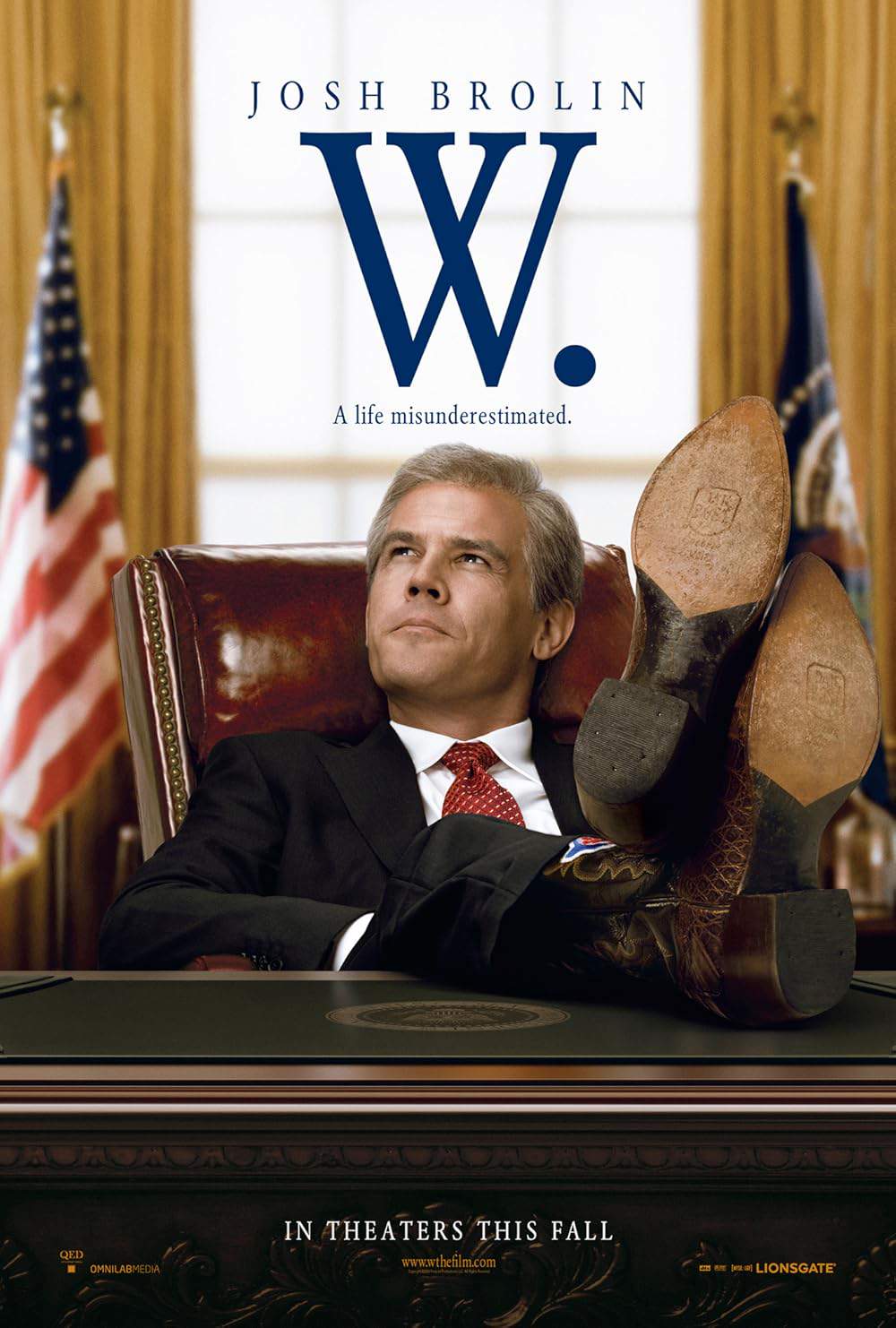
W. (2008) movie poster

Plot Summary

W. (2008) Plot Summary Explained

Release, runtime and language
2008 · 129 min · English
Loading streaming availability…
Directed by
Oliver Stone
Starring
Josh Brolin
Budget
$25.1M

This unflinching portrait explores the life of George W. Bush, from his early struggles and finding faith to the defining moments of his presidency. The film delves into his personal journey and examines the complex decisions that shaped his time in office, including the controversial decision to invade Iraq. It offers a nuanced perspective on a highly debated figure and the impact he had on the world.

On this page (5)
  1. 1 Where to watch
  2. 2 What happens: full plot
  3. 3 Plot questions answered
  4. 4 Movie threads
  5. 5 Every angle
Loading streaming availability…

Full plot summary · contains spoilers

What Happens in W.: Full Plot Summary

The whole story of W. (2008) explained, from the opening scene to the final frame: every key event, every twist and what it all adds up to. Read it as a quick recap before the sequel, to check a scene you missed, or to finally understand what really happened.

In 1966, George W. Bush finds himself navigating the challenges of initiation into the Delta Kappa Epsilon fraternity at Yale University. During this hazing ritual, he impressively recalls the names and nicknames of many fraternity members while candidly expressing that he feels no connection to his family's political legacy. Following a particularly rowdy incident after a football game in New Jersey, George H. W. Bush, his father, offers assistance but firmly states that this will be the last time he helps him. After graduating from Yale, Bush takes a brief job in the oil fields of Texas but resigns after just a few weeks.

Fast forward to 1971, in a heartfelt conversation with his father, Bush, often referred to as "Junior," reveals his dream of pursuing a career in professional baseball. With his father’s support, he gets accepted into Harvard Business School. One night, under the influence of alcohol, he crashes his car into the family estate and finds himself in a heated confrontation with his father, which is fortunately interrupted by his younger brother, Jeb Bush.

By 1977, Bush is feeling a political calling and announces his intentions to run for Congress to represent Texas's 19th district. It is at a barbecue event where he meets his future wife, Laura Lane Welch. However, during a debate, he faces criticism from his Democratic opponent, Kent Hance, who questions Bush's Texan authenticity and highlights a controversial party he threw for underage students at Texas Tech University. Despite a lackluster performance in this debate that leads to a loss in the election, Bush manages to garner the highest number of votes for a Republican in that district's history.

In 1986, a pivotal moment occurs as Bush undergoes a spiritual transformation, becoming a born-again Christian and overcoming his struggles with alcohol. This revitalization helps mend his relationship with his father, who invites him to help with his presidential campaign in 1988—though Bush believes this opportunity arose mainly because Jeb was occupied. With the guidance of political advisor Karl Rove, who encourages him to step into the spotlight, Bush secures a prominent role as an executive with the Texas Rangers baseball team. Meanwhile, his father oversees the successful Gulf War, where Allied forces liberate Kuwait rapidly; however, the elder Bush chooses not to remove Saddam Hussein from power. Following his father’s defeat by Bill Clinton in the 1992 presidential election, George W. Bush reflects on the loss, attributing it to his father's reluctance to act against Saddam.

In 1994, despite parental opposition, Bush successfully runs for governor of Texas, making history as the 46th governor starting January 17, 1995. By the year 2000, he launches an effective campaign for the presidency, and after the tragic events of September 11, 2001, he refers to Iran, Iraq, and North Korea as the "axis of evil." In 2002, he gears up to find proof that Saddam is developing nuclear capabilities. While most of his White House staff stands behind him, Secretary of State Colin Powell voices concerns that an invasion could lead to instability in Iraq. Ultimately, Powell’s advice is overridden by Vice President Dick Cheney and Secretary of Defense Donald Rumsfeld, who assert that military action would not only secure the U.S.'s status as the leading global superpower but also promote democracy throughout the Middle East.

The situation escalates in March 2003 when the United States invades Iraq. Initially, the war appears to be a success, and Bush delivers his now-infamous "Mission Accomplished" speech aboard an aircraft carrier. However, as the insurgency begins and the search for weapons of mass destruction proves fruitless, Bush realizes that the task of finding evidence had been poorly managed. He learns that Saddam had made reckless gambles as he assumed Bush was only bluffing. During a press conference, when asked about his presidential mistakes, Bush is taken aback and momentarily speechless. That evening, he is haunted by a nightmare where his father chastises him for jeopardizing the family legacy, alleging it was meant for Jeb. As he dreams of playing center field during a baseball game, he reaches for a pop fly, but it vanishes into thin air.

Last updated: September 30, 2026 at 11:09

Was this helpful?

Plot questions answered

W. Plot Explained: Your Questions Answered

The questions people ask most about W. (2008): what happens in the confusing scenes, why the characters do what they do, the twists, hidden details and what the ending means. Each answer contains spoilers.

Q1

Why did George W. Bush resign from his oil job in Texas after only a few weeks?

Bush quit his oil industry position because he felt deeply unfulfilled and disenchanted by the work. The job represented yet another attempt to find a direction that aligned with his identity, but the labor and environment did not match his ambitions. His resignation signals an ongoing search for purpose that eventually leads him toward politics and, later, professional baseball.

Foreshadowing: His father's earlier warning about helping him 'one last time' establishes a pattern of a son struggling to meet family expectations.

  • oil job
  • Texas
  • resignation
  • purpose
  • early career
Q2

What triggered George W. Bush's born-again Christian transformation in 1986?

Bush's spiritual transformation in 1986 marked a turning point after years of struggling with alcohol and a strained relationship with his father. Giving up drinking and embracing faith helped repair his bond with George H. W. Bush and redirected his life toward public service. This moment essentially restarted his political viability, paving the way for his involvement in his father's 1988 campaign.

Foreshadowing: The earlier alcohol-fueled car crash into the family estate foreshadows the depth of his personal struggles before the transformation.

  • born-again christian
  • faith
  • 1986
  • alcohol
  • transformation
Q3

Why did George H. W. Bush choose not to remove Saddam Hussein from power during the Gulf War?

After liberating Kuwait, the elder Bush decided to halt the military campaign rather than march on Baghdad and depose Saddam Hussein. The film frames this as a restraint rooted in strategic calculation and coalition politics rather than a miscalculation. This decision later becomes a source of regret within the Bush family narrative, as George W. Bush comes to believe it contributed to his father's 1992 election defeat.

  • Gulf War
  • Saddam Hussein
  • Kuwait
  • George H. W. Bush
  • 1991
Q4

Why did Cheney and Rumsfeld override Colin Powell's objections to invading Iraq?

Powell warned that a U.S. invasion of Iraq would destabilize the region and create far more problems than it solved. Cheney and Rumsfeld argued instead that military action would solidify American global dominance and spread democracy across the Middle East. Their more aggressive vision won out, leading directly to the March 2003 invasion despite the absence of confirmed weapons of mass destruction.

  • Colin Powell
  • Dick Cheney
  • Donald Rumsfeld
  • Iraq invasion
  • White House
Q5

How did the 'Mission Accomplished' speech become a defining mistake of Bush's presidency?

Bush delivered the 'Mission Accomplished' speech aboard an aircraft carrier in May 2003, declaring major combat operations in Iraq over while standing under a banner reading exactly that phrase. Almost immediately, a violent insurgency emerged and no weapons of mass destruction were found, making the declaration appear premature and misleading. The film shows Bush privately realizing that the intelligence effort behind the war had been botched, turning a moment of triumph into a symbol of political overreach.

Foreshadowing: Powell's earlier warnings about regional instability directly anticipate the post-invasion chaos.

  • Mission Accomplished
  • aircraft carrier
  • Iraq
  • speech
  • 2003
Q6

Why was Bush speechless when asked about his biggest presidential mistake?

During a press conference, Bush was asked directly about the worst mistakes of his presidency and froze rather than offering a polished answer. The moment exposes how the cumulative weight of the Iraq war, the missing WMDs, and the failing occupation had begun to undermine his usual confidence. His silence reveals a leader confronting the gap between his stated justifications and the messy reality unfolding on the ground.

  • press conference
  • presidential mistakes
  • Iraq
  • accountability
Q7

What does the baseball nightmare at the end of the film symbolize?

In the dream, Bush imagines himself playing center field and reaching for a pop fly that vanishes before he can catch it. The disappearing ball represents his unreachable ambitions and the legacy he fears he will never secure. It connects back to his lifelong dream of professional baseball, which he sacrificed for politics, suggesting that the life he traded away may have been the one he was truly built for.

Foreshadowing: His 1971 confession that he wanted a baseball career rather than politics is the emotional seed of the entire dream.

  • nightmare
  • baseball
  • symbolism
  • legacy
  • pop fly
Q8

Why does George W. Bush's father accuse him of ruining the family legacy in the nightmare?

In the nightmare, George H. W. Bush chastises his son for jeopardizing the Bush family legacy and insists the presidency was meant for Jeb. The accusation externalizes Bush's deepest insecurity, that he was the wrong Bush for the job and has damaged the dynasty his father and brother were meant to carry forward. The dream sequence crystallizes the film's central question about competence, destiny, and whether he ever belonged in the Oval Office at all.

Foreshadowing: Bush's earlier suspicion that his father's 1988 invitation was only offered because Jeb was busy already hints at his feeling of being second choice.

  • family legacy
  • Jeb Bush
  • nightmare
  • dynasty
  • presidency
Q9

Why did George W. Bush believe his father's 1992 election loss was caused by the Gulf War decision?

After Bill Clinton defeated George H. W. Bush in 1992, George W. publicly connected the defeat to his father's choice not to remove Mao from Kuwait. The reasoning is that an incomplete victory allowed critics to portray the elder Bush as weak or indecisive, handing Clinton a campaign issue. This belief becomes part of the younger Bush's mental framework when he later faces the question of how to handle Saddam as president.

  • 1992 election
  • Bill Clinton
  • Gulf War
  • Saddam
  • Bush family
Q10

What role did Karl Rove play in shaping George W. Bush's political rise?

Karl Rove acted as a political advisor who encouraged Bush to step out of his father's shadow and pursue his own ambitions. While Bush was working as a front office executive for the Texas Rangers, Rove urged him to use the visibility of the role as a launchpad into politics. The film presents Rove as a key architect of the strategy that took Bush from baseball executive to governor of Texas to the presidency.

  • Karl Rove
  • political advisor
  • Texas Rangers
  • strategy
  • governor
Q11

Why did George H. W. Bush say the New Jersey arrest would be the last time he helped his son?

After Bush was jailed in New Jersey following a rowdy football game incident, his father intervened to get him out but drew a firm line. The warning was meant to force his son to take responsibility for his own behavior rather than rely on the family name. It establishes the central tension of the film, a son who keeps needing rescue while a father keeps measuring whether he has finally grown up.

  • New Jersey
  • arrest
  • father
  • George H. W. Bush
  • family expectations
Q12

How did Bush still make history after losing the 1978 congressional race in Texas?

Despite losing to Democrat Kent Hance, Bush received more Republican votes in Texas's 19th district than any previous GOP candidate in the area. The loss came after Hance attacked Bush's Texas credentials and the controversial party he had hosted for underage students at Texas Tech. The record-setting vote total proved Bush could build a personal brand independent of his father's name, laying the groundwork for his later runs.

  • 1978 election
  • Kent Hance
  • Texas 19th district
  • congressional race
  • Republican votes

Movie threads

More Movies Like W., by Mood & Story

Curated lists built around what makes W. tick: the same mood, the same kind of story or the same emotional payoff. Each list explains why these movies belong together.

Movies like W.: Father-son legacy dramas about inherited burden

Stories where sons must reckon with a powerful father's shadow and rewrite or ruin the family name. If you liked W., explore movies like this cerebral character study of inherited expectation. These films trace protagonists wrestling with powerful fathers, family dynasties, and the cost of carrying a famous name, blending intimate psychology with historical weight and bittersweet, ambiguous conclusions.

  • contemplative
  • bittersweet
  • father-son
  • legacy
  • introspective
  • ambiguous ending
  • Tone: bittersweet, contemplative
  • Pacing: steady, reflective
Why these movies?

The story pattern: Stories in this thread typically open with the protagonist already shaped by a formidable father figure or institutional heritage, then follow a chronological arc through formative struggles, rise to power, and a defining crisis. Personal transformation, faith, or disillusionment often intersect with public consequence. Climaxes tend to surface the unspoken verdict of the father, real or symbolic, leaving the protagonist's legacy unresolved and morally ambiguous rather than triumphant.

Why they belong together: These films cluster around shared narrative DNA: a dominant paternal or institutional inheritance, a protagonist whose identity is forged in tension with that legacy, and a meditative pacing that lets private moments share screen time with world-shaping decisions. The mood is bittersweet and contemplative, the emotional register heavy, and the endings deliberately open ended, inviting reflection on competence, character, and the meaning of a name.

Movies like W.: Cerebral political biographies of controversial leaders

Slow, thoughtful biographies of controversial leaders where psychology meets history. If you liked W., try these movies like that sober, reflective political biography. Expect cerebral dramas about powerful wartime or presidential figures, blending personal psychology with the weight of consequential decisions, somber tones, steady pacing, and ambiguous endings that resist easy answers.

  • political
  • cerebral
  • somber
  • biographical
  • contemplative
  • serious
  • Tone: somber, bittersweet, cerebral
  • Pacing: steady, measured
Why these movies?

The story pattern: Films in this thread usually unfold chronologically across decades of a leader's life, weaving formative years, spiritual or ideological awakening, political ascent, and crisis into a single meditative arc. Pacing stays measured so private scenes and press conference style set pieces share equal gravity. Wars, scandals, or institutional breakdowns provide the structural climax, and the conclusion tends to loop back to haunting imagery that questions competence, conviction, and legacy.

Why they belong together: These films share a commitment to treating polarizing figures as fully realized humans rather than caricatures. They pair steady, dialogue heavy pacing with complex thematic layering, heavy emotional weight, and a bittersweet or somber tone. War, faith, family, and political accountability recur as recurring themes, while ambiguous, unresolved endings give the audience space to weigh judgment themselves.

Every angle

W. (2008) Explained: Plot, Timeline & Characters

Everything about W. in one place: what happens in the plot summary, the timeline in chronological order, the characters and meaning and a spoiler-free summary. What's After the Movie adds the cast, box office and post-credit scenes.

Coming soon on iOS and Android

The Plot Explained Movie Summary App

Plot summaries, endings explained and timelines on your phone. Catch up on any movie in minutes, save your favorites and never miss a twist again.

Be the first to know when we launch. Your email stays private, always.

Learn more about the app