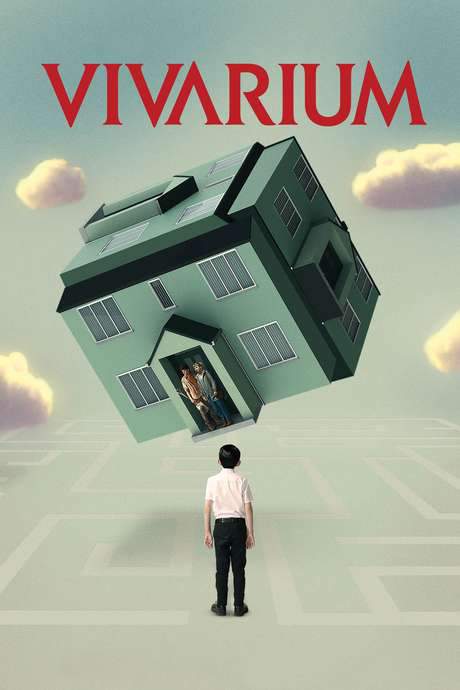
The ending of Vivarium reveals the terrifying, cyclical nature of the trap that Tom and Gemma have fallen into, confirming that there is no escape from the artificial suburban hellscape of Yonder. After being imprisoned and forced to raise a strange, rapidly aging child, the couple succumbs to the inevitable drain of their captivity. Tom, who has spent his time obsessively digging a hole in the front yard, eventually uncovers a corpse in a body bag—foreshadowing his own fate—before his health fails and he dies. When the fully grown "boy" returns to collect Tom's body, Gemma attempts to fight back, only to discover the true scale of their prison. In a surreal, Escher-like sequence, she tears through the pavement and falls into a dimension showing endless rows of identical houses, each containing a trapped couple in varying states of despair. This revelation confirms that Yonder is a vast, predatory experiment where humans are used as specimens.
With Gemma's death, the boy disposes of her body in the same hole Tom dug, completing his maturation process. He then leaves Yonder to return to the real estate office where the story began. There, he finds Martin, the original real estate agent, now aged and on the verge of death. In a chilling passing of the torch, Martin hands his name badge to the boy before dying, revealing that Martin was once a "boy" raised by a previous set of victims. The new adult alien takes Martin's place, ready to greet a fresh couple and restart the cycle of entrapment and death.
The conclusion serves as a dark metaphor for brood parasitism, a concept visualized in the opening scene where a cuckoo bird pushes other hatchlings from a nest. Just as the cuckoo tricks other birds into raising its young, the entities in Vivarium trap human couples to nurture their parasitic offspring. The film posits that the suburban dream—symbolized by the identical houses and the unwanted child—is a suffocating social contract that drains the life out of individuals. The promise that the couple would be "released" once the child was raised was a literal interpretation of death; they were never meant to leave alive. By ending with the cycle restarting, the movie emphasizes the inescapable repetition of societal expectations, suggesting that the pressures of conformity and parenting can feel like an alien invasion that consumes one's identity and autonomy.