Plot Explained Spoilers guaranteed!
Plot Explained

Browse by genre

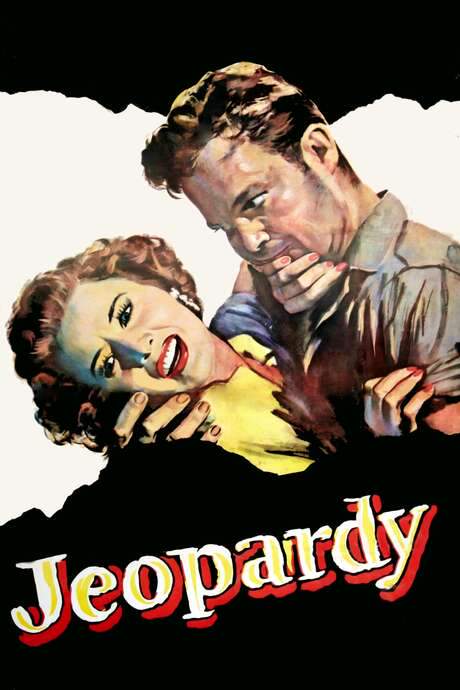
Jeopardy (1953) movie poster

Plot Summary

Jeopardy (1953) Plot Summary Explained

Release, runtime and language
1953 · 69 mins · English
Directed by
John Sturges
Starring
Ralph Meeker, Barry Sullivan, Barbara Stanwyck, Lee Aaker, Natividad Vacío, Charles Stevens

She acted because her fear outweighed her shame, leading her to a desperate decision. While seeking assistance for her husband, who is stranded on a beach as the tide rises fast enough to drown him, she is abducted. The film follows her struggle to escape captivity and save her husband before the water swallows him.

On this page (6)
  1. 1 What happens: full plot
  2. 2 Plot questions answered
  3. 3 Movie threads
  4. 4 Movies like Jeopardy
  5. 5 Categories
  6. 6 Every angle

Full plot summary · contains spoilers

What Happens in Jeopardy: Full Plot Summary

The whole story of Jeopardy (1953) explained, from the opening scene to the final frame: every key event, every twist and what it all adds up to. Read it as a quick recap before the sequel, to check a scene you missed, or to finally understand what really happened.

Americans Doug Stilwin and Helen Stilwin and their young son Bobby Stilwin embark on a family vacation, driving deep into the desolate stretches of Baja California toward a remote coastal spot that Helen’s father used to visit with his old military friends. The trip starts as a quiet escape, a chance to linger along a rugged coastline and breathe fresh air, but the mood soon grows tense as the ocean winds and the isolation press in.

At the distant end of a weathered pier, young Bobby Stilwin scampers out to explore, drawn by the thrill of a precarious, rotting structure that looms high above the surf. In a moment of danger, his foot slips into a crack between the boards. Doug acts quickly to free him, and for a heartbeat the family seems to regain normalcy—until disaster strikes: part of the wharf collapses, and a heavy wooden piling crashes down, trapping Doug on the beach as the tide begins to creep in.

Desperation mounts as Helen tries to lift the stubborn piling with the car jack, only to have it snap under the strain. With Doug’s life hanging in the balance, she races back to a deserted gas station they had passed earlier, hoping to find rope or any other means to pull him free. A figure appears in the shadows—a man named Lawson—not to help, but to take advantage. Hidden from Helen’s sight, a dead man lies in the back of the car, and it becomes chillingly clear that Lawson is not a stranger in need of aid; he’s a dangerous escaped convict who has zero intention of sharing a rescue.

Lawson’s presence shifts the entire predicament. He seizes Doug’s pistol from the glove compartment and brazenly assumes control, forcing Helen to drive as he monitors every move and warns that betrayal will be fatal. A police car briefly appears on the horizon, but Lawson keeps them moving, feigning sleep to maintain the ruse. Helen, determined to save her husband, becomes both ally and leverage, while Lawson tests the boundaries of trust, especially as a potential opportunity to manipulate a disguise emerges.

A distant fishing boat drifts by, its crew mistaking the family’s hour of distress for a harmless tourist moment, and the chance to signal for real help slips away as the boat sails on. Lawson presses onward, blasting through a police roadblock and later causing a collision that flips a patrol car. He flees, hiding out in an abandoned house to lay low while the sound of sirens grows closer and closer.

In this claustrophobic stalemate, Helen reveals a formidable resolve. She proposes a dangerous plan that hinges on Lawson’s willingness to swap places, or at least to borrow the identity of Doug long enough to finish the rescue. The plan hinges on timing and deception: Lawson could swap into Doug’s clothes, acquire Doug’s documents, and keep Helen by his side to serve as a convincing ally. Lawson is wary at first, but Helen’s plea—she would do “anything” to save Doug—begins to sway him. A tense exchange of glances and a few calculated moves later, Lawson returns to the coast with a new sense of purpose.

Back at the beach, Lawson threads the rope to the fallen piling and uses the car bumper as a makeshift anchor. He works with method and nerve, sliding a plank into place to wedge the piling loose, inching Doug’s life back from the edge of the sea. The moment is slow to come, but the outcome is a lifeline: Doug’s life is saved by a combination of Lawson’s reluctant cunning and Helen’s unwavering persistence, a fragile alliance forged in crisis rather than trust.

With Doug breathing more freely, Lawson’s initial plan to disappear shifts. He considers leaving with Helen, but the practical choice—an ever-looming siren and the rising threat of pursuit—takes precedence. In a final, silent exchange, Helen extends a hand in acknowledgment as Lawson begins to retreat along the coast. When police close in, Helen chooses not to reveal Lawson’s presence, protecting him for the moment while still guarding Doug’s future.

What began as a family vacation devolves into a moral calculus under pressure: a husband’s survival, a wife’s readiness to barter safety for time, and a fugitive’s cunning, all set against the indifferent, endless sea. The film lingers on the line between rescue and manipulation, between loyalty and survival, leaving the audience with a stark portrait of a family tested by fear, ingenuity, and the unpredictable turns of a coastal chase.
Last updated: October 09, 2025 at 10:49

Was this helpful?

Plot questions answered

Jeopardy Plot Explained: Your Questions Answered

The questions people ask most about Jeopardy (1953): what happens in the confusing scenes, why the characters do what they do, the twists, hidden details and what the ending means. Each answer contains spoilers.

Q1

Why does Lawson agree to help rescue Doug after kidnapping Helen?

Lawson's change of heart comes after Helen pleads with him, saying she would do anything to save Doug. Touched by her desperation and loyalty, Lawson decides to help because he sees an opportunity to prove he isn't entirely without conscience. His criminal past doesn't make him completely heartless, and the plea from a wife willing to do anything for her husband awakens something human in him. He also calculates that helping could give him a chance to escape with useful documents and clothes from Doug.

Foreshadowing: Earlier, Lawson tests Helen's trustworthiness by watching how she reacts to his presence, showing he's evaluating whether she might be someone he can trust.

  • lawson
  • doug rescue
  • helen pleads
  • criminal help
Q2

Why does Helen choose not to tell police about Lawson after Doug is saved?

Helen protects Lawson because he did save her husband's life, even though he held them captive. She feels a complicated sense of debt and gratitude toward him, despite his threats. Additionally, she recognizes that revealing Lawson would bring more trouble, the police would investigate, questions would arise about the dead body in the car, and the entire traumatic night would be dragged through an investigation. By staying silent, she protects her family from further chaos and honors the strange agreement that saved Doug.

  • helen protects lawson
  • police
  • silence
  • gratitude
Q3

How does Lawson manage to free Doug from the heavy piling?

Lawson uses a car bumper as a makeshift anchor and threads rope around the fallen piling. He then slides a plank underneath the piling to wedge it loose, applying mechanical leverage to gradually lift the weight off Doug's leg. The method requires careful timing and nerve, working against the rising tide while the waves crash nearby. It's a combination of resourcefulness and brute force that finally frees Doug just as the water reaches dangerous levels.

Foreshadowing: Lawson demonstrates his cunning earlier when he evades police roadblocks and flips a patrol car, showing he's skilled at improvising under pressure.

  • piling rescue
  • rope
  • bumper
  • mechanical leverage
  • tide
Q4

Why doesn't the fishing boat stop to help them?

The fishing boat crew sees the family from a distance and mistakes their frantic distress for ordinary tourist activity. From offshore, there's no way to hear their shouts or understand the urgency of their situation. The boat sails on without realizing that a man's life is hanging in the balance on the beach below. This moment underscores the family's isolation and desperation, as their best chance for help passes by without intervention.

  • fishing boat
  • offshore
  • missed help
  • shouts unheard
Q5

Why does Lawson take control of the situation at the gas station?

Lawson is an escaped convict hiding in the shadows at the gas station when Helen arrives. He sees an opportunity: a desperate woman alone, a car with supplies, and a husband trapped on a beach. He seizes Doug's pistol from the glove compartment and forces Helen to drive him away from the area, using her as both leverage and a means of escape. His intention is to use the situation to further his own escape, not to help rescue anyone.

  • lawson takes control
  • pistol
  • escaped convict
  • gas station
Q6

Why does Helen suggest Lawson swap clothes and documents with Doug?

Helen proposes the swap as a way to manipulate the situation for rescue. If Lawson pretends to be Doug, he can work alongside Helen at the beach without raising suspicion from police who might be watching. She needs his strength and cunning to lift the piling, but she also needs to keep him close and compliant. The swap gives Lawson a disguise and a reason to stay involved, making him feel invested in the rescue rather than just fleeing.

  • clothes swap
  • documents
  • disguise
  • helen plan
  • lawson disguise
Q7

What happened to the dead body Helen discovered in her car?

The dead man in the back of the car is never explicitly explained in the film. Lawson was traveling with a corpse, which suggests he may have killed someone during his escape or earlier. The presence of the body indicates Lawson is dangerous and has committed murder, raising the stakes of Helen's situation. However, the film doesn't focus on this detail, it remains a dark implication rather than a plot point that gets resolved.

  • dead body
  • corpse
  • lawson escape
  • murder
Q8

Why does the car jack fail when Helen tries to lift the piling?

Helen attempts to use the car jack to lift the heavy wooden piling crushing Doug's leg, but the jack snaps under the strain. The piling is too heavy and wedged too firmly for such a simple tool to handle. This failure forces Helen to leave Doug alone on the beach while she searches for another solution, creating the dangerous window where Lawson intercepts her at the gas station.

  • car jack
  • lifting piling
  • tool failure
  • helen rescue attempt
Q9

Why does Lawson keep driving despite police roadblocks?

Lawson knows he's an escaped convict with a dead body in the car, so stopping at any police checkpoint means capture or worse. He blasts through the first roadblock, and when a tire blows during the chase, he changes it and continues. When another police car pursues him, he forces it off the road by flipping it, escalating the danger but maintaining his freedom. His primary motivation is always self-preservation, even as he eventually decides to help rescue Doug.

  • police chase
  • roadblocks
  • lawson escape
  • car pursuit
Q10

What finally convinces Lawson to help with the rescue?

Helen's plea that she would do anything to save Doug is the turning point. Lawson sees genuine love and desperation in her eyes, and it strikes a chord. He also calculates the practical benefits: swapping clothes and documents gives him a disguise, and helping with the rescue keeps him close to the car he needs for his escape. It's a mixture of genuine emotion and self-interest that finally pushes him to use his skills for rescue instead of just running.

  • lawson change of heart
  • helen plea
  • emotional appeal
  • rescue decision
Q11

Why does Helen go to the gas station alone instead of taking Bobby?

Helen leaves Bobby with Doug on the beach because the situation is too dangerous for a child. Doug is trapped and unable to move, Bobby needs to stay with his father, and the gas station is far enough away that bringing a child would slow her down. Doug specifically instructs her to go alone and hurry back, there are only four hours before the rising tide drowns him. Time is critical, and taking Bobby would endanger everyone.

  • helen alone
  • rope rescue
  • four hours
  • time limit
  • bobby safety

Movie threads

More Movies Like Jeopardy, by Mood & Story

Curated lists built around what makes Jeopardy tick: the same mood, the same kind of story or the same emotional payoff. Each list explains why these movies belong together.

Ticking clock thrillers like Jeopardy

High-stakes stories where characters must beat a relentless deadline to survive. Movies like Jeopardy that put their characters in a desperate race against time. If you enjoyed the relentless, rising-tide urgency of Jeopardy, you'll find similar high-stakes tension in these films where every second counts for survival.

  • urgent
  • desperate
  • suspenseful
  • frantic
  • anxious
  • high-stakes
  • Tone: tense, desperate
  • Pacing: fast, relentless
Why these movies?

The story pattern: The narrative is propelled by a literal or figurative clock, creating a linear, high-pressure chase. Characters are stripped of options and must rely on ingenuity, courage, or sheer desperation to overcome a rapidly approaching deadline, often involving environmental dangers or a fixed point of no return.

Why they belong together: They are grouped by their shared structure of unrelenting urgency, where the core conflict is a battle against time itself. This creates a specific, intense viewing experience defined by breathless pacing and constant suspense.

Claustrophobic thrillers with forced alliances like Jeopardy

Intense stories where enemies must cooperate in close quarters to survive. If you liked the tense hostage dynamic in Jeopardy, explore these movies about characters forced into dangerous partnerships. They share a focus on psychological tension, moral ambiguity, and survival pacts formed under extreme pressure.

  • claustrophobic
  • tense
  • morally complex
  • psychological
  • uneasy
  • hostage
  • Tone: tense, morally ambiguous
  • Pacing: steady, building tension
Why these movies?

The story pattern: The story hinges on a tense, character-driven conflict within a confined setting. The central journey involves navigating a relationship built on mutual need but fraught with suspicion and opposing goals. The climax often resolves the immediate threat but leaves the ethical consequences of the alliance unresolved.

Why they belong together: They are united by their exploration of morally complex and tense relationships formed in life-or-death situations. The shared focus is on psychological suspense and the blurring of lines between captive and savior, resulting in endings that are often morally gray.

If you liked this

Movies Like Jeopardy

Similar movies to Jeopardy: the same genre, themes or kind of story. Each one comes with its own plot summary, timeline and ending explained.

Browse all movie summaries

Categories

Movie Lists Featuring Jeopardy

Jeopardy appears in these hand-built movie categories. Each one groups movies by a specific mood, theme or story type, with their plot summaries and endings explained.

View all movie categories

Every angle

Jeopardy (1953) Explained: Plot, Timeline & Characters

Everything about Jeopardy in one place: what happens in the plot summary, the timeline in chronological order, the characters and meaning and a spoiler-free summary. What's After the Movie adds the cast, box office and post-credit scenes.

Coming soon on iOS and Android

The Plot Explained Movie Summary App

Plot summaries, endings explained and timelines on your phone. Catch up on any movie in minutes, save your favorites and never miss a twist again.

Be the first to know when we launch. Your email stays private, always.

Learn more about the app