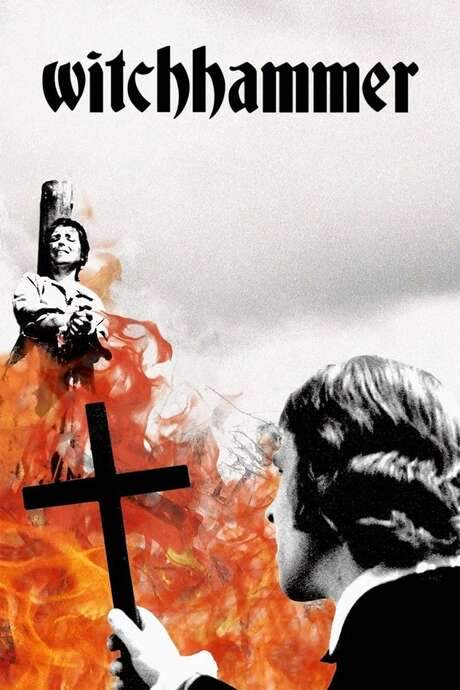
In 17th century England, the magistrate Sir Andrew Pike summons the witch-finders Mr Warren and Mr Clarke to the village of Little Happens. Seventy-year-old Elizabeth Gadge has been accused of witchcraft, and Pike is excited that outsiders have arrived to investigate. Pike and Warren already seem convinced of Gadge's guilt, but Clarke remains skeptical, trying to weigh evidence with caution while the others lean into spectacle. The tension between curiosity, fear, and profit hangs heavy over the village, and Pike’s interest in the visitors and the possible revival of trade grows as the rumors spread.
Elizabeth's case is brought to trial the following morning, with the help of the cobbler Richard Two-Shoes. Elizabeth's daughter Sarah Nutter and son-in-law Thomas Nutter testify that they witnessed her performing bizarre acts—sucking from the teat of a furry creature and speaking to a mouse believed to be a demon. Elizabeth counters that the accusations are lies meant to push her out of the house she shares with them. The tension in the courtroom rises as witnesses clash, and the atmosphere becomes charged with fear and emotion. Elizabeth maintains her innocence, insisting that her accusers want to seize her place in the family and in the home.
The prosecution’s case grows more intense as George Waterhouse(/actor/trevor-cooper) testifies against Elizabeth, and the court begins to bend under the weight of fear and superstition. As the proceedings unfold, laughter from the onlookers escalates the risk: Warren declares that the next person to laugh will be executed as a witch. The room erupts, and after a heated argument, the witch-finders and Pike decide that the remainder of the trial should be conducted in private. Elizabeth is pricked with a needle to test for the devil's mark, a brutal and medieval ritual that leaves a mark on her dignity as well as her body.
A remorseful Sarah tries to step forward to defend her mother, but Warren dismisses her plea. Elizabeth contends that her alleged lewd acts were either exaggerated or lies told to gain control of her space, claiming she had attempted to survive by prostituting herself to Two-Shoes, who wears a fur coat; Two-Shoes vehemently denies this, and the trial is adjourned for the time being. Throughout the proceedings, Warren remains accusatory and aggressive, while Clarke’s caution and moral doubt grow louder in private moments. Pike, meanwhile, is captivated by the lurid details and by the torturous implements on display, imagining how profit and fear might revive the town’s fortunes.
Clarke privately confides to Warren that he suspects Elizabeth’s innocence and that he questions whether they are truly doing God’s work. Warren warns Clarke that any objection could become grounds for him to be tried and convicted as well, a threat that cracks the brittle alliance between the two men. The trial resumes—Elizabeth having endured an overnight of interrogation and torment—and the witch's fate seems sealed when the real mouse, Snowflake, is released to lead the investigators to an answer. Crumbs are sprinkled in front of Elizabeth, and when Snowflake approaches, Pike declares her a witch and condemns her to be burned.
Thomas and Sarah bid farewell to a hooded and bound Elizabeth as she awaits execution. Clarke dismisses them, then dramatically unmasks a hooded figure to reveal that he has bound Warren in Elizabeth’s place, hoping to root out what he sees as evil within the pair. Clarke replaces the hood, and Pike returns, pleased that the trial has sparked renewed trade and attracted visitors to the village. Warren is taken away to be burned, but Clarke releases the real Elizabeth, only to have her reveal that she truly is a witch. She breaks Clarke’s neck, killing him, and the crowd outside responds to the flames lighting Elizabeth’s face. She tells Snowflake she will go to her master, and then she transforms into a raven and flies away, leaving the village to its unsettled future.
The ending leaves a haunting impression of power, betrayal, and survival, where fear masquerades as justice, and a woman’s fate is sealed by a system hungry for spectacle as much as superstition.