

Plot Explained Spoilers guaranteed!
Plot Explained

Browse by genre

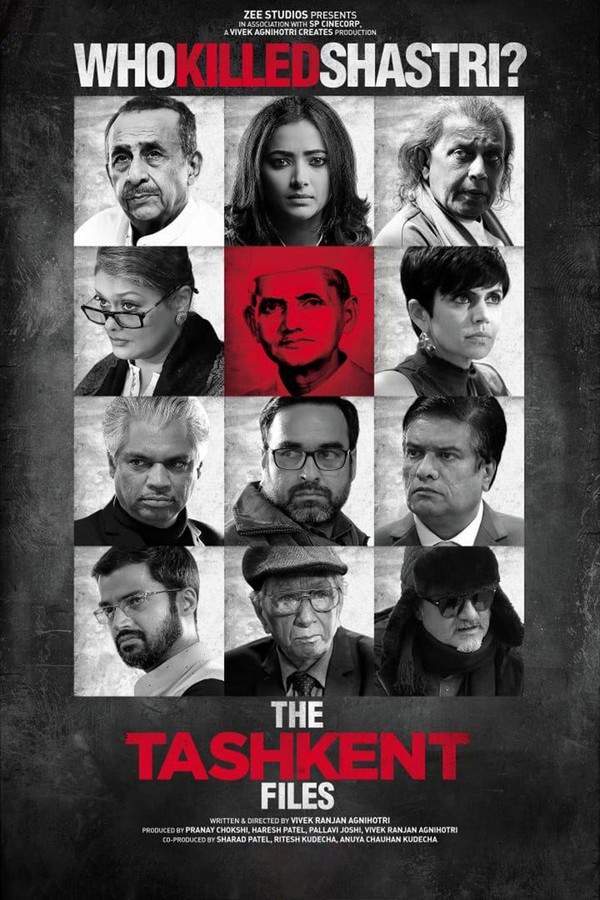
The Tashkent Files (2019) movie poster

Timeline

The Tashkent Files (2019) Timeline Explained – Every Event in Order

Release, runtime and language
2019 · 134 min · Hindi
Echo score 40
Directed by
Vivek Agnihotri
Starring
Ravi Shankar Jaiswal, Pankaj Tripathy, Vinay Pathak, Naseeruddin Shah, Achint Kaur, Shweta Prasad

Following the sudden and unexpected death of India’s second Prime Minister, a journalist embarks on an investigation to determine the circumstances surrounding his demise. Driven by a desire for the truth, he uncovers a complex web of political maneuvering and hidden agendas. His inquiries expose long-buried secrets and potentially destabilizing revelations, forcing him to confront powerful forces who want the truth to remain hidden.

On this page (6)
  1. 1 Where to watch
  2. 2 Events in order (15)
  3. 3 Timeline questions answered
  4. 4 Movie threads
  5. 5 Movies like The Tashkent Files
  6. 6 Every angle

Where to watch

Where to Watch The Tashkent Files (2019)

Where can you watch The Tashkent Files? Stream, rent or buy it in the US, including on fuboTV: current JustWatch availability with up-to-date prices.

Streaming availability powered by JustWatch

15 events in order · contains spoilers

The Tashkent Files Timeline: Events in Chronological Order

Every key event of The Tashkent Files (2019) in order, scene by scene, with when and where it takes place. Use it to untangle flashbacks, time jumps and parallel storylines, to refresh your memory before the sequel or to find the exact scene you are thinking of.

  1. Lal Bahadur Shastri's Leadership

    Lal Bahadur Shastri serves as the 2nd Prime Minister of India. Under his guidance, India secures a significant victory against Pakistan in the war of 1965, marking a pivotal moment in the country's history.

    When
    1965
  2. Tashkent Agreement Negotiations

    Following India's victory, Shastri travels to Tashkent, Uzbekistan, to negotiate peace terms with Pakistan. These negotiations culminate in the signing of the Tashkent Agreement on January 10, 1966, after six days of intense discussions.

    When
    January 10, 1966
    Where
    Tashkent, Uzbekistan
  3. Shastri's Mysterious Death

    Just hours after signing the agreement, Shastri dies under suspicious circumstances. His sudden death raises questions about whether it was caused by natural causes or foul play, as the postmortem report is mysteriously missing.

    When
    January 10, 1966
  4. Russian Spy's Revelation

    In 1992, a Russian KGB spy approaches the British Embassy in Latvia, providing documents that detail the ominous elimination of state leaders worldwide by the USSR. This revelation opens a new chapter in investigating political corruption and conspiracy.

    When
    1992
    Where
    British Embassy, Latvia
  5. Raagini Phule's Investigation Starts

    Raagini Phule, an ambitious investigative journalist, receives an anonymous call guiding her to vital documents about Shastri's life and death. This leads her to propose a report on the missing postmortem details, igniting public interest and media frenzy.

  6. The Committee Formation

    Home Minister P. K. R. Natarajan and opposition leader Shyam Sunder Tripathi discreetly agree to form a committee to investigate Shastri's death, each nominating four members. Raagini is invited to join, providing her with a platform to expose the truth.

  7. Concerns Over Medical Treatment

    Details emerge about Shastri's medical treatment in Tashkent, raising alarms about the lack of proper medical facilities at his lodging. Observations include discrepancies in the medical report, and doubts arise about the adequacy of care he received during his last moments.

    Where
    Tashkent
  8. Conflicting Medical Reports

    Raagini's anonymous benefactor provides her with a Soviet version of Shastri's medical report, contradicting the official Indian version. The new document suggests that Shastri's death was not from heart failure, intensifying the investigation's urgency.

  9. Witnesses Mysteriously Die

    The investigation reveals that two key witnesses, Shastri's doctor and his assistant, died under mysterious circumstances shortly after his death. This further deepens suspicions of a cover-up and the possibility of an orchestrated elimination.

  10. Raagini's Claims of Poisoning

    Raagini uncovers that Shastri's body exhibited signs of poisoning, with visible signs of blood oozing even postmortem. This evidence suggests that he was not only poisoned but that a systematic attempt was made to cover up the actual cause of death.

  11. Bakshi's Truth

    Raagini meets Bakshi, her benefactor, who reveals a conspiracy involving the Congress party and the KGB against Shastri. He claims that Shastri was eliminated to facilitate Indira Gandhi's rise, providing further context to the political machinations post-war.

  12. Raagini's Ejection from the Committee

    Utilizing their political power, Tripathi and Natarajan expel Raagini from the investigation committee, stifling her efforts. Raagini bears her frustrations and pleads for one last chance to present her compelling findings to the committee.

  13. The Tashkent Files Revelation

    Raagini ultimately reveals the Tashkent Files, which detail the KGB's operations in India, suggesting a systemic conspiracy against Shastri. This pivotal evidence implicates high-level corruption and treachery at the hands of political leaders.

  14. Historical Manipulation

    The investigation culminates in the assertion that after Shastri's death, the Indian government became effectively a Soviet colony. The event raises questions about how history is shaped and the implications of political alignment on national identity.

  15. Indira Gandhi's Controversial Connection

    The narrative concludes with the implication that Indira Gandhi was on the KGB's payroll, suggesting that she played a crucial role in perpetuating a political narrative favorable to the USSR. This revelation shocks the nation and re-contextualizes Shastri's legacy.

Last updated: November 25, 2024 at 19:24

Was this helpful?

Timeline questions answered

The Tashkent Files Timeline Explained: Your Questions Answered

When does it happen, and why in that order? The questions people ask about the chronology of The Tashkent Files (2019): time jumps, flashbacks, cause and effect between scenes and the correct order of events, each answered with spoilers.

Q1

Why was Shastri moved from the hotel to a bungalow in Tashkent?

Shastri was abruptly moved from a well-equipped hotel to a mere bungalow shortly before his death. The hotel had an operating theater and oxygen facilities, while the bungalow lacked even basic medical provisions. This sudden accommodation change has raised serious questions about whether his care was deliberately compromised.

Foreshadowing: Earlier concerns about Shastri's security arrangements had been raised by his aides.

  • shastri
  • tashkent
  • bungalow
  • hotel
  • medical facilities
  • conspiracy
Q2

Why did only 6 of the 8 doctors sign Shastri's medical report?

Eight doctors attended to Shastri in Tashkent, but only six were willing to sign off on the medical report. This refusal by two doctors to endorse the official findings has been cited as evidence of discrepancies in the official narrative surrounding his death.

Foreshadowing: The committee members noted early on that inconsistencies existed in the documentation.

  • shastri
  • doctors
  • medical report
  • signature
  • tashkent
  • investigation
Q3

Why was Shastri given an intramuscular injection instead of intravenous treatment?

Medical experts have questioned why Shastri received only an intramuscular injection when an intravenous option was available and potentially life-saving. This decision is particularly troubling given his history of two prior heart attacks and the lack of proper medical facilities at the bungalow.

Foreshadowing: The committee noted Shastri's pre-existing heart condition during their investigation.

  • shastri
  • injection
  • medical treatment
  • heart attack
  • tashkent
Q4

What happened to the doctor and assistant who witnessed Shastri's death?

Two key witnesses to Shastri's death, his personal doctor and an assistant, died under mysterious circumstances just days after Shastri himself passed away. Their deaths eliminated crucial firsthand testimony and significantly hampered any subsequent investigation into the true cause of death.

Foreshadowing: The film establishes early that powerful forces wanted the truth to remain hidden.

  • shastri
  • doctor
  • assistant
  • witnesses
  • death
  • cover-up
Q5

What evidence suggests Shastri was poisoned rather than dying from natural causes?

Raagini uncovers several pieces of evidence pointing to poisoning: Shastri's body turned black upon returning to India, blood oozed from his injuries posthumously, and his personal cap bore blood stains from injuries sustained after death. Additionally, the Soviet medical report contradicted the official Indian version that stated heart failure as the cause.

Foreshadowing: The conflicting medical reports were introduced early in the investigation.

  • shastri
  • poisoning
  • black body
  • blood
  • medical report
  • soviet
Q6

What are the Tashkent Files and why are they important?

The Tashkent Files are classified documents that were once deemed inaccessible to the public. These files detail the complex operations between the KGB and Indian political leaders, specifically implicating Indira Gandhi in a conspiracy with Soviet intelligence. The revelation of these files exposes the political manipulation that shaped India's trajectory after Shastri's death.

Foreshadowing: The entire committee investigation builds toward uncovering these documents.

  • tashkent files
  • classified documents
  • kgb
  • indira gandhi
  • conspiracy
Q7

Why was Shastri's postmortem report missing for over fifty years?

Shastri's postmortem report mysteriously vanished for more than fifty years, despite being a critical piece of evidence in determining the true cause of his death. The film's narrative suggests this disappearance was part of a systematic cover-up orchestrated by powerful political forces who wanted to suppress the truth about his demise.

Foreshadowing: Raagini's investigation specifically targets this missing documentation.

  • shastri
  • postmortem
  • missing report
  • cover-up
  • investigation
Q8

What is the alleged connection between Indira Gandhi and the KGB?

The film claims that Indira Gandhi was on the KGB's payroll, suggesting she was complicit in a larger scheme to secure her power. According to the narrative, this connection explains how Shastri was eliminated to pave the way for her ascendancy, and how India subsequently aligned under Soviet influence, even embedding 'Socialism' in the constitution.

Foreshadowing: Bakshi's revelation provides the crucial link between Congress and Soviet intelligence.

  • indira gandhi
  • kgb
  • soviet
  • congress
  • socialism
  • conspiracy
Q9

Why was Shastri's legacy deliberately erased from Indian history?

The investigation reveals that Shastri's contributions, including the Green Revolution, White Revolution, and advancements in India's atomic program, were largely erased from public consciousness. The committee concludes that the Congress party suppressed a non-Nehru figure who had become a transformative leader, preferring to elevate Indira Gandhi instead.

Foreshadowing: The committee members discuss how Shastri's policies shaped modern India.

  • shastri
  • legacy
  • green revolution
  • white revolution
  • congress
  • erasure
Q10

How did Shastri become Prime Minister after Nehru's death?

After Jawaharlal Nehru's death, the Congress party leader Kamaraj played a significant role in elevating Lal Bahadur Shastri to the position of Prime Minister. However, the film suggests this was part of a political maneuver, Kamaraj later paved the way for Indira Gandhi to ascend as PM following Shastri's death.

Foreshadowing: Natarajan recalls these political maneuvers during committee discussions.

  • shastri
  • prime minister
  • kamaraj
  • nehru
  • indira gandhi
  • congress
Q11

What role did the CIA allegedly play in Shastri's death?

According to the film, a book by a former CIA operative suggests that both Shastri and Homi Bhabha, who were poised to advance India's nuclear capabilities, were systematically eliminated by CIA machinations. This ties into the broader geopolitical tension of the Cold War era.

Foreshadowing: The committee discusses international powers' interest in India's leadership.

  • cia
  • shastri
  • homi bhabha
  • nuclear
  • cold war
  • assassination
Q12

Why was Raagini Phule expelled from the investigation committee?

Home Minister Natarajan and opposition leader Tripathi used their political power to expel Raagini from the committee, hiding behind the Official Secrets Act. This was an attempt to suppress her findings and stop the investigation from reaching its conclusions.

Foreshadowing: Earlier scenes show both politicians conspiring to control the investigation's outcome.

  • raagini phule
  • committee
  • expelled
  • official secrets act
  • natarajan
  • tripathi

Movie threads

More Movies Like The Tashkent Files, by Mood & Story

Curated lists built around what makes The Tashkent Files tick: the same mood, the same kind of story or the same emotional payoff. Each list explains why these movies belong together.

Political Thrillers with Ambiguous Endings like The Tashkent Files

Investigation stories where revealing the truth leaves more unsettling questions than answers. For viewers who enjoyed the investigative tension and unsettling revelations of The Tashkent Files, this section features movies like it: complex political thrillers where the search for truth pits a determined individual against a systemic conspiracy, often ending with more questions than answers. These films deliver a heavy, thought-provoking experience centered on historical cover-ups and government corruption.

  • investigative
  • unsettling
  • thought-provoking
  • tense
  • clandestine
  • paranoid
  • Tone: tense, unsettling, paranoid
  • Pacing: steady, investigative
Why these movies?

The story pattern: Stories in this thread typically follow a journalist, researcher, or investigator who doggedly pursues a historical mystery or political crime. They methodically gather evidence and confront witnesses, facing intimidation and danger from powerful institutions. The narrative arc is less about a tidy resolution and more about exposing the depth of the corruption, often concluding with the truth being revealed but systemic injustice remaining largely intact.

Why they belong together: These films are grouped together because they share a specific combination of a tense, investigative tone, a complex plot involving real-world political machinations, a steady, methodical pacing, and a profoundly ambiguous ending that reinforces the theme of enduring, unaccountable power. The emotional journey is heavy and thought-provoking, not cathartic.

Suspenseful Movies about Historical Cover-ups like The Tashkent Files

Where one person's quest for a buried truth unveils a dangerous web of lies. If you liked the clandestine suspense and historical mystery of The Tashkent Files, you'll find similar movies here. This collection features tense, paranoid thrillers about uncovering cold war secrets, assassination plots, and government cover-ups, where the investigator's pursuit of the truth becomes a perilous journey against unseen adversaries.

  • paranoid
  • suspenseful
  • clandestine
  • investigative
  • unsettling
  • tense
  • Tone: tense, paranoid, suspenseful
  • Pacing: steady, methodical
Why these movies?

The story pattern: The narrative pattern involves an outsider—a journalist, an academic, or a relative of a victim—becoming obsessed with a historical event whose official story doesn't add up. Their investigation is a slow unraveling of a tightly woven conspiracy, encountering reluctant witnesses, fabricated evidence, and direct threats. The story structure builds a pervasive sense of being watched and manipulated, creating a deeply paranoid viewing experience.

Why they belong together: These movies are united by their specific vibe: a tense, suspenseful, and paranoid mood generated by a high-stakes investigation into a historical cover-up. They share a steady pacing that allows dread to build, high intensity from the life-or-death implications of the inquiry, and a focus on the psychological toll of uncovering secrets that powerful people want hidden.

If you liked this

Movies Like The Tashkent Files

Similar movies to The Tashkent Files: the same genre, themes or kind of story. Each one comes with its own plot summary, timeline and ending explained.

Browse all movie summaries

Every angle

The Tashkent Files (2019) Explained: Plot, Timeline & Characters

Everything about The Tashkent Files in one place: what happens in the plot summary, the timeline in chronological order, the characters and meaning and a spoiler-free summary. What's After the Movie adds the cast, box office and post-credit scenes.

Coming soon on iOS and Android

The Plot Explained Movie Summary App

Plot summaries, endings explained and timelines on your phone. Catch up on any movie in minutes, save your favorites and never miss a twist again.

Be the first to know when we launch. Your email stays private, always.

Learn more about the app