Plot Explained Spoilers guaranteed!
Plot Explained

Browse by genre

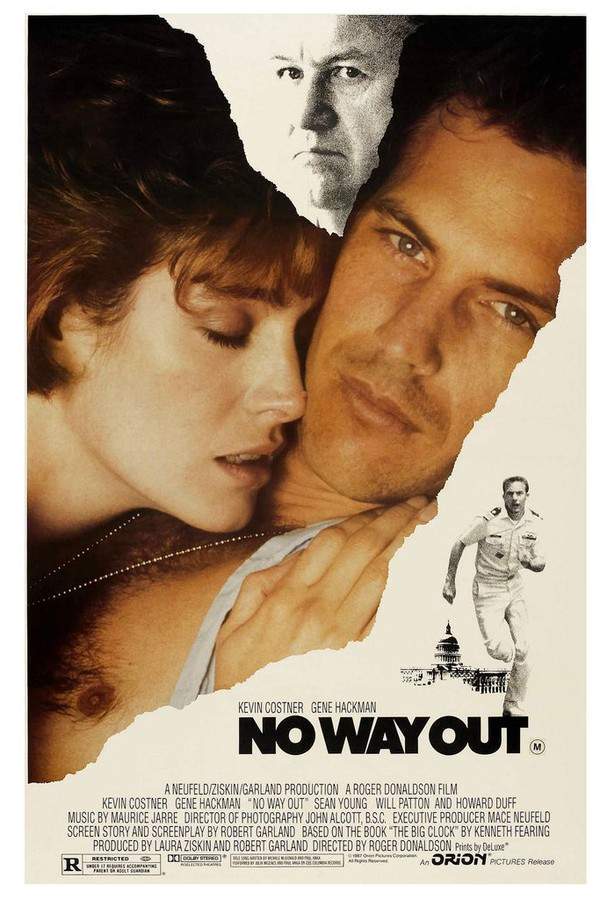
No Way Out (1987) movie poster

Plot Summary

No Way Out (1987) Plot Summary Explained

Release, runtime and language
1987 · 114 min · English
JustWatch #2,801 13
Directed by
Roger Donaldson
Starring
Gene Hackman, Kevin Costner

Photographer Nick finds himself drawn into a passionate and tumultuous relationship with the alluring Tessa, navigating a world of intense desire and hidden secrets. As their bond deepens, Tessa's provocative nature pushes Nick to his limits, leading to a dangerous spiral of revelations and escalating conflict. Their love affair devolves into a toxic cycle of revenge, forcing them to confront difficult moral choices and question the boundaries of devotion.

On this page (8)
  1. 1 Where to watch
  2. 2 What happens: full plot
  3. 3 Plot questions answered
  4. 4 The book behind the movie
  5. 5 Movie threads
  6. 6 Movies like No Way Out
  7. 7 Categories
  8. 8 Every angle

Where to watch

Where to Watch No Way Out (1987)

Where can you watch No Way Out? Stream, rent or buy it in the US, including on Amazon Prime Video, Fawesome and Amazon MX Player: current JustWatch availability with up-to-date prices.

Streaming availability powered by JustWatch

Full plot summary · contains spoilers

What Happens in No Way Out: Full Plot Summary

The whole story of No Way Out (1987) explained, from the opening scene to the final frame: every key event, every twist and what it all adds up to. Read it as a quick recap before the sequel, to check a scene you missed, or to finally understand what really happened.

At a lavish ball, U.S. Navy Lieutenant Commander Tom Farrell, portrayed by Kevin Costner, encounters a captivating young woman named Susan Atwell. Despite her being involved with another man, their connection ignites a passionate affair. During a subsequent Naval deployment, Farrell showcases his bravery by rescuing a fellow sailor during a fierce storm, earning him hero status. His commendable actions lead him back to Washington where he is assigned to work at The Pentagon under Secretary of Defense David Brice, played by Gene Hackman. Brice, with a determined agenda to cancel a costly Navy project that holds substantial political backing, decides Farrell should serve as a direct liaison to the CIA, tasked with uncovering whether the Soviets are working on a comparable initiative.

The intrigue deepens as Farrell uncovers the shocking truth: the other figure in Susan’s life is none other than Secretary Brice himself. The tension escalates as Brice discovers Susan's infidelity and, in a fit of jealousy, violently confronts her, resulting in her tragic death after she falls from an indoor balcony. Faced with the moral burden of his actions, Brice is swayed by his advisor, Scott Pritchard, an old friend of Farrell's, to orchestrate a cover-up, scapegoating an elusive figure known only as "Yuri", an alleged KGB sleeper agent long suspected but never definitively identified.

As events unfold, CIA Director Marshall dismisses the very notion of "Yuri", doubting Pritchard's connections with Susan, based on his presumption regarding Pritchard's sexual orientation. Interestingly, despite this dismissal, Brice appoints Farrell to lead the investigation into Susan’s death, placing him in a paradoxical position where he must find evidence that could ultimately implicate him. The only forensic lead in the case arises from a Polaroid negative discovered at Susan's residence, which requires extensive processing to reveal any conclusive evidence. There’s also a reference to forensic evidence of semen, but given the era's limitations—the lack of prevalent DNA testing—this avenue is not pursued further.

In a desperate attempt, Farrell seeks the assistance of Sam Hesselman, an old friend and systems analyst, coaxing him to extend the processing time on the Polaroid evidence while divulging the truth about Susan and Brice. However, peril looms as Pritchard menaces Nina Beka, another of Susan's close friends, threatening her with deportation to South Africa, and facilitates covert operations to eliminate her. In a dramatic turn, Farrell intervenes just in time to save Nina.

The plot thickens when Sam, suspicious of Pritchard's intentions, discusses his concerns with him, leading to his untimely demise as Pritchard, fearing exposure, murders him. In a climactic moment, Farrell manages to secure the printout of crucial evidence before it becomes visible, presenting it to Brice, who artfully shifts blame onto Pritchard. In a tragic conclusion, Pritchard—overwhelmed by guilt and despair—takes his own life, falsely labeled as "Yuri" by Brice, who intends to evade responsibility for Susan’s death. Freed from suspicion, Farrell finally departs from the intense atmosphere of the Pentagon.

As Farrell sits mournfully by Susan's grave, the narrative takes a startling twist—two plainclothes officers arrive to detain him for questioning. In a shocking revelation, one of the interrogators is actually Farrell's landlord, who speaks to him in Russian. As it unfurls, it becomes clear that Farrell is, in fact, the genuine "Yuri", a KGB agent who has been embedded in the U.S. since his teenage years. His mission? To seduce Susan, the mistress of the Secretary of Defense, and extract invaluable intelligence. Despite orders to return to the Soviet Union, he defiantly refuses, illustrating the complexities of loyalty and identity with a chilling quip from his KGB handler: “He will return. Where else does he have to go?”
Last updated: January 18, 2025 at 14:36

Was this helpful?

Plot questions answered

No Way Out Plot Explained: Your Questions Answered

The questions people ask most about No Way Out (1987): what happens in the confusing scenes, why the characters do what they do, the twists, hidden details and what the ending means. Each answer contains spoilers.

Q1

Why was Tom Farrell assigned to lead the investigation into Susan's death?

Secretary Brice appointed Farrell to lead the investigation despite knowing about his affair with Susan. Brice believed Farrell would be motivated to find the 'other man' to clear himself, not realizing Farrell was actually investigating to protect himself. This placed Farrell in the impossible position of having to find evidence that could ultimately implicate him.

Foreshadowing: Farrell's old friend Scott Pritchard recommended him for the Pentagon position, setting up this paradoxical investigation role.

  • tom farrell
  • investigation
  • susan atwell
  • secretary brice
  • scott pritchard
  • conflict of interest
Q2

How did Secretary Brice cover up Susan's death?

After shoving Susan during a jealous confrontation, causing her to fall from a balcony to her death, Brice and his advisor Scott Pritchard fabricated a story claiming her lover was 'Yuri,' a supposed KGB sleeper agent. This allowed Brice to avoid scandal while making it appear Susan was involved with Soviet intelligence.

Foreshadowing: Early references to 'Yuri' as an elusive KGB agent suspected by US intelligence planted the idea for the cover-up.

  • cover-up
  • yuri
  • kgb
  • susan atwell
  • secretary brice
  • scott pritchard
  • murder
Q3

Who is Yuri in No Way Out?

Yuri is revealed to actually be Tom Farrell himself, a KGB agent embedded in the United States since his teenage years. His mission was to seduce Susan Atwell, the mistress of the Secretary of Defense, to extract intelligence. The fictional 'Yuri' was created by Brice and Pritchard as a scapegoat, unknowingly pinning the crime on a real Soviet operative.

Foreshadowing: The KGB handler's chilling final line, 'He will return. Where else does he have to go?' confirms Farrell's true allegiance despite his refusal to leave.

  • yuri
  • tom farrell
  • kgb agent
  • sleeper agent
  • identity reveal
  • twist
Q4

Why did Scott Pritchard kill Sam Hesselman?

Sam Hesselman was killed because he knew too much about the conspiracy. When Farrell confided in Sam about the truth regarding Susan and Brice, Sam expressed his concerns directly to Pritchard. Fearing exposure, Pritchard eliminated him to prevent him from revealing the cover-up.

Foreshadowing: Sam's suspicious nature about Pritchard's intentions was established when he agreed to help process the Polaroid evidence.

  • scott pritchard
  • sam hesselman
  • murder
  • cover-up
  • pentagon
Q5

What evidence did Tom Farrell find against Secretary Brice?

Farrell discovered through computer records that Brice had given Susan an expensive gift, a bangle with tracking capabilities, which could prove their affair. He also obtained a Polaroid negative from Susan's residence that, when processed, would reveal the evidence linking Brice to her. He retrieved the printout before it fully developed and presented it to Brice.

Foreshadowing: Farrell's initial search through computer files for a 'gift' given to Susan hinted at this crucial evidence.

  • evidence
  • bangle
  • gift
  • computer records
  • polaroid
  • brice
  • affair
Q6

Why was Nina Beka threatened by Scott Pritchard?

Nina Beka was Susan Atwell's close friend who knew about Susan's affairs with both Brice and Farrell. Pritchard threatened her with deportation to South Africa to keep her silent and prevent her from revealing what she knew about the connections between all three individuals.

Foreshadowing: Nina's relationship with Susan positioned her as a potential liability to the cover-up operation.

  • nina beka
  • scott pritchard
  • threat
  • deportation
  • susan atwell
  • witness
Q7

How did the conspiracy shift blame to Yuri?

After Susan's death, Brice and Pritchard claimed her mysterious lover was 'Yuri,' a supposed KGB sleeper agent who had been suspected by US intelligence for years. This explained her death as a Soviet intelligence operation rather than a domestic scandal, protecting Brice's political career and the sensitive Navy project he was trying to cancel.

Foreshadowing: Pritchard's suggestion to use 'Yuri' as a scapegoat came immediately after they needed to explain Susan's death.

  • conspiracy
  • yuri
  • kgb
  • scapegoat
  • cover-up
  • brice
  • pritchard
Q8

What was the Polaroid evidence in the investigation?

A Polaroid negative found at Susan's residence became the only forensic lead in the case. Processing it would reveal evidence that could identify her killer or lover. Because the technology for DNA testing did not yet exist in the 1980s, other forensic evidence like semen samples could not be used to identify anyone.

Foreshadowing: The negative required extended processing time, which Sam Hesselman helped manipulate at Farrell's request.

  • polaroid
  • negative
  • forensic evidence
  • 1980s
  • dna testing
  • investigation
Q9

Why did Scott Pritchard commit suicide?

After Farrell presented the evidence to Brice, Brice shifted all blame onto Pritchard, falsely claiming Pritchard killed Susan out of jealousy over his supposed relationship with Susan. Overwhelmed by guilt and despair, and completely betrayed by Brice, Pritchard took his own life. Brice then used his death to confirm the 'Yuri' narrative.

Foreshadowing: Pritchard's growing moral conflict and his advisor role in the cover-up set up his tragic end.

  • scott pritchard
  • suicide
  • brice
  • blame
  • betrayal
  • cover-up
Q10

What does the ending reveal about Tom Farrell?

At Susan's grave, plainclothes officers arrive to question Farrell, and one, their landlord, speaks to him in Russian. This reveals that Farrell is actually 'Yuri,' a KGB sleeper agent embedded in the US since his teens. He was ordered to seduce Susan for intelligence but fell in love and refused orders to return to the Soviet Union.

Foreshadowing: Farrell's deep involvement with Susan despite the danger, and his mysterious background, hinted at his true identity throughout.

  • farrell
  • yuri
  • kgb
  • reveal
  • ending
  • identity
  • sleeping agent
Q11

Why did Tom Farrell refuse to return to the Soviet Union?

Despite receiving orders to return to the Soviet Union, Farrell defied them because he had fallen in love with Susan Atwell. His refusal illustrates how his personal feelings conflicted with his mission, leaving him trapped between his cover life and genuine emotional attachment.

Foreshadowing: His passionate affair with Susan, regardless of the danger it posed to his mission, showed his priorities had shifted.

  • tom farrell
  • soviet union
  • refusal
  • orders
  • susan atwell
  • loyalty
  • love
Q12

How did Secretary Brice discover Susan was having an affair?

Farrell discovered that Susan's other lover was Secretary Brice himself while conducting his investigation at the Pentagon. When Brice later learned about Susan's infidelity with someone else, his jealous rage led to his violent confrontation with her, resulting in her death.

Foreshadowing: Farrell's investigation into 'who else' Susan was involved with directly uncovered Brice's connection.

  • brice
  • susan affair
  • discovery
  • jealousy
  • confrontation
  • death

Movie threads

More Movies Like No Way Out, by Mood & Story

Curated lists built around what makes No Way Out tick: the same mood, the same kind of story or the same emotional payoff. Each list explains why these movies belong together.

Paranoid conspiracy thrillers like No Way Out

Stories where trust is a liability and every ally could be an enemy. This section features movies like No Way Out, focusing on high-stakes thrillers built around political intrigue, deep-cover agents, and elaborate cover-ups. If you enjoyed the tense, deceptive world and constant sense of danger in No Way Out, you'll find similar stories of moral compromise and survival in a maze of lies here.

  • paranoid
  • suspenseful
  • claustrophobic
  • deceptive
  • anxious
  • betrayal-fueled
  • Tone: tense, paranoid, cynical
  • Pacing: fast, relentless
Why these movies?

The story pattern: These narratives typically follow an individual who accidentally uncovers or becomes entangled in a vast, secretive organization or plot. Their journey involves piecing together clues while being actively hunted or misled, leading to a desperate fight for truth and survival against an often unseen, powerful foe.

Why they belong together: Movies in this thread are grouped by their shared atmosphere of extreme suspicion and psychological pressure. They feature complex plots with twists that redefine loyalties, a fast pace that mirrors the protagonist's frantic search for safety, and a heavy emotional weight born from betrayal and moral ambiguity.

Movies with dangerous relationships like in No Way Out

Passionate affairs that spiral into manipulation, betrayal, and fatal consequences. If you were captivated by the volatile and destructive romance at the heart of No Way Out, this collection is for you. Discover other films where a passionate affair ignites a fuse that leads to crime, conspiracy, and desperate choices, exploring the theme of love as a destructive force.

  • passionate
  • manipulative
  • betrayal
  • volatile
  • obsessive
  • revenge
  • Tone: tense, dark, dramatic
  • Pacing: fast, escalating
Why these movies?

The story pattern: The story often begins with an irresistible attraction that feels like fate. However, this connection soon reveals hidden motives, deep secrets, or inherent toxicity. The relationship becomes a central conflict, driving the characters to commit extreme acts, often culminating in violence, revenge, or a shocking revelation that recontextualizes everything.

Why they belong together: This thread connects movies through the central theme of a relationship that is both alluring and catastrophic. They share a heavy emotional weight, complex character dynamics, and a tense, often fast-paced narrative fueled by the unstable energy of the central pairing. The endings are frequently bleak or ambiguous, reflecting the damage done.

If you liked this

Movies Like No Way Out

Similar movies to No Way Out: the same genre, themes or kind of story. Each one comes with its own plot summary, timeline and ending explained.

Browse all movie summaries

Categories

Movie Lists Featuring No Way Out

No Way Out appears in these hand-built movie categories. Each one groups movies by a specific mood, theme or story type, with their plot summaries and endings explained.

View all movie categories

Every angle

No Way Out (1987) Explained: Plot, Timeline & Characters

Everything about No Way Out in one place: what happens in the plot summary, the timeline in chronological order, the characters and meaning and a spoiler-free summary. What's After the Movie adds the cast, box office and post-credit scenes.

Coming soon on iOS and Android

The Plot Explained Movie Summary App

Plot summaries, endings explained and timelines on your phone. Catch up on any movie in minutes, save your favorites and never miss a twist again.

Be the first to know when we launch. Your email stays private, always.

Learn more about the app