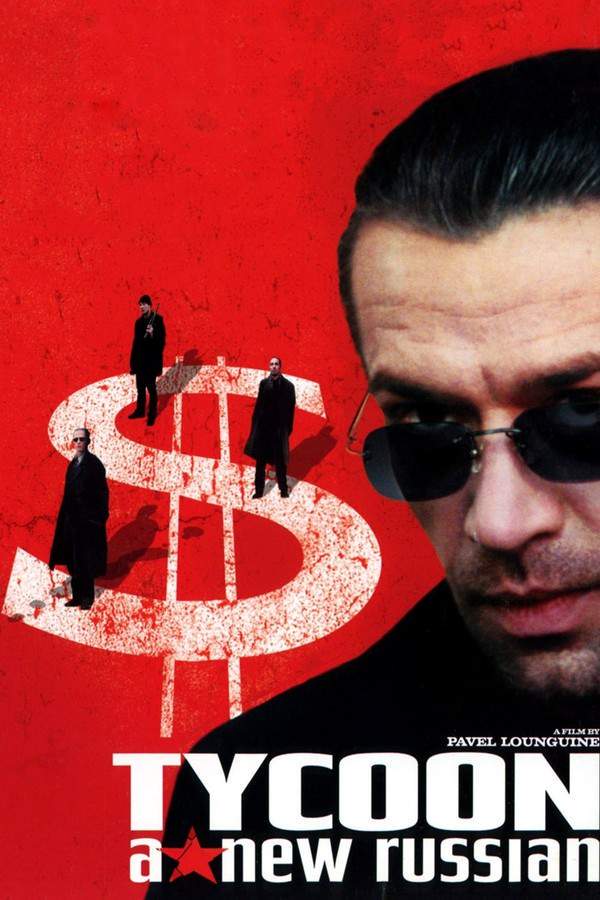
In the Russian Empire at the turn of the 19th century, a tense political thriller unfolds on the edge of Moscow’s power circle. On the Petersburg-Moscow line, a train car shields a high-security visitor: a man who presents himself as state councilor Erast Fandorin, an official tasked with safeguarding the Moscow governor-general’s security. Yet this newcomer quickly reveals himself as a man who resembles the legendary investigator, because the real Erast Fandorin is known for his sharp deductive mind and unshakeable composure. The guards, recognizing the verbal portrait of the official known to them, grant him entry, but soon the mood shifts from guarded courtesy to chaos: the Moscow governor-general is found dead in his compartment, a bloody blade in hand bearing the mark of the elusive terrorist group called the BG.
The murderer who impersonated the famed sleuth – a killer nicknamed Green – slips away and settles in Moscow with three accomplices: Rahmet, Emelya, and Snegir. They are aided by a local revolutionary who goes by Needle, and the group quickly proves that their reach extends far beyond a single act of violence. The investigators realize that the impersonator’s degree of familiarity with the security details of the general points to a leak from a tightly knit circle. The real Erast Fandorin will have to untangle a web woven by people who once stood closest to the scene.
As the investigation unfolds, one lead surfaces with startling clarity: the first clues come from the terrorists themselves. They knew who was responsible for the general’s security in Moscow and had a detailed description of the man who would arrive. Only a very small group could have leaked that information, and it is this revelation that pushes the case toward a sharp confrontation with the Moscow garrison’s own ranks. The investigation intensifies when the team detains one member of the group, Rahmet, though the capture is not without frictions, as the celebrated investigator General Prince Pozharsky arrives from Petersburg to oversee the case.
Meanwhile, the BG escalates its activity, striking at the treasury car and breaking security in a dramatic theft that shakes the capital. Fandorin decides to identify the source of the leak by feeding each suspect different pieces of information and watching how the terrorists react. The reaction is revealing in the most unexpected way: the leak originates with Prince Pozharsky himself, a startling admission that reframes the entire investigation.
Pozharsky maneuvers to trap the Combat Group with a calculated operation designed to end in what would look like a fatal accident for Fandorin. Yet Fandorin’s agility keeps him alive, and the assault leaves Snegir and Emelya dead, while Green remains at large, continued in part by Needle’s help and loyalty. In a private conversation, Pozharsky concedes that Green’s initial success began with the general’s own actions to manipulate events, using the terrorists to eliminate rivals and to present himself as the indispensable rescuer of the state. The conspirators’ plan is laid bare: the Moscow Governor-General would ascend to power, Simeon Alexandrovich the Grand Duke would become his patron, and Pozharsky himself would rise to the rank of Moscow Chief Policeman.
Facing the bleak calculus of power, Erast Fandorin cannot openly denounce Pozharsky; no one would believe him. The key to the master plan lies in Julie Lenard, a figure who has become a pawn in the game, whom Green forces to arrange a meeting with Pozharsky. The shocking revelation is that Julie Lenard’s appointment is part of a larger scheme to mislead and manipulate, and the truth about the betrayal is finally whispered in a moment of quiet reflection: Evil devours itself.
The tension culminates as Pozharsky tries to solidify his control, eliminating Green and Julie, though he pays a high price by dying alongside Needle, who had sabotaged him and spoken the truth only in her final breath. The wake of these events leaves the political landscape altered, with the new governor-general offering Erast Fandorin the post of chief policeman and a promise of patronage. Initially, Fandorin refuses, but after the urging of the old servant who served the governor-general, he returns to Simeon’s office and accepts the responsibility, stepping into a complex new chapter where loyalty, cunning, and conscience clash once more.
- The film paints a meticulous picture of power dynamics in a pre-revolutionary capital, weaving together intrigue, loyalty, and the brittle boundaries between public duty and private ambition.
- It highlights how information, once weaponized, can redefine alliances and reshape destinies, often at a terrible personal cost.
- The characters are drawn with a cool, deliberate pace, letting the moral ambiguities drive the narrative as much as the plot twists themselves.
- Throughout, the atmosphere remains taut and restrained, with the period setting enriching the texture of every confrontation and revelation.
> Evil devours itself.


![Investigation of a Citizen Above Suspicion [re-release] movie poster](https://whats-after-the-movie-ti152.sevalla.storage/movies/investigation-of-a-citizen-above-suspicion.jpg)