Plot Explained Spoilers guaranteed!
Plot Explained

Browse by genre

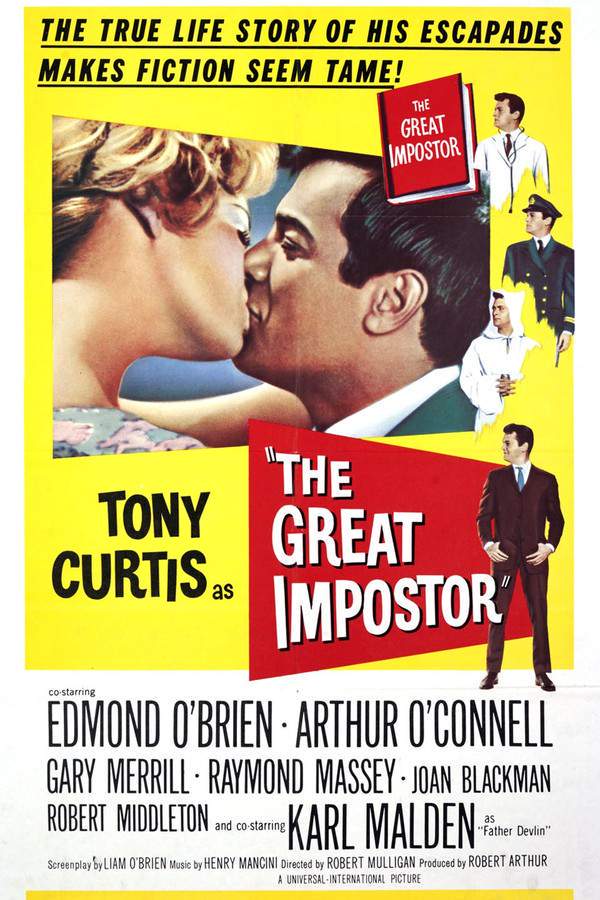
The Great Impostor (1961) movie poster

Characters & Themes

The Great Impostor (1961) Characters, Setting & Themes Explained

Release, runtime and language
1961 · 113 min · English
Loading streaming availability…
Directed by
Robert Mulligan
Starring
Karl Malden, Edmond O'Brien, Tony Curtis, Jeanette Nolan, Arthur O'Connell, Gary Merrill

The story follows Ferdinand Waldo Demara Jr., a man who repeatedly assumed false identities throughout his life. As the U.S. Coast Guard investigates his elaborate deceptions, flashbacks reveal a series of astonishing impersonations. He convincingly posed as an Army soldier, a monk, a sailor, a prison warden, a teacher, and even a doctor. This true story explores the life of a complex and charismatic individual, portrayed by Tony Curtis, and examines the motivations behind his extraordinary odyssey of identity theft.

On this page (8)
  1. 1 Where to watch
  2. 2 Characters explained (3)
  3. 3 Where & when it takes place
  4. 4 Themes & meaning (3)
  5. 5 Character & meaning questions
  6. 6 Movie threads
  7. 7 Movies like The Great Impostor
  8. 8 Every angle
Loading streaming availability…

3 main characters · contains spoilers

The Great Impostor Characters Explained: Who Is Who

The main characters of The Great Impostor (1961), heroes and villains: what drives them, how they change over the course of the story and what each of them reveals about the film's bigger ideas.

  • Ferdinand Waldo Demara

    Ferdinand Waldo Demara is the central character whose life of deception takes him through various identities and experiences. Driven by ambition and a desire for acceptance, he embodies intelligence and charisma, yet often finds himself in precarious situations due to his lies. Demara's character reflects the struggle between aspiration and authenticity.

    • 🧑‍✈️ Impersonator
    • 🎓 Deceptive
  • Eulalie

    played by Joan Blackman

    Eulalie, portrayed by Joan Blackman, is the warden’s daughter who becomes romantically interested in Demara. Her character represents innocence and hope, as she sees beyond his deceptive facade. Eulalie's affection for Demara complicates his situation, highlighting themes of love and trust.

    • 💖 Love Interest
    • 🌟 Innocent
  • Nurse Catherine Lacey

    played by Jeanette Nolan

    Nurse Catherine Lacey, played by Jeanette Nolan, is a compassionate figure who supports Demara despite his past. Her character embodies empathy and moral integrity. Lacey's dedication to helping others plays a crucial role in the narrative, illustrating the complexities of loyalty and forgiveness.

    • 🤍 Compassionate
    • 🩺 Nurse

Last updated: October 22, 2024 at 21:49

Was this helpful?

Setting

Where and When Does The Great Impostor Take Place?

The setting of The Great Impostor (1961): the year and time period, the places and locations, and how they shape the characters, the mood and the tension of the story.

Time period

Korean War era

The events primarily take place during the Korean War era, a time marked by global tension and conflict. This period saw a surge of military enlistment and personal sacrifices, where young men were called to serve their countries. Demara's experiences highlight the chaos and uncertainties faced by soldiers during this tumultuous time.

Location

New England, Texas, Royal Canadian Navy

The story unfolds across various places, including the picturesque and serene landscapes of New England, known for its rich history and coastal beauty. Texas plays a significant role as the backdrop for a large prison where Demara's impersonation takes root. The Royal Canadian Navy illustrates a military environment, showcasing the bravery and challenges faced during service.

  • 🏖️ Island
  • 🇺🇸 USA
  • ⚓ Navy

Last updated: October 22, 2024 at 21:49

Was this helpful?

3 major themes

The Great Impostor Meaning: Themes & Message Explained

What is The Great Impostor (1961) really about? The emotional, social and philosophical themes the film keeps returning to, its symbolism and the message beneath the surface.

  • Deception

    Deception is a central theme in the film, as Demara navigates life through a web of lies and false identities. His ability to impersonate others raises questions about identity and the nature of self. This theme explores the consequences of deceit, both on an individual and societal level, as Demara's actions lead him through a tumultuous and unpredictable life.

  • Identity Crisis

    Demara's journey is a profound exploration of identity crisis, where he struggles with his true self amidst various personas. His multiple aliases reflect an underlying quest for belonging and acceptance. The theme delves into the psychological impact of living a lie, ultimately leading to a confrontation with himself.

  • Second Chances

    The theme of second chances resonates throughout Demara's story as he continually reinvents himself after each failure. Despite the moral implications of his actions, he finds avenues for redemption through his heroic acts in the Navy. This theme emphasizes the idea that everyone deserves a second chance, regardless of their past.

Last updated: October 22, 2024 at 21:49

Was this helpful?

Character & theme questions

The Great Impostor Characters & Meaning: Your Questions Answered

The questions people ask about The Great Impostor (1961): who the characters really are, their relationships, what the symbols mean, where it takes place and what the movie is really about. Each answer contains spoilers.

Q1

Where is The Great Impostor set?

The movie takes place across multiple locations, primarily in New England with its picturesque coastal landscapes, in Texas where a major prison serves as a key setting, and within the Royal Canadian Navy environment. These distinct locations each play a role in showcasing different aspects of Demara's impersonations.

  • setting
  • locations
  • new england
  • texas
  • navy
Q2

When does The Great Impostor take place?

The story occurs during the Korean War era, a period marked by global tension and conflict. This time period is significant because it created an environment of military enlistment and personal sacrifice, providing the chaotic backdrop that allowed Demara's deceptions to flourish.

  • time period
  • korean war
  • era
  • historical context
Q3

What are the main themes in The Great Impostor?

The film centers on three major themes: deception as Demara navigates life through false identities; identity crisis, exploring his struggle between his true self and his various personas; and second chances, as he finds redemption through heroic acts despite his dishonest past.

  • themes
  • deception
  • identity
  • second chances
Q4

What does the movie say about identity?

The film explores how Demara's multiple aliases reflect an underlying quest for belonging and acceptance. His constant reinventions raise questions about whether identity is fixed or fluid, ultimately suggesting that living a lie takes a psychological toll as he must confront who he truly is.

  • identity
  • self
  • persona
  • authenticity
Q5

Who is Ferdinand Demara?

Ferdinand Waldo Demara Jr. is the central character, a charismatic and intelligent man who repeatedly assumed false identities throughout his life. He posed as an Army soldier, monk, sailor, prison warden, teacher, and even a doctor, driven by ambition and a deep desire for acceptance.

  • ferdinand demara
  • protagonist
  • impostor
Q6

Who is Nurse Catherine Lacey?

Nurse Catherine Lacey is a compassionate figure in the film who supports Demara despite learning of his deceptive past. She embodies empathy and moral integrity, demonstrating loyalty and forgiveness even toward someone who has lied extensively.

  • catherine lacey
  • nurse
  • compassion
  • forgiveness
Q7

Who is Eulalie in the movie?

Eulalie is the prison warden's daughter who becomes romantically interested in Demara. She represents innocence and hope in the film, seeing beyond his deceptive facade and becoming affectionately involved with him despite his false identity.

  • eulalie
  • warden's daughter
  • love interest
Q8

What does The Great Impostor say about second chances?

The theme of second chances resonates strongly as Demara continually reinvents himself after each failure. Despite the moral implications of his actions, he finds redemption through his heroic service in the Navy, suggesting that people deserve opportunities to prove themselves regardless of their past.

  • redemption
  • second chances
  • forgiveness
Q9

Why does Ferdinand Demara keep changing his identity?

Demara's constant impersonations stem from a desire for acceptance and belonging that he cannot find as himself. His multiple identities reflect an underlying quest for purpose and validation, though this pursuit ultimately leads to a turbulent and unpredictable life.

  • motivation
  • identity change
  • belonging
Q10

Is The Great Impostor based on a true story?

Yes, The Great Impostor is based on the real life of Ferdinand Waldo Demara Jr., a notorious impostor who genuinely assumed numerous false identities including soldier, monk, sailor, warden, teacher, and doctor. The film presents his extraordinary story with a balanced, journalistic approach.

  • true story
  • real life
  • biography
Q11

What is the tone of The Great Impostor?

The film maintains a neutral journalistic tone that neither glorifies nor condemns Demara. It presents his actions and consequences with balanced perspective, allowing viewers to form their own opinions about his motivations and morality.

  • tone
  • style
  • perspective
  • narrative
Q12

What motivates Demara to impersonate so many professions?

Demara's motivations appear to stem from a combination of ambition and an innate desire to be someone else. His intelligence and charisma enable him to convincingly assume roles he has no training for, suggesting a deeper psychological need to escape his true identity and prove his worth through success in various fields.

  • motivation
  • ambition
  • professions
  • impersonation

Movie threads

More Movies Like The Great Impostor, by Mood & Story

Curated lists built around what makes The Great Impostor tick: the same mood, the same kind of story or the same emotional payoff. Each list explains why these movies belong together.

Movies about charismatic impostors like The Great Impostor

Stories about charming con artists living elaborate, fabricated lives. If you liked Tony Curtis as Ferdinand Demara in The Great Impostor, you'll enjoy these movies about charming con artists and identity thieves. This collection features fast-paced dramas and comedies where charismatic anti-heroes assume false lives, exploring themes of identity, deception, and the consequences of living a lie.

  • witty
  • restless
  • chameleonic
  • anxious
  • charismatic
  • high-stakes
  • Tone: witty, neutral, reflective
  • Pacing: fast, episodic
Why these movies?

The story pattern: Narratives in this thread typically follow a protagonist as they successfully, and often audaciously, infiltrate various roles and institutions. The structure is often episodic, moving from one deception to the next, building tension with each close call. The character's motivation is key, often stemming from a deep-seated restlessness or a desire to escape their own identity.

Why they belong together: These films are grouped by their shared focus on a specific character archetype: the charismatic impostor. They generate a similar vibe through a mix of witty dialogue, restless pacing, and a medium intensity derived from the high-stakes nature of the cons. The tone is frequently neutral or slightly comedic, observing the anti-hero's actions without heavy moral judgment.

Fast-paced biographical movies like The Great Impostor

Rapid-fire biographical films that cover vast stretches of a remarkable life. Find more fast-paced true stories similar to The Great Impostor. These films cover extraordinary lives with a rapid, engaging pace, blending drama and real-world events. If you enjoyed the episodic journey through Ferdinand Demara's many identities, you'll appreciate these other energetic biographical odysseys.

  • reflective
  • melancholic
  • restless
  • engaging
  • picaresque
  • true story
  • Tone: neutral, reflective, melancholic
  • Pacing: fast, sweeping
Why these movies?

The story pattern: The narrative pattern is linear but accelerated, often structured around a series of significant episodes or chapters in the subject's life. This approach emphasizes the cumulative impact of their experiences and choices. The emotional journey can be complex, mirroring the subject's own highs and lows, and often concludes with an ambiguous or reflective ending that sums up their legacy.

Why they belong together: These films share a specific storytelling approach to biography: a fast pace that propels the viewer through a life story. They create a cohesive vibe through their moderate complexity, neutral to reflective tone, and a structure that feels like a highlight reel of a fascinating existence. The emotional weight is typically medium, balancing serious themes with the engaging pace of the narrative.

If you liked this

Movies Like The Great Impostor

Similar movies to The Great Impostor: the same genre, themes or kind of story. Each one comes with its own plot summary, timeline and ending explained.

Browse all movie summaries

Every angle

The Great Impostor (1961) Explained: Plot, Timeline & Characters

Everything about The Great Impostor in one place: what happens in the plot summary, the timeline in chronological order, the characters and meaning and a spoiler-free summary. What's After the Movie adds the cast, box office and post-credit scenes.

Coming soon on iOS and Android

The Plot Explained Movie Summary App

Plot summaries, endings explained and timelines on your phone. Catch up on any movie in minutes, save your favorites and never miss a twist again.

Be the first to know when we launch. Your email stays private, always.

Learn more about the app