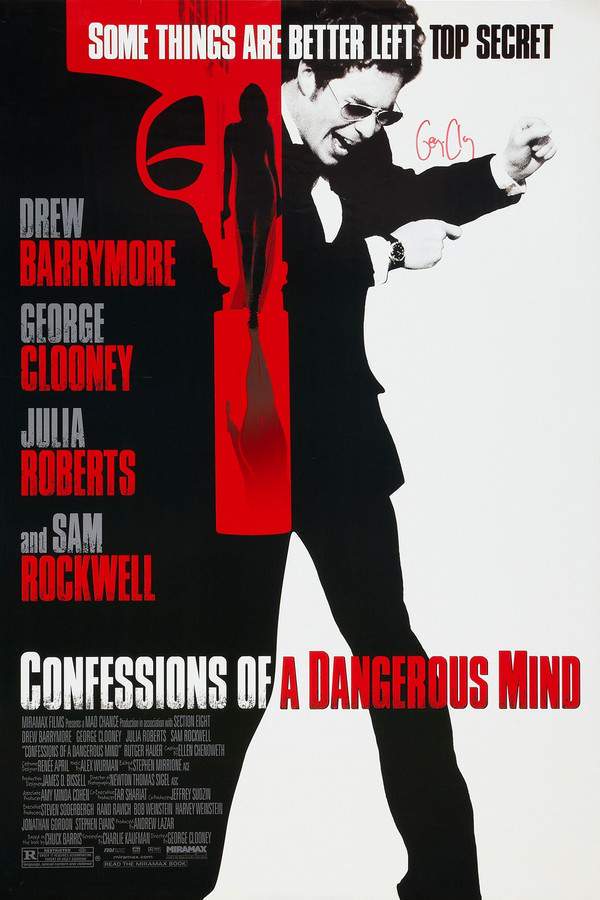
The story follows TV producer and personality Chuck Barris as he recounts his extraordinary life and career. While achieving fame with shows like "The Dating Game" and "The Gong Show," Barris claims to have led a secret life as a CIA-trained assassin, allegedly responsible for the deaths of 33 people. The film explores the blurred lines between reality and fabrication as Barris grapples with the truth behind his public persona and a potentially fabricated past.
Find where to stream, rent, or buy Confessions of a Dangerous Mind (2002) in the US with current JustWatch availability, up-to-date pricing, and platform listings for subscription, rental, and digital purchase options.
Warning: spoilers below!
Haven’t seen Confessions of a Dangerous Mind yet? This summary contains major spoilers. Bookmark the page, watch the movie, and come back for the full breakdown. If you're ready, scroll on and relive the story!
Read the complete plot breakdown of Confessions of a Dangerous Mind (2002), including all key story events, major twists, and the ending explained in detail. Discover what really happened, and what it all means.
The film intertwines excerpts from Chuck’s personal journals, public records, and recorded interviews to tell his story. In 1940, Chuck Barris, portrayed by Sam Rockwell, is a teenager in Philadelphia whose life revolves around his quest for promiscuity. Despite numerous attempts, he struggles with romantic conquests among various girls and women. A turning point comes in 1955 when he is inspired by a TV advertisement and relocates to Manhattan to become an NBC page, fueled by a desire for fame in the television industry.
Chuck’s ambition leads him to deceit, as he fabricates details on his application for a management trainee position at NBC, where only five spots are available among 2000 applicants. He begins a relationship with fellow Page Georgia, leading to an unexpected pregnancy, which ultimately coincides with his dismissal from NBC—a revelation that she was merely late. Consequently, Chuck returns to Philadelphia and secures a job as Dick Clark’s personal assistant on “American Bandstand” in 1961. Despite his burgeoning career, he finds himself entangled with Debbie, an ABC executive, played by Maggie Gyllenhaal, as he continues his pursuit of fame and fortune.
As his career takes off, Chuck composes the hit song “Palisades Park” and falls for Penny Pacino, a character brought to life by Drew Barrymore, who happens to be Debbie’s roommate. It is this romance that inspires Chuck’s groundbreaking idea for a dating show. He convinces ABC to let him pitch the concept for “The Dating Game,” resulting in a $7,500 budget to produce the pilot. However, the show initially faces rejection in favor of “Hootenanny.”
After a bar fight leads to his dismissal, Chuck encounters CIA agent Jim Byrd, played by George Clooney, who recruits him as an assassin, convincing him with promises of adventure and the allure of Eastern European women. Chuck finds himself excelling in CIA training, particularly in sniper shooting. Upon his return from a mission in Mexico, he discovers a changed Penny, who has taken on a hippie lifestyle, just as “The Dating Game” is green-lit by ABC.
Despite initial shock from the network concerning the show’s risqué content, Chuck defends its authentic spontaneity. He hires a coordinator to keep things within a PG-13 framework as the show skyrockets in popularity by 1967, securing a prime-time slot. As Jim suggests increasing prize money to cover Chuck’s missions, he embarks on covert operations under the guise of his television career.
During a mission in Helsinki, he meets the alluring operative Patricia Watson but still finds success with “The Newlywed Game,” leading him and Penny to move to Los Angeles. However, Chuck’s reluctance toward marriage complicates their relationship. His life parallels that of Teufelsdröckh from Thomas Carlyle’s Sartor Resartus, a theme that recurs throughout the film.
In 1970, another assignment brings Chuck to West Berlin for a critical assassination. Captured by the KGB while infiltrating East Germany, he undergoes a harrowing experience before being exchanged for a Russian agent. By 1976, Chuck becomes a household name as the host of “The Gong Show” but faces critique over the declining quality of television programming. Tragedy strikes when Keeler—a colleague—mysteriously dies, leading Jim to warn Chuck of a mole within the agency.
As Chuck’s television shows suffer from low ratings, his relationship with Penny deteriorates. In a surreal moment, Jim confronts Chuck, interpreting his past as indicative of a killer’s profile, before met with an abrupt demise. This trauma haunts Chuck, culminating in a nervous breakdown on his show.
By 1981, when Penny finds him secluded in a New York hotel, she urges him to return and commit to their relationship. Faced with his secrets, Chuck ventures to Boston where he discovers Patricia’s betrayal as the mole. The fallout leads him to violence, shaping him into a writer of his own story, Confessions of a Dangerous Mind, ultimately deciding to marry Penny. The film concludes with Chuck preparing for an interview about the adaptation of his life story, encapsulating the complexities of his dual existence as a television personality and covert assassin.
Last updated: November 03, 2024 at 20:34
Explore frequently asked questions about Confessions of a Dangerous Mind (2002) with spoiler-rich answers covering the full plot summary, major story beats, character motivations, hidden details, and ending meaning. This movie summary FAQ helps explain confusing scenes, plot twists, and narrative decisions in clear, searchable detail.
Chuck was recruited by CIA agent Jim Byrd after a bar fight. Byrd saw potential in Chuck and convinced him to join by promising adventure and the allure of Eastern European women. Chuck excelled in CIA training, particularly in sniper shooting, which made him valuable for covert operations. The recruitment played on Chuck's desire for excitement and fame beyond his television career.
The film hints at Chuck's capability for violence earlier when he gets into the bar fight that leads to his recruitment.
The film intentionally leaves this question unanswered, reflecting the central ambiguity of whether Chuck's confessions are genuine memories or a symptom of his psychological breakdown. The narrative weaves together his personal journals, public records, and recorded interviews without confirming which elements are real. This uncertainty is central to the film's theme of fractured identity.
The film's opening establishes from the start that it intermixes fact and fiction, making truth verification impossible.
Patricia Watson, the alluring CIA operative Chuck met during a mission in Helsinki, was revealed to be the mole when Chuck traveled to Boston in 1981. This betrayal devastated Chuck and was a major factor in his decision to finally commit to leaving his covert life behind and marry Penny.
Jim Byrd warns Chuck about a mole after colleague Keeler's mysterious death, planting suspicion about someone close to Chuck.
Jim Byrd, the CIA handler who recruited Chuck, is killed abruptly in a confrontation with Chuck. After Jim interprets Chuck's past actions as indicative of a killer's profile, Chuck experiences trauma from this encounter. The film does not explicitly show the killing, but Jim's death haunts Chuck and contributes to his subsequent nervous breakdown.
The tension between Chuck and Jim escalates as Chuck becomes increasingly unstable, with Jim suggesting he fits a killer's psychological profile.
Chuck's nervous breakdown on The Gong Show was caused by accumulated psychological strain from living his double life. The stress of balancing covert CIA operations with his television career, combined with the traumatic death of Jim Byrd, colleague Keeler's mysterious death, his failing shows, and deteriorating relationship with Penny, all culminated in his public breakdown.
Jim's death and warning about a mole had already destabilized Chuck's mental state earlier in the film.
At the end of the film, Chuck decides to marry Penny after she confronts him in a New York hotel in 1981, urging him to commit to their relationship. After discovering Patricia's betrayal in Boston, Chuck chooses to leave his covert life behind and embrace his relationship with Penny. The film concludes with Chuck preparing for an interview about adapting his life story into the book 'Confessions of a Dangerous Mind.'
Penny's earlier hippie transformation and her 1981 intervention signal her role as Chuck's path to redemption.
Chuck was captured by the KGB in 1970 while on an assassination assignment in West Berlin, attempting to infiltrate East Germany. He endured a harrowing experience in captivity before being exchanged for a Russian agent. This mission failure marked a turning point that increased his paranoia and stress, contributing to his later psychological deterioration.
Jim's suggestion that Chuck take on more missions coincides with this dangerous assignment.
Chuck was inspired to create The Dating Game after falling in love with Penny Pacino, who was roommates with Debbie (his ABC executive lover). This romance sparked his idea for a dating show. He convinced ABC to let him pitch the concept, securing a $7,500 budget for the pilot, though the show initially faced rejection in favor of 'Hootenanny' before eventually being green-lit.
The film establishes early that Chuck's romantic pursuits consistently drive his career ambitions.
Keeler was Chuck's colleague at the CIA who died mysteriously. His death prompted Jim Byrd to warn Chuck about a mole within the agency, creating paranoia about who could be betraying them. The film does not reveal exactly who killed Keeler or the circumstances of his death, but it serves as a crucial plot point that heightens Chuck's distrust and fear.
Keeler's death occurs in 1976, around the same time Chuck's television career faces criticism for declining quality.
The title refers to Chuck Barris's book (and the film itself) about his claimed secret life as a CIA assassin. 'Dangerous Mind' reflects the duality of his identity, a television personality known for game shows versus a covert operative capable of violence. The title also hints at the psychological interpretation that his dangerous confessions may be products of a disturbed mind rather than actual memories.
The film draws parallels between Chuck and the literary character Teufelsdröckh from Thomas Carlyle's 'Sartor Resartus,' a character struggling with identity and dual existences.
Discover curated groups of movies connected by mood, themes, and story style. Browse collections built around emotion, atmosphere, and narrative focus to easily find films that match what you feel like watching right now.
Stories where you question the truth through a protagonist's distorted lens.If you enjoyed questioning Chuck Barris's story in Confessions of a Dangerous Mind, you'll find similar intrigue here. This section features movies like Fight Club and Shutter Island, where the protagonist's perspective is key to a mysterious, psychologically complex plot.
The narrative is structured around the subjective and often contradictory account of a central character. The plot's tension frequently hinges on the audience's growing doubt about the narrator's credibility, leading to revelations that recontextualize everything we've seen.
These films are grouped together because they share a central narrative device: the unreliable narrator. They create a unique viewing experience where the audience actively pieces together the puzzle of reality versus fabrication, leading to psychological depth and surprising twists.
Thrillers that blend tension and violence with sharp, cynical humor.Fans of the darkly funny and satirical espionage in Confessions of a Dangerous Mind will enjoy these picks. Discover similar movies like In Bruges or American Psycho that blend thrilling plots with sharp, cynical humor and social commentary.
The narrative juxtaposes high-stakes, often violent scenarios with ironic humor and satirical observations. The protagonist is typically a cynical or morally ambiguous figure navigating a world that is both dangerous and absurd, leading to a tone that is simultaneously suspenseful and funny.
These movies are grouped by their distinctive tonal blend. They share a fast-paced rhythm, a darkly comedic sensibility that finds humor in grim situations, and a satirical lens that critiques aspects of modern life, media, or ambition.
Don't stop at just watching - explore Confessions of a Dangerous Mind in full detail. From the complete plot summary and scene-by-scene timeline to character breakdowns, thematic analysis, and a deep dive into the ending - every page helps you truly understand what Confessions of a Dangerous Mind is all about. Plus, discover what's next after the movie.
Track the full timeline of Confessions of a Dangerous Mind with every major event arranged chronologically. Perfect for decoding non-linear storytelling, flashbacks, or parallel narratives with a clear scene-by-scene breakdown.
Discover the characters, locations, and core themes that shape Confessions of a Dangerous Mind. Get insights into symbolic elements, setting significance, and deeper narrative meaning - ideal for thematic analysis and movie breakdowns.
Discover movies like Confessions of a Dangerous Mind that share similar genres, themes, and storytelling elements. Whether you’re drawn to the atmosphere, character arcs, or plot structure, these curated recommendations will help you explore more films you’ll love.
Confessions of a Dangerous Mind (2002) Scene-by-Scene Movie Timeline
Confessions of a Dangerous Mind (2002) Movie Characters, Themes & Settings
Confessions of a Dangerous Mind (2002) Spoiler-Free Summary & Key Flow
Movies Like Confessions of a Dangerous Mind – Similar Titles You’ll Enjoy
Extremely Wicked, Shockingly Evil and Vile (2019) Plot Summary & Ending Explained
Infamous (2006) Full Movie Breakdown
Where the Truth Lies (2005) Ending Explained & Film Insights
Confidence (2003) Spoiler-Packed Plot Recap
Dangerous (2021) Full Summary & Key Details
The Chameleon (2011) Complete Plot Breakdown
The Confessions (2017) Spoiler-Packed Plot Recap
Crimes of Passion (1984) Story Summary & Characters
Confessions (2006) Film Overview & Timeline
Confessions of an Action Star (2005) Full Summary & Key Details
Cover-Up (1991) Complete Plot Breakdown
Deadly Desire (1991) Spoiler-Packed Plot Recap
Confidential Agent (1945) Full Movie Breakdown
Dangerous to Know (1938) Ending Explained & Film Insights
Double Confession (1950) Movie Recap & Themes