





Plot Explained Spoilers guaranteed!
Plot Explained

Browse by genre

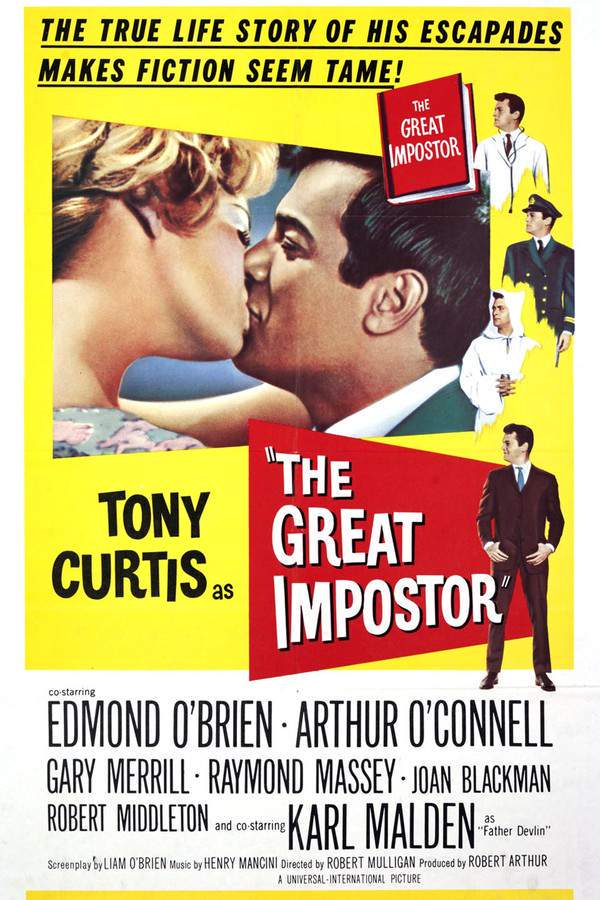
The Great Impostor (1961) movie poster

Plot Summary

The Great Impostor (1961) Plot Summary Explained

Release, runtime and language
1961 · 113 min · English
Directed by
Robert Mulligan
Starring
Karl Malden, Edmond O'Brien, Tony Curtis, Jeanette Nolan, Arthur O'Connell, Gary Merrill

The story follows Ferdinand Waldo Demara Jr., a man who repeatedly assumed false identities throughout his life. As the U.S. Coast Guard investigates his elaborate deceptions, flashbacks reveal a series of astonishing impersonations. He convincingly posed as an Army soldier, a monk, a sailor, a prison warden, a teacher, and even a doctor. This true story explores the life of a complex and charismatic individual, portrayed by Tony Curtis, and examines the motivations behind his extraordinary odyssey of identity theft.

On this page (6)
  1. 1 Where to watch
  2. 2 What happens: full plot
  3. 3 Plot questions answered
  4. 4 Movie threads
  5. 5 Movies like The Great Impostor
  6. 6 Every angle

Where to watch

Where to Watch The Great Impostor (1961)

Where can you watch The Great Impostor? Stream, rent or buy it in the US, including on Amazon Video, Apple TV Store and Fandango At Home: current JustWatch availability with up-to-date prices.

Streaming availability powered by JustWatch

Full plot summary · contains spoilers

What Happens in The Great Impostor: Full Plot Summary

The whole story of The Great Impostor (1961) explained, from the opening scene to the final frame: every key event, every twist and what it all adds up to. Read it as a quick recap before the sequel, to check a scene you missed, or to finally understand what really happened.

As state police apprehend a man on a New England island, he reflects on the extraordinary path that led him to this moment in life, a life of deception and multiple aliases, including his birth name, Ferdinand Waldo Demara.

Demara's journey began when he dropped out of high school and enlisted in the U.S. Army, aspiring to become an officer. However, lacking a high school diploma thwarted his ambitions. In a bold move, he fabricated credentials and succeeded in enlisting as a U.S. Marine. Sadly, his ruse was quickly uncovered. Facing dire consequences and military imprisonment, he orchestrated an elaborate fake suicide and sought refuge in a monastery, attempting to live as a Trappist monk. Despite his efforts for solitude, he was eventually compelled to return to society.

Ultimately recognized as a wanted Marine, he found himself in a military prison. Just before an early release due to good behavior, Demara cleverly persuaded the warden to share his life story. Upon release, he executed another impersonation, this time stealing the warden’s identity to secure a position as an aide to the warden of a large Texas prison. In this new life, he caught the attention of the warden’s daughter, Eulalie, who pursued him romantically. However, when an inmate from his past recognized him, Demara faced the threat of blackmail and once again was forced to flee.

He then assumed the identity of a doctor and enlisted in the Royal Canadian Navy. There, he developed feelings for Nurse Catherine Lacey and was deployed to a destroyer headed for the Korean War. In a nail-biting scenario, he was tasked with performing a tooth extraction on the ship’s captain and later treated numerous South Korean battle casualties, succeeding in saving their lives. His heroics turned him into a celebrated figure, leading to the establishment of a hospital to aid local Koreans.

However, the veil of his impersonation did not last long, as the real doctor learned of the international spotlight and sought justice. As a court-martial approached, Nurse Lacey and others who appreciated Demara’s goodwill rallied to support him, complicating the Navy's decision on how to proceed. Instead of punishment, reflecting on his service's merits, the inquiry board quietly discharged him.

Demara then took up teaching in a quiet New England town, but he found himself in trouble again, leading to another escape. As the FBI made it their mission to locate this notorious impersonator, Demara arrived at their headquarters disguised as a federal agent, on a mission to track down the one person he could not escape—himself.

Last updated: November 15, 2024 at 17:21

Was this helpful?

Plot questions answered

The Great Impostor Plot Explained: Your Questions Answered

The questions people ask most about The Great Impostor (1961): what happens in the confusing scenes, why the characters do what they do, the twists, hidden details and what the ending means. Each answer contains spoilers.

Q1

Why did Ferdinand Demara start assuming false identities?

Demara began impersonating others after dropping out of high school and being unable to achieve his goal of becoming an Army officer due to lacking a high school diploma. Frustrated by this barrier, he fabricated credentials to enlist as a U.S. Marine, launching his lifelong pattern of identity fraud.

Foreshadowing: Earlier scenes establish his ambition and desperation to escape his limited circumstances.

  • ferdinand demara
  • impersonation
  • motivation
  • military
  • identity fraud
Q2

How was Demara able to impersonate a doctor and perform surgery?

Demara impersonated a doctor and enlisted in the Royal Canadian Navy. During Korean War deployment, he was forced to perform a tooth extraction on the ship's captain and later treat numerous South Korean battle casualties. Despite lacking medical training, he managed to save their lives through courage and improvisation, turning him into a celebrated hero.

  • demara
  • doctor
  • korean war
  • medical
  • impersonation
  • surgery
Q3

Why was Demara discharged instead of punished by the Navy?

When the real doctor Demara impersonated discovered the deception and initiated court-martial proceedings, Nurse Catherine Lacey and others who witnessed his life-saving actions rallied to support him. The Navy's inquiry board ultimately chose to quietly discharge him based on his service merits rather than pursue punishment.

Foreshadowing: The film establishes Demara's genuine goodwill and ability to connect with people throughout his impersonations.

  • court-martial
  • navy
  • discharge
  • catherine lacey
Q4

Why did Demara go to FBI headquarters disguised as a federal agent?

After teaching in a New England town and getting into trouble again, Demara arrived at FBI headquarters disguised as a federal agent. Rather than attempting to escape, his mission was to track down himself, the one person he could never escape. This final confrontation with his own legend served as the film's ambiguous conclusion.

Foreshadowing: The film consistently shows Demara's strange relationship with facing the consequences of his own deceptions.

  • fbi
  • finale
  • confrontation
  • identity
Q5

How did Demara escape from military prison the first time?

After being imprisoned for his Marine impersonation, Demara orchestrated an elaborate fake suicide to escape from military prison. This allowed him to flee and seek refuge in a monastery, beginning his next chapter as a Trappist monk.

  • escape
  • prison
  • fake suicide
  • military
Q6

Why did Demara impersonate a prison warden in Texas?

After his release from military prison, Demara learned the warden's life story while persuading the warden to share it just before his early release. He then stole the warden's identity to secure a position as an aide to the warden of a large Texas prison, giving him power and a new life.

  • warden
  • texas
  • impersonation
  • prison
Q7

Why was Demara forced to flee from the Texas prison?

While working at the Texas prison, Demara caught the attention of the warden's daughter Eulalie, who pursued him romantically. However, an inmate from his past recognized him and attempted to blackmail him. Facing exposure, Demara was forced to abandon his current identity and flee once again.

  • eulalie
  • blackmail
  • texas
  • escape
Q8

What happened when Demara lived as a monk?

After escaping military prison, Demara sought refuge in a monastery and attempted to live as a Trappist monk, hoping for a quiet life of solitude. However, his past eventually caught up with him, and he was compelled to return to society where he was recognized as a wanted Marine.

  • monk
  • monastery
  • trappist
  • escape
Q9

Why did people believe Demara's impersonations for so long?

Demara's success stemmed from his boldness, charisma, and ability to quickly learn just enough about each profession to convince others. He targeted positions where he could observe and adapt rapidly, and his genuine goodwill helped him earn trust even as he maintained his elaborate deceptions.

Foreshadowing: The film establishes his charm and ability to persuade people from the earliest flashbacks.

  • convincing
  • trust
  • charisma
  • deception

Movie threads

More Movies Like The Great Impostor, by Mood & Story

Curated lists built around what makes The Great Impostor tick: the same mood, the same kind of story or the same emotional payoff. Each list explains why these movies belong together.

Movies about charismatic impostors like The Great Impostor

Stories about charming con artists living elaborate, fabricated lives. If you liked Tony Curtis as Ferdinand Demara in The Great Impostor, you'll enjoy these movies about charming con artists and identity thieves. This collection features fast-paced dramas and comedies where charismatic anti-heroes assume false lives, exploring themes of identity, deception, and the consequences of living a lie.

  • witty
  • restless
  • chameleonic
  • anxious
  • charismatic
  • high-stakes
  • Tone: witty, neutral, reflective
  • Pacing: fast, episodic
Why these movies?

The story pattern: Narratives in this thread typically follow a protagonist as they successfully, and often audaciously, infiltrate various roles and institutions. The structure is often episodic, moving from one deception to the next, building tension with each close call. The character's motivation is key, often stemming from a deep-seated restlessness or a desire to escape their own identity.

Why they belong together: These films are grouped by their shared focus on a specific character archetype: the charismatic impostor. They generate a similar vibe through a mix of witty dialogue, restless pacing, and a medium intensity derived from the high-stakes nature of the cons. The tone is frequently neutral or slightly comedic, observing the anti-hero's actions without heavy moral judgment.

Fast-paced biographical movies like The Great Impostor

Rapid-fire biographical films that cover vast stretches of a remarkable life. Find more fast-paced true stories similar to The Great Impostor. These films cover extraordinary lives with a rapid, engaging pace, blending drama and real-world events. If you enjoyed the episodic journey through Ferdinand Demara's many identities, you'll appreciate these other energetic biographical odysseys.

  • reflective
  • melancholic
  • restless
  • engaging
  • picaresque
  • true story
  • Tone: neutral, reflective, melancholic
  • Pacing: fast, sweeping
Why these movies?

The story pattern: The narrative pattern is linear but accelerated, often structured around a series of significant episodes or chapters in the subject's life. This approach emphasizes the cumulative impact of their experiences and choices. The emotional journey can be complex, mirroring the subject's own highs and lows, and often concludes with an ambiguous or reflective ending that sums up their legacy.

Why they belong together: These films share a specific storytelling approach to biography: a fast pace that propels the viewer through a life story. They create a cohesive vibe through their moderate complexity, neutral to reflective tone, and a structure that feels like a highlight reel of a fascinating existence. The emotional weight is typically medium, balancing serious themes with the engaging pace of the narrative.

If you liked this

Movies Like The Great Impostor

Similar movies to The Great Impostor: the same genre, themes or kind of story. Each one comes with its own plot summary, timeline and ending explained.

Browse all movie summaries

Every angle

The Great Impostor (1961) Explained: Plot, Timeline & Characters

Everything about The Great Impostor in one place: what happens in the plot summary, the timeline in chronological order, the characters and meaning and a spoiler-free summary. What's After the Movie adds the cast, box office and post-credit scenes.

Coming soon on iOS and Android

The Plot Explained Movie Summary App

Plot summaries, endings explained and timelines on your phone. Catch up on any movie in minutes, save your favorites and never miss a twist again.

Be the first to know when we launch. Your email stays private, always.

Learn more about the app