



Plot Explained Spoilers guaranteed!
Plot Explained

Browse by genre

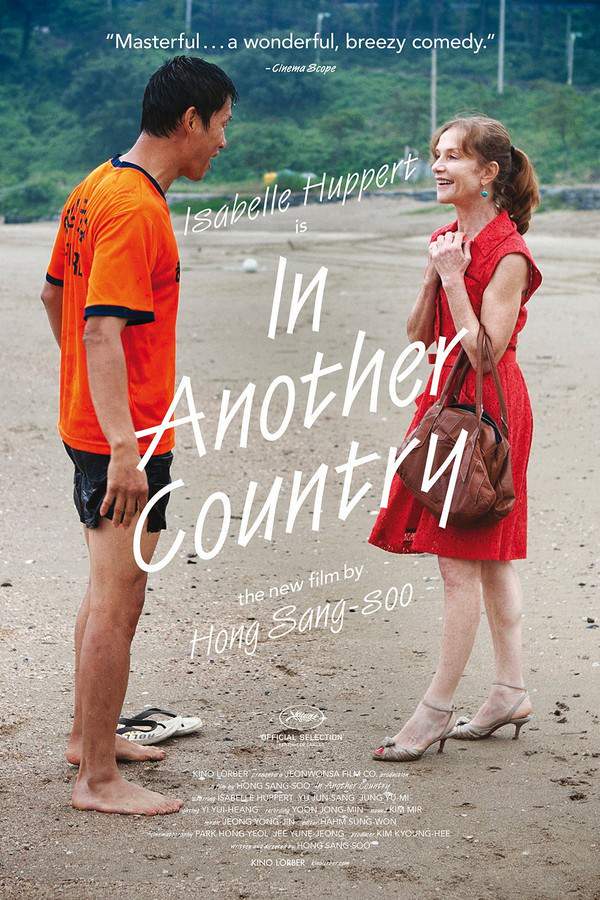
In Another Country (2012) movie poster

Plot Summary

In Another Country (2012) Plot Summary Explained

Release, runtime and language
2012 · 89 min · Korean
JustWatch #10,578 14
Directed by
Sang-soo Hong

Faced with financial hardship, a young film student and her mother seek refuge in the seaside town of Mohang. There, they encounter three women all named Anne, each grappling with personal struggles and hidden pasts. As the mother and daughter navigate their own challenges, they become intertwined with the lives of these other women, finding unexpected connections and a shared search for healing and understanding in a quiet coastal setting.

On this page (7)
  1. 1 Where to watch
  2. 2 What happens: full plot
  3. 3 Plot questions answered
  4. 4 Movie threads
  5. 5 Movies like In Another Country
  6. 6 Categories
  7. 7 Every angle

Where to watch

Where to Watch In Another Country (2012)

Where can you watch In Another Country? Stream, rent or buy it in the US, including on MUBI and Kanopy: current JustWatch availability with up-to-date prices.

Streaming availability powered by JustWatch

Full plot summary · contains spoilers

What Happens in In Another Country: Full Plot Summary

The whole story of In Another Country (2012) explained, from the opening scene to the final frame: every key event, every twist and what it all adds up to. Read it as a quick recap before the sequel, to check a scene you missed, or to finally understand what really happened.

The film follows Won-joo (played by Jung Yu-mi), a young film student, and her mother Park Sook (portrayed by Youn Yuh-jung), as they try to evade their creditors in the quaint seaside town of Mohang, located in Buan, North Jeolla. Feeling restless, Won-joo embarks on a creative journey to write a screenplay that will incorporate their current surroundings. Interestingly, she ends up drafting three different narratives, all rooted in the same foundational concept.

In each of these variations, the central character is a charismatic French visitor named Anne (played by Isabelle Huppert). In the first segment, Anne is a renowned filmmaker visiting a Korean director Jong-soo (played by Kwon Hae-hyo) and his heavily pregnant and envious wife Geum-hee (portrayed by Moon So-ri). The second narrative presents her as the spouse of a French motor company executive, arriving at the same guesthouse to rendezvous with her lover, a Korean filmmaker named Moon-soo (played by Moon Sung-keun). In the third tale, she is a divorced housewife arriving for some solace alongside her friend Park Soon (again featuring Youn Yuh-jung) after her husband leaves her for a younger Korean secretary.

Themes of infidelity weave through each storyline, alongside the presence of a brawny but somewhat dim lifeguard (played by Yoo Jun-sang), whom Anne encounters during her beach walks while searching for a mini-lighthouse in all three episodes.

As various Annes engage with the locals, including Won-joo, who works at Anne’s lodging and assists in guiding her around, certain expressions, scenarios, and pieces of dialogue reappear, each time transforming in their significance and intent depending on the context and manner in which they are delivered.

Last updated: November 16, 2024 at 11:22

Was this helpful?

Plot questions answered

In Another Country Plot Explained: Your Questions Answered

The questions people ask most about In Another Country (2012): what happens in the confusing scenes, why the characters do what they do, the twists, hidden details and what the ending means. Each answer contains spoilers.

Q1

Why does Won-joo write three different stories about Anne?

Won-joo, a film student feeling restless in Mohang, uses her surroundings as inspiration for a screenplay. She creates three distinct narratives featuring Anne to explore different scenarios and emotional possibilities, essentially using the same foundation to examine variations in relationships and personal struggles.

Foreshadowing: Earlier, Won-joo is described as feeling restless and wanting to channel her creative energy into writing.

  • Won-joo
  • Anne
  • screenplay
  • three stories
  • film student
  • creative process
Q2

How are the three Annes in the film connected?

All three Annes are the same French woman portrayed by Isabelle Huppert, but Won-joo's screenplay places her in three different life situations. Each Anne shares core characteristics, charismatic and searching for connection, but experiences different relationships and emotional journeys.

Foreshadowing: The film establishes early on that Won-joo is drafting three narratives 'all rooted in the same foundational concept.'

  • Anne
  • Isabelle Huppert
  • three stories
  • character connection
  • French visitor
Q3

Why does the lifeguard appear in all three of Anne's stories?

The brawny lifeguard is a recurring element across all three narratives that Won-joo writes. In each storyline, Anne encounters him during her beach walks while searching for a mini-lighthouse. This repetition is intentional, serving as a structural motif that connects the different fictional scenarios together.

Foreshadowing: The timeline mentions the lifeguard's introduction occurring in each narrative during Anne's beach walks.

  • lifeguard
  • beach
  • mini-lighthouse
  • recurring character
  • repetition
Q4

Why do certain dialogues and scenarios repeat across the three stories?

The repeated expressions, scenarios, and dialogue lines are deliberate meta-fictional elements. As Won-joo rewrites the same basic story, these repetitions shift in meaning and intent depending on the context and delivery in each variation. The film explores how the same words can carry different weight based on circumstances.

Foreshadowing: The summary notes that certain expressions 'reappear, each time transforming in their significance and intent.'

  • repetition
  • dialogue
  • meta-fiction
  • storytelling
  • shifting meaning
Q5

Why is Won-joo hiding from creditors in Mohang?

Won-joo and her mother Park Sook are evading their creditors in Mohang due to financial hardship. This reality drives them to seek refuge in the quiet seaside town, where Won-joo's creative journey eventually becomes a way to process her circumstances while staying hidden.

Foreshadowing: The film opens by introducing Won-joo and Park Sook 'navigating the challenges of evading their creditors.'

  • creditors
  • financial hardship
  • Won-joo
  • Park Sook
  • Mohang
  • hiding
Q6

What connects the three different storylines in the film?

All three storylines share the same core elements: the seaside town of Mohang, the guesthouse setting, the character of Anne, recurring interactions with locals including Won-joo as guide, and themes of infidelity. Won-joo's screenplay uses these固定 elements to explore different emotional scenarios.

Foreshadowing: The timeline states the three narratives are 'interconnected by a core theme' and feature 'the same foundational concept.'

  • three stories
  • connection
  • shared elements
  • guesthouse
  • Mohang
  • Won-joo
Q7

Why does each of Anne's stories involve infidelity?

Infidelity serves as the central theme connecting all three narratives. Won-joo's screenplay explores different facets of romantic betrayal: Anne as the other woman in the first story, a cheating spouse in the second, and a betrayed wife in the third. This repetition allows the film to examine infidelity's various emotional consequences.

Foreshadowing: The timeline explicitly notes 'a common thread of infidelity runs through all three narratives.'

  • infidelity
  • love affair
  • betrayal
  • theme
  • relationships
Q8

What is Won-joo's motivation for creating these particular stories?

Won-joo's creative motivation stems from her restless state while hiding in Mohang. She uses her immediate environment, the guesthouse, the beach, the visitors, as source material. The three stories appear to be her way of processing the emotional landscape around her, including themes of financial struggle, displacement, and complex relationships.

Foreshadowing: Won-joo 'embarks on a creative journey' and begins drafting a screenplay 'drawing inspiration from her immediate environment.'

  • Won-joo
  • motivation
  • creativity
  • screenplay
  • film student
  • artistic process
Q9

Why does Anne search for the mini-lighthouse in each story?

In each of the three narratives, Anne goes on beach walks searching for a mini-lighthouse. This quest appears in all three variations, making it a consistent element that anchors the different stories together, though the significance of her search may shift depending on the context of each storyline.

Foreshadowing: The summary states Anne 'encounters' the lifeguard 'while searching for a mini-lighthouse in all three episodes.'

  • mini-lighthouse
  • beach
  • Anne
  • search
  • symbol
Q10

Why is the film structured as three separate narratives?

The three-narrative structure reflects Won-joo's process as a film student writing and rewriting a screenplay. This meta-fictional approach allows director Hong Sang-soo to explore how the same basic story elements can transform in meaning when context changes, demonstrating the malleable nature of storytelling itself.

Foreshadowing: The film establishes early that Won-joo is 'drafting three different narratives' from 'the same foundational concept.'

  • three narratives
  • structure
  • meta-fiction
  • Hong Sang-soo
  • screenplay
  • film student
Q11

What role does Won-joo play in each of Anne's stories?

In all three narratives, Won-joo appears as a working guide at the guesthouse where Anne stays. She assists Anne and helps her navigate the local area. This consistent role allows Won-joo to observe and interact with each version of Anne while maintaining her position as both participant and observer in the stories she creates.

Foreshadowing: The timeline states Won-joo 'takes on the role of a guide for Anne, working at her lodging.'

  • Won-joo
  • guide
  • guesthouse
  • Anne
  • observer
  • role
Q12

Why does Anne meet different Korean men in each story?

Each narrative places Anne in a different romantic situation: she meets director Jong-soo in the first story, filmmaker Moon-soo in the second, and no romantic interest is mentioned in the third. These different male connections allow Won-joo to explore various relationship dynamics and emotional conflicts within her screenplay variations.

Foreshadowing: The three stories present Anne with 'Jong-soo,' 'Moon-soo,' and no clear romantic partner respectively.

  • Anne
  • Korean men
  • Jong-soo
  • Moon-soo
  • relationships
  • romantic interest

Movie threads

More Movies Like In Another Country, by Mood & Story

Curated lists built around what makes In Another Country tick: the same mood, the same kind of story or the same emotional payoff. Each list explains why these movies belong together.

Movies with Interwoven Stories like In Another Country

Character-driven narratives where lives intersect in a serene, isolated setting. Discover films like In Another Country that use a quiet coastal or small-town setting to bring together disparate characters. If you enjoyed the gentle convergence of stories and the reflective mood, you'll find similar contemplative dramas here.

  • interconnected
  • contemplative
  • serene
  • melancholic
  • quiet
  • reflective
  • Tone: melancholic, contemplative
  • Pacing: slow, deliberate
Why these movies?

The story pattern: Stories typically unfold through multiple perspectives, gradually revealing how characters are connected by place, circumstance, or theme. The narrative structure is often non-linear or episodic, focusing on emotional resonance over a single, driving plot.

Why they belong together: These films are grouped by their shared use of a tranquil, almost dreamlike setting as a character in itself, and their focus on exploring complex human emotions through the subtle weaving together of different lives.
Melancholic Metafiction Movies like In Another Country

Films that blur the line between storytelling and the storyteller's reality. If you liked the film-within-a-film structure and reflective tone of In Another Country, explore similar movies about storytelling and creative process. These films often feature melancholic, complex narratives that ponder art and life.

  • metafiction
  • dreamlike
  • contemplative
  • reflective
  • complex
  • melancholic
  • Tone: melancholic, reflective, dreamlike
  • Pacing: slow, contemplative
Why these movies?

The story pattern: The narrative often unfolds through variations on a theme, repetitions, or alternate scenarios, mirroring the creative act itself. The journey is less about plot resolution and more about the exploration of ideas, memory, and the act of creation.

Why they belong together: They share a common focus on the creative process as a narrative device, a melancholic and contemplative mood, and a complex structure that invites the audience to reflect on the nature of storytelling and reality.

If you liked this

Movies Like In Another Country

Similar movies to In Another Country: the same genre, themes or kind of story. Each one comes with its own plot summary, timeline and ending explained.

Browse all movie summaries

Categories

Movie Lists Featuring In Another Country

In Another Country appears in these hand-built movie categories. Each one groups movies by a specific mood, theme or story type, with their plot summaries and endings explained.

View all movie categories

Every angle

In Another Country (2012) Explained: Plot, Timeline & Characters

Everything about In Another Country in one place: what happens in the plot summary, the timeline in chronological order, the characters and meaning and a spoiler-free summary. What's After the Movie adds the cast, box office and post-credit scenes.

Coming soon on iOS and Android

The Plot Explained Movie Summary App

Plot summaries, endings explained and timelines on your phone. Catch up on any movie in minutes, save your favorites and never miss a twist again.

Be the first to know when we launch. Your email stays private, always.

Learn more about the app